Wednesday, December 31, 2025

Tom Petty and the Heartbreakers


The lake was Lake Alice, on the campus of the University of Florida, in Gainesville. My parents moved there for work at the university in 1970, just before I was born, and we stayed until I was eight years old, living in a ranch house with a carport, a big backyard, and bright pink azalea bushes springing up in front of my bedroom window.

I’ve been thinking about those years a lot lately thanks to my discovery of Tom Petty’s “Gainesville.” The song was recorded in 1998 but not released until 2018, one year after Petty’s death from a drug overdose at age 66. Petty was born in Gainesville in 1950, twenty years and one day before I was, and lived there until 1974, when he left for Los Angeles with his first band, Mudcrutch. The song’s music video is full of shots of parts of the city he was known to have frequented. There are one-story ranch houses like the one I grew up in; red-brick university buildings; Griffin Stadium (“the Swamp”), where the Gators play; trees decorated with Spanish moss. And there’s Lake Alice and its alligators. As I watched the video, childhood memories surged from the back of my brain to the front, and I felt a sadness for my old town I hadn’t felt in years. Gainesville was a big town, Petty sings. It wasn’t really, but for a while it was the only one we both knew.

The video also has a shot of the mailbox at one of Petty’s childhood homes. It shows the address: 1715 NW 6th Terrace. I grew up on 16th Terrace, a 38-minute walk away (according to Google Maps). In 2019, after the video came out, someone stole the mailbox. (...)

Petty and I overlapped in Gainesville for just four years and obviously led very different lives. (I wasn’t playing in Mudcrutch; I was going to pre-kindergarten.) But it turns out we both transgressed at Lake Alice. Watching the “Gainesville” video sent me down a rabbit hole of research into Petty’s early life, savoring the chance to connect with my own story through his. I found a Gainesville Sun article about how, in 1966, when Petty was 16 and had just earned his driver’s license, he accidentally drove his mother’s old Chevy Impala into the lake. He was supposed to be at a dance, and his mom had to come pick him up in their other family car. (...)

Reading that Gainesville Sun article, I found myself wondering about Tom Petty’s mom. What was she thinking as she drove her son home from Lake Alice that night, unaware of the fame that would find him just a few years later? Did she try to teach him some kind of lesson? Or was she thinking, instead, of her own transgressions, perhaps invisible to her son? Did he—sitting, embarrassed in the passenger seat—still believe she was larger than life? Or was he already past that?

You’re all right anywhere you land, he would write 22 years later. You’re okay anywhere you fall. For both of us, that was Gainesville, for a while. And then Gainesville shrank, becoming something else: somewhere we used to live, somewhere we no longer know, somewhere we were all so young. Long ago and far away, another time, another day.  ~ Tracks on Tracks

[ed. Thought I'd heard most TP songs, but not this one.]

Suzuribako writing box, Last third of the 19th century. Box: wood, lacquer, mother-of-pearl, ivory, stone. Techniques: iro-urushi, takamaki-e, hiramaki-e, togidashi, nashiji, ohirame, inlay, carving. Water-dropper: silver, non-ferrous alloys, 24.3 × 22 × 4.9cm

Pair of vases, Ando workshop, 1910s. Copper alloy, silver, enamel. Height:44.8cm

Force-Feeding AI on an Unwilling Public

Frank Zappa offers a possible mission statement for Microsoft back in 1976, a few months after the company is founded.

The Force-Feeding of AI on an Unwilling Public

Most people won’t pay for AI voluntarily—just 8% according to a recent survey. So they need to bundle it with some other essential product.

You never get to decide.

Before proceeding let me ask a simple question: Has there ever been a major innovation that helped society, but only 8% of the public would pay for it?

That’s never happened before in human history. Everybody wanted electricity in their homes. Everybody wanted a radio. Everybody wanted a phone. Everybody wanted a refrigerator. Everybody wanted a TV set. Everybody wanted the Internet.

They wanted it. They paid for it. They enjoyed it.

AI isn’t like that. People distrust it or even hate it—and more so with each passing month. So the purveyors must bundle it into current offerings, and force usage that way. (...)

Let me address a final question—which is the frequently mentioned argument that the US needs to develop AI as fast as possible to get there before the Chinese.

I’m not sure where there is. But I’m happy to let China or other countries arrive at that unhappy destination while I wait behind and watch.

I’m absolutely certain that getting there will be a matter of great regret. There might even be the last place you would want to be. So I’d rather it happened as far away from here as possible.

by Ted Gioia, The Honest Broker |  Read more:
Image: Frank Zappa/uncredited
[ed. 100 percent. So sick of having AI jammed down my throat at every turn. Especially when the product being pushed is so buggy, unreliable, and dangerous. Also: smart anythings...tvs, appliances, phones, home security systems, etc., and don't even get me started on touchscreens vs. buttons (see also: Why buttons are back in fashion (Cybernews).] 

via:

The Egg

You were on your way home when you died.

It was a car accident. Nothing particularly remarkable, but fatal nonetheless. You left behind a wife and two children. It was a painless death. The EMTs tried their best to save you, but to no avail. Your body was so utterly shattered you were better off, trust me.

And that’s when you met me.

“What… what happened?” You asked. “Where am I?”

“You died,” I said, matter-of-factly. No point in mincing words.

“There was a… a truck and it was skidding…”

“Yup,” I said.

“I… I died?”

“Yup. But don’t feel bad about it. Everyone dies,” I said.

You looked around. There was nothingness. Just you and me. “What is this place?” You asked. “Is this the afterlife?”

“More or less,” I said.

“Are you god?” You asked.

“Yup,” I replied. “I’m God.”

“My kids… my wife,” you said.

“What about them?”

“Will they be all right?”

“That’s what I like to see,” I said. “You just died and your main concern is for your family. That’s good stuff right there.”

You looked at me with fascination. To you, I didn’t look like God. I just looked like some man. Or possibly a woman. Some vague authority figure, maybe. More of a grammar school teacher than the almighty.

“Don’t worry,” I said. “They’ll be fine. Your kids will remember you as perfect in every way. They didn’t have time to grow contempt for you. Your wife will cry on the outside, but will be secretly relieved. To be fair, your marriage was falling apart. If it’s any consolation, she’ll feel very guilty for feeling relieved.”

“Oh,” you said. “So what happens now? Do I go to heaven or hell or something?”

“Neither,” I said. “You’ll be reincarnated.”

“Ah,” you said. “So the Hindus were right,”

“All religions are right in their own way,” I said. “Walk with me.”

You followed along as we strode through the void. “Where are we going?”

“Nowhere in particular,” I said. “It’s just nice to walk while we talk.”

“So what’s the point, then?” You asked. “When I get reborn, I’ll just be a blank slate, right? A baby. So all my experiences and everything I did in this life won’t matter.”

“Not so!” I said. “You have within you all the knowledge and experiences of all your past lives. You just don’t remember them right now.”

I stopped walking and took you by the shoulders. “Your soul is more magnificent, beautiful, and gigantic than you can possibly imagine. A human mind can only contain a tiny fraction of what you are. It’s like sticking your finger in a glass of water to see if it’s hot or cold. You put a tiny part of yourself into the vessel, and when you bring it back out, you’ve gained all the experiences it had.

“You’ve been in a human for the last 48 years, so you haven’t stretched out yet and felt the rest of your immense consciousness. If we hung out here for long enough, you’d start remembering everything. But there’s no point to doing that between each life.”

“How many times have I been reincarnated, then?”

“Oh lots. Lots and lots. An in to lots of different lives.” I said. “This time around, you’ll be a Chinese peasant girl in 540 AD.”

“Wait, what?” You stammered. “You’re sending me back in time?”

“Well, I guess technically. Time, as you know it, only exists in your universe. Things are different where I come from.”

“Where you come from?” You said.

“Oh sure,” I explained “I come from somewhere. Somewhere else. And there are others like me. I know you’ll want to know what it’s like there, but honestly you wouldn’t understand.”

“Oh,” you said, a little let down. “But wait. If I get reincarnated to other places in time, I could have interacted with myself at some point.”

“Sure. Happens all the time. And with both lives only aware of their own lifespan you don’t even know it’s happening.”

“So what’s the point of it all?”

“Seriously?” I asked. “Seriously? You’re asking me for the meaning of life? Isn’t that a little stereotypical?”

“Well it’s a reasonable question,” you persisted.

I looked you in the eye. “The meaning of life, the reason I made this whole universe, is for you to mature.”

“You mean mankind? You want us to mature?”

“No, just you. I made this whole universe for you. With each new life you grow and mature and become a larger and greater intellect.”

“Just me? What about everyone else?”

“There is no one else,” I said. “In this universe, there’s just you and me.”

You stared blankly at me. “But all the people on earth…”

“All you. Different incarnations of you.”

“Wait. I’m everyone!?”

“Now you’re getting it,” I said, with a congratulatory slap on the back.

“I’m every human being who ever lived?”

“Or who will ever live, yes.”

“I’m Abraham Lincoln?”

“And you’re John Wilkes Booth, too,” I added.

“I’m Hitler?” You said, appalled.

“And you’re the millions he killed.”

“I’m Jesus?”

“And you’re everyone who followed him.”

You fell silent.

“Every time you victimized someone,” I said, “you were victimizing yourself. Every act of kindness you’ve done, you’ve done to yourself. Every happy and sad moment ever experienced by any human was, or will be, experienced by you.”

You thought for a long time.

“Why?” You asked me. “Why do all this?”

“Because someday, you will become like me. Because that’s what you are. You’re one of my kind. You’re my child.”

“Whoa,” you said, incredulous. “You mean I’m a god?”

“No. Not yet. You’re a fetus. You’re still growing. Once you’ve lived every human life throughout all time, you will have grown enough to be born.”

“So the whole universe,” you said, “it’s just…”

“An egg.” I answered. “Now it’s time for you to move on to your next life.”

And I sent you on your way.

by Andy Weir, Galactanet |  Read more:
[ed. Mr. Weir is of course author of the popular books The Martian and Project Hail Mary. See also: The Egg: Wikipedia.  ]

Flower & Garden Magazine, August 1968

Tuesday, December 30, 2025

Tatiana Schlossberg Dies at 35

Tatiana Schlossberg, an environmental journalist and a daughter of Caroline Kennedy — and granddaughter of President John F. Kennedy — whose harrowing essay about her rare and aggressive blood cancer, published in The New Yorker magazine in November, drew worldwide sympathy and praise for Ms. Schlossberg’s courage and raw honesty, died on Tuesday. She was 35.

Her death was announced in an Instagram post by the John F. Kennedy Library Foundation, signed by her family. It did not say where she died.

Titled “A Battle With My Blood,” the essay appeared online on Nov. 22, the 62nd anniversary of her grandfather’s assassination. (It appeared in print in the Dec. 8 issue of the magazine with a different headline, “A Further Shore.”) In it, Ms. Schlossberg wrote of how she learned of her cancer after the birth of her daughter in May 2024. There was something off about her blood count, her doctor noticed, telling her, “It could just be something related to pregnancy and delivery, or it could be leukemia.”

It was leukemia, with a rare mutation. Ms. Schlossberg had a new baby, and a 2-year-old son.

“I did not — could not — believe that they were talking about me,” she wrote. “I had swum a mile in the pool the day before, nine months pregnant. I wasn’t sick. I didn’t feel sick. I was actually one of the healthiest people I knew. I regularly ran five to ten miles in Central Park. I once swam three miles across the Hudson River — eerily, to raise money for the Leukemia and Lymphoma Society.”

She added, “This could not possibly be my life.”

She wrote of months of chemotherapy and a postpartum hemorrhage, from which she almost bled to death, followed by more chemo and then a stem cell transplant — a Hail Mary pass that might cure her. Her older sister, Rose Schlossberg, was a match and would donate her cells. Her brother, Jack Schlossberg, now running for Congress in New York’s 12th district, was a half-match; nonetheless he pressed the doctors, asking if a half-match might be good enough. Could he donate, too? (He could not.)

After the transplant, when Ms. Schlossberg’s hair fell out, Jack shaved his head in solidarity. She wore scarves to cover her bare scalp; when her son came to visit her in the hospital, he did, too.

She was never able to fully care for her daughter — to feed, diaper or bathe her — because of the risk of infection, and her treatments had kept her away from home for nearly half of her daughter’s first year of life.

“I don’t know who, really, she thinks I am,” Ms. Schlossberg wrote, “and whether she will feel or remember, when I am gone, that I am her mother.”

She went into remission, had more chemo, relapsed and joined a clinical trial. There were blood transfusions, another stem cell transplant, from an unrelated donor, more chemo, more setbacks. She went into remission again, relapsed, joined another clinical trial and contracted a form of the Epstein-Barr virus. The donated cells attacked her own, a condition called graft-versus-host disease. When she came home after a stint in the hospital in October, she was too weak to pick up her children.

Her oncologist told her that he thought he could, maybe, keep her alive for another year.

“For my whole life, I have tried to be good,” she wrote, “to be a good student and a good sister and a good daughter, and to protect my mother and never make her upset or angry. Now I have added a new tragedy to her life, to our family’s life, and there’s nothing I can do to stop it.”

Tragedy, of course, has trailed the Kennedy family for decades. Caroline Kennedy, a former ambassador to Australia and Japan, was just 5 when her father was assassinated on Nov. 22, 1963; she was 10 when her uncle Robert F. Kennedy, a presidential candidate in the Democratic primary of 1968, was murdered. Her brother, John F. Kennedy Jr., died in 1999, when the plane he was piloting crashed off Martha’s Vineyard, killing him, his wife, Carolyn Bessette Kennedy, and her sister, Lauren Bessette. He was 38 years old, and Tatiana had been a flower girl at his wedding three years earlier.

Having grown up in the glare of her parents’ glamour, and her family’s tragedies, Ms. Kennedy largely succeeded in giving her own children a life out of the spotlight — a relatively normal, if privileged, upbringing, along with a call to public service that was the Kennedy legacy.

by Penelope Green, NY Times |  Read more:
Image: Sonia Moskowitz/Globe Photos/ZUMA
[ed. A strong, intelligent woman. And another Kennedy tragedy. See also: A Battle With My Blood (New Yorker).]

The Depressed Person

The depressed person was interrible and unceasing emotional pain, and the impossibility of sharing or articulating this pain was itself a component of the pain and a contributing factor in its essential horror. 

Despairing, then, of describing the emotional pain itself, the depressed person hoped at least to be able to express something of its contextits shape and texture, as it were-by recounting circumstances related to its etiology. The depressed person's parents, for example, who had divorced when she was a child, had used her as a pawn in the sick games they played, as in when the depressed person had required orthodonture and each parent had claimed-not without some cause, the depressed person always inserted, given the Medicean legal ambiguities of the divorce settlement-that the other should pay for it. Both parents were well-off, and each had privately expressed to the depressed person a willingness, if push came to shove, to bite the bullet and pay, explaining that it was a matter not of money or dentition but of "principle." And the depressed person always took care, when as an adult she attempted to describe to a supportive friend the venomous struggle over the cost of her orthodonture and that struggle's legacy of emotional pain for her, to concede that it may well truly have appeared to each parent to have been, in fact, a matter of "principle," though unfortunately not a "principle" that took into account their daughter's feelings at receiving the emotional message that scoring petty points off each other was more important to her parents than her own maxillofacial health and thus constituted, if considered from a certain perspective, a form of neglect or abandonment or even outright abuse, an abuse clearly connected-here she nearly always inserted that her therapist concurred with this assessment-to the bottomless, chronic adult despair she suffered every day and felt hopelessly trapped in.

The approximately half-dozen friends whom her therapist-who had earned both a terminal graduate degree and a medical degree-referred to as the depressed person's Support System tended to be either female acquaintances from childhood or else girls she had roomed with at various stages of her school career, nurturing and comparatively undamaged women who now lived in all manner of different cities and whom the depressed person often had not laid eyes on in years and years, and whom she called late in the evening, long-distance, for badly needed sharing and support and just a few well-chosen words to help her get some realistic perspective on the day's despair and get centered and gather together the strength to fight through the emotional agony of the next day, and to whom, when she telephoned, the depressed person always apologized for dragging them down or coming off as boring or self-pitying or repellent or taking them away from their active, vibrant, largely pain-free long-distance lives. She was, in addition, also always extremely careful to share with the friends in her Support System her belief that it would be whiny and pathetic to play what she derisively called the "Blame Game" and blame her constant and indescribable adult pain on her parents' traumatic divorce or their cynical use of her. Her parents had, after all-as her therapist had helped the depressed person to see---done the very best they could do with the emotional resources they'd had at the time. And she had, the depressed person always inserted, laughing weakly, eventually gotten the orthoprecedence and required her (i.e., the friend) to get off the telephone. 

The feelings of shame and inadequacy the depressed person experienced about calling members of her Support System long-distance late at night and burdening them with her clumsy attempts to describe at least the contextual texture of her emotional agony were an issue on which she and her therapist were currently doing a great deal of work in their time together. The depressed person confessed that when whatever supportive friend she was sharing with finally confessed that she (i.e., the friend) was dreadfully sorry but there was no helping it she absolutely had to get off the telephone, and had verbally detached the depressed person's needy fingers from her pantcuff and returned to the demands of her full, vibrant long-distance life, the depressed person always sat there listening to the empty apian drone of the dial tone feeling even more isolated and inadequate and unempathized-with than she had before she'd called. The depressed person confessed to her therapist that when she reached out long-distance to a member of her Support System she almost always imagined that she could detect, in the friend's increasingly long silences and/or repetitions of encouraging cliches, the boredom and abstract guilt people always feel when someone is clinging to them and being a joyless burden. The depressed person confessed that she could well imagine each "friend" wincing now when the telephone rang late at night, or during the conversation looking impatiently at the clock or directing silent gestures and facial expressions communicating her boredom and frustration and helpless entrapment to all the other people in the room with her, the expressive gestures becoming more desperate and extreme as the depressed person went on and on and on. The depressed person's therapist's most noticeable unconscious personal habit or tic consisted of placing the tips of all her fingers together in her lap and manipulating them idly as she listened supportively, so that her mated hands formed various enclosing shapes-e.g., cube, sphere, cone, right cylinder-and then seeming to study or contemplate them. The depressed person disliked the habit, though she was quick to admit that this was chiefly because it drew her attention to the therapist's fingers and fingernails and caused her to compare them with her own. donture she'd needed. The former acquaintances and classmates who composed her Support System often told the depressed person that they just wished she could be a little less hard on herself, to which the depressed person responded by bursting involuntarily into tears and telling them that she knew all too well that she was one of those dreaded types of everyone's grim acquaintance who call at inconvenient times and just go on and on about themselves. The depressed person said that she was all too excruciatingly aware of what a joyless burden she was, and during the calls she always made it a point to express the enormous gratitude she felt at having a friend she could call and get nurturing and support from, however briefly, before the demands of that friend's full, joyful, active life took understandable.

The depressed person shared that she could remember, all too clearly, how at her third boarding school she had once watched her roommate talk to some boy on their room's telephone as she (i.e., the roommate) made faces and gestures of entrapped repulsion and boredom with the call, this popular, attractive, and self-assured roommate finally directing at the depressed person an exaggerated pantomime of someone knocking on a door until the depressed person understood that she was to open their room's door and step outside and knock loudly on it so as to give the roommate an excuse to end the call. The depressed person had shared this traumatic memory with members of her Support System and had tried to articulate how bottomlessly horrible she had felt it would have been to have been that nameless pathetic boy on the phone and how now, as a legacy of that experience, she dreaded, more than almost anything, the thought of ever being someone you had to appeal silently to someone nearby to help you contrive an excuse to get off the phone with. The depressed person would implore each supportive friend to tell her the very moment she (i.e., the friend) was getting bored or frustrated or repelled or felt she (i.e., the friend) had other more urgent or interesting things to attend to, to please for God's sake be utterly candid and frank and not spend one moment longer on the phone than she was absolutely glad to spend. The depressed person knew perfectly well, of course, she assured the therapist;' how such a request could all too possibly be heard not as an invitation to get off the telephone at will but actually as a needy, manipulative plea not to get off the telephone - never get off - the telephone.

by David Foster Wallace, Harper's |  Read more (pdf):
Image: uncredited
[ed. Hadn't seen this essay before, but it got me wondering how it might relate to Good Old Neon:]
***
My whole life I’ve been a fraud. I’m not exaggerating. Pretty much all I’ve ever done all the time is try to create a certain impression of me in other people. Mostly to be liked or admired. It’s a little more complicated than that, maybe. But when you come right down to it it’s to be liked, loved. Admired, approved of, applauded, whatever. You get the idea. I did well in school, but deep down the whole thing’s motive wasn’t to learn or improve myself but just to do well, to get good grades and make sports teams and perform well. To have a good transcript or varsity letters to show people. I didn’t enjoy it much because I was always scared I wouldn’t do well enough. The fear made me work really hard, so I’d always do well and end up getting what I wanted. But then, once I got the best grade or made All City or got Angela Mead to let me put my hand on her breast, I wouldn’t feel much of anything except maybe fear that I wouldn’t be able to get it again.The next time or next thing I wanted. I remember being down in the rec room in Angela Mead’s basement on the couch and having her let me get my hand up under her blouse and not even really feeling the soft aliveness or whatever of her breast because all I was doing was thinking, ‘Now I’m the guy that Mead let get to second with her.’ Later that seemed so sad. This was in middle school. She was a very big-hearted, quiet, selfcontained, thoughtful girl — she’s a veterinarian now, with her own Good Old Neon practice — and I never even really saw her, I couldn’t see anything except who I might be in her eyes, this cheerleader and probably number two or three among the most desirable girls in middle school that year. She was much more than that, she was beyond all that adolescent ranking and popularity crap, but I never really let her be or saw her as more, although I put up a very good front as somebody who could have deep conversations and really wanted to know and understand who she was inside. 

Later I was in analysis, I tried analysis like almost everybody else then in their late twenties who’d made some money or had a family or whatever they thought they wanted and still didn’t feel that they were happy. A lot of people I knew tried it. It didn’t really work, although it did make everyone sound more aware of their own problems and added some useful vocabulary and concepts to the way we all had to talk to each other to fit in and sound a certain way. You know what I mean. I was in regional advertising at the time in Chicago, having made the jump from media buyer for a large consulting firm, and at only twenty-nine I’d made creative associate, and verily as they say I was a fair-haired boy and on the fast track but wasn’t happy at all, whatever happy means, but of course I didn’t say this to anybody because it was such a cliché — ‘Tears of a Clown,’ ‘Richard Cory,’ etc. — and the circle of people who seemed important to me seemed much more dry, oblique and contemptuous of clichés than that, and so of course I spent all my time trying to get them to think I was dry and jaded as well, doing things like yawning and looking at my nails and saying things like, ‘Am I happy? is one of those questions that, if it has got to be asked, more or less dictates its own answer,’ etc. Putting in all this time and energy to create a certain impression and get approval or acceptance that then I felt nothing about because it didn’t have anything to do with who I really was inside, and I was disgusted with myself for always being such a fraud, but I couldn’t seem to help it. Here are some of the various things I tried: EST, riding a ten-speed to Nova Scotia and back, hypnosis, cocaine, sacro-cervical chiropractic, joining a charismatic church, jogging, pro bono work for the Ad Council, meditation classes, the Masons, analysis, the Landmark Forum, the 142 David Foster Wallace Course in Miracles, a right-brain drawing workshop, celibacy, collecting and restoring vintage Corvettes, and trying to sleep with a different girl every night for two straight months (I racked up a total of thirty-six for sixty-one and also got chlamydia, which I told friends about, acting like I was embarrassed but secretly expecting most of them to be impressed — which, under the cover of making a lot of jokes at my expense, I think they were — but for the most part the two months just made me feel shallow and predatory, plus I missed a great deal of sleep and was a wreck at work — that was also the period I tried cocaine). I know this part is boring and probably boring you, by the way, but it gets a lot more interesting when I get to the part where I kill myself and discover what happens immediately after a person dies. In terms of the list, psychoanalysis was pretty much the last thing I tried.

The analyst I saw was OK, a big soft older guy with a big ginger mustache and a pleasant, sort of informal manner. I’m not sure I remember him alive too well. He was a fairly good listener, and seemed interested and sympathetic in a slightly distant way. At first I suspected he didn’t like me or was uneasy around me. I don’t think he was used to patients who were already aware of what their real problem was. He was also a bit of a pill-pusher. I balked at trying antidepressants, I just couldn’t see myself taking pills to try to be less of a fraud. I said that even if they worked, how would I know if it was me or the pills? By that time I already knew I was a fraud. I knew what my problem was. I just couldn’t seem to stop. I remember I spent maybe the first twenty times or so in analysis acting all open and candid but in reality sort of fencing with him or leading him around by the nose, basically showing him that I wasn’t just another one of those patients who stumbled in with no clue what their real problem was or who were totally out of touch with the truth about themselves. When you come right down to it, I was trying to show him that I was at least as smart as he was and that there wasn’t much of anything he was going to see about me that I hadn’t already seen and figured out. And yet I wanted help and really was there to try to get help. I didn’t even tell him how unhappy I was until five or six months into the analysis, mostly because Oblivion 143 I didn’t want to seem like just another whining, self-absorbed yuppie, even though I think even then I was on some level conscious that that’s all I really was, deep down.  (more...)  ~ Good Old Neon

Open Reel Ensemble

Open Reel Ensemble Composes Ethereal ‘Magnetic Folklore’ Using Reel-to-Reel Recorders
via: Colossus (also feat. Electronicos Fantasticos).

Numb At Burning Man

Numb at Burning Man (long..)

Every year, seventy thousand hippies, libertarians, tech entrepreneurs, utopians, hula-hoop artists, psychonauts, Israelis, perverts, polyamorists, EDM listeners, spiritual healers, Israelis, coders, venture capitalists, fire spinners, elderly nudists, white girls with cornrows, Geoff Dyers, and Israelis come together to build a city in the middle of the Nevada desert. The Black Rock Desert is one of the most inhospitable places on the planet. The ground there isn’t even sand, but a fine alkaline powder that causes chemical burns on contact with your skin, and it’s constantly whipped up into towering dust storms. Nothing grows there. There’s no water, no roads, and no phone signal. In the daytime the heat is deadly and it’s freezing cold at night. The main virtue of the place is that it’s extremely flat; it’s been the site of two land speed records. But for one week, it becomes a lurid wonderland entirely devoted to human pleasure. Then, once the week is up, it’s completely dismantled again. They rake over the desert and remove every last scrap of plastic or fuzzball of human hair. Afterwards the wind moves over the lifeless alkaline flats as if no one was ever there.

They’ve been doing this there since 1990, as long as I’ve been alive, and for the most part I’ve been happy to leave them to it. Burning Man might be where the world’s new ruling class are free to express their desires without inhibitions, which makes it a model of what they want to do to the rest of the world; if you want to know what horrors are heading our way, you have to go. But I don’t do drugs, I don’t like camping, and I can’t stand EDM. It’s just not really my scene.

What happened is that in February this year I received a strange email from two strangers who said they wanted to commission me to write an essay. They weren’t editors, they didn’t have a magazine, and they didn’t care where I published the essay once I wrote it; all they wanted was for me to go to Burning Man and say something about the experience. (...)

Up before dawn. Seventy thousand people would be attempting to get into Burning Man that day; to avoid queues your best bet is to go early. Three hours driving through some of the most gorgeous landscapes anywhere in the world, green meadows between sheer slabs of rock, glittering black crystal lakes, until finally the mountains fall away and you’re left on an endless flat grey plain. Nine thousand years ago, this was a lakebed. Now it’s nothing at all. Drive along a rutted track into this emptiness until, suddenly, you reach the end of the line. Ahead of us were tens of thousands of vehicles, cars and trucks and RVs, jammed along a single track far into the horizon. Like a migrant caravan, like a people in flight. If we’re lucky, Alan said, we should get in and have our tents set up before sunset. Wait, I said, does that mean that if we’re unlucky, we might not? Alan shrugged. He explained that once he’d been stuck in this line for nearly twelve hours. He’d staved off boredom by playing Go against himself on the surface of an imaginary Klein bottle... Every half an hour the great mass of vehicles would crawl ahead thirty, forty, fifty metres and then stop. (...)

I don’t know exactly what I’d expected the place to look like. For the best possible experience, I’d studiously avoided doing any research whatsoever. A hazy mental image of some vast cuddle puddle, beautiful glowing naked freaks. What it actually looked like was a refugee camp. Tract after tract of mud-splattered tents, rows of RVs, general detritus scattered everywhere. Our camp, when we finally arrived, was a disaster zone. A few people had already arrived and set up, but the previous night’s storm had uprooted practically everything. Tents crumpled under a collapsed shade structure; tarps sagging with muddy water, pegs and poles and other bits of important metal all strewn about like a dyspraxic toddler’s toys. The ground moved underfoot. When it rains over the alkaline flats you don’t get normal, wholesome, Glastonbury-style mud. Not the dirt that makes flowers plants grow. An alien, sterile, non-Newtonian substance, sucking at my shoes. (...)

My camp for the duration of Burning Man was named BrainFish. We were a theme camp. Most camps are just a small group of friends pitching their tents together, but some are big. Dozens or hundreds of people who have come to offer something. All free, all in the gift economy. A bar, or food, or yoga classes, or orgies. One camp runs a library, which contains a lot of books about astrology and drug legalisation, plus two copies of Fake Accounts by Lauren Oyler. Mostly, though, theme camps are the ones with geodesic domes. (...)

What I learned, digging and hauling all day and talking to BrainFish at night, is that Burning Man is not really a festival. Festivals have a very long history. A thousand years ago, the villagers could spend the feast day drinking and feasting, while the bishop had to ride through town backwards on a donkey being pelted with turds. A brief moment of communal plenty. Leftists like me like the festival; what we want is essentially for life to be one big festival all the time. But as conservative critics point out, you can’t really consider the festival in isolation, and there’s no feast without a fast. There are also days of abstention and self-denial, when people are forbidden from laughing or talking, solemn mortification of the flesh. Burning Man is something new: a festival and an antifestival at the same time. Everything that’s scarce in the outside world is abundant. There are boutiques where you can just wander in and take a handful of clothes for free; there’s a basically infinite supply of drugs, and a similarly infinite supply of random casual sex. It is the highest-trust society to have ever existed anywhere in the world. At the same time, some extremely rich and powerful people come to Burning Man to experience deprivation and suffering. All the ordinary ties and comforts of a complex society are gone. No public authority that owes you anything, no public services, no concept of the public at all, just whatever other individuals choose to gift you. This is the only city in the world without any kind of water supply, or system for managing waste, or reliable protection from the elements. You are something less than human here. Not a political animal, but a mangy desert creature, rutting in the dust.

Not everyone experiences the same level of discomfort. There are plug-and-play camps, where they hire a team of paid staff to set up all the amenities, and you can just arrive, stay in a luxury caravan, and have fun. They get private showers. Everyone else despises these people, supposedly because it’s not in keeping with the ethos of the place. I’m not sure it’s just that. There’s something more at stake.

Tech people tend to have a very particular view of their role in the universe. They are the creators, the people who build the world, who bless the rest of us with useful and entertaining apps. But they’re never allowed to simply get on with their job of engineering reality; they’re constantly held back from doing whatever they want by petty political forces that try to hold back progress in the name of dusty eighteenth-century principles like democracy. As if the public’s revealed preferences weren’t already expressed through the market. Every so often an imbecile politician will demand that tech companies turn off the algorithm. They don’t know what an algorithm is, they just know it’s bad. The British government thinks you can save water by deleting old emails. These people straightforwardly don’t understand anything about the industry they’re trying to regulate, but if you suggest getting rid of the whole useless political layer people get upset. You can’t win. But Burning Man is a showcase for the totally unlimited power of the builders. Here they get to be Stalinist technocrats, summoning utopia out of the Plan. The difference is that unlike the Soviet model, their utopia really works. Look what we can do. From literally nothing, from a barren desert, we can build a paradise of pleasure in a week and then dismantle it again. And all of this could be yours, every day, if you give over the world to me.

But all these tech people are, as everyone knows, interlopers. Burning Man used to be for weirdos and dreamers; now it’s been colonised by start-up drones, shuffling around autistically in the dirt, looking at their phones, setting up Starlink connections so they can keep monitoring their KPIs in the middle of the orgy. Which just shows how little people know, because the hippie counterculture and the tech industry are obviously just two stages in the development of the same thing. They call it non-monogamy instead of free love, and there’s a lot more business software involved, but the doctrine is exactly the same: tear down all the hoary old repressive forces; bring about a new Aquarian age of pleasure and desire. Turn on, tune in, spend all day looking at your phone. It’s what you want to do. Your feed doesn’t want to harsh your trip with any rules. It just wants to give you more of what you want.

by Sam Kriss, Numb at the Lodge |  Read more:
Image: uncredited

How Precision Leads to Poetry

My friend Hua and I have been discussing how much ordinary and lovely language is contained in technical descriptions of the world. If you want to write poetic language, you can learn a lot from descriptions that aren’t even trying to be beautiful! They’re simply trying to capture reality, as precisely and clearly as possible.

One of the best examples, made popular by the renowned short story writer and translator Lydia Davis, is the Beaufort wind scale:


There is a precision in these descriptions that rises to the level of poetry. Beaufort 2: wind felt on face. Beaufort 5: crested wavelets form on inland waters. Beaufort 8: moving cars veer.

Where else can we find descriptions like these? (Not a rhetorical question!)

by Celine Nguyen, Personal Cannon |  Read more:
Image: Merriam Webster chart of the Beaufort Scale
[ed. See also: Mere description (PC):]

We describe things. All the time. And those descriptions can be ordinary, unremarkable, obvious—or they can be strange, surreal, exciting, unexpected. When I write I’m always trying to do the second kind of description (good, interesting, literary description) and avoid the first. But it’s hard to describe things well, like really well. And lately I’ve been thinking that my fear of ordinary description is the problem.

I’m still reading The Everyday, the contemporary art anthology I wrote about in my last post. This week I came across a passage from the French novelist and essayist Georges Perec. He describes, in playfully deliberate detail, a particular street in Paris. Then he explains his approach towards writing:
Observe the street…Note down what you can see. Anything worth of note going on.

Do you know how to see what’s worthy of note?

Is there anything that strikes you?

Nothing strikes you. You don’t know how to see.

You must set about it more slowly, almost stupidly.

Force yourself to write down what is of no interest, what is most obvious, most common, most colourless.
What struck me was this advice: Nothing strikes you. You don’t know how to see. You must set about it more slowly, almost stupidly. We think we know more than we do, understand more than we do, until we describe it.

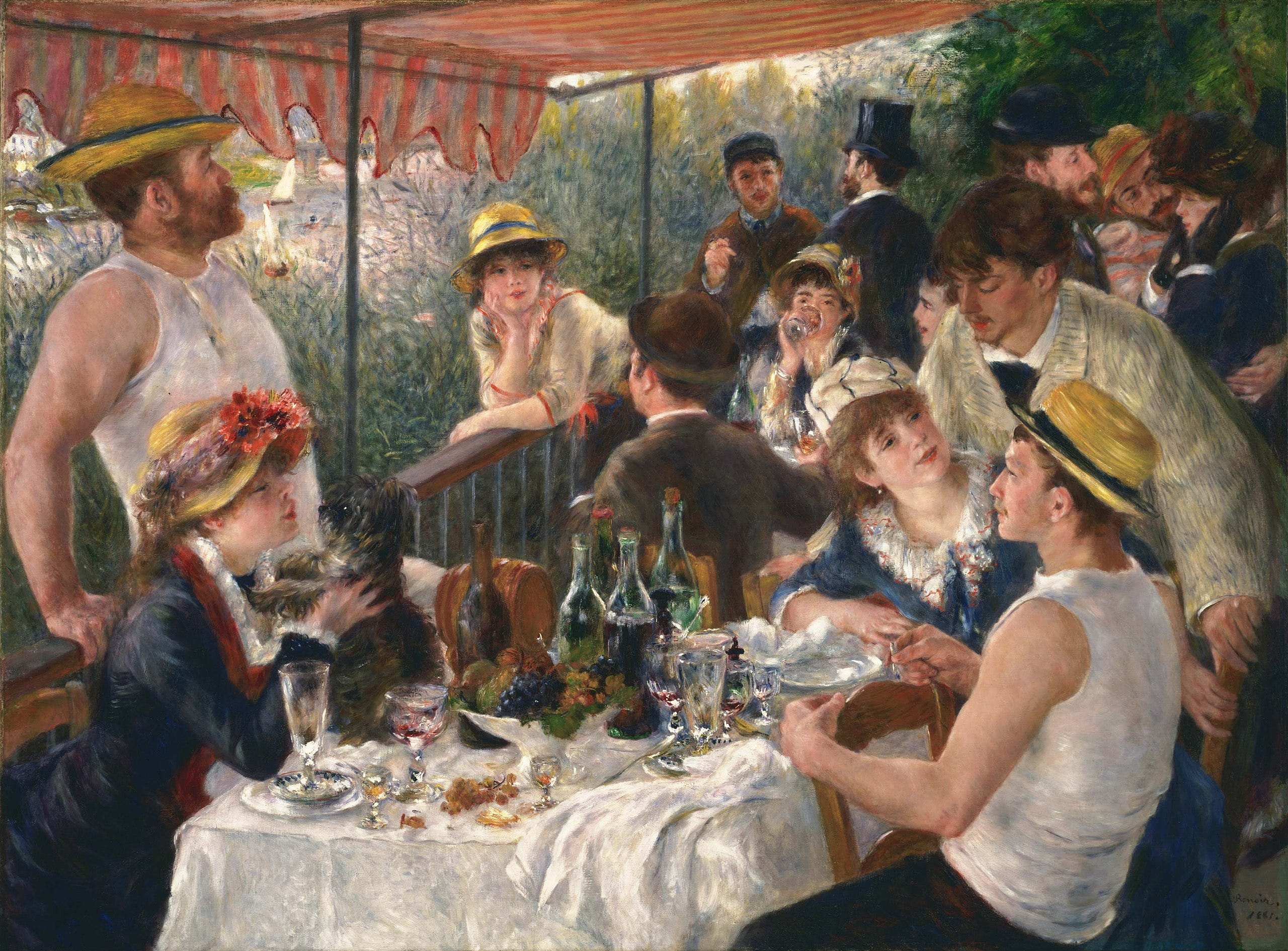
I was talking to a friend about Renoir yesterday, so let’s take Renoir’s famous Luncheon of the Boating Party painting as an example. What do I see? A group of people having lunch. Wait, but do I know they’re having lunch because of the title has luncheon in the name, or because it looks like lunch? I see wine bottles, a bowl of fruits with the grapes spilling over the edge, empty plates and cups.

Pierre-Auguste Renoir’s Luncheon of the Boating Party/Le déjeuner des canotiers, 1880–1. Image from Google Arts & Culture

There’s so much more to describe. Everyone in it is white. (Probably.) They’re dressed in white and navy, mostly, but there’s a man to the right whose jacket is—how would I describe it? Is it meant to be a pale yellow with black pinstripes? And now that I’ve tried to describe the colors, I’m noticing the man in a brown jacket, the man in the very back of the—I mean, what are they on? A terrace or veranda (I could have said “patio”, too, but I don’t like how that word looks as much) with that stripy covering—is there a name for that kind of thing? You know, the stripy…fabric…???

Slowly, almost stupidly, I look at the painting, I pay attention, I try to understand what I’m seeing. (...)

Mere description: it’s easy to forget about! But it’s worth it.

Very, very good descriptions

The goal, of course, is for mere description to become more than that. Even a functional description can, in the details it includes and the specificity of those details, become beautifully expressive.

A beautiful example of this comes from Flights, a novel by the Nobel Prize in Literature laureate Olga Tokarczuk. Before I tell you anything about the novel, let’s start with how the narrator of Flights is described:
I have a practical build. I’m petite, compact. My stomach is tight, small, undemanding. My lungs and my shoulders are strong. I’m not on any prescriptions—not even the pill—and I don’t wear glasses. I cut my hair with clippers, once every three months, and I use almost no makeup. My teeth are healthy, perhaps a bit uneven, but intact, and I have just one old filling, which I believe is located in my lower left canine. My liver function is within the normal range. As is my pancreas. Both my right and left kidneys are in great shape. My abdominal aorta is normal. My bladder works. Hemoglobin 12.7. Leukocytes 4.5. Hematocrit 41.6. Platelets 228. Cholesterol 204. Creatinine 1.0. Bilirubin 4.2. And so on. My IQ—if you put any stock in that kind of thing—is 121; it’s passable. My spatial reasoning is particularly advanced, almost eidetic, though my laterality is lousy. Personality unstable, or not entirely reliable. Age all in your mind. Gender grammatical. I actually buy my books in paperback, so that I can leave them without remorse on the platform, for someone else to find. I don’t collect anything.
In this highly specific, highly dispassionate description of the self, we learn quite a bit about the narrator. A woman (petite, not on the pill: only women describe themselves with these details). Capable of cool self-assessment (teeth: healthy, IQ: passable, personality: unstable). Some personal interest or professional expertise in the body, because she specifies a filling in her lower left canine, not just a tooth.

What kind of character introduces herself by telling us about her hemoglobin levels and leukocyte count? The central character of a novel that, as it unfolds, is obsessed with the body, with how the organs function (or don’t), the medical interventions that can extend or shorten life, the ways in which bodies are preserved after death. The novel follows this unnamed woman through various airports as she visits museums devoted to anatomy and the body. Later on in the novel, the narrator asserts that “Every body part deserves to be remembered. Every human body deserves to last. It is an outrage that it’s so fragile, so delicate.” This ideal is reflected in how the narrator describes herself—in her intense concern with the mechanics of her own body.

Equally striking are Tokarczuk’s descriptions of the world. Tokarczuk was a poet first, actually, and published a poetry collection before turning to the novels that made her famous in Poland and then the world. And you get a sense of that poetic background in the great economy and beauty of descriptions like this:
A crisp morning, the streets are lively, sunrise, the sun’s disk scraped up by slender poplars—it’s a pleasant walk.
This description is seared into my memory. Ordinary descriptions—a crisp morning, a pleasant walk—bracket an extraordinary poetic image: the sun’s disk scraped up by slender poplars...

It’s a great verb, scraped. Mostly deployed to describe scraping your knee, scraping the burnt bits off a pan, scraping ice off of a car windshield. An ordinary verb, turned towards extraordinary purposes..

Monday, December 29, 2025

Milcho Leviev

[ed. See also: Milcho Leviev & Dave Holland, album "The oracle", live al Suntory hall, Tokyo, 1986.]

Sebastien Genez, SH100 Easy Snowshoe
via: Experimenta
[ed. Cool idea (and design).]

We’re All Unique. Or Are We?


Have you ever found yourself in a new place and realized you don’t quite fit in? Your shoes, which made sense at the office, are not quite the right ones for the date after work in a different part of the city. Your hairstyle, which felt normal when you left your hometown, suddenly labels you uncool in a new city.

Or perhaps you’ve had the opposite experience? You feel out of place in your day-to-day circle and dress in hopes that someone with taste as refined as yours will see your attempts to distinguish yourself in your natty suits.

Most of us have at least a passing acquaintance with the push and pull between the desire to fit in and the urge to stand out depending on the setting. Everyone, as some point, discovers the subtle sartorial codes governing their communities and must decide how much to adopt or reject them.

The two have made those sub-classifications the basis of their three-decade-long art project, which now exceeds 200 groups arranged by visual likeness. Each category features 12 individual portraits organized in a grid, named and arranged with the precision of butterflies in a entomologist’s case.

To flip at random through “Exactitudes” (a portmanteau of exact and attitudes) is to be struck by the cleverness and care the artists have taken in selecting their subjects. Looking through each grid is like playing a game. Your eyes dart from frame to frame, in search of the subtle deviances in hairstyles and the way body language speaks volumes.

Now, on the occasion of publishing the seventh and final edition of “Exactitudes,” the duo is putting the project to bed. After three decades of collaboration, they look back in fondness at the time capsules they’ve created. (...)

When they don’t have a firm handle on a subculture they’re photographing, they listen. “Some of the groups, you start and you have a vague idea about them,” Mr. Versluis said. By listening, he said, “you get educated, especially when it’s a super-niche culture or something new.”

Sometimes they wait many days on location before finding enough willing participants. Sometimes the people in the grid know each other, but not always. For the most part, they say, participants are flattered to be included in the project.

‘The diverse human experience of getting dressed.’

Both artists have always worked independently and will continue to do so, though they did not rule out the possibility of a returning if a tantalizing commission comes along. Since they began shooting “Exactitudes,” the world has transformed from an one dominated by analog technologies to one ruled by digital algorithms. Where they were once perceptive humans finding patterns among the other humans, social media now serves up endless micro-trends to viewers the world over. In some way the magic of their project has been consumed by TikTok and Instagram.

by Stella Bugbee, NY Times | Read more:
Image:Ari Versluis and Ellie Uyttenbroek/Exactitudes

Woodshedding It

[ed. Persevering at something even though you suck at it.]

Generally speaking, we have lost respect for how much time something takes. In our impatient and thus increasingly plagiarized society, practice is daunting. It is seen as prerequisite, a kind of pointless suffering you have to endure before Being Good At Something and Therefore an Artist instead of the very marrow of what it means to do anything, inextricable from the human task of creation, no matter one’s level of skill.

Many words have been spilled about the inherent humanity evident in artistic merit and talent; far fewer words have been spilled on something even more human: not being very good at something, but wanting to do it anyway, and thus working to get better. To persevere in sucking at something is just as noble as winning the Man Booker. It is self-effacing, humbling, frustrating, but also pleasurable in its own right because, well, you are doing the thing you want to do. You want to make something, you want to be creative, you have a vision and have to try and get to the point where it can be feasibly executed. Sometimes this takes a few years and sometimes it takes an entire lifetime, which should be an exciting rather than a devastating thought because there is a redemptive truth in practice — it only moves in one direction, which is forward. There is no final skill, no true perfection.

Practice is in service not to some abstract arbiter of craft, the insular juries of the world, the little skills bar over a character’s head in The Sims, but to you. Sure, practice is never-ending. Even Yo-Yo Ma practices, probably more than most. That’s also what’s so great about it, that it never ends. You can do it forever in an age where nothing lasts. Nobody even has to know. It’s a great trick — you just show up more improved than you were before, because, for better or for worse, rarely is practice public.

by Kate Wagner, The Late Review |  Read more:

Sunday, December 28, 2025

December 26, 2025: Christmas Greetings From the President

Axios reported on December 23 that the White House has taken over the X account of the Justice Department, and on the same day, that account tried to undercut the new information by claiming that accusations in it are “unfounded and false.” But Trump’s behavior on December 25, Christmas, suggested otherwise.

Trump’s social media account posted: “Merry Christmas to all, including the many Sleazebags who loved Jeffrey Epstein, gave him bundles of money, went to his Island, attended his parties, and thought he was the greatest guy on earth, only to ‘drop him like a dog’ when things got too HOT, falsely claimed they had nothing to do with him, didn’t know him, said he was a disgusting person, and then blame, of course, President Donald J. Trump, who was actually the only one who did drop Epstein, and long before it became fashionable to do so. When their names get brought out in the ongoing Radical Left Witch Hunt (plus one lowlife ‘Republican,’ Massie!), and it is revealed that they are Democrats all, there will be a lot of explaining to do, much like there was when it was made public that the Russia, Russia, Russia Hoax was a fictitious story—a total Scam—and had nothing to do with ‘TRUMP.’”

After misrepresenting the New York Times, he went on: “Now the same losers are at it again, only this time so many of their friends, mostly innocent, will be badly hurt and reputationally tarnished. But, sadly, that’s the way it is in the World of Corrupt Democrat Politics!!! Enjoy what may be your last Merry Christmas! President Donald J. Trump.” (...)

This evening, Trump posted: “Now 1,000,000 more pages on Epstein are found. DOJ is being forced to spend all of its time on this Democrat inspired Hoax. When do they say NO MORE, and work on Election Fraud etc. The Dem[ocrat]s are the ones who worked with Epstein, not the Republicans. Release all of their names, embarrass them, and get back to helping our Country! The Radical Left doesn’t want people talking about TRUMP & REPUBLICAN SUCCESS, only a long ago dead Jeffrey Epstein—Just another Witch Hunt!!!”

“I love the smell of panic in the evening,” former representative and Trump critic Adam Kinzinger (R-IL) posted over Trump’s screed. “Smells like… victory.”

Even before Trump’s evening post, in Meditations in an Emergency, Rebecca Solnit noted that it seems “clear that there is likely something in the files that further incriminates” Trump, an observation with which scholar of authoritarianism Timothy Snyder agreed. He added: “Horrible as the facts at hand are, there must be something else, something verging on the unimaginable.”

by Heather Cox Richardson, Letters From An American |  Read more:
Image: none, too disgusted
[ed. It's called Illeism (to talk about yourself in the third person):]
In the realm of clinical psychology, illeism takes on a whole new dimension. It’s been observed in certain personality disorders and mental health conditions, sometimes as a coping mechanism or a symptom of dissociation.
***
[ed. Also this: Americans are waking up. A grand reckoning awaits us (Guardian):]

The US had to come to this point. We couldn’t go on as we were, even under Democratic presidents. For 40 years, a narrow economic elite has been siphoning off ever more wealth and power.

I’m old enough to remember when the US had the largest and fastest-growing middle class in the world. We adhered to the basic bargain that if someone worked hard and played by the rules, they’d do better than their parents, and their children would do even better.

I remember when CEOs took home 20 times the pay of their workers, not 300 times. When members of Congress acted in the interests of their constituents rather than being bribed by campaign donations to do the bidding of big corporations and the super-wealthy.

I remember when our biggest domestic challenges were civil rights, women’s rights and gay rights – not the very survival of democracy and the rule of law.

But over the last 40 years, starting with Ronald Reagan, the US went off the rails: deregulation, privatization, free trade, wild gambling by Wall Street, union-busting, monopolization, record levels of inequality, stagnant wages for most, staggering wealth for a few, big money taking over our politics.

Corporate profits became more important than good jobs and good wages for all, stock buy-backs and the wellbeing of investors more important than the common good.

Democratic presidents were better than Republicans, to be sure, but the underlying rot worsened. It was undermining the foundations of the US.

Trump has precipitated a long-overdue reckoning.

That reckoning has revealed the rot.

It has also revealed the suck-up cowardice of so many CEOs, billionaires, Wall Street bankers, media moguls, tech titans, Republican politicians and other so-called “leaders” who have stayed silent or actively sought to curry Trump’s favor.

America’s so-called “leadership class” is a sham. Most of them do not care a whit for the rest of the US. They are out for themselves.

The “fucking nightmare” is not over by any stretch. It’s likely to get worse in 2026 as Trump and his sycophants, and many of America’s “leaders”, realize 2026 may be their last unrestrained year to inflict damage and siphon off the spoils.

Hollywood Has Left L.A.

The past decade has been tough on Hollywood — both the industry and the place. L.A. has endured a parade of black-swan catastrophes that have repeatedly upended its signature business, including fires, strikes, COVID, the decline of movie theaters and linear TV, and streaming’s boom and bust. Taken together, these disasters have triggered something like an identity crisis. If you call up a couple dozen executives, agents, directors, producers, writers, actors, and below-the-line artists and ask about the scene on the ground right now, they’ll describe a city detached from its old rhythms and sense of purpose. Today’s L.A., a few say, feels more like a Rust Belt crater than the glamorous capital of the world’s entertainment. “It’s so grim, like a sad company town where the mill is closing,” says one executive. “It’s morose, and everybody’s scared,” says the actor and director Mark Duplass. “It’s a bummer to live here now,” says a writer.

Pieces of the business still hum along in the city, albeit more quietly than they used to. Executives and agents are back in the office, at least the ones who weren’t laid off. Pitching and deal-making continue, though much of that now happens over Zoom. But production — the physical process of turning script pages into movies and TV shows — has largely left town. What began years ago as a trickle has suddenly become an exodus. Today, only about a fifth of American movies and shows are filmed in L.A. (...)

As the labor of making movies and shows splinters across far-flung cities and countries, Hollywood has become dislodged from its physical home. Some of these new hubs may suit the needs of individual projects, but none of them offers what L.A. did for most of the past century: a stable gravitational center where crews can make a living and the craft can be passed down. This isn’t just a logistical reorganization; it’s an existential shift, and there may be no going back. “The nucleus that Hollywood grew out of is dying,” says Jonathan Nolan, the writer-director whose work includes Person of Interest, Westworld, and Fallout. “I don’t think Hollywood the industry has much to do with Hollywood the place anymore,” says Lowe.

One reason L.A. even became a city at all is because it was a great place to make movies. (It helped that it was far enough from New Jersey to escape the enforcement of Thomas Edison’s patents on motion-picture cameras and projectors.) The weather allowed for year-round outdoor shooting, attracting the industry’s best filmmakers, actors, and crews. This created a self-reinforcing bubble in which the top talent was all concentrated in the same place; this, in turn, supported an informal apprenticeship system under which younger crew members learned on the job, providing a steady influx of skilled labor. For a long time, there was usually no good reason to shoot anywhere else.

Then, in the 1990s, British Columbia hatched a plan to bring some of that action north. The Canadian provincial government introduced one of the world’s first film tax credits — a financial incentive meant to lure foreign productions — offering a modest rebate on money spent employing local crews. It worked, and many U.S. states took notice. In the early aughts, Louisiana and New Mexico rolled out flashy credits of their own, transforming New Orleans and Albuquerque into viable production hubs.

A short while later, streaming boomed, and the demand for scripted entertainment exploded. With more production in play, regions around the world began ramping up their incentives, and many built soundstages and crew bases that could compete with those in L.A. What followed was a global bakeoff for Hollywood’s business. Canada, the U.K., and Australia enhanced their already aggressive tax credits, often made even more appealing by favorable exchange rates. Many U.S. states, including Georgia and New York, followed. Before long, most of the country, and dozens of countries beyond, were offering some version of a production subsidy.

These incentives can be shockingly generous. Today, producers can shoot in certain locations and receive back 30 to 40 percent of a project’s budget with local taxpayers footing the bill. Unlike traditional tax breaks, which merely reduce what a company owes, these credits often amount to direct cash payments, issued regardless of whether the production generates significant tax revenue in return. New York State, for example, offers a 30 percent base tax credit with a 10 percent bonus for projects made upstate. Last year, New York tax dollars helped subsidize TV shows including HBO’s The Gilded Age (which received $52 million from state coffers), Prime Video’s The Marvelous Mrs. Maisel ($46 million), and Apple TV+’s Severance ($39 million). An Albany-funded audit of New York’s film tax credit, published last year, determined that the incentive is probably a net loss for the state, returning as little as 15 cents in direct tax revenue for every dollar spent. Regardless, in May, New York added an additional $100 million for independent films, bringing the state’s total film subsidies to $800 million.

Meanwhile, California mostly sat on its hands, assuming its long-standing monopoly on talent and infrastructure would be enough to keep Hollywood anchored. Subsidizing an industry already based there was a tougher political sell, but the state introduced its own incentive program in 2009 and has sweetened it since. Unfortunately, while the credit may sound generous, in practice it’s miserly to the point of uselessness.

by Lane Brown, Vulture |  Read more:
Image: Alvaro Dominguez

How NIL is Failing College Sports

Editor’s Note (September 2025): This article was first published in May 2025. Since then, NIL controversies have only grown—lawsuits over transfers, new collective rules, and court rulings are fueling even more debate. The problems outlined below remain at the heart of the chaos.

When the NCAA implemented its interim policy on Name, Image, and Likeness (NIL) in July 2021, it was heralded as a long-overdue victory for student-athletes. Finally, college athletes could monetize their personal brands while maintaining eligibility. But three years in, the reality of NIL has exposed deep, structural problems that threaten the very foundation of college sports.

Far from the fair, equitable system its proponents envisioned, NIL has morphed into a thinly veiled pay-for-play scheme dominated by wealthy donors, corporate interests, and an increasingly professionalized amateur sports landscape that’s leaving many athletes and institutions behind.

NIL Is Bad in Its Current Form, But the Concept Isn’t

Let’s be clear: this is not to say NIL is all bad. The core principle—that athletes deserve compensation for the use of their name, image, and likeness—remains valid and important. Student-athletes absolutely deserve to get paid. But this implementation ain’t it.

The problem is the execution. NIL went from zero to 200 MPH overnight with no guardrails. It’s like giving someone a supercar capable of high speeds and letting them drive it through downtown at rush hour. Just because a car can go that fast doesn’t mean it should outside of a sanctioned and governed NASCAR race. Similarly, NIL needed careful implementation with proper rules and oversight—not the free-for-all we’re currently witnessing.

NIL Is Bad for Creating the Collective Problem: Pay-for-Play in Disguise

The most troubling development in the NIL era has been the rise of “collectives” – donor-organized groups that pool money to facilitate NIL deals for athletes at specific schools. These collectives have quickly evolved from their original purpose into recruitment vehicles that effectively function as booster-funded payrolls.

College football’s biggest donors have orchestrated business ventures distributing five-, six- and seven-figure payments to athletes under the guise of endorsement opportunities and appearance fees. While technically legal within vague NCAA guidelines, these arrangements clearly violate the spirit of what NIL was supposed to be.

Consider the case of quarterback Nico Iamaleava, whose story perfectly illustrates the chaos. After signing with Tennessee on a lucrative NIL deal, he later tried to renegotiate his contract during the 2025 offseason. When Tennessee refused both because his performance didn’t warrant the increase and the amount was too high, Iamaleava explored other options. After other schools balked at his demands, he eventually landed at UCLA for significantly less money than he was seeking. Meanwhile, Texas will spend an astounding $40 million on its football roster in 2025-26. But that’s not the issue—why wouldn’t they if they can? The problem is that if another team wants to compete, there’s only one way forward: pay up.

This isn’t about athletes receiving fair compensation for actual marketing value – it’s about wealthy boosters creating slush funds to buy talent. And as long as deals include some nominal “deliverable” from the athlete and are signed after their national letter of intent, there’s little the NCAA can do to stop it. (SportsEpreneur Update as of September 2025: read more about the NIL Clearinghouse and the first NIL deal report.)

NIL Is Bad for Boosting Egos Instead of Programs

A particularly troubling aspect that’s emerged is how NIL has become an ego-driven playground for wealthy boosters. For many donors, it’s no longer about supporting their alma mater—it’s about directly influencing outcomes and claiming credit for wins.

These boosters are essentially treating college teams like fantasy sports with real money. They get a dopamine hit from watching “their” players succeed, knowing their financial contribution made it possible. It’s an addiction—the thrill of buying talent and then basking in reflected glory when that talent performs well.

This creates a dangerous dynamic where the interests of boosters, rather than educational or developmental goals, drive decisions. Coaches find themselves answering not just to athletic directors, but to the whims of deep-pocketed collectives who can control the talent pipeline.

[ed. ...and much more:]

NIL Is Bad for Widening the Gap: Competitive Balance Destroyed

NIL Is Bad for Creating Transfer Portal Chaos: The Free Agency Problem

NIL Is Bad for Athletes Making Short-Term Decisions

NIL Is Bad for the Athlete-Fan Relationship

NIL Is Bad for Corruption and Exploitation: The Dark Side

NIL Is Bad for College Sports’ Identity Crisis

NIL Is Bad for International Student-Athletes

NIL Is Bad, But Reform Is Possible

by SportsEMedia |  Read more:
Image: Tyler Kaufman/Getty
[ed. Money is killing sports (and most everything else), and nobody pays even lip service to educational opportunities anymore. See also: Limbo Field (HCB); and,  The college football spending cap is brand new, and here’s how schools already are ignoring it (The Athletic).]

via: