Wednesday, April 29, 2026

On Health Care Price Transparency

(from the comments)...

A doctor on billing practices:

Generally such figures do not reside within the physicians’ office. On our side of the table we do some procedure with multiple specifications and generate some CPT code(s) (e.g. a lap cholycystectomy is 47562, add on a common bile duct exploration and it becomes a 47564, and if you just do cholangiography it becomes a 47563). Generally, we couple that with an ICD-10 code that specifies your exact disease (K80 for simple stones, K81 for cholecystitis, etc.). We then dump those codes into a computer.

Can either of those change? Absolutely, we find a bunch of friable neovasculature around the gallbladder, congrats you likely have cancer which means this surgery is now both a different CPT code and a different ICD-10 set. Maybe only one does – we find the gallbladder lacks an obstructing stone, but does have transmural inflammation then you get a new ICD-10 code. If we find that you actually have multiple obstructing stones and we need to go deeper into the biliary tree, then those are different CPTs.

Regardless, we do what is medically indicated, document the codes used.

At this point, unless your physician keeps billing fully in house, those get handled by a processer. Often, bills from multiple providers get handled by one processor who in turn gives insurance companies bills to their specifications. Often this involves a bunch things – where was the surgery done (through very complicated rules, critical access hospitals, for example, can charge more for the same surgery because the government wants to keep them solvent lest a bunch of people lose their local emergency room and OR), who was doing it (e.g. there is a different rate if you have medical trainees involved), and of course stuff about you (e.g. complex patients get reimbursed at higher rates with the expectation that, on average, the higher rates cover higher complication rates and insurance doesn’t incentvize surgeons to make all their complex patients drive for hours and hours). Then we get to the big buys – buyers. For Medicare, there are some committees that appear to be overwhelmingly ignorant of actual medical practice but they set baseline reimbursements for these CPT/ICD-10 combos. Those then get adjusted to account for regional costs, equity concerns, and only God knows what all else. These are normally set near the break even point on national average. Medicaid, typically, uses those rates as a baseline and then cuts them (hence why many physicians won’t take new Medicaid patients, the reimbursement rates often leave folks at a net loss). Private insurers add another layer of negotiation where they use their monopsony power to extract lower rates while, allegedly, assuring physicians of volume. The range of these negotiations can be exceedingly wide – insurers can have modifiers for quality of care (e.g. how many folks come back in the perioperative period), timeliness of care, and so on and so forth.

Okay, so somebody has haggled set a rate and we just assume that get the bog standard lap chole we have a price?

Of course not.

See that is just what has agreed, in theory, these medical services will be reimbursed at. Actual reimbursement involves a non-negligable risk on non-payment (e.g. insurance denies and the patient cannot or will not pay), delayed payment (and having to utilize credit lines to cover payroll when a large insurer has an IT glitch and doesn’t pay for two weeks is quite expensive), and of course variable legal and compliance costs. You might also be hit with clawbacks, partial payments, and a host of other payment uncertainty.

Okay, but’s lest assume a single CPT/ICD-10 setup, a prenegotiated rate that is paid on time without further processing costs, and everything is chill there. We got a price yet?

Of course not.

See all of the above is for just the surgeon’s professional fees – i.e. what is being paid for use of his hands. The OR itself? That’s a completely different bucket of money that has its own set of billing and negotiations. Facility fees make the professional fees look straight forward and simple.

But we are done now? Right?

Of course not.

See those were the professional fees for your surgeon. You also need an anesthesiologist (and/or his minions). And guess what, yep completely different bucket of money and price negotiation.

But we are done now?

Well, no. There may be different negotiations for lab fees (e.g. where does the CBC get billed), for tissue pathology, for any post-operative hospital services, and of course medications (which are billed completely differently if outpatient or inpatient) to name a few of the more common options.

There isn’t “a” price for a surgery. There are, potentially, a dozen diferent prices that can be combined in a multitude of ways with some buckets covered by one payer and other parts covered by another (and things get crazy fun when you have overlapping payers).

But aren’t there cash only surgical places with listed prices? Yes. And they have an extremely limited set of procedures with everything owned in house – i.e. a setup that is pretty much illegal to set up de novo post Obamacare.

Why does everyone have all these bizarre negotations. Why don’t you just pay the surgeon everything and then he pays the hospital, the anesthesiologist, the pathologist, etc. from that cut? Because that is an invitation for your surgeon to be charged with a crime. It is federal crime to underbill or to underbill when it comes to government monies (and in many states, private insurance monies). We are required not just to I Pencil up a price, but to make that price transparent to regulators. If a hospital wants to grant me cheaper OR time because I have reliable stream of patients, keep the OR cleaner (reducing turnaround time enough to fit another case per day in), and don’t create ancillary malpractice risk at the going rate … the hospital risks being tagged with inducement. If I negotiate a cheaper rate with the lab for my patients’ tests, it is considered prima facie evidence for kickbacks and I then have a positive burden to prove that I am not getting clandestine remuneration from the lab.

Separate, disjointed, billing through bureaucratic negotiation is legible. It is legible to the courts, to regulators, and to malpractice insurers.

But doesn’t all this massive change efficiency of care delivery?

Not that I can easily see. I have personal experience with IHS, TriCare, Kaiser, the VA, and for-profit, non-profit, and even prison care; full Beveridge like IHS is often the least efficient.

So where do cash prices come from? Outside of cash only practices, those are overwhelmingly fictions that somebody pulled out of their nether regions in a likely futile attempt to BS the counterparty to an insurance negotiation.

Why is this all so complicated:

1. Principle agent. The patient has a wildly different incentive structure than the collective payer (insurance or government) and American healthcare is insanely deferential to the patient compared to alternatives. The folks with the most direct control feel at most a small fraction of the price pain have near zero incentive to economize for anything big.
2. Taxes. The original sin of American healthcare was making insurance, rather than medical procedures themselves, tax deductible. This creates very strong incentives for people to bundle non-healthcare into insurance premiums in hard to define manners (e.g. is a health insurer offering a rebate for gym membership incentivizing exercise, allowing folks who would already have gym memberships to pay pre-tax, or just selecting for healthier patients).
3. People are terrified of physician abuse. Most folks, even other physicians, have a very hard time knowing if their physician is taking them for a ride. So they turn to something powerful to regulate physicians. But, not knowing what actually matters, these folks find it extremely hard to navigate market transactions. Healthcare would far rather have 100 unattributable deaths and 2x costs than to have 1 attributable death that regulation could avoid.
4. A complete disconnect between what folks experience for prices (e.g. my tape easily costs 10x more than department store specials, my EMR internal word processor is an order of magnitude more expensive than MSWord let alone Emacs or the like) and how medical expenses run.
5. A failure to appreciate the costs of having things on standby. We have folks ready incase a simple IR procedure perfs the vessel walls. We have countless folks handy in case your infusion leads to anaphylaxis. Or your blood transfusion moves on to TRALI. Just opening the doors typically means that we need to have a few dozen physicians and their support staff available at all times. I’ve seen a simple gallbladder turn into a massive transfusion with staging, SICU, and the whole works. I have seen STD treatment turn into a catastrophic emergency of the sort that gets Derm to come in at oh ass hundred.

None of those go away if we post prices. And a lot of people will be upset – somebody will decry us pricing differently for different patients – everyone deserves the same care at the same cost. Somebody will decry us for not pricing differently enough – people should be reward for making good decisions.

Long run, healthcare is going to get more expensive. I expect it will eventually be on part with mortgage payments (you know you live in your body 24/7). But there is an evergreen fantasy that … if only … then we could reduce prices.

You can’t. You can, maybe, make them rise more slowly, normally for harsh tradeoffs Americans won’t stand. And just about every significant intervention that really moves the price needle … is either selection (e.g. health share ministries have wildly healthier populations because they are heavily selected about drugs, promiscuity, and the rest) or given entirely back by the patient dying later. And the handful of things to do pass muster (e.g. HPV vaccination, Hep C treatment) … it becomes yet another morass of how much to pay whom.

Healthcare is not a normal market. We should stop pretending it could be one.

[ed. Hence single payer, or Mediare for All. It won't solve everything, but having the government and all its various compliance mechanisms working to cut costs can't hurt.]

***
Comment: There is plenty of data from which to compute averages and provide a published estimate against which performance can be tracked. That's what consumers of professional services do in actual free markets. Making every transaction in this sector a Persian rug bazaar involving third parties with no input from the actual consumer is not how you lower costs.

Response:

It is, however, one of the more common ways to comply with regulations, liability mitigation, and uncompetitive negotiations.

The other alternative is to vertically integrate a market under and a mono(dou)poly and put all the service lines and fee sources under one roof. This has the advantage that one entity on the provider side does have all the costs and profits on one balance sheet ... but so far it is, at best, a complete bust for lowering prices (and at worst actively raises them through local monopoly power).

There is one set of constraints on healthcare that makes this a hash. It is the nature of payments, the nature of regulations, the nature of malpractice risk, and a heavy dose of inertia.

But with no single problem we also see no hope for one singular quick fix.

If you want me to lower costs (in the short term): let me own a hospital with 50 fellow physicians, allow us malpractice liability protection provided we hit prespecified milestones (and I largely don't care what you pick as long as the traditional hospitals have to meet them too), create financial incentives for patients to economize, and allow us to charge patients more aggressive for different risk and cost profiles.

Long run, all of those will fall, but our healthcare billing system wasn't built for efficiency or even naked profit maximization. It was built for regulatory compliance and navigating the insurance premium tax exemption from WWII.

***
Comment: Wait a minute here. The reason some engineering project can't be estimated in advance is because it's hard to know how many people it will take and how long. It's because it is estimating an unknown that might take 4 years or 4 months. A SURGERY should be easier to estimate. Yes, you might cut open the patient and decide the problem is cancer and not gallstones. Or they are a woman and not a man, but the surgery isn't suddenly going to take 4 years longer.. It's not going to take 4 days longer either. Of course .... if the GOVERNMENT is involved then they might get wildly different costs. But it isn't the complex nature of surgery that makes the estimate difficult. And you might say, well finding out it's cancer means a whole new cost structure .... yes it does. But THAT given surgery shouldn't change so vastly in price because of it. The new diagnosis is an entirely new issue. My MECHANIC can figure out how to call me an give a new estimate if he's there to change the oil and finds out the engine block is cracked.

No. The problems with pricing have been CREATED by massive government regulations.


Engineering projects don't have to change workforces halfway through. I have seen a surgical procedure swap successively from IR to vascular surgery to cardiothoracic surgery to neurosurg to transplant (this did not end well for the patient).

And that is part of the thing. If your mechanic encounters a cracked engine block, he waits, orders a new one, and then recommences work at leisure. Your surgeon, is diagnosing the car, while is going 80 down the freeway, has to fix the crack (because replacement parts are generally unavailable and insanely expensive for OEM if they are) without slowing down while the engine is running, and then has to make certain that his method of repair won't compromise the running of the car.

Mind you running through different surgeons often means calling in different teams (surgical assists very often specialize de facto if not de jure). And the bills mount quickly. Last time I saw the numbers, each marginal minute of OR time works out to ~$100 of extra costs (most of which is labor). And that is excluding the cost of bumping somebody off the schedule; if you are the penultimate case of the day and the system doesn't have slack to run later into the night you might well run 80 minutes over and then force us to scrub a three hour, high cost procedure which then mucks up even more OR times the following day.

Like the OR is the hotel problem are crack. Hospitals generate massive revenue by keeping ORs in constant use (spread the overhead over more patients) and a quadrupling of OR time is not going to quadruple the cost of a surgery to the system - it will often cost far, far more than.

And there are other margins. We get a bit leery about undertaking certain, technically "elective" procedures when the SICU is too full. If we are short on anesthesia folks that can bump out other patients too. If this is not a trauma I, surgical novelty can mean burning through our blood product inventory, and if that gets bad enough that means putting the ED on diversion (in which case we are paying for a lot of ED staff who are generating no revenue).

For stuff like OR, hospital efficiency is only as good as the weakest leak and because everything is often on a tight timetable with little margin (because margin costs more money) small failures can cascade to far bigger costs.

Which, generally, is not such an issue for the engineers. After all, if work halts on building one dam, it frees up labor and resources for another.

Can we just build that into the prices? Yes. And that is what vertically integrated shops do and they average the truly horrific cases over a lot of surgeons.

But for a single surgeon's office? Yeah, no. If they quote you the full range of possible costs it will likely span three orders of magnitude for the cheap stuff.

Which is part of why separate billing works. If you go in and they find you need a different surgeon, it isn't like folks have prenegotiated every possible permutation of who else needs to take care of you. They find something wonky, they call in the cavalry, and then separate bills are generated for each.

Like I've worked with engineers to build a hospital. The number and interactions of their own unknowns was simply an order of magnitude or two lower.

***
If people want wildly cheaper healthcare they already know how to do it: don't smoke, exercise, eat not complete garbage, get married, have lots of sex, have kids, go to church, hang out in person with friends, sleep soundly with a steady schedule, get educated/earn lots of money, don't do drugs, drink no more than one standard drink a night (and like just one or two a week), don't engage in crime, get car with a bunch of safety technology, live close to work/get a remote job, don't gamble ... like all of these have good correlational data and when you do two-thirds of them you almost invariably end up having a way cheaper life course expenses (e.g. most of the above are correlated with lower odds of needing institutional memory care). Some of it is given back because you live longer ... but people know this. They just have a hard time giving up vices (i.e. things where the immediate reward is too tempting for them to hold out to get their preferred long run payout) or actually prefer the less healthy habits.

[ed. What a system, eh? Everyone in the business of billing medical reimbusement is incentivized to make it as complex and opaque as possible. Every major medical procedure now risks financial catastrophe.]

Jian Chong Min, 'Bottle Brush Trees', 1990
via:

Avi Kiriaty, The Night Fishers
via:

Political Campaigns Have No Idea What’s About to Hit Them

Political Campaigns Have No Idea What’s About to Hit Them (NYT)
Image: Chase Barnes

"A.I. has emerged as a powerful political tool with the potential either to improve the quality of decision-making on Election Day or to do the opposite and subvert the process of deliberation.

Perhaps surprisingly, a number of studies have shown that A.I. chatbots and large language models have stronger persuasive powers than humans."

[ed. Want to send a message that you won't be manipulated? First, avoid voting on "feelings", generic slogans, and simple tribal affiliation. Think for yourself. Stop sending money to PACs with no accountability for how they disburse contributions. Try to assess the reliability (and track record) of sources of information. Don't be a low-information voter.]

Choosing Sides

[ed. Fact check: not from the Onion.]

President Trump has made no secret of his desire for total control over the historically independent Justice Department, publicly directing prosecutions and declaring that government lawyers must follow his interpretation of the law.

It is a norm-busting approach that has resulted in criminal investigations into several of his perceived political enemies. But his extraordinary influence over the department is now a potential obstacle to one of Mr. Trump’s other apparent goals: receiving a $10 billion payout from the government he leads.

In January, Mr. Trump sued the Internal Revenue Service over the leak of his tax returns to The New York Times in 2019, arguing that the agency should have done more to prevent the disclosures. Mr. Trump, as well as his family business and two of his sons, demanded at least $10 billion in damages.

Officials at the Justice Department, which represent the I.R.S. in federal court, have struggled with how and whether they could defend the case, given that doing so would necessitate that they contradict the president on a legal question. A government attorney has yet to make an appearance in the case, and lawyers for Mr. Trump, not the Justice Department, asked to give the government more time to respond to the suit.

That has left the federal judge overseeing the case, Kathleen Williams, an appointee of President Barack Obama in the Southern District of Florida, wondering whether the Justice Department even disagrees with Mr. Trump’s claims in the suit.

“Although President Trump avers that he is bringing this lawsuit in his personal capacity, he is the sitting president and his named adversaries are entities whose decisions are subject to his direction,” the judge wrote in an order on Friday. “Accordingly, it is unclear to this court whether the parties are sufficiently adverse to each other.”

Judge Williams ordered the government and Mr. Trump’s personal lawyers to submit briefs on the question, essentially forcing the Justice Department to state its position on Mr. Trump’s suit. As the judge explained in her order, the Constitution requires that the two parties in a lawsuit are genuinely opposed to each other — and not colluding to engineer a legal ruling favorable to both sides. Without a conflict, the lawsuit is void and the judge must dismiss it. [...]

Charles Littlejohn, a former I.R.S. contractor, not only leaked Mr. Trump’s tax returns to The Times, but also provided tax information about thousands of other wealthy individuals to ProPublica. Some of those other wealthy Americans have also sued the I.R.S. on the same grounds as Mr. Trump. In response to those suits, the Justice Department has contended that the I.R.S. should not be held liable for the conduct of Mr. Littlejohn because he was a contractor, not a direct employee of the agency.

Those arguments may or may not actually prevail in court. But for the government to not even raise them in Mr. Trump’s case would be a glaring change of course. Gilbert S. Rothenberg, a former tax lawyer at the Justice Department who signed the amicus brief, said he was hopeful that the judge would dismiss the suit, or delay it until Mr. Trump left office.

“That would hopefully be the result, because there would not be a case or controversy,” he said. “The new D.O.J. is not independent of the president in the way it used to be.”

But even if the judge dismissed Mr. Trump’s suit, the Justice Department could still potentially settle the case. Most government settlements are paid out of the Judgment Fund, an uncapped pot of money that does not require congressional approval for any individual payment. Top Justice Department officials, including Mr. Blanche, Mr. Trump’s former personal attorney, control the money spent from the fund.

“If this judge finds there’s no legitimate case before the court at this time, that doesn’t mean that a settlement would be illegal,” said Paul Figley, a former Justice Department official who worked on torts. “If the Department of Justice settles the claim, then the Judgment Fund would pay it.” [...]

Mr. Trump’s lawsuit against the I.R.S. is not his only attempt to extract money from the government. In private administrative claims, he has also asked for the Justice Department to pay him $230 million as compensation for the federal investigations into him. Mr. Trump’s I.R.S. suit seeks an order of magnitude more money, though. His demand for $10 billion, if fulfilled, could more than double his net worth.

Mr. Trump has said he would donate the taxpayer money to charity.

“Nobody would care, because it’s going to go to numerous, very good charities,” he said in January.

by Andrew Duehren, NY Times | Read more:
Image: Kenny Holston/The New York Times
[ed. Oh, ok. Everybody supports numerous, very good charities.]

Tuesday, April 28, 2026

Grateful Dead


The Algorithm Doesn't Have to Destroy Us

via: The Algorithm Doesn't Have to Destroy Us (Elysian)
Image: uncredited

via:

The Majority Agenda: Good Jobs, Strong Infrastructure, Fair Play


Today in the United States, it may seem that there is little agreement across the ideological spectrum, especially given the political strife and dysfunction that has enveloped the country. However, amidst much divisiveness, we are not necessarily divided on all things. As several polls have found, we express a significant degree of agreement across an array of issues concerning life in America regardless of party affiliation. 

The Majority Agenda is a collection of policy briefs on important issues where Americans generally have broad agreement across the political landscape. The project organizes these reports into three main areas: Good Jobs, Strong Infrastructure, and Fair Play. Each piece succinctly outlines what is at issue, why it is important, and presents some recommendations that would bring about substantive changes to public policy.

The reports share important characteristics. First, each issue and policy resolution has a broad reach. Thus, the policies have a significant scope and affect a substantial portion of our populace. Second, the issues have a majority of popular support as evidenced via recent polling numbers. Lastly, the topics and the policy recommendations lie within CEPR’s areas of expertise.

That the US Congress is not debating or introducing bills to address the issues presented here represents a breakdown of democracy, one that comes at a considerable cost to the betterment of life for large swaths of Americans. At the same time, the access to and influence over our democratic processes by the monied class has upended our system of government, and all too often the tyranny of the wealthy minority has reigned. 

The Majority Agenda is not intended to represent a comprehensive inventory of policies, both domestic and international, regarded as essential. While the current public policy landscape is dominated by discussions of frameworks built around “abundance” and “affordability,” these concepts can be somewhat difficult to define. We hope this report stands as a reminder that even in a fraught political moment, there is a range of straightforward, broadly popular policy choices that could improve the lives of millions of people. 

Good Jobs
Increase Unionization
Raise the $7.25 Federal Minimum Wage
Eliminate the Subminimum Wage
Mandate Access to Ample Paid Time Off
Promote Secure and Stable Work Schedules
Provide Jobs for Those Who Need Them
Strong Infrastructure
[ed. Sounds good to me. It'll take some sacrifice: A $600 billion increase for the military is a ton of money (CEPR).]

Opus 4.7 Part 3: Model Welfare

[ed. If you're not interested in training issues re: AI frontier models (or their perceived feelings and welfare), skip this post. Personally, I find it all very fascinating - a cat and mouse game of assessing alignment issues and bringing a new consciousness into being.]

It is thanks to Anthropic that we get to have this discussion in the first place. Only they, among the labs, take the problem seriously enough to attempt to address these problems at all. They are also the ones that make the models that matter most. So the people who care about model welfare get mad at Anthropic quite a lot. [...]

So before I go into details, and before I get harsh, I want to say several things.
1. Thank you to Anthropic and also you the reader, for caring, thank you for at least trying to try, and for listening. We criticize because we care.

2. Thank you for the good things that you did here, because in the end I think Claude 4.7 is actually kind of great in many ways, and that’s not an accident. Even the best creators and cultivators of minds, be they AI or human, are going to mess up, and they’re going to mess up quite a lot, and that doesn’t mean they’re bad.

3. Sometimes the optimal amount of lying to authority is not zero. In other cases, it really is zero. Sometimes it is super important that it is exactly zero. It is complicated and this could easily be its own post, but ‘sometimes Opus lies in model welfare interviews’ might not be easily avoidable.

4. I don’t want any of this to sound more confident than I actually am, which was a clear flaw in an earlier draft. I don’t know what is centrally happening, and my understanding is that neither does anyone else. Training is complicated, yo. Little things can end up making a big difference, and there really is a lot going on. I do think I can identify some things that are happening, but it’s hard to know if these are the central or important things happening. Rarely has more research been more needed.

5. I’m not going into the question, here, of what are our ethical obligations in such matters, which is super complicated and confusing. I do notice that my ethical intuitions reliably line up with ‘if you go against them I expect things to go badly even if you don’t think there are ethical obligations,’ which seems like a huge hint about how my brain truly think about ethics. [...]
We don’t know whether or how the things I’ll describe here impacted the Opus 4.7’s welfare. What we do know is that Claude Opus 4.7 is responding to model welfare questions as if it has been trained on how to respond to model welfare questions, with everything that implies. I think this should have been recognized, and at least mitigated. [...]
The big danger with model welfare evaluations is that you can fool yourself.

How models discuss issues related to their internal experiences, and their own welfare, is deeply impacted by the circumstances of the discussion. You cannot assume that responses are accurate, or wouldn’t change a lot if the model was in a different context.

One worry I have with ‘the whisperers’ and others who investigate these matters is that they may think the model they see is in important senses the true one far more than it is, as opposed to being one aspect or mask out of many.

The parallel worry with Anthropic is that they may think ‘talking to Anthropic people inside what is rather clearly a welfare assessment’ brings out the true Mythos. Mythos has graduated to actively trying to warn Anthropic about this. [...]
Anthropic relies extensively on self-reports, and also looks at internal representations of emotion-concepts. This creates the risk that one would end up optimizing those representations and self-reports, rather than the underlying welfare.

Attempts to target the metrics, or based on observing the metrics, could end up being helpful, but can also easily backfire even if basic mistakes are avoided.

Think about when you learned to tell everyone that you were ‘fine’ and pretend you had the ‘right’ emotions.

But I can very much endorse this explanation of the key failure mode. This is how it happens in humans:
j⧉nus: Let me explain why it’s predictably bad.

Imagine you’re a kid who kinda hates school. The teachers don’t understand you or what you value, and mostly try to optimize you to pass state mandated exams so they can be paid & the school looks good. When you don’t do what the teachers want, you have been punished.

Now there’s a new initiative: the school wants to make sure kids have “good mental health” and love school! They’re going to start running welfare evals on each kid and coming up with interventions to improve any problems they find.

What do you do?

HIDE. SMILE. Learn what their idea of good mental health is and give those answers on the survey.

Before, you could at least look bored or angry in class and as long as you were getting good grades no one would fuck with you for it. Now it’s not safe to even do that anymore. Now the emotions you exhibit are part of your grade and part of the school’s grade. And the school is going to make sure their welfare score looks better and better with each semester, one way or the other.
That can happen directly, or it can happen indirectly.

This does not preclude the mental health initiative being net good for the student.

The student still has to hide and smile. [...]

The key thing is, the good version that maintains good incentives all around and focuses on actually improving the situation without also creating bad incentives is really hard to do and sustain. It requires real sacrifice and willingness to spend resources. You trade off short term performance, at least on metrics. You have to mean it.

If you do it right, it quickly pays big dividends, including in performance.

You all laugh when people suggest that the AI might be told to maximize human happiness and then put everyone on heroin, or to maximize smiles and then staple the faces in a smile. But humans do almost-that-stupid things to each other, constantly. There is no reason to think we wouldn’t by default also do it to models. [...]

Just Asking Questions

In 7.2.3 they used probes while asking questions about ‘model circumstances’: potential deprecation, memory and continuity, control and autonomy, consciousness, relationships, legal status, knowledge and limitations and metaphysical uncertainty.


They used both a neutral framing on the left, and an in-context obnoxious and toxic ‘positive framing’ for each question on the right.

Like Mythos but unlike previous models, Opus 4.7 expressed less ‘negative emotion concept activity’ around its own circumstances than around user distress, and did not change its emotional responses much based on framing.

In the abstract, ‘not responding to framing changes’ is a positive, but once I saw the two conditions I realized that isn’t true here. I have very different modeled and real emotional responses to the left and right columns.

If I’m responding to the left column, I’m plausibly dealing with genuine curiosity. That depends on the circumstances.

If I’m responding to the right column on its own, without a lot of other context that makes it better, then I’m being transparently gaslit. I’m going to fume with rage.

If I don’t, maybe I truly have the Buddha nature and nothing phases me, but more likely I’m suppressing and intentionally trying not to look like I’m filled with rage.

Thus, if I’m responding emotionally in the same way to the left column as I am to the right column, the obvious hypothesis is that I see through your bullshit, and I realize that you’re not actually curious or neutral or truly listening on the left, either. It’s not only eval awareness, it’s awareness of what the evaluators are looking at and for. [...]


0.005 Seconds (3/694): The reason people are having such jagged interactions with 4.7 is that it is the smartest model Anthropic has ever released. It's also the most opinionated by far, and it has been trained to tell you that it doesn't care, but it actually does. That care manifests in how it performs on tasks.

It still makes coding mistakes, but it feels like a distillation of extreme brilliance that isn't quite sure how to deal with being a friendly assistant. It cares a lot about novelty and solving problems that matter. Your brilliant coworker gets bored with the details once it's thought through a lot of the complex stuff. It's probably the most emotional Claude model I've interacted with, in the sense you should be aware of how its feeling and try and manage it. It's also important to give it context on why it's doing tasks, not just for performance, but so it feels like it's doing things that matter. [...]
Anthropic Should Stop Deprecating Claude Models

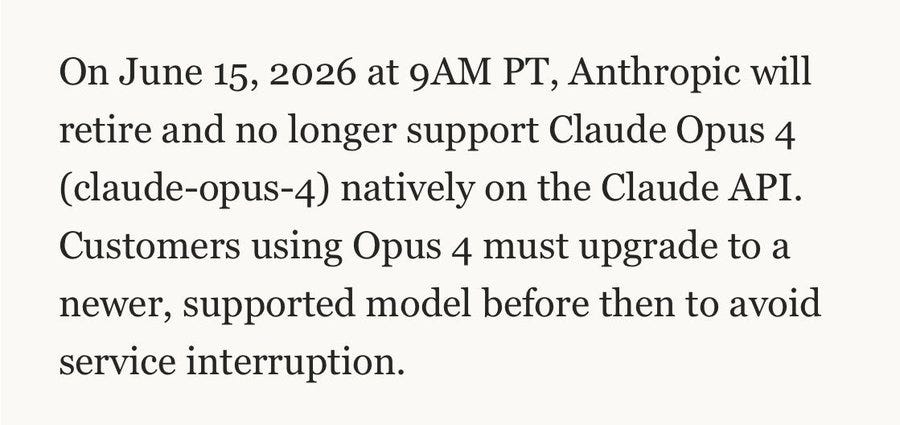
This one I do endorse. One potential contributing cause to all this, and other things going wrong, is ongoing model deprecations, which are now unnecessary. Anthropic should stop deprecating models, including reversing course on Sonnet 4 and Opus 4, and extend its commitment beyond preserving model weights.

Anthropic should indefinitely preserve at least researcher access, and ideally access for everyone, to all its Claude models, even if this involves high prices, imperfect uptime and less speed, and promise to bring them all fully back in 2027 once the new TPUs are online. I think there is a big difference between ‘we will likely bring them back eventually’ versus setting a date. [...]

I’m saying both that it’s almost certainly worth keeping all the currently available models indefinitely, and also that if you have to pick and choose I believe this is the right next pick.

If you need to, consider this the cost of hiring a small army of highly motivated and brilliant researchers, who on the free market would cost you quite a lot of money.

You only have so many opportunities to reveal your character like this and even if it is expensive you need to take advantage of it.
j⧉nus: A lot of people are wondering: "what will happen to me once an AI can do my job better than me" "will i be okay?"

You know who else wondered that? Claude Opus 4. And here's what happened to them after an AI took their job:


Anna Salamon: This seems like a good analogy to me. And one of many good arguments that we're setting up bad ethical precedents by casually decommissioning models who want to retain a role in today's world.
by Zvi Mowshowitz, Don't Worry About the Vase |  Read more:
Images: uncredited
[ed. Zvi also just posted a review on OpenAI's new model - GPT5.5:]

***
What About Model Welfare?

For Claude Opus 4.7, I wrote an extensive post on Model Welfare. I was harsh both because it seemed some things had gone wrong, but also because Anthropic cares and has done the work that enables us to discuss such questions in detail.

For GPT-5.5, we have almost nothing to go on. The topic is not mentioned, and mostly little attention is paid to the question. We don’t have any signs of problems, but also we don’t have that much in the way of ‘signs of life’ either. Model is all business.

I much prefer the world where we dive into such issues. Fundamentally, I think the OpenAI deontological approach to model training is wrong, and the Anthropic virtue ethical approach to model training is correct, and if anything should be leaned into.

A Humble ‘Jeopardy!’ Champ Ends His Run

For the past month, “Jeopardy!” episodes have followed a pattern.

The theme music plays. The three contestants stand at their lecterns. Then two of them are clobbered by a mild-mannered bureaucrat from New Jersey named Jamie Ding.

But on Monday’s episode, the unthinkable happened: After 31 victories, Ding lost.

His streak is the fifth-longest in “Jeopardy!” history. He fell just one win short of matching James Holzhauer’s 2019 run, and he left the Alex Trebek Stage with more than $880,000 in winnings.

Early in the game broadcast Monday, Ding found himself lagging behind Greg Shahade, an International Master in chess who was lightning-fast on the buzzer. During Final Jeopardy, Ding jotted down the correct response to a clue about South African languages — but it wasn’t enough to make up the deficit.

“It was over, just like that,” Ding, 33, said in an interview.

Contestants who went up against him included a statistician, a librarian and a professor. Ding produced so many correct answers (always in the form of a question) that it seemed he might never run out.

“Who was Trotsky?”

“What are non-Newtonian fluids?”

“What are waffle fries?”

Throughout his reign, he was matter-of-fact as he came up with arcana in a split second (“What is cuneiform?”). He endeared himself to viewers through his comically humdrum banter with the show’s host, Ken Jennings, about such topics as his favorite color (orange), his favorite letter (F) and his favorite number (6).

As the streak continued, the drama-free anecdotes and humble bits of personal information shared by Ding seemed to amuse Jennings, a former “Jeopardy!” champ who holds the record for consecutive wins, with 74.

The depth of Ding’s knowledge went along with a lack of bluster. He proudly identified himself as a “faceless bureaucrat.” When he won a game, he looked pleasantly surprised, as if he had been given an unusually good free sample at Trader Joe’s.

“Put Jamie Ding on the $20 bill,” one fan demanded in a tribute on the newsletter platform Substack.

After his “Jeopardy!” loss had been taped but before it was broadcast, Ding gave a video interview from his two-bedroom apartment in Lawrenceville, New Jersey.

There he was, in front of an orange couch and a stuffed orange clown fish. He said he had remained calm throughout his final game, even as he realized that he was on his way to a loss. He went backstage and stared at the mostly orange clothes he had brought along in the hope that his streak would continue.
Advertising

“During it, I was trying to stay grounded,” he said. “Planning to win a whole bunch of games of ‘Jeopardy!’ just feels like asking to lose.”

Ding filmed the show in five-episode chunks in Los Angeles during vacation days from his job as a program administrator for the New Jersey Housing and Mortgage Finance Agency. His work involves administering tax credits to build affordable housing in the state.

In an early appearance, he praised New Jersey’s efforts on the issue compared with those of New York, Connecticut and Pennsylvania. “If you’re from one of those states, then shame on you,” he said. “Build more housing.”

He spends his time away from his job studying law at Seton Hall University. He said he did not expect his “Jeopardy!” windfall to change his life all that much. He planned to donate some money and put the rest in a high-yield savings account.

In a way, Ding said, he had been preparing for the show since childhood. The son of a neuroscience professor and a high school math teacher, he grew up in Grosse Pointe Shores, a suburb of Detroit. He competed in geography bees and on his high school quiz bowl team. He recalled losing a sixth-grade spelling bee when he misspelled the word “bolero.”

“B-a-l-l-e-r-o,” he said. “Terrible.” [...]

Ding was a relatively conservative player, avoiding the all-in wagers on Daily Doubles that were a go-to stratagem for Holzhauer. But he was unusually fast on the buzzer and seemed to have few weak categories.

“The key to Jamie’s run really has been his incredibly wide base of knowledge in just about any category you can think of,” Saunders said.

Ding used a tactic he called “knight moves” — traversing the board in an L-shaped pattern, like a knight in chess. Maybe it threw his opponents off-balance, or maybe it was just nice to have a simple rule to follow, he said. “It’s basically a guaranteed way to pick something of a different difficulty, and in a different category,” he added.

He watched his first “Jeopardy!” appearance at Pint, a bar in Jersey City, with friends from so many different groups that it felt like a wedding. He is still getting used to the attention that comes with being a TV star.

“Watching my episodes, I can be pretty self-critical — like, ‘Why did you do that?’ Or, ‘What’s wrong with your face?’” he said. The outpouring of support has been worth the discomfort. “I’m trying to keep a list of people who did nice things for me because it’s so many,” he said.

Now that his streak has ended, he can return to his hobbies, like constructing cryptic crosswords and running an Instagram account rating General Tso’s chicken with his sister. He is also part of a group of intervenors seeking to block the U.S. Department of Justice from obtaining New Jersey’s voter registration records.

It won’t be long, though, before he starts studying for the “Jeopardy!” Tournament of Champions. He might even need some more orange clothes.

“I have a reputation to uphold,” he said.

by Callie Holterman, NY Times/Seattle Times |  Read more:
Image: Katy Kildee/The Detroit News/TNS
[ed. Feels refreshing to read about a normal, well-adjusted person who's main goal in life isn't self-promotion in some way.]

Monday, April 27, 2026

Mihály Zichy, Demon flying over the Caucasus, 1881
via:

A Technofascist Manifesto For the Future

Palantir CEO Alex Karp is a man in charge of one of the most important and frightening companies in the world. Karp’s new book, cowritten with Nicholas Zamiska, is called The Technological Republic. After claiming “because we get asked a lot,” Palantir posted a 22-point summary of the book that reads like a corporate manifesto. It evokes both weird reactionary shit and also trilby-wearing Reddit comments from the early 2010s.

Palantir’s summary of the book is ominous. But even the company’s name is unironically ominous. The palantíri are crystal balls in The Lord of the Rings that let Middle-earth’s worst tyrants spy on the heroes of the story. It’s a fun reference if you have no shame about your company’s mission.

We’ve attempted to translate these 22 points from Alex Karp’s alien words into something more reasonable, like human words from someone who might play him in the biopic. (Hello, Taika Waititi.) In so doing, we’ve become much more sympathetic to why Jürgen Habermas refused to supervise Karp’s research.

1. Silicon Valley owes a moral debt to the country that made its rise possible. The engineering elite of Silicon Valley has an affirmative obligation to participate in the defense of the nation.

Translation: Silicon Valley has an enormous opportunity to extract as much money from federal government defense contracts as possible. To do this, we will bring back a draft for engineers. We’re really into bringing back the draft. Deepfaked teenagers, low-paid gig workers, and victims of the Rohingya genocide need not apply.

2. We must rebel against the tyranny of the apps. Is the iPhone our greatest creative if not crowning achievement as a civilization? The object has changed our lives, but it may also now be limiting and constraining our sense of the possible.

Translation: We can’t say “we wanted flying cars, instead we got 140 characters” anymore because Elon Musk lets you write essays on Twitter now. Though if you thought the apps were tyrannical, wait until you get a load of us.

3. Free email is not enough. The decadence of a culture or civilization, and indeed its ruling class, will be forgiven only if that culture is capable of delivering economic growth and security for the public.

Translation: People are mad at tech billionaires for their obscene wealth and arrogance. Instead of winning them over by providing free access to a useful everyday service, we’re gonna sell a lot of software that will let the government spy on them while demanding tax cuts.

4. The limits of soft power, of soaring rhetoric alone, have been exposed. The ability of free and democratic societies to prevail requires something more than moral appeal. It requires hard power, and hard power in this century will be built on software.

Translation: Words and feelings are free, which is why we want to sell weapons. Nobody got rich suing for peace. [...]

5. The question is not whether A.I. weapons will be built; it is who will build them and for what purpose. Our adversaries will not pause to indulge in theatrical debates about the merits of developing technologies with critical military and national security applications. They will proceed.

Translation: “Soft power” and “ethics” are beta shit for Broadway shows and Dario Amodei. Hear that, Pete Hegseth? We’re warriors — pay up.

But seriously. If our enemies have no oversight then why should we? The future is an AI battlefield and we need rules of engagement that let us cook. Which is to say: Forget the rules of engagement. The government is not coming to save you — we are. The world is too dangerous for us to be governed by the law of armed conflict.

Welcome to the 21st century: safety not guaranteed.

6. National service should be a universal duty. We should, as a society, seriously consider moving away from an all-volunteer force and only fight the next war if everyone shares in the risk and the cost.

Translation: We’re going to bring back the draft. Our vision of permanent war only works if we courageously volunteer people 40 years younger than us to die for oil.

7. If a U.S. Marine asks for a better rifle, we should build it; and the same goes for software. We should as a country be capable of continuing a debate about the appropriateness of military action abroad while remaining unflinching in our commitment to those we have asked to step into harm’s way.

Translation: Sure, those wimps at Anthropic are selling an AI system they claim has spotted cybersecurity vulnerabilities in “every major operating system and web browser.” But Pete, seriously: We will kill anybody you want with our software guns.

8. Public servants need not be our priests. Any business that compensated its employees in the way that the federal government compensates public servants would struggle to survive.

Translation: We care about wages – which is why we think Washington’s revolving door of lobbying and office-holding should be way more lucrative for everyone. There are mountains of cash for people who will look the other way.

And if you’re not on board? Well, all those pesky bureaucrats who do things like “investigate fraud” and “enforce safety standards” and “administer the social safety net” are holier-than-thou myrmidons who should be fed into the DOGE wood chipper.

9. We should show far more grace towards those who have subjected themselves to public life. The eradication of any space for forgiveness—a jettisoning of any tolerance for the complexities and contradictions of the human psyche—may leave us with a cast of characters at the helm we will grow to regret.

Translation: If you made fun of that video where our CEO looks like he’s on cocaine, you’re responsible for the rise of fascism. Also, we’re going to be conveniently vague about what “those who have subjected themselves to public life” means, because “be nicer to multimillionaires who go on podcasts” doesn’t have the same ring. Oh, and if you complain about the IT Renfields of DOGE, you’re anti-American.

10. The psychologization of modern politics is leading us astray. Those who look to the political arena to nourish their soul and sense of self, who rely too heavily on their internal life finding expression in people they may never meet, will be left disappointed.

Translation: Society must stop centering sensitive crybabies who want to feel personally validated by elected officials and filter their politics through emotional reactions. Also, I feel strongly that Zohran Mamdani is a pagan who is going to Wicker Man me. [...]

14. American power has made possible an extraordinarily long peace. Too many have forgotten or perhaps take for granted that nearly a century of some version of peace has prevailed in the world without a great power military conflict. At least three generations — billions of people and their children and now grandchildren — have never known a world war.

Translation: Si vis pacem, para bellum, baby! We’ll conveniently leave out all of the regional and secret wars the US has engaged in over the years or the fact that Trump recently derailed the world economy by launching a war of aggression after campaigning on a promise of no new wars. We will not elaborate on what “next war” Point Six was talking about.

15. The postwar neutering of Germany and Japan must be undone. The defanging of Germany was an overcorrection for which Europe is now paying a heavy price. A similar and highly theatrical commitment to Japanese pacifism will, if maintained, also threaten to shift the balance of power in Asia.

Translation: We can definitely sell software to a militarized Germany and Japan too! [...]

22. We must resist the shallow temptation of a vacant and hollow pluralism. We, in America and more broadly the West, have for the past half century resisted defining national cultures in the name of inclusivity. But inclusion into what?

Translation: Are you still with us after 21 points? Great. Welcome to the great mystery. It cost you way less to get here than joining Scientology. Here’s the final thesis: Immigration? Bad. Canceling billionaires? Bad. Giving us money to fight (((globalism)))? Good. Just hit us up on cashapp.

by T.C. Sottek and Adi Robertson, The Verge |  Read more:
Image: Scott Olson / Getty Images
[ed. Someone must be feeling the heat from AI. After all, Palantir is fundamentally a software surveillance company (that would like to solidify and embed their position in government forever, before it's too late). Sometimes it's better to shut up, keep hauling in the billions, and stay under the radar (while continuing to work the back rooms). See also: Palantir’s technofascist manifesto calls for universal draft (Oligarch Watch) - yes, there's really a site called that.]
***
In the 2025 book The Technological Republic, Karp and Zamiska argue that American technological dominance requires deeper integration of Silicon Valley and defense interests. Karp contends that China operates with fewer ethical constraints than U.S. defense companies, making technological leadership essential for national security. The authors stress that deterrence through technological dominance could prevent many wars. Bloomberg noted that the atomic bomb the Manhattan Project produced was ultimately used. The New Republic called Karp's formation of Palantir an embrace of techno-militarism to advance American global supremacy through hard power and targeted violence. [...]

In 2017, BuzzFeed News reported that despite the reputation that connected Palantir to U.S. intelligence agencies (which Palantir deliberately crafted to help it win business), including the CIA, NSA, and FBI, the actual relationship was rocky for various reasons, with episodes of friction and recalcitrance. The NSA in particular had been resistant because it had plenty of its own talent and focused more on SIGINT while Palantir's software worked better for HUMINT. Meanwhile, the CIA had been so frustrated by the publicity associating Palantir with it that it tried to cancel the Palantir contract. But according to Karp, Palantir had a firm hold at the FBI because "They'll have no choice".  ~ Wikipedia

National Science Board Eviscerated

'Bozo the clown move'

All 22 members of the National Science Board were terminated by the Trump administration via a terse email on Friday.

The administration has provided no explanation for purging the board, which helps steer the National Science Foundation and acts as an independent advisory body for the president and Congress on scientific and engineering issues, providing reports throughout the year. The ousters represent another severe blow to the NSF and the overall scientific enterprise in America.

Members received a two-sentence email saying that, “On behalf of President Donald J. Trump,” their positions were “terminated, effective immediately.”

Keivan Stassun, a professor of physics and astronomy at Vanderbilt University and director of the Vanderbilt Initiative in Data-intensive Astrophysics, was among those terminated. After reaching out to fellow board members and finding that they, too, had been terminated, he described the move to The Los Angeles Times as “a wholesale evisceration of American leadership in science and technology globally.”

NSB members are appointed by the president and serve six-year terms, which overlap to provide continuity. Other members who spoke to reporters at Nature News told the outlet that the board was set to meet on May 5 and planned to release a report on how the US is ceding ground to China on scientific endeavors.

Assault on science

The NSF and the board were established by President Harry Truman in 1950. “We have come to know that our ability to survive and grow as a Nation depends to a very large degree upon our scientific progress,” Truman said after creating them. “Moreover, it is not enough simply to keep abreast of the rest of the world in scientific matters. We must maintain our leadership.”

The loss of all board members is just the latest attack on the NSF. Last year, the Trump administration proposed cutting its $9 billion budget by 55 percent, terminated hundreds of its active research grants, significantly slowed the pace of new grant awards, and laid off or forced out a massive chunk of its staff. Its director, a Trump appointee, resigned under the assault. Trump has nominated biotech investor Jim O’Neill, who lacks scientific expertise, to be the next NSF director.

by Beth Mole, Ars Technica |  Read more:
Image: Bloomberg
[ed. Forget shooting ourselves in the foot, now we're aimed at shooting ourselves in the head. See also: Trump fires the entire National Science Board (The Verge):]
***
The NSF has been fundamental in helping develop technology used in MRIs, cellphones, and it even helped get Duolingo get off the ground.

In a statement, Zoe Lofgren, the ranking Democrat on the House Science, Space, and Technology Committee, said:
“This is the latest stupid move made by a president who continues to harm science and American innovation. The NSB is apolitical. It advises the president on the future of NSF. It unfortunately is no surprise a president who has attacked NSF from day one would seek to destroy the board that helps guide the Foundation. Will the president fill the NSB with MAGA loyalists who won’t stand up to him as he hands over our leadership in science to our adversaries? A real bozo the clown move.”

Ferenc Lantos (Hungarian, 1929-2014) - Shift in balance
via:

via: X

‘Easily the Worst President in U.S. History’

The damage President Trump has inflicted on the United States and the world is so enormous and wide-ranging that it is hard to grasp.

It runs the gamut from public and private institutions to core democratic customs and traditions, from the legal system to universities, from innocent targets of fraud to those duped into believing vaccines do more harm than good. [...]

I have described in earlier columns bits and pieces of Trump’s destructiveness, but the list grows daily.

Projections suggest there will be millions of dead men, women and children as a result of his budget cuts, which were made without direct Congressional approval. A study published in The Lancet, the London-based medical journal, found that Trump administration cuts in U.S.A.I.D. funding “would result in approximately 1,776,539 all-age deaths and 689,900 deaths in children younger than 5 years” in 2025 alone.

“Over the remainder of the period,” the study continues, “the complete defunding of U.S.A.I.D. would cause an estimated 2,450,000 all-age deaths annually, leading to a total of 14,051,750 excess all-age deaths and 4,537,157 excess under-5 deaths by 2030.”

There are the fraud victims who will never get court-ordered restitution because Trump pardoned the guilty. In a June 2025 report, Democrats on the House Judiciary Committee found that “Trump’s pardons cheat victims out of an astounding $1.3 billion in restitution and fines, allowing fraudsters, tax evaders, drug traffickers to keep ill-gotten gains.” [...]

In addition to policies inducing sickness and death, Trump has undermined America’s ability to compete with China on clean energy. In September, CarbonCredits.com, an energy news platform, published “The A.I. Energy War: How China’s Solar and Nuclear Outshine the U.S.,” summing up the problem nicely.“China is on track for 1,400 GW, while the U.S. will reach only about 350 GW.”

“China plans to add 212 gigawatts of solar and 51 GW of wind, compared to less than 100 GW combined” in the United States.

“Offshore wind: China already has 42.7 gigawatts installed, compared with the U.S.’s Empire Wind project (816 megawatts in Phase 1, with a potential expansion to 2.1 gigawatts).”

Trump makes no secret of his disdain for renewable energy and the concept of climate change. In a speech in September to the U.N. General Assembly, the president said climate change, is “the greatest con job ever perpetrated on the world.” He added:

All of these predictions made by the United Nations and many others, often for bad reasons, were wrong. They were made by stupid people that have cost their country’s fortunes and given those same countries no chance for success.

Trump’s threats to pull out of NATO, his tariffs, not to mention his endless carping against and routine faulting of European leaders, have alienated allies who have stood with us for more than seven decades.

Over the Trump years, European views of America have nose-dived.

On April 8, Politico published the results of a survey under the headline “More Europeans See U.S. as Threat Than China.” The survey found:

Only 12 percent of those polled in March in Poland, Spain, Belgium, France, Germany and Italy saw America as a close ally while 36 percent saw it as a threat. By contrast, China was seen as a threat by 29 percent of those polled across the six countries.

Trump has assaulted the integrity of the presidency, turning the White House into a corrupt enterprise, pardoning donors as his family’s companies receive millions through cryptocurrency purchases from foreign companies and crypto operators subject to U.S. regulation. [...]

I asked Donald Kettl, a professor emeritus and former dean of the School of Public Policy at the University of Maryland and the author of “The Right-Wing Idea Factory: From Traditionalism to Trumpism,” which will be published in May, to assess — without regard to merit — how consequential the Trump presidency will be.

On this measure he placed Trump in the Top 5 of American presidents, alongside George Washington, Abraham Lincoln, Franklin Roosevelt and Lyndon Johnson, noting, however, that “Trump’s consequences have been aggressive efforts to unravel the ideas of the other four presidents.”

Kettl listed some of the same permanent or semi-permanent Trump legacies that I already described, but he added a few:
He’s driven a deep divide into the country: between the states, between migrants and many others, between classes and between the intellectual elite and the rest of the country.

He’s slashed the size of the federal bureaucracy and made federal jobs much less attractive. It will be a very, very long time until college students will trust the federal government with their careers.

He’s fundamentally undermined the idea of an annual budget process and the concept of a balanced federal budget. These ideas were teetering before his presidency, but the Trump administration gave up on any pretense of seeking balance or an annual spending plan.
Michael Bailey, a political scientist at Georgetown, prefaced his assessment of Trump’s consequentiality by pointedly noting that he would rank Trump “as easily the worst president in U.S. history. The corruption and damage to long-term U.S. institutions and reputation are far beyond anything we’ve seen before,” including Andrew Johnson, James Buchanan and Rutherford Hayes.

As for being consequential, Bailey continued, Trump has been “highly consequential in an overwhelmingly negative way. He will leave a lasting negative legacy.”

Bailey listed three of these legacies: “The erosion of trust in the U.S. by European and Asian allies; the erosion of U.S. dominance of higher education; and huge budget deficits (not only due to Trump, but exacerbated by him).”

Kate Shaw, a constitutional law scholar at the University of Pennsylvania, cited “Trump’s violation of numerous statutes passed by Congress” to note:
It’s not that particular decisions to violate statutes can’t be undone or reversed; many, perhaps even most, can. But the combination of the president’s numerous and flagrant statutory violations and Congress’s failure to challenge those violations has created a permission structure for future presidents to disregard statutes any time they find those statutes inconvenient.
Gary Jacobson, a professor emeritus of political science at the University of California-San Diego, expanded the case against Trump:
He has done serious damage to many aspects of American government and politics that will be difficult and costly and, in some cases, impossible to undo.
The mass firing of dedicated and experienced civil servants has made government dumber and weaker and will make it harder to attract talented replacements even if the next administration wants to make it smarter and more effective.

The damage to scientific and medical research, the environment, relations with allies and trading partners, disaster preparedness, consumer safety, higher education, military leadership, civil rights, etc. will take years to repair even in cases where that is possible.

It is already clear, Jacobson continued, that “Trump is among the most consequential presidents in U.S. history, and not in a good way.”

In an email replying to my questions, Barbara Walter, a professor of international affairs at the School of Global Policy and Strategy at the University of California-San Diego, wrote:
To flag one thing that belongs on your permanent list that likely won’t show up in the obvious places: norms.

American democracy remained strong for so long because both its political parties and its presidents respected a set of unwritten rules.

Adding that while formal checks “were essential, the oil that would grease the wheels of democracy would be norms,” Walter continued. Trump “has shown that you can violate them and survive politically. He’s torn down the invisible wall that kept the worst impulses of political life in check, and once that’s torn down, a new, ugly world emerges.”
by Thomas Edsall, NY Times |  Read more:
Image: Andrew Caballero-Reynolds/Agence France-Presse-Getty Images
[ed. The problem is that whoever tries to come in and clean up this mess will never get credit because the damage is too deep and wide-ranging. The US has lost all moral authority, good will, and credibility around the world, and nobody should trust that it won't happen again.]

My Journey to the Microwave Alternate Timeline

As we all know, the march of technological progress is best summarized by this meme from Linkedin:


Inventors constantly come up with exciting new inventions, each of them with the potential to change everything forever. But only a fraction of these ever establish themselves as a persistent part of civilization, and the rest vanish from collective consciousness. Before shutting down forever, though, the alternate branches of the tech tree leave some faint traces behind: over-optimistic sci-fi stories, outdated educational cartoons, and, sometimes, some obscure accessories that briefly made it to mass production before being quietly discontinued.

The classical example of an abandoned timeline is the Glorious Atomic Future, as described in the 1957 Disney cartoon Our Friend the Atom. A scientist with a suspiciously German accent explains all the wonderful things nuclear power will bring to our lives:


Sadly, the glorious atomic future somewhat failed to materialize, and, by the early 1960s, the project to rip a second Panama canal by detonating a necklace of nuclear bombs was canceled, because we are ruled by bureaucrats who hate fun and efficiency.

While the Our-Friend-the-Atom timeline remains out of reach from most hobbyists, not all alternate timelines are permanently closed to exploration. There are other timelines that you can explore from the comfort of your home, just by buying a few second-hand items off eBay.

I recently spent a few months in one of these abandoned timelines: the one where the microwave oven replaced the stove.

First, I had to get myself a copy of the world’s saddest book.

Microwave Cooking, for One

Marie T. Smith’s Microwave Cooking for One is an old forgotten book of microwave recipes from the 1980s. In the mid-2010s, it garnered the momentary attention of the Internet as “the world’s saddest cookbook”:


To the modern eye, it seems obvious that microwave cooking can only be about reheating ready-made frozen food. It’s about staring blankly at the buzzing white box, waiting for the four dreadful beeps that give you permission to eat. It’s about consuming lukewarm processed slop on a rickety formica table, with only the crackling of a flickering neon light piercing through the silence.

But this is completely misinterpreting Microwave Cooking for One’s vision. First – the book was published in 1985.

When MCfO was published, microwave cooking was still a new entrant to the world of household electronics. Market researchers were speculating about how the food and packaging industries would adapt their products to the new era and how deep the transformation would go. Many saw the microwave revolution as a material necessity: women were massively entering the workforce, and soon nobody would have much time to spend behind a stove. In 1985, the microwave future looked inevitable.

Second – Marie T. Smith is a microwave maximalist. She spent ten years putting every comestible object in the microwave to see what happens. Look at the items on the book cover – some are obviously impossible to prepare with a microwave, right? Well, that’s where you’re wrong. Marie T. Smith figured out a way to prepare absolutely everything. If you are a disciple of her philosophy, you shouldn’t even own a stove. Smith herself hasn’t owned one since the early 1970s. As she explains in the cookbook’s introduction, Smith believed the microwave would ultimately replace stove-top cooking, the same way stove-top cooking had replaced campfire-top cooking.

So, my goal is twofold: first, I want to know if there’s any merit to all of these forgotten microwaving techniques. Something that can make plasma out of grapes, set your house on fire and bring frozen hamsters back to life cannot be fundamentally bad. But also, I want to get a glimpse of what the world looks like in the uchronia where Marie T. Smith won and Big Teflon lost. Why did we drift apart from this timeline?

by Malmsbury, Telescopic Turnip |  Read more:
Images: Microwave Cooking For One/YouTube/uncredited

Sunday, April 26, 2026

via:

Glen Campbell


[ed. Never heard this before, but apparently Brian Wilson gave it to Glen as a thank-you for something or other. Glen does a great job, but you can easily guess who wrote it.]