Thursday, May 7, 2026

Iran: The Second Amendment Solution

[ed. Not the Onion.]

US President Donald Trump should send large amounts of weapons to Iranian civilians in order to spark a civil war in the country, Senator Lindsey Graham, one of the biggest cheerleaders of the US-Israeli war on Iran, has suggested.

Speaking to Fox News host Sean Hannity on Monday, the South Carolina war hawk Republican framed the proposal as a “Second Amendment solution” for the Islamic Republic and an alternative to deploying American ground troops.
 
“If I were President Trump and I were Israel, I would load the Iranian people up with weapons so they can go to the streets armed and turn the tide of battle inside Iran,” Graham said.

Hannity noted in the interview that Washington had already tried this approach in the past. Last month, Trump confirmed that the US had sent “a lot” of firearms to Iranian protesters during the nationwide unrest that erupted in late 2025. However, the guns were supposedly stolen, according to Trump, and Washington’s efforts to spark regime change in the country have consistently failed, even after assassinating Supreme Leader Ayatollah Ali Khamenei in February.

“Do it again,” Graham demanded, adding that “I love the idea of empowering the Iranian people with weapons.” He further fantasized that the plan would make life “hell” for the Islamic Revolutionary Guard Corps (IRGC) and that “it’s one thing to be bombed by America. It’s another thing to have your neighbor shoot back at you.”

The South Carolina senator’s latest call to orchestrate mass social unrest within the Islamic Republic comes after years of him advocating the destruction of Iran’s government, demanding that the US military “destroy the air force, sink their navy,” urging not to “underrate killing them all,” and calling for the country to be blown “off the map.”

by RT Media |  Read more:
Image: Fox "News"
[ed. Wow, that's some awesome "outside the box" thinking: arm your enemies to win! America's number one war-mongering, chickenhawk (close race with you know who) is giving that one last brain cell a workout. Here's the full text (via RCP):]
***
SENATOR LINDSEY GRAHAM: I love the idea of a Second Amendment solution for the Iranian people. To those who want to eliminate the Second Amendment in our country — no way. What did the Founding Fathers do? When they got to America, free from the King, they made sure the people would be able to be armed.

The first thing a king does is take guns away from his subjects. The first thing a religious theocracy does is make sure nobody can have a gun to threaten the regime.

If I were President Trump and Israel, I would load the Iranian people up with weapons so they can go to the streets armed and turn the tide of battle inside Iran. We don't need American boots on the ground. We've got millions of boots on the ground in Iran — they just don't have any weapons. Give them the weapons so they can rise up like we did and destroy this regime. A Second Amendment solution, I think, would go a long way to ending this war. If we can take control of the Strait, checkmate.

SEAN HANNITY: Okay. My understanding is there have been attempts to do so and they tried to funnel it through groups. My understanding is, for example, the Kurds were stealing 90% of the weapons.

SENATOR LINDSEY GRAHAM: Don't work with the Kurds. Work with somebody else. If you can prove to me the Kurds were stealing the weapons, the Kurds will regret that. I love the idea of empowering the Iranian people with weapons — a Second Amendment solution to make the Revolutionary Guard's life hell. It's one thing to be bombed by America. It's another thing to have your neighbor shoot back at you because they're tired of being slaughtered.

Number two, the Strait of Hormuz is the only thing left. This has been a brilliant campaign by President Trump and our military. The nuclear program of Iran has been destroyed. Their ability to spread terrorism has been destroyed because they're on their knees economically. If we can take back control of the Strait of Hormuz, it is checkmate. This thing is over.

For the American people — I know gas prices are high and I know we're suffering right now. But you pay now or you pay later against thugs like Iran. They tried to get a nuclear weapon. If you don't believe that, you shouldn't be allowed to drive in your hometown. Donald Trump stopped Iran from having eight to ten nuclear weapons by bombing their enrichment facilities. God bless you, President Trump. We were weeks away from a nuclear-armed Iran. No more. Everything has been obliterated. Their economy is in tatters. Their military has been decimated. There's more to do. If we can control the Strait — checkmate against Iran. Blockade plus. Arm the people. And to our allies throughout the world who depend on the Strait of Hormuz more than we do: get off your ass and help us.

via:

Ted Turner, Cable TV Visionary Dies at 87

Ted Turner, a mercurial tycoon and gadfly visionary whose “superstation” TBS was a cornerstone of cable TV’s early success, whose 24-hour news channel CNN revolutionized TV journalism, and whose sprawling legacy encompassed conservation, philanthropy and professional sports, died Wednesday at his home near Tallahassee. He was 87.

His death was confirmed by Phillip Evans, a spokesman for Turner Enterprises. Mr. Turner revealed in 2018 that he had Lewy body dementia, a progressive brain disorder.

A serial entrepreneur known as “the Mouth of the South” for his bellicosity and bravado, Mr. Turner took over his family’s Georgia-based billboard company at 24, after his father’s suicide, and transformed the business into a media juggernaut that would forever alter broadcasting.

“CNN really heralds the world of Twitter and social networks and interactivity,” said Ken Auletta, a Turner biographer and media writer for the New Yorker. “During the Persian Gulf War, you had a live war for the first time, without commercial breaks. You’d see bombs dropping and people screaming and fire engines roaring. Everything is immediate. It’s the world we live in today. He’s the father of that world.”

Mr. Turner’s achievements transcended journalism and business, and his much-publicized personality — charming, vulgar, daring, impulsive, idealistic, titanically self-regarding — made him one of the most captivating public figures of his generation.

He presented himself as a Southern gentleman. But he also boasted of being a Ferrari in the bedroom, and with his incessant philandering, he burned through three marriages, including his last, to actress Jane Fonda.

The billionaire Mr. Turner championed a world free of conflict but was on friendly terms with dictators and despots, including Saddam Hussein and Vladi­mir Putin. A Goldwater Republican turned unabashed liberal, he had friends running the political gamut — from former President Jimmy Carter to Sen. Jesse Helms (R-North Carolina), from televangelist Jerry Falwell to communist Cuban leader Fidel Castro, who became a duck-hunting companion.

On his cable channels TBS and TNT, Mr. Turner delivered wholesome family fare, including sports and black-and-white reruns. But in his prime, he was a self-confessed absentee husband and father, with family below business and sailing on his list of priorities.

As skipper of the yacht Courageous in 1977, Mr. Turner won the America’s Cup, sailing’s most prestigious trophy. He also brought his competitive drive to ownership of the Atlanta Braves, the long-hapless baseball team he bought in 1976. The team rewarded his vigorous support and patience with a World Series victory in 1995 over the Cleveland Indians.

His interests and ambitions seemingly boundless, Mr. Turner became one of the largest private landowners in the Western Hemisphere, and he used his more than 2 million acres, from Montana to Argentina, to preserve endangered flora and fauna. He underwrote foundations that campaigned against nuclear arms proliferation and for such causes as population control, solar energy and debt forgiveness for developing countries.

In 1986, he created the Goodwill Games to foster brotherhood among athletes after the two world superpowers — the United States and Soviet Union — traded boycotts of the Summer Olympics in Moscow (1980) and Los Angeles (1984) during a surge in Cold War tensions. He lavished hundreds of millions of dollars on the venture before it was shuttered in 2001 because of low television ratings.

Years before Microsoft co-founder Bill Gates rose to the top of world philanthropy, Mr. Turner donated $1 billion to start a foundation to support United Nations projects in developing countries.

In business, as in all his undertakings, Mr. Turner cultivated a renegade persona. The bad boy yachtsman, who galled the elite gatekeepers of sailing in New York and Newport, Rhode Island, was also the Atlanta David battling the media Goliaths of New York. “I was cable,” he once quipped, “when cable wasn’t cool.”

Mr. Turner thrived on the role of buccaneer, and he looked the part with his rugged 6-foot-3 frame, square jaw, cleft chin and tidy mustache. A cigar, a beer can and a quip were ever at the ready. “If I only had a little humility,” he once joked in his booming Southern drawl, “I’d be perfect.” [...]

“Ted is a complicated guy, but he is part genius,” Fay Vincent, the former baseball commissioner, told The New York Times in 2001. “Ted doesn’t mean the harm he causes; he just cannot shut up.”

by Adam Bernstein, Washington Post/Seattle Times |  Read more:
Images:Michael Williamson/Craig Herndon/Washington Post
[ed. What a life. And he married Jane Fonda, too.]

Dr. Bobby

Bobby Wagner, former Seahawks star, earns honorary doctorate from Utah State.

Former Seahawk Bobby Wagner … oops. Former Seahawk Dr. Bobby Wagner had to crack a few jokes when he took the stage at Utah State University’s graduation last week.

Wagner, who played for the Seahawks from 2012 to 2021 and again in 2023, returned to his alma mater on April 29 as the commencement speaker. During the ceremony, Wagner received an honorary doctoral degree from Utah State.

“If you didn’t know, my name is now Dr. Bobby Wagner,” Wagner said. “And to any family members here, you need to update my name in your phone. It’s ‘Dr.’ now. I will no longer respond to ‘Bobby.’ It’s Dr. only.”

The honorary doctorate adds to a long list of accolades that Wagner has collected throughout his career. In addition to his Super Bowl win with the Seahawks, he is a 10-time Pro Bowler and six-time All-Pro. Wagner also was named the 2025 Walter Payton NFL Man of the Year.

Wagner’s jokes were on display when he accepted that award, too.

“I really didn’t think I was going to win this award,” Wagner said on stage after learning he won the Walter Payton award. “I almost didn’t even come to be honest. I’m glad I did.”

While accepting that honor back in February, Wagner delivered a speech that balanced humor with thoughtful reflection and gratitude for his mother who died of stroke complications when Wagner was a student athlete at Utah State.

Speaking to a crowd of more than 6,000 graduates in late April, Wagner joked about how lucky the graduating class was to have a Target in town, a luxury that wasn’t around during his time, before telling the story of how he ended up at Utah state.

He recalled a winter visit he made to the university with his mother. On the trip, he was offered a scholarship and despite having no other scholarship offers, Wagner told his mother he wanted to take his chances.

“She told me I either accept the scholarship, or I wasn’t coming back home,” Wagner said standing at the podium. “Back then there was no Ubers. There was no NIL. I wasn’t getting paid. So, I accepted the scholarship.”

“One of the things that taught me was the place you least expect to be is the place you’re exactly supposed to be,” Wagner said.

Wagner went on to be a four-year starter at Utah State, leading the program to their first bowl game in 14 years. He tied the school record with 446 career tackles and earned various other individual honors.

After graduating, Wagner was selected by the Seahawks in the second round of the 2012 draft.

The linebacker’s speech continued on, talking about the importance of building connections and going after personal goals. In addition to his NFL career, Wagner has various off-field pursuits including the Phenia Mae Fund and FAST54 that promote stroke education in honor of his mother. Wagner also recently earned his MBA from the Howard University School of Business.

Wagner’s 15-minute speech was threaded with jokes, including some well received trash talk.

“It’s fun to be able to talk trash to every other school, like I tell them, ‘I don’t know, Stanford’s cool, but it’s not Utah State,’ you know what I mean?” Wagner said.

by Sofia Schwarzwalder, Seattle Times | Read more:
Image: Dean Rutz/Seattle Times
[ed. Dr. Bobby. Blessed with class and talent. Seattle's been lucky. We've had Ichiro, too.]

Wednesday, May 6, 2026

Doomers in Love

Last February, a group of young conservatives in Washington hosted an open-invitation Valentine’s Day debate party. There, a month after the inauguration, dozens of young men in or around Trump’s new administration gathered to discuss not the great man in the White House, not political revolution, but love.

This is an era of good feelings for these young men, and the theme would seem to reflect the mood. It is also promisingly uncontroversial, and thus more welcoming: more women have come to this event than most conservative mixers, raising their average attendance from the single digits to tentative double digits. For a generation of young men increasingly politically divorced from women their age, who make up the most anti-GOP and anti-Trump demographic, the idea that love could overcome any obstacle is a hopeful premise.

But in the debate that ensues, nearly every speech is against romance. The arguments detail the dangers of infatuation, and amid the laudations of reason over passion, logic over love, are explicit and implicit warnings against being a “simp” or a “sucker.” Some wonder aloud whether one should ask out women at all, who, in the age of dating apps, receive far too much male attention, and as a result have become too picky, exacting and fickle. Eventually, a quip about women’s suffrage comes from the audience, prompting a jocular back-and-forth. I ask a friend why they are suddenly discussing whether women should vote. He looks at me and sighs. “Women’s suffrage always comes up.” By night’s end, almost nobody has asked out any of the women present in the room; the only man who ventures to do so is summarily rejected.

Afterwards, at a nearby bar, I find again a lot of single young men talking about women, rather than to women. One tells me that his friend, who is not here tonight, recently found a girlfriend: “I’m really happy for him. But now he texts our group chat advice, acting like he’s got the key to life, like he’s got it all figured out. And sometimes I’m not sure what to talk about with him anymore. We used to bond over not having a girl.” I think of my own “girlfriends,” who’ve told me to break up with previous boyfriends over their greater or lesser faults, imploring me to think of “how fun it would be to be single together.”

In another corner of the bar, I encounter a group of three twentysomething young men. The young, right-leaning women who had shown up hopeful have gone home. These men are now here alone on a Saturday night, in hour one of a five-hour debate about the nature of love. They are lonely experts, armed with elaborate theories of the female mind. The discussants go around in circles for hours, discussing what men truly want, what women truly want. Theses abound: “Men want respect; women want to be desired”; “Men are easily satisfied, but women are always afraid of making the wrong choice and not maximizing their options”; “Men are the only true romantics.” And questions remain: How many past sexual partners is too many? How many is too few? Does she need to share your interests, or is femininity more important than intellectual compatibility? Is it a red flag if she’s unmarried after 25? Is it a red flag if she’s single? What if we just assigned girlfriends and boyfriends randomly, wouldn’t they be happier than if we let them choose?

These single men talk amongst themselves about how many kids they want, out of an earnest aspiration but also, at times, as if in competition to prove their traditional virility. It is easier to talk about wanting ten kids while unattached and 24 than to raise ten kids with one’s wife, but tonight the effect is the same: here, you are based. One asks me how many I want. “I don’t know yet; I have to find someone first. Three, four?” He gives me a look. “Those are liberal numbers.”

A few weeks later I attend another party in similar circles. It is almost midnight, ten minutes until my 27th birthday. I want to go home. As I walk out I encounter two young men, staffers in Trump’s administration, talking on the sidewalk in their suits and loosened ties, smoking cigarettes. Hesitantly, I say hello. I am exhausted by the theories I’ve heard over the last few weeks about women’s virtues and faults and nearly wince, expecting more to come. Behind me, I recognize two college-aged guys from recent media exposés; they work for DOGE and are evaluating some absent girl’s Instagram page.

I exchange a few pleasantries and introductions with the two men in front of me instead. Midway through the conversation, I mention that I ought to go home soon, but a friend walks past and wishes me a happy birthday. One of my new acquaintances walks abruptly toward a flowering dogwood tree, picks a flower from a branch, and comes back to present it to me without a word. I hold it in my hand, shy and elated. The DOGE boys call him a simp.

One thing I and other young women in D.C. have observed since the election is a shift in how young men speak to and appraise us. Passing through conservative mixers, parties and young-professional networks in Trump’s Washington, we’ve increasingly felt like we’re working against an assumption that women are tainted and guilty until proven otherwise. “Among all the young men I’ve met on the right, especially on the far right, I would guess that 10 to 20 percent of them hate all women,” my acquaintance Oliver, someone familiar with these circles, tells me somewhat sarcastically. I share Oliver’s estimate with a twentysomething right-wing influencer. He widens his eyes and laughs, but concedes there’s truth to it. “Look, lots of these guys, they just consider you less reliable if you talk to women. You’re compromised, in a real way.”

I later tell Jake,* the Trump staffer who picked me the flower, about the statistic. He is a former fraternity president and hardly uses X. He looks bewildered. “Where do you find these guys?” He shakes his head. “Whoever they are, they don’t talk to me.” Jake seems to be as-yet uncontaminated by the culture on the right that views women as saboteurs of right-wing ideological purity and hen-pecking nuisances to be avoided. He suggests to me that, as a 27-year-old, he’s already older than the demographic that received their intellectual and social formation online. His romantic imagination was shaped more by fraternity mixers and reading physical books. Jake quotes Gerard Manley Hopkins and Goethe’s Faust, revealing a talent I suspect will bode better for his own fertility than that of the young men studying tweets about female fertility.

The three of us meet again for drinks, and the other young staffer I met on my birthday, James,* offers his own explanation for his peers: “My working thesis is that all of these stupid, these ridiculous rules—they come from a sense of anxiety. People feel very anxious that the normal rules have broken down.” He references not just the disappearance of in-person dating scripts, or our confusion about gender roles, but the widespread anxiety around expressing desire toward women, even verbally approaching women without clear permission, in the wake of #MeToo. “They [young men] think, ‘I have to make my own new rules.’ But people’s new rules are worse. Much worse. Real life has been so eroded” by social media, COVID lockdowns and dating apps “that people are forced to retreat into this kind of categorical thinking. Because opportunities to casually meet people as they actually come, as entire people and not checklists, are no longer available to most people. It’s all first principles. Yeah, right. Like, what’s the ‘first principles’ wife? ‘Doesn’t have too many tattoos.’ ‘I just want a woman who dresses modestly.’ Where are we, fucking Qatar?”

“For most young men, their lives are consumed by thinking about these categories,” he continues, “because real life is degraded for most people, and they can’t exit out of these imagined categories and just meet human beings. Real life is not degraded for me, because I’m relatively good-looking and charming and rich.” He pauses and gives me a smile. “But I can understand it. We’ve outsourced opportunities for normal connection. You go to bars today and it’s literally groups of guys in three and groups of women in three, and none of them talk to each other. That was not how it was fifty years ago. If you’re just a well-meaning young person who is not extraordinary in any way, what are you supposed to do?”

I think of his peers, the young right-wing men at parties around the city, surrounded by young women who share their values. Amid a post-election renaissance of right-wing social life in D.C., they’ve had all summer to pursue opportunities in real life, but the forms of gender-specific discourse that had given them consolation were more gratifying, or familiar, than the opportunity to encounter real and receptive women. Instead, they talked about the abstract women, archetypes they’d read about online, who would always hurt them.

by Mana Afsari, The Point | Read more:
Image: via
[ed. Maybe it's because these guys don't have fully formed personalities and rely too heavily on being told what to think, be, expect by dumb macho podcasters.]

via:

Tuesday, May 5, 2026

Why Airlines Are Always Going Bankrupt

How aviation companies (fail to) make a profit

It might not be the most important story in the world right now, as our species takes its first halting steps into a brave new world of technological power whose contours are still to us mysterious and weighted with fearful portent, but lately I’ve been spending a good bit of time reading about the death of Spirit Airlines. Spirit, for those lucky enough to have never flown on one of its planes—I have a few memories of terrible Spirit flights from New York to Miami in my teenage years—is, or rather was, one of the ten or so largest airlines in the United States, and, after its more popular rival Southwest, the most prominent of the budget airlines. (JetBlue is somewhat larger, but can’t be considered a “true” budget airline.) And, for the last few years, Spirit had been hurtling toward insolvency.

Spirit had last turned a profit in 2019; things turned disastrously bad with the COVID pandemic in 2020—as was the case for every other airline—but whereas larger flyers generally recovered, things went from bad to worse for Spirit. Corporate leadership pursued a merger with JetBlue, but this was blocked by a federal judge. And so in November 2024, Spirit filed for Chapter 11 bankruptcy protection; then it filed again, less than a year later, in August 2025. But these filings did little to save Spirit. There was talk of liquidating the company. The Trump administration raised the prospect of a capital injection that would leave the federal government with a 90 percent stake in the airline (the first time in American history that the federal government has owned a passenger airline outright), but the talks collapsed, and so in early May 2026 Spirit announced that it was shutting down for good.

The collapse of Spirit was unique in that in its death throes it managed to solicit a bailout offer from the U.S. government; but it was not unique among its fellow airlines in going broke. Airlines are a bad business: a really, really bad business. The International Air Transport Association, the trade body of the global airline industry, has documented for years that airlines as a sector destroy investor value in the aggregate. The IATA’s 2026 outlook, looking forward to a quite strong year—this was before the Iran war broke out and oil prices surged—projected an average return on invested capital of 6.8 percent, against a weighted average cost of capital of 8.2 percent. As the IATA’s report said, “the airline industry collectively does not generate earnings that cover its cost of capital.” This has been the case for a long time. From its deregulation in 1978 to the end of 2025, the airline industry has cumulatively lost money: its net profit over those 47 years sits at negative $37 billion.

Given these grim economics, you won’t be surprised to hear that airlines have a bad habit of going insolvent. This includes many of the most famous names in the history of aviation. Pan Am, long the unofficial flag carrier of the United States, ceased operations in 1991; Eastern Air Lines liquidated the same year; TWA, the carrier of Howard Hughes, was absorbed into American Airlines after a third bankruptcy filing in 2001; Braniff died in 1982. And those are only the most famous names; countless aviation startups have come and gone. (Have you ever heard of Trump Shuttle?) Even airlines with the backing of a national government go bankrupt all the time: Alitalia, Italy’s flag carrier, reported only a single year of profit since its founding in 1946 and was saved countless times by the Italian government before ultimately ceasing operations in 2021. Even those airlines that survive for long periods of time are perpetually in financial distress. Between 1978 and 2005, more than 160 airlines filed for bankruptcy; virtually every major U.S. carrier other than Southwest has been to bankruptcy court at least once. In September 2005, every one of the four largest American airlines—United, Delta, Northwest, and US Airways—was operating simultaneously under Chapter 11 protection.

This is very strange. There’s not really a conventional economic explanation for an industry whose long-term equilibrium is losing money: an industry that, on a purely economic level, should not exist. Warren Buffett once called the airline industry a “bottomless pit” for investor capital. “Indeed,” he wrote, “if a farsighted capitalist had been present at Kitty Hawk, he would have done his successors a huge favor by shooting Orville down.”

So why is the airline business so remarkably bad?

One answer is that airlines are particularly vulnerable to shocks. There are so many potential risks with air travel that practically anything going wrong will have some effect. The September 11th attacks, for example, had a huge effect on air travel; so did the surging oil prices of the 2000s, the financial crisis of 2008 and the resulting recession, the 2020 pandemic, and now the volatility in oil prices surrounding the Iran war. Whenever a major shock occurs you tend to see a huge wave of airline bankruptcies.

But airlines obviously aren’t the only type of business in the world that’s vulnerable to shocks. Hotels, for instance, are heavily exposed to recessions, terrorism, and pandemics; their costs are heavily front-loaded into the property, just as an airline’s costs are loaded into the plane; and yet the hotel industry doesn’t go through synchronized waves of bankruptcy each time a shock hits. Shocks might explain why airlines tip over the edge into restructuring or liquidation; but they don’t really explain why they’re so vulnerable in the first place, or why the airline sector—uniquely among all major industries—is unable to generate profit in the aggregate.

And we don’t see the same structural unprofitability in any of the other companies of the aviation ecosystem: engine and avionics manufacturers, for example, do totally fine; so do the service suppliers that sell into airlines.

Maybe, then, the answer is that airlines specifically are just poorly managed. This was the dominant view in the 2000s and 2010s: legacy full-service carriers were chronic money-losers; budget airlines, like Southwest and Ryanair, were much more profitable; and so in the future air travel would bifurcate into budget aviation for the masses and Emirates-style luxury travel for the few. But the budget airlines don’t look so good anymore. Spirit was a flagship budget airline and has now been liquidated; JetBlue and Frontier, two budget or semi-budget competitors, are also at risk of bankruptcy; even Southwest, the most durable and iconic of the low-cost carriers, has been unable to make a profit since the pandemic and is now fending off an activist challenge from the hedge fund Elliott Management. So the budget strategy clearly wasn’t a solution to the airline industry’s problems.

So explanations that cite shocks or bad management either explain too much or too little. If it’s just vulnerability to shocks, why don’t other industries have such huge bankruptcy waves? And if it’s bad management, why has no airline in the long history of aviation figured out a replicable solution to running the business profitably?

I’d like to suggest that the problem with the airline industry is much deeper than people seem to think. Losing money in the aggregate is a feature, not a bug, of a competitive airline industry. The airline sector, for reasons that go into the essential nature of the industry, cannot reach a profitable competitive equilibrium. This is not because airlines are vulnerable to shocks or because they’re poorly managed. The airline industry itself can either be profitable, or it can be competitive: but it can’t really be both.

To understand why, we have to learn a little bit about game theory.

by David Oks, Substack |  Read more:
Image: Mike Kelley from “Life Cycles” series
[ed. Interesting thesis. I'd never have imagined the industry as being systemically unprofitable given ticket prices and all the add-on charges. Or, at least wildly profitable during certain periods to compensate for the occasional downdrafts.]

Ronnie Earl & The Broadcasters

[ed. From Just For Today (full album). Bonus: Song for a Sun:]

Banter

I run into a lot of people who don’t seem to understand what banter is. In my experience, it has exactly two ingredients:
  • You call someone out for a transgression that is, in fact, a transgression—something where they are in fact cringe, have in fact lost some points.
  • You do so in a context and in a manner where it’s clear that this doesn’t matter, overall—that they are safe, and still “in.” That the loss is small and absorbable and forgettable.
That’s it.

If you (metaphorically or literally) fart while everyone is eating, and nobody mentions it, this can be a certain kind of anxiety-inducing. It’s not clear whether the faux pas was noticed, and by whom; it’s not clear whether it’s being left unmentioned because it’s a really big deal, actually; it’s not clear whether maybe people are going to talk about it later, behind your back, or whether the loss of status is so great that actually this is the last time you’ll be invited, or whether they think that you are so fragile and thin-skinned that they don’t dare to just … acknowledge plain reality.

But if you fart, and everybody groans and calls you the Field-Marshal of Flatulence, and there’s good-natured laughter, and then the conversation moves on to the next target…

What’s happened is that a cap has been put, on how bad it could possibly be. That the group feels safe acknowledging plain reality. They feel like it’s fine. They’re showing, viscerally, that it’s fine. They’re defusing the potential of social land mines by loudly stomping around, laughing and unafraid. They’re not so concerned over the loss of a few points that they’re making A Big Deal Out Of It.

This can go south, in a number of ways. It’s not always easy to distinguish loving banter from contempt; they sort of necessarily use the same words and the same channels.

And if you yourself are not secure in your position within the group—if you’re either genuinely afraid that you don’t have very many points, or if you just kind of happen to be eternally socially anxious, such that you feel threatened by the pointing-out—this can cause you to react loudly to the attempted gentle slug-on-the-shoulder, in a way that demonstrates back to the group that it’s not safe to josh you, actually, and that whole thing can start a spiral away from a starting point that was actually safe (if only you’d known).

But overall, friendships that have had a few fights and then recovered feel more secure than friendships that have only ever been Good Vibes Only. People who’ve made a couple of mistakes and come out of it fine are less terrified of misstepping than people who’ve never gotten anything wrong, in a given context, and don’t know what will happen if they do. One feels less scared of small downturns in the market if one has been investing for a while, and seen the squiggles go up and down, and trusts that they mostly go up in the end.

Banter is your friends’ expression of the sentiment “We see you. We actually see you. We see your flaws, your foibles. We accept you, warts and all. We’re not going to only conspicuously be accepting of your carefully curated best face.” [...]

Banter is your friends telling you “look, yeah, you lost some points, but whatever, you had 9567 and now you have 9548, big deal, nobody cares.”

And that’s a lot more safety-inducing, for most people, than “Whoa, whoa, whoa—you just lost 19 points!? Jesus, you’d better get your shit together, you can’t afford to do that very many times.”...

And it’s a lot more safety-inducing, for most people, than [embarrassing moment] → [radio silence]. Radio silence could mean anything.

by Duncan Sabien, Homo Sabiens |  Read more:
Image: uncredited via

Monday, May 4, 2026

Jan Lauschmann, Bent Tree, 1934

Ukai Uchiyama (1907-1983), Spring Onion and Taro

via:
[ed. Juilliard School of Fine Arms.]

Japanese House

Shooting and Crying

The focus of a recent conversation on the New York Times’s “The Opinions” podcast with Jia Tolentino and Hasan Piker, hosted by Nadja Spiegelman, was whether stealing from large corporations is justified and/or constitutes a meaningful form of protest or political action. Most of the controversy that ensued had to do with the fact that while Tolentino denied the latter (“Any successful direct action in history has to be ostentatious, has to make itself known, it’s ideally collective”), she affirmed the former, and not so sheepishly admitted to stealing from Whole Foods herself. Commentators expressed outrage at her glib affirmation of petty crime. What caught my attention however was something different altogether. It wasn’t a matter of questionable conduct, or a specious form of moral reasoning, per se. What struck me was a peculiar understanding of what it means to be moral at all.

Spiegelman ended the conversation by asking, “What’s one thing that you think should be OK but currently isn’t OK?” Piker answered briefly, “I.P. theft. Stealing movies, things like that.” But Tolentino struggled to answer the question directly:
One thing that should be legal that isn’t—it’s interesting, because I have to regularly explain this stuff to a small child, and have so thoroughly explained to her that some things are against the rules, but they’re OK, depending on who you are. And some things are not against the rules, but they’re not OK. There are so many perfectly legal things I do regularly that I find mildly immoral. Like getting iced coffee in a plastic cup. I find that to be a profoundly selfish, immoral, collectively destructive action. I have taken so many planes for so many pleasure reasons; I have acted in so many selfish ways that are not only legal, but they’re sanctioned and they’re unbelievably valorized, culturally. So, maybe things like blowing up a pipeline, let’s say that. (Emphasis mine.)
Spiegelman found this particularly relatable. “It is so hard to live ethically in an unethical society,” she agreed. “I’m constantly acting in ways that don’t align with my belief system. And constantly having to justify that, like ordering in food when it’s raining out … my comfort is more important than someone bringing me food through the rain. And it doesn’t feel good. But it is part of living—I mean, no one’s making me do that, but it is part of the way in which we live in our society.”

On the standard view of what it means to act in the light of moral knowledge—to act while possessing a capacity to tell right from wrong—when one confronts a moral injunction, say, “don’t do X,” one faces a choice between two courses of action: refrain from Xing or figure out why “don’t do X” is only apparently a moral injunction. Show, to yourself if not also to others, why it is, in general, or under these circumstances, okay to do X.

Both paths can be difficult. Not Xing may come at great personal cost, or one might really love Xing. And figuring out why it is actually okay to do X could be tricky because it might just not be okay to do X, at all; or the argument to the effect that Xing is fine, actually, might be elusive, requiring a lot of serious thinking; or these arguments may be such as to put one in conflict with oneself—with other beliefs one espouses and ways one conducts oneself—or with others, on whose companionship, or approval, or readership, one depends. In other words, the incentives to find ways to both do X and distance oneself from doing X, at one and the same time, are plentiful and powerful.

Jia Tolentino has always been particularly interested in such dilemmas. In her best-selling 2019 essay collection Trick Mirror, she wrote probingly about the difficulty of abstaining from Amazon, Ballet Barre, Sephora, expensive haircuts and salad chains. In 2026, she adds to these moral torments iced coffee in plastic cups and flying for pleasure. By her own admission, all of these temptations might be just the tip of the iceberg.

Tolentino’s curious confessions—“I do so many immoral things every day!” she jauntily reassured Spiegelman—put me in mind of an expression in Hebrew that is meant to capture a way of responding to the powerful incentives to do X and distance oneself from doing X at one and the same time: yorim ve bochim, “shooting and crying.”

Shooting and crying is a term of derision directed at the attitude that IDF soldiers and Israelis more generally have been known to take toward the violence they routinely employ. While it was first and mostly subsequently used to mock a certain kind of post-factum lament—soldiers complaining after the Six Day war, or the first Lebanon war, or the second Lebanon war, or the Gaza war, about the military’s conduct, the implicit idea is that the crying and the shooting might as well be contemporaneous. This is because, while in individual cases those accused of shooting and crying might have been expressing genuine moral contrition—indeed some of those blithely accused of shooting and crying have gone on to dedicate their lives to justice and reform—collectively, a certain kind of crying enables rather than curbs moral disaster. This is the kind of crying that is calibrated to express regret not for what one has done and should not have done so much as for what one, regrettably, had to do. In this way, the avowed hatred of violence absolves the personal and national conscience (cf. “I find that to be a profoundly selfish, immoral, collectively destructive action”) and thereby clears a path for its infinite repetition (cf. “I do so many immoral things every day”). At the same time, the professed “moral injury” to self turns the perpetrator into a victim (cf. “It is so hard to live ethically in an unethical society”). The problem with shooting and crying is that all too often you are not really crying for anyone but yourself.

Far be it from me to propose that a slippery slope leads from Ballet Barre to what Tolentino would be very happy to call a genocide. At the same time, Tolentino’s own moral trajectory does suggest, minimally, that one is liable to gain a certain facility with the move. Do it enough and shooting and crying starts to come easy.

by Anastasia Berg, The Point |  Read more:
Image: via
[ed. I love this term - shooting and crying. It applies to so many bad decisions and behaviors (especially former and present wars). After the fact contrition where before the fact certainty once ruled. If only we had known then what we know now. No. You were told then and refused to listen.] 

AI Jobs For the Future

[ed. If we have one.]

The jump from working with a chatbot to having an agent that actually helps automate a process requires a real amount of work. 

Most companies will need to have dedicated people that are responsible for bringing automation to their teams, instead of leaving this up to every individual employee. Partly because the work is more technical than we imagine today, and partly because it’s just hard to do this as a side project. 

The job spec is to map out new workflows with agents, implement new systems to deploy agents, make sure the agent has all the right (up to date) context to work with, wiring up internal systems to connect to the agents, creating evals for the agents, figuring out where the human is in the loop, managing the system when there are new upgrades, helping with the change management of the existing business process, and so on. 

These jobs may come from IT or engineering, or live directly in the business function itself. They’ll be called different things depending on the company, and in some sense it’s the future of software engineering that you’ll see a huge growth of in non-tech companies. Most companies will have to be hiring for this now or in the future, and it’s another example of the kind of new jobs that will be created in AI.

by Aaron Levie, X |  Read more:
[ed. Once these processes are up and running it's hard to see why they would need continual human maintenance.]

via:

via:
[ed. Courtesy Palantir surveillance systems. See also: What does Palantir Actually Do? (Wired).]

What Makes Art Great?

Shakespeare is excellent, whereas AI writing is — at least, for now — dull. AIs can now write much of our code, review legal contracts, and perform various impressive feats; they have achieved gold-medal-level scores at the IMO. But, as of this writing, I am not aware of a truly interesting AI-written poem or even essay. Why?

This breaks down into two questions:
1. What makes texts good?

2. Why is it difficult for AI to do that?
This essay will focus on question 1, and is thus mostly about aesthetics.

1. Surprise

One of the things that so offends us about AI ‘slop’ images is a sense that the details don’t matter. The cup is green, but it may as well have been blue. In good human works, every detail feels carefully chosen. Arbitrarily changing a color in a Hopper painting would make it worse.

You can put this in terms of compression. A cliche illustration of, say, a vase of flowers can just be described as “imagine a New Yorker cartoon of a vase of flowers“. But a really good painting of a vase of flowers can only be captured by seeing the painting itself: nothing else will substitute. Great artworks are hard to compress (i.e. have high information content); slop is easy to compress. When you type a few short sentences into an AI image generator and it makes you an image for your blog post, you are likely generating slop because you are injecting relatively little information yourself. 

Another word for ‘high information’ is ‘surprising’. Thus:
1. Great art is not predictable or obvious, it is surprising.
One can explain this using the predictive processing model of the brain. As we are scanning a text, our brain is constructing the meaning and predicting the next several words. Where there is no surprise — where something is perfectly predictable, or fits some pattern that we know — our brain registers only dullness. When our expectations are violated in a way that’s satisfying to resolve, we get pleasure and novelty. [...]

Compare the famous passage from Macbeth, where both of the bolded words are famously surprising:
Will all great Neptune’s ocean wash this blood
Clean from my hand? No, this my hand will rather
The multitudinous seas incarnadine,
Making the green one red.
Hence, too, the story of the writing professor who would give his students a copy of the below stanza from Larkin’s The Whitsun Weddings with many words blanked out, and ask them to guess those words, and claimed that nobody had ever gotten ‘hothouse’ or ‘uniquely’:
All afternoon, through the tall heat that slept
For miles inland,
A slow and stopping curve southwards we kept.
Wide farms went by, short-shadowed cattle, and
Canals with floatings of industrial froth;
A hothouse flashed uniquely: hedges dipped
And rose…
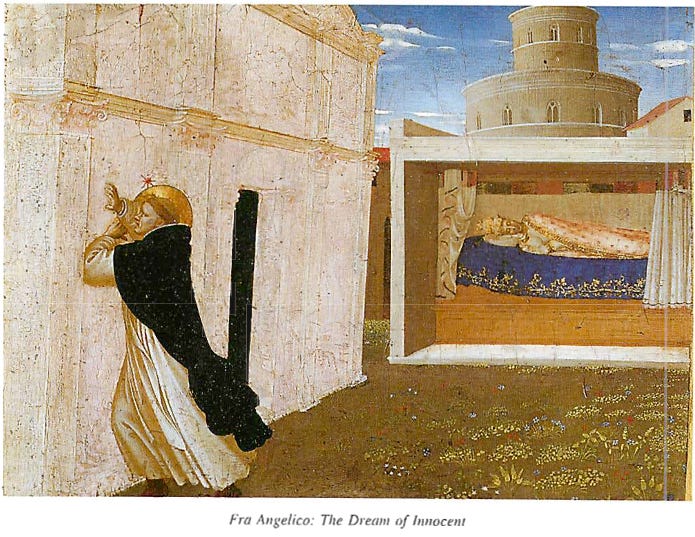
The value of surprise is more obvious in visual art. In his four-volume work The Nature of Order, the architect Christopher Alexander gives this example from a Fra Angelico painting:


Alexander asks us to cover up the black stripe on the priest’s robes and the door, and imagine we were the painter:
Imagine some moment before the black of the door and priest’s robe had been painted, but when everything else is more or less already there...You can see what I mean by putting your hand over the picture, so as not to see the black parts. Do you see that the picture loses much of its haunting character...can you see how immensely surprising it is?
— Christopher Alexander, The Nature of Order, Book 4, p. 133
The surprise principle operates in other ways, too. We barely see everyday objects because we are so used to them (low novel information again), but great art can make you see these objects afresh, the way a child might. This too is a kind of surprise, sometimes called defamiliarization. This is a favorite technique of Tolstoy’s, who often takes a normal action that we are all familiar with, and describes it the way an alien might. Thus he describes a person being whipped as “to strip people who have broken the law, to hurl them to the floor...“ and so on, deconstructing the action without ever using the word ‘whipping’. This makes you feel the action much more viscerally than if he had just used the word to summarize it.

These are all familiar points to lovers of art. But the surprise principle operates at even deeper levels, below even our conscious perception. [...]

My main argument in this section has been that surprisingness, or strangeness, operates at many different levels in the art we value: word choice (or color choice), grammar, sentence, plot, form, and so on. This strangeness is essential for the effect of great art, because we like to make sense of things, and if we make sense of things too easily they are not interesting to us; great works of art are therefore necessarily somewhat difficult to grasp the meaning of, their meanings are multiple and constantly shifting, and they require a pleasant kind of effort to make sense of.

To go back to AI, all of this gives us some sense of why LLMs aren’t great writers by default. At the word level, they tend to pick relatively ‘obvious’ choices. Thus, I ask the model currently considered the best AI writer: “write a descriptive paragraph about a day in the park“ and it starts with: “A warm afternoon unfolds in the park, where sunlight filters through the canopy of old oak trees and dapples the ground in shifting patterns of gold and green“. Note that this is the most cliche possible detail to have picked, and the word ‘dapples’ is the most common word to use in this context; in short, the whole thing is unsurprising.

And yet: you cannot fix this problem simply by asking the AI to be more surprising. Why?

2. Echoes
The eye is the first circle; the horizon which it forms is the second; and throughout nature this primary figure is repeated without end. It is the highest emblem in the cipher of the world. St. Augustine described the nature of God as a circle whose centre was everywhere and its circumference nowhere. We are all our lifetime reading the copious sense of this first of forms…
— Ralph Waldo Emerson, Circles
The most surprising sequence of numbers is a random one, but a random sequence of numbers is not great art. You need more than just surprise. The details of great artworks relate to each other somehow. They are chosen in such a way that they cohere with each other at multiple levels.

Great works are full of patterns. They are as intricately patterned as Persian rugs or Norwegian stave churches. [...]
2. Great art contains multiple overlapping layers of echoes.
This is often harder to spot in verbal artifacts, but it is this feature that I think distinguishes really good works of art from merely ‘ok’ ones.

Most of us are familiar with the surface level ways of doing this: rhyme, for example, knits together different lines of a poem in a semantically irrelevant way that nevertheless makes it feel like part of a unifying whole. Same with assonance and other such effects most of us are familiar with from English class. It is echoes, for example, that make so many verses from the King James Bible so pleasing and beautiful to listen to:
“Arise, shine; for thy light is come, and the glory of the Lord is risen upon thee.” (Isaiah 60:1)
Note the echoing vowel sounds throughout in ‘arise’, ‘shine’, ‘light’, and ‘thy’. Rhyme and assonance are verbal echoes.

In music, the most famous example perhaps is Beethoven’s Fifth, with its famous “ba-ba-ba-BUM“ theme; the short-short-short-long statement in the beginning then echoes through that movement in thousands of ways, sometimes stretched, sometimes slowed down, so that the whole movement feels like an organic thing that has grown from that single seed.

Good art layers these, one on top of another, to build up artifacts of stunning complexity. These are the text equivalents of Gothic cathedrals. Each layer alludes to other layers, too, adding more and more constraints, until you get an artifact where changing any one word does violence to the whole.

To see this density in action, let’s look at Shakespeare’s Sonnet 15. Click through the layers to see how a single fourteen-line poem simultaneously participates in half a dozen independent systems of meaning — sonic, structural, thematic, and more.
Shakespeare, Sonnet 15 
When I consider everything that grows
Holds in perfection but a little moment,
That this huge stage presenteth nought but shows
Whereon the stars in secret influence comment;
When I perceive that men as plants increase,
Cheerèd and checked even by the selfsame sky,
Vaunt in their youthful sap, at height decrease,
And wear their brave state out of memory:
Then the conceit of this inconstant stay
Sets you most rich in youth before my sight,
Where wasteful Time debateth with Decay
To change your day of youth to sullied night:
And, all in war with Time for love of you,
As he takes from you, I ingraft you new.
(The interactive version of this essay lets you click through a few layers of the poem and see the below analysis.) [...]

Echoes are sewn through sophisticated literary works in more subtle ways, too.

Thus Nabokov, in his Lectures on Literature, points out that Anna Karenina is filled with trains and railway images even apart from the fact that the main plot points occur at railway stations; Kafka’s Metamorphosis is filled with occurrences of the number three. Lots of movies and books use Christian symbolism this way — crosses, doves, and so on. Macbeth is full of birds (ravens, crows, bats, owls, the Thane of *Caw*dor...).

Sometimes these symbols are significant, as in the Christian symbolism; and sometimes they are insignificant, as in the number three; but either way, the density of these symbols strewn throughout a work give it an additional coherence that would be lacking if you wrote down things at random. It gives it the same type of coherence that you see when you look at a beautiful tree, or a grassy field: things feel right. This feeling of rightness is achieved through these echoes.

by Nabeel S. Qureshi, Substack | Read more:
Image: Fra Angelico

Vermeer, View of Delft (1660)
via:

A Life Hack for the Ultra-Wealthy Is Going Mainstream

Here is the promise of a house manager. Hire one, and soon someone else could be doing your laundry, washing your dishes, prepping your meals, and completing those Amazon returns you’ve been meaning to make. They could reorganize the utensil drawer, notice if your kid is outgrowing their shoes and order more, take your car to the repair shop, and be at home to meet the plumber. If your child needs food for a class party, a house manager could make the dish and drop it off; if that child also has a pet lizard, a house manager could buy the crickets to feed it.

House managers are not a nanny or a house cleaner. They’re a “chief of staff for the home,” a “personal assistant for Mom,” and “a clone of myself,” according to the more than a dozen people I spoke with who have either hired one or work as one. They are, in effect, what might have once been called a housekeeper—a person who helps oversee a household’s basic functioning. Middle- and upper-class families used to more commonly employ this kind of position (the title “house manager” dates back to at least the 1830s), but it has become rare enough that a couple of people I spoke with thought they may have come up with the term.

Whatever you call the job, the ultra-wealthy have maintained some version of this role in their homes for years, but more and more companies are cropping up to serve Americans with salaries in the lower six figures—a cohort that is nowhere near having a private jet but might already use a house cleaner or have a regular handyman.

Some will argue that shouldering the burden of household work is a necessary part of adulthood. But for many on the high side of the country’s wealth divide, time is at enough of a premium that buying it back feels worth the money. Kelly Hubbell, who in 2023 founded Sage Haus, a company that helps people find house managers, told me that many of her clients are dual-income households where tasks pile up beyond what two adults can handle; a house manager steps in as a third. Several women described their house manager to me as “my wife.” One company offering the service is even called “Rent A Wife—Oregon.” (Its founder, Brianna Ruelas Zuniga, knows what the name sounds like; she still likes it, she told me.)

Many house-managing businesses started around the country at about the same time. In 2022, Amy Root was running a home-organization business in central Connecticut—clearing out people’s garages and adding shelving to their closets—but she realized that even if she got the right home systems in place, “the laundry still needed to get done,” she told me. People needed “help with their regular to-dos but also the aspiration checklist,” such as finally hanging that one painting they bought a year ago, she said. In 2023, she pivoted to running a house-managing business, Personal Assistant for Mom, and now leads a team of five (soon to be seven) part-time house managers.

The crew includes retirees and empty nesters, as well as a woman training to be a doula and an artist who needed an extra gig. Rates for house managers generally are $25 to $50 an hour; some agencies take a cut. (Sage Haus charges clients a finder’s fee; house managers are paid directly.) Today’s version of the job is very much part of the gig economy, and like many gig workers, the managers are usually responsible for their own health insurance. Some of the house managers I spoke with work full-time for one family, but many are cobbling together part-time gigs with multiple families while also working as a nanny or cleaner.

When Root tells people what a house manager does, most of the time, their response is “Someone will do that for me?” A time-saving purchase like that just doesn’t occur to a lot of people, Ashley Whillans, a Harvard Business School professor who studies such spending, told me... “I’m buying back joy and time where I can right now,” Barbara Mighdoll, a mother of two and a business owner who now has a house manager for 15 hours a week, told me. Each time her house manager does a chore, she said, “that is a tab that is now closed in my brain.” When she’s with her family, she no longer has ticker tape running through her head about the laundry she needs to put away. The house manager already took care of it.

A purchase like that really can buy happiness, according to Whillans’s research. She and her colleagues have found that when people outsource bothersome chores and reinvest that time in something they actually care about, they report being more satisfied with their life. (Anyone who hates doing the dishes will not be surprised by this.) In one study, she and her co-authors found that couples who take that freed-up time and spend it on each other say that it improved their relationship. So far, Whillans has yet to see a point at which couples who off-load their to-dos stop getting happier. Some tentative evidence, she said, suggests that when given money for time-saving purchases, lower-income people report more benefits than their wealthier counterparts. But where someone in the so-called upper-middle class might consider $30 an hour a bargain, being able to buy back time is still a luxury.

by Nancy Walecki, The Atlantic | Read more:
Image: The Atlantic
[ed. As I've gotten older, I've sometimes imagined what I really need is a personal secretary. Not a care-taker or health aide or some other limited form of assistance, but someone who's overseeing all the tasks in my frantic, highly complex, and multi-dimensional life (ha!). Actually, the thought evolved mostly after reading Murakami's Kafka on the Shore, then listening to an interview with Joni Mitchell where she casually mentions in passing her secretary's duties, including among other things, taking care of her scheduling, providing companionship, grocery shopping, driving, bill paying, and almost everything else. I thought wow, now that's it. That's what I need!]