via:
[ed. Bravo! Can't imagine what it must feel like to see this sheet music for the first time.]


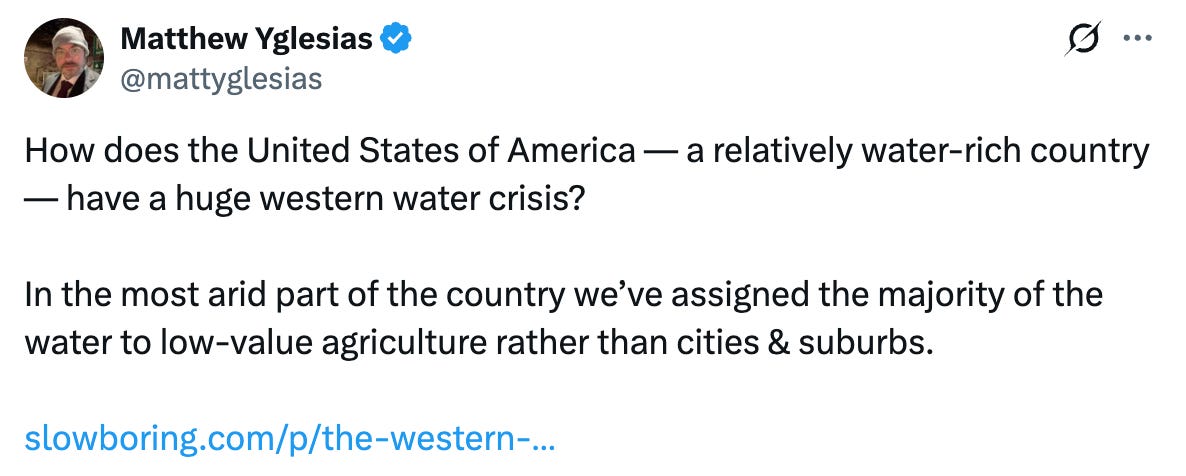

Even worse, the whole Western water conflict has an incredibly simple solution: End federal law’s current stipulation that a huge share of the available water must be sold at very low prices exclusively for the purpose of agriculture.Uh, not quite.
The issue here is well known, well understood, and not particularly controversial. It’s just that nobody seems to want to actually fix it.
“The whole crisis is because of alfalfa” sounds ridiculous, in part because alfalfa is a funny word. But also because it’s so random. Wheat? That’s in bread and pasta. Everyone loves wheat. Cotton? That’s my shirt, I get why we need cotton.Now, I’m no alfalfa apologist (nor am I an alfalfaphobe), but I feel like I should point out that most of the alfalfa grown with Colorado River water is used to feed dairy cows, which in turn produce milk and cheese and ice cream. Unless Yglesias is a vegan, he might want to consider that. He then argues that since alfalfa is relatively low-value (money wise) compared to Las Vegas casinos, Phoenix microchip factories, or housing, the water should be going to casinos, factories, and housing, not farms, which would presumably happen if farmers had to pay more for water (i.e. they’d go broke and be forced to sell).
But alfalfa?
Alfalfa is grown as animal feed.
The real point here, though, isn’t that the farmers are living high on the hog and need to be taken down a peg. You could easily let them keep their windfall water rights but turn those rights into property that they’re able to sell. Then existing cities or industrial users or real estate developers looking to build new housing or whoever else could just buy out the alfalfa farmers. The land currently under cultivation could shift to less water-intensive uses. Even a golf course uses significantly less water per acre than an alfalfa farm. Much of the land would, of course, turn into housing, but some could become non-irrigated parks with native vegetation.First off, there is nothing novel or groundbreaking about this idea. Sprawl has been gobbling up farmland, and water rights, for decades in the West. Phoenix didn’t just grow into the desert, it also grew into citrus orchards and alfalfa fields, and will probably continue to build housing and data centers on what ag land remains. A different version of this concept, where a city or developer purchases a farmer’s water rights, but uses them somewhere else — a practice known as buy and dry — is also not uncommon.

They’re coaching your child’s soccer team, sitting next to you at community fundraisers, or chatting with you at neighborhood barbecues. They might be the dentist who expanded his office to a regional network of practices, the commercial HVAC contractor whose trucks you see around town, or the owner of that local restaurant chain that keeps opening new locations.These are the “real rich” in America, Zidar and Zwick argue, and they matter much more than “a few high-profile billionaires on the coasts.” It’s an audacious claim, but one that’s hard to shoot down. The four hundred richest Americans—think of Bezos, Buffett, etc.—held about $4 trillion in wealth in 2022. The roughly three million Main Street Millionaires hold more than thirteen times as much. By investigating how these people made their fortunes, and how they wield them, Zidar and Zwick upend the consensus on wealth inequality in America. Yet their sobering conclusions aren’t enough to exorcise the authors of their Mammonism.


“As a Power 4 college football player you’re working out year-round, you’re getting paid …. I don’t see why people wouldn’t see us as employees.”Just a few days later, the Oregon State women’s basketball team collected enough signatures to seek an election with the United College Athletes Association. They have filed a petition with the Oregon Employment Relations Board. From the university, which is opposing the effort:
“Playing on a college basketball team is not service performed for hire …. Student athletes at OSU matriculate to obtain and [sic] education and voluntarily pursue basketball as part of that experience.”Last year, over 100 women’s basketball players wrote to Big Ten commissioner Tony Petitti and SEC commissioner Greg Sankey asking for a formal way to be heard on the rules that govern their sport. Neither agreed to meet.


