Fandom as contagion
When Eliza McLamb heard this interview with the founders of Chaotic Good Projects on Billboard, she was shocked to discover that an artist and track she thought was her own “perfect, beautiful little secret” actually came from them as a part of a “narrative campaign”.
“I thought this was the kind of thing that was only deployed in service of mass-market, commercial pop... But [Chaotic Good’s] roster runs deep, far past the predictable internet sensations one could expect... Geese and Cameron Winter, but also Dijon and Mk.gee. Laufey and Wet Leg. Oklou and Jane Remover.”Chaotic Good works by, in their own words, “controlling the discourse”.
“I think in the past, let’s say like a label and a management team do a great job. They get their artists on SNL or Tiny Desk or Triple J or something like that. Then they post it and then they kind of wait for the comments […] what we do at Chaotic and with our management clients is, the second SNL drops at midnight, you should post a hundred times saying that was the best performance of the year.”Chaotic Good doesn’t just share content, it creates accounts to respond to that content and simulate trends, which will ideally snowball into real, organic users jumping on the trend and amplifying it. They’re simulating until the simulation becomes real.

“I think most people see a video or see something about an album that came out and it’s like the first thing that they see or that first comment that they see is their opinion even when they haven’t heard the whole album.”In behavioural psychology this is known as social proof. Part of what made Eliza McLamb’s article go viral is the way it exposes how our behaviour is manipulated by the marketing machine. We know about propaganda but for some reason assume social media is immune to this kind of manipulation. We think we’re interacting with real people online, people we subconsciously infer guidance from, but we’re not. Much of what we see has been infiltrated by external agents to shape a particular opinion.
However, the underlying issue is not just the fact that the opinions we thought were our own have been subtly shaped by an expensive machine, it’s that if artists today can’t afford to pay for that expensive machine, no one will hear their music.
The False Promise Of The Social Media Democracy
Once upon a time there was a social media platform called MySpace. It gave everyone their own web page connected to other MySpace users. They could customize it to look however they wanted, people could comment, and send messages to each other. There were no ads. There was no algorithm. Just the free flow of information.
Many bands in the ‘00s blew up because of MySpace. Arctic Monkeys, Lily Allen, Calvin Harris, to name a few. Our very own Chris Black’s previous band Katsen landed record deals through MySpace. The early days of social media are responsible for the persistent myth of going viral then making lots of money. The two halves of that equation have never been more disconnected.
MySpace succumbed to algorithm-driven platforms and the gatekeeping emerged again, this time with the tech titans controlling the interactions between musicians and fans. I remember discovering for the first time that even though we had a few hundred followers on Facebook, they wouldn’t see our posts unless we paid to “boost” them. That was just the beginning.
As the algorithms evolved, the content that rose to the top was not just the most liked and shared but the most consistently and frequently posted. To be seen on social media one has to spend hours, daily, posting and engaging in other people’s content. Most artists don’t want that job and moreover, don’t have the capacity. Kamola Atajanova of Tape Wounds articulates it perfectly in their response to the Chaotic Good furore:
“Not every artist is built for social media. Not every artist wants to make their life into a performance. Some people are better at writing songs than posting clips. Some people’s work comes from privacy, patience, or introspection. That should not make them less valid. But this system does make them less visible. It filters them out before the music even has a chance. So when people say “it’s just marketing,” what they really mean is: this is the cost of entry now. And that’s exactly what makes it feel so hostile. Not everyone can afford that cost. Not financially, not creatively, not psychologically.”Hiroki Tanaka’s candid Reddit post about the failure of his “by the book” album PR campaign sparked a wave of recognition across the music world. After two decades in music and awards with his previous band he decided to release his solo album, his “last hurrah”, with management, a label, and a professional PR campaign. He even started a TikTok account posting show videos, behind the scenes and goofy memes all around managing a job and family life.
Tanaka watched the release arrive after eight months of promotion to little more than “a weak trickle” of attention. For most musicians, Tanaka’s story didn’t feel exceptional, it felt familiar.
“I was told, under no uncertain terms, that my lack of a social media presence and streaming metrics meant that certain media outlets that had reviewed my work (highly, I might add) in the past could no longer spend money on paying a writer and editor to review my work… I would have preferred if they had said they didn’t like my album. Being rejected because of my metrics is a slap in the face for art.”Social media has become the driving force behind a release, and while it is accessible to anyone, there’s actually a huge price to pay in both time and mental health. The volume of content required to feed it is beyond most musicians, who are generally holding down full time jobs to survive. The underlying purpose of all this extra content is to feed a machine, and it doesn’t feel good dedicating your precious little free time to feeding a machine.
Jumping Jacks For Clicks
Soon after reading Tanaka’s post, we got an email from YouTube Creators prompting us to “Get Creative With Goals” on our livestreams.
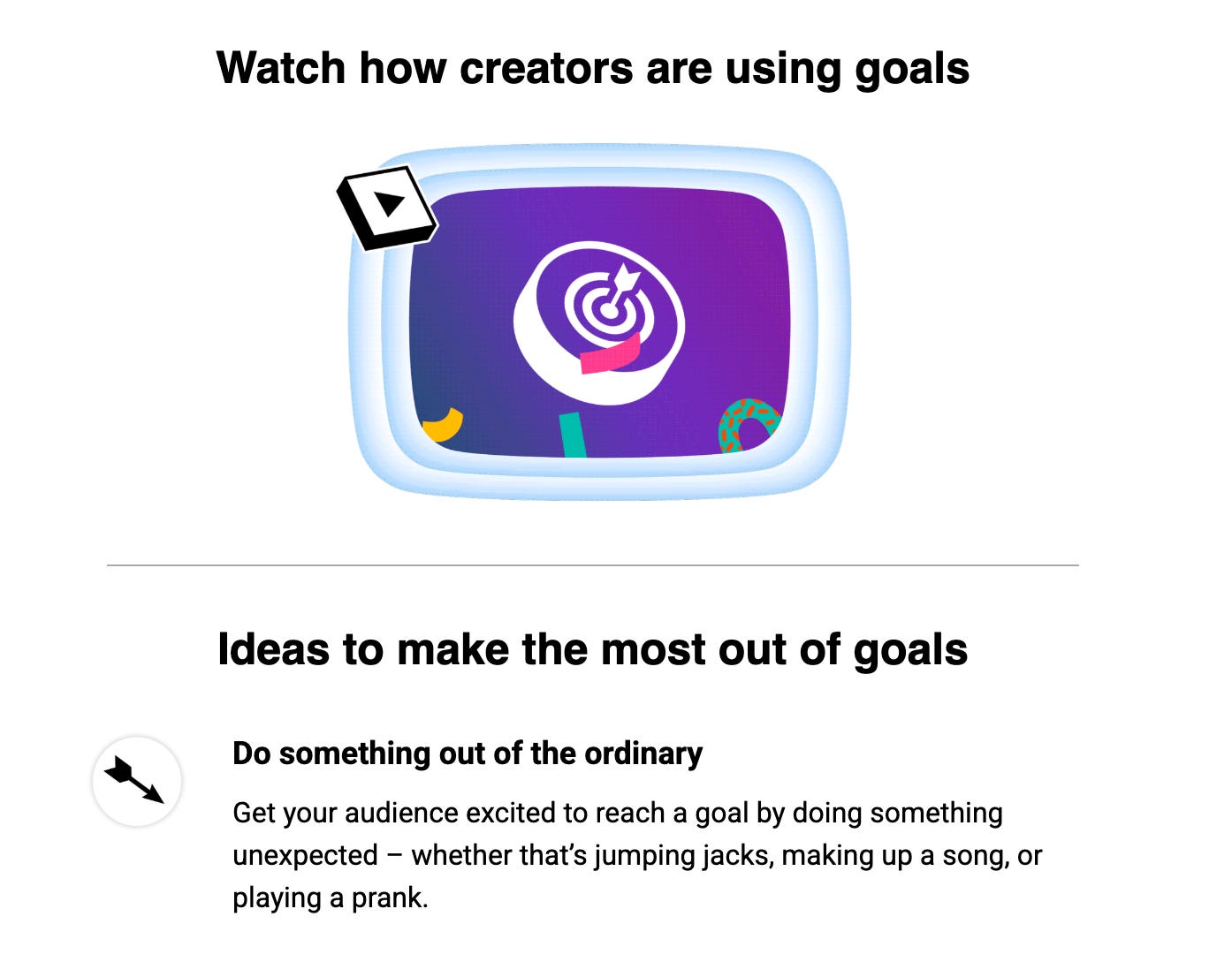
They’re encouraging us to “set goals that encourage your community to collaborate,” and suggest celebrating those goals by “doing something unexpected – whether that’s jumping jacks, making up a song, or playing a prank.”
Yes, you read that correctly. YouTube is telling artists that the path to success involves performing arbitrary physical tasks to generate engagement.
It’s sad how often life imitates an episode of Black Mirror these days but this is almost exactly the scenario in season seven’s episode “Common People”. A man who needs money for an enshittified service ends up performing increasingly degrading stunts on a streaming platform for money. What was meant as dystopian satire has become platform policy. [...]
What Comes Next?
We may be reaching an inflection point. As McLamb notes, the more ubiquitous manufactured virality becomes, the more artists will resist it entirely, pulling back from streaming and social media in favour of hyper-local, scene-based growth. A return to the tangible, the real, the unmediated.
While this sounds good in theory, it’s probably not going to work for unusual artists in small towns. They’d have to go to a city to have more of a chance of finding their people, and with the cost of living, moving to a city isn’t possible for everyone. By the time I left London in 2009 all the artists I knew were leaving, it just wasn’t sustainable anymore.
The problem is systemic. Musicians don’t typically make a living from their music. This means their time is diverted to day jobs. Their dwindling leisure time is necessary for making and performing music. There isn’t time to also produce a volume of “content” for social media. On top of that the mental health cost of interacting with addictive apps as a performing monkey is not appetising. This creates a class system in the music industry. There are those who can afford to pay to be heard and those who can’t. And those who can’t are either paying with their souls, or they’re opting out altogether and not being heard at all.
Images: uncredited/YouTube
[ed. Works for some, not for others. Which, I guess is the point. The algorithm is selecting for a certain type of musician - not necessarily the best. That YouTube email really says everything you need to know about their business model, doesn't it?]

