What’s needed, I believe, is not just a tactical, temporary retreat. We need to stop and think why a maximal pro-immigration policy is something that we need to retreat from in the first place. We need a new concept of what a sustainable liberal immigration policy looks like.
Since I started writing, I’ve been an advocate of more immigration to the United States. This does not mean I ever favored unrestrained immigration or open borders. I’ve consistently argued that favoring skilled immigration will bring more economic benefits to native-born Americans, and be more politically palatable as well. And while I don’t hate illegal immigrants for trying to better their lot in life, I favor strong border controls, because nations have the right to decide, democratically, who gets in and out. It’s understandable when people get mad at seeing their decisions flouted.
On top of that, I’ve always remained agnostic on immigration to other countries; although I find much to admire in Canada’s points-based system, for example, I don’t think that qualifies me to decide whether more immigration is good for Canada overall. If the people of a country decide that immigration is diluting their local culture unacceptably, for instance, I think they have every right to cut it off. That’s just Westphalian sovereignty — not a perfect system, but the best system we’ve ever found for organizing humanity into geographic units. As an American, I don’t view it as my place to tell Japan, or the UK, or any other country that immigration is the right choice for them.
Despite those reservations, I’ve always thought that immigration to the U.S. is a basically good thing, and should be expanded. The economic benefits are pretty undeniable — higher tax revenue to shore up our dangerously depleted government finances, dominance in high-tech industries and innovation, and so on. And while some of the economic costs are real — local housing shortages and strains on local government finances being the two biggest ones — many of the fears are overblown. In particular, the bulk of the evidence concludes that immigrants don’t reduce wages or job opportunities for native-born Americans.
And importantly, lots of Americans share my overall positive view of immigration. If you ask Americans whether they think immigration is good or bad, most will say “good”:
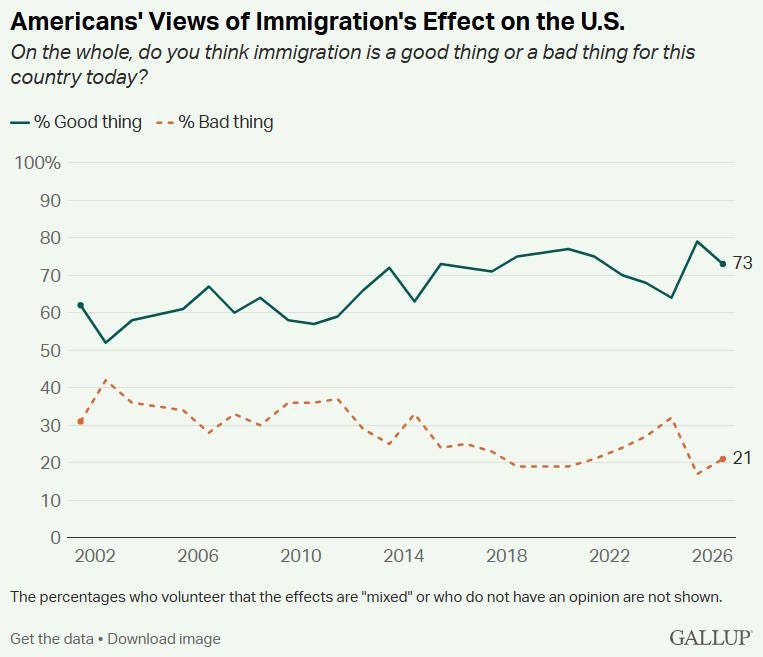
Source: Gallup
And if you ask Americans whether the annual rate of immigration should be increased, decreased, or kept the same, you get a pretty even split: [...]
So I’ve never really felt like I was going out on a limb or advocating an unpopular position when it came to this issue. Sure, rightists will direct online vitriol toward anyone who supports any immigration at all, but their energy and savagery shouldn’t be mistaken for majority support.
And yet there will always be some amount of immigration — and some types of immigration — that will arouse even the most open and welcoming people to ire and make them think about shutting the doors. We saw this in the U.S. in 2023-24, when anti-immigration sentiment spiked in response to Biden’s permissive asylum policies. Yes, that sentiment crashed again when Trump took power and started committing abuses. But if liberals don’t change how we approach immigration, the sentiment will simply rise again and again, as it has so many times throughout our history. And the Donald Trump and Stephen Miller types will be right back in power — and our country will be worse off for it.
Liberals need an immigration approach that can be sustained for long periods of time — i.e., one that doesn’t enrage the public every time it manages to get in power. What would that look like?
The first thing liberals (and progressives, and Democrats, and European lefties, etc.) need to admit is that migration is not a human right. We live in a world of sovereign nation-states, and unless we find some better way of dividing up and administering the world, we will continue to live in a world of sovereign nation-states. And nations are, necessarily, exclusive clubs; they have the right to restrict immigration for any reason whatsoever.
Liberals must therefore not view borders and citizenship as annoying obstacles to be tactically circumvented or overcome; instead, we must view them as fundamental parts of the social compact that allows nations, including liberal nations, to exist in the first place. Nation-states and their laws and their police and their courts and their armies are the fundamental guarantors of the human rights that define liberalism. And for better or for worse, the ability to decide who gets in and who has to keep out is a necessary precondition for nation-states to exist.
That means we need to recognize that immigration law is legitimate and needs to be upheld. Some progressives have tried to advance the notion that being undocumented is a marginalized identity that needs to be protected and supported by the state. But this is absurd; it’s like if progressives decided that people who drive over the speed limit are a minority group.
Illegal immigrants chose to break U.S. law when they came to this country. Our democratically elected leaders made those laws, and they should be honored. We should treat illegal immigrants humanely, of course, and we should not tear local communities apart just to hunt down a few people. But there has to be some way of enforcing the law, because a law without enforcement is no law at all.
A third principle that liberals should embrace is that the purpose of immigration is to benefit the people who already live in the country that is receiving the immigrants. Immigration to America must be for the benefit of Americans. We must flatly reject any concept of immigration that sees it as a necessary sacrifice on the part of American citizens. [...]
Instead, liberals need to promote immigration because of the benefits it brings to the American citizenry. This includes economic benefits — the tax revenue, the investment, the eldercare, the innovation, the entrepreneurship, the expanded market size. But it also includes cultural benefits — the constant reinvigoration of this nation of immigrants by new waves of people with the gumption and bravery to pick up and move across the world in search of opportunity and freedom.
America has always been the country of the frontier; in order to maintain that ethos in the modern age, we need people for whom America itself is the frontier. And our founding ideals — which are very liberal ideals, of liberty and opportunity and the rights of the individual — are strengthened by people who make the conscious choice to move to a country that represents those ideals...
And if this requires us to be selective about which immigrants we bring in, then so be it. Skilled immigrants bring far more economic benefits per capita than others — so by all means, let us tilt our system toward them, as American voters of both parties want. Immigrants who don’t love and embrace American culture will probably invigorate our nation less — so by all means, let us bar immigrants who have been part of groups that see America as evil, using the law with which we once banned immigration by members of communist parties.
These are the kinds of decisions that nation-states, including liberal nation-states, are inherently entitled to make. And we should expect Europe to make different decisions than America makes. That’s perfectly OK. Because immigration is fundamentally the decision of each sovereign nation-state, it’s inevitable that we’ll make different decisions. JD Vance wants us to think that France’s immigration policy, or Germany’s, is inextricably tied to America’s. But it’s not, and we shouldn’t let him get away with conflating the two.
For America, the kind of immigration agenda I’ve sketched out — which all the polls show Americans favor by substantial margins — would not be a “far right” policy, even though some progressives and leftists will inevitably try to label it as such. In fact, it would allow in far more immigration than the policies of Franklin D. Roosevelt or Harry Truman. It won’t satisfy progressives who dream of a borderless world, or leftists who salivate over the chance to make the West pay for colonialism. But I believe it will preserve America as the kind of liberal nation-state that we knew it as in the days before Trump.
As for the rest of the world, countries like Germany and Canada and Japan have to make their own decisions. I can’t tell them what kind of nation to build; I can only try to promise that as an American, I’ll respect their decision. If they want to shut their doors in order to slow the pace of cultural change, it’s not my job to lecture them otherwise.
by Noah Smith, Noahpinion | Read more:
Image: Gallup

