It is similar to the FRONTIER Act, with stronger preemption of state laws, stronger transparency provisions and weaker enforcement provisions.
Having slept on this, I find it unacceptable that Anthropic is actively shopping exactly the type of bill I have warned we will need to fight against during the lame duck session. They are trying to use this last time with a Republican Congress to pass preemption of exactly the important state laws, and get some transparency but not much enforcement in exchange.
This reads as intentional, that Anthropic is more afraid that the government might enforce rules against Anthropic, than they are worried about the ability of the government to enforce rules against everyone. Anthropic’s policy team seems to have, chosen protecting their business interests and guarding against their political risk, at the expense of safety considerations.
There was no need for the company purportedly existing to promote safety to propose a bill that is not even actively stronger than the FRONTIER Act, when the FRONTIER Act was a compromise bill proposed back in June.
Even if you were fine with what is being given up, what you get in return very obviously does not meet the moment. Nor is there any need for such compromises. It seems rather insane for Anthropic to be proposing it now. This seems like the bill that someone on the anti-regulatory side should be pushing. It is not obvious this makes us safer than doing nothing, even if the alternative is fully nothing at all levels.
Say it isn't so, Anthropic, or at least that it was a mistake and is no longer so, or I am going to be rather cross.
Others RTFB (Read the Bill)
I have not had the time to do so, but the other usual suspects quickly sprinted to RTFB (read the bill) and they did not like what they saw. You can try to call this a ‘pretty reasonable AI safety bill’ as Charlie Bullock does, but that is by the standards of people trying to protect the industry from more impactful regulation. [...]
Charlie Bullock: Big news. My take: Anthropic deserves some credit for actually proposing a pretty reasonable AI safety bill; that’s more than other frontier labs have done.
But they don’t deserve *too* much credit, IMO; this bill is weaker than the Trahan-Obernolte FRONTIER Act in some key ways, and since the political momentum has shifted significantly in the direction of safety since FRONTIER was introduced back in July, I think new bills introduced today should ideally go further than FRONTIER was able to go rather than regressing.
To be fair to Anthropic, the main places where this bill is significantly weaker than FRONTIER are (a) rulemaking (very strong in FRONTIER, almost nonexistent in Anthropic’s bill) and (b) the emergency shutdown authority. Even if you take safety seriously, it might make some sense to dial those authorities back if you didn’t trust the executive branch to wield them responsibly, because those are the easiest provisions for a hypothetical President who hypothetically might not like a certain frontier AI company to abuse.
There are some improvements over FRONTIER as well; for instance, this bill does specify that auditors are employed on a continuing basis and has better provisions regarding auditor access to information. Happy to see that from Anthropic (although I think their access provision is still a little undercooked and has Fourth Amendment problems).
Overall, I think the embedded auditor bills that get introduced in the coming months are going to be significantly better and more ambitious than this, and I hope Anthropic supports those bills instead of opposing anything that treats catastrophic risks like the serious national security issue they are. Still, it’s encouraging to see a frontier lab come this far. [...]
Nathan Calvin: Charlie’s analysis is right but he is nicer than I am - I found myself viscerally angry at multiple points reading this bill. There are some good and sensible parts, but overall this legislation is not remotely close to meeting the moment and I overall think passing it would make us less protected against catastrophic risks than we are under existing law.
Two parts that stand out as particularly infuriating when taken together:
1. Some of the preemption provisions are remarkably far reaching and consequential, and in addition to preempting legislation like SB 53 would also remove general powers that state courts have to enjoin defendants and protect the public. Most outrageously, it has a provision that looks like its intended to stops states from enforcing laws or judicial decrees that “suspend the development, deployment, or internal use of an AI model” to protect their citizens from imminent catastrophic harms. Such powers to block and suspend model deployments would then only reside with the federal government.
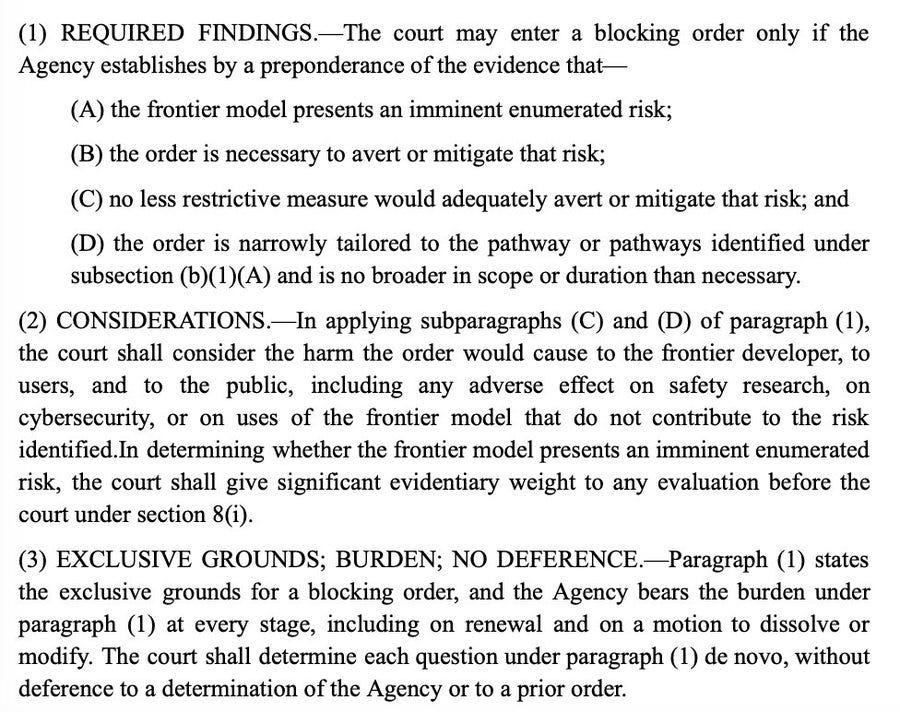
2. The federal governments powers to restrict the development, deployment, or internal use of a frontier model has to meet an absurdly high bar.
First, there needs to be an imminent risk of a catastrophic harm (meaning killing more than 50 people or causing more than a billion dollars in damage). But thats not enough! The agency head needs to make a detailed determination with no deference given to show why no alternative would prevent the imminent catastrophe. Next the court is also explicitly told to consider the harms to the developer and other harms from restricting the model, but no considerations in the other direction.
This is absurd! For all of its warning about the potential for AI to cause a catastrophe that kills literally everyone on the planet, Anthropic’s proposed federal law likely makes it harder than under existing law for a court to get an order blocking or restricting the development of frontier models? WTF??
There are also a bunch of others things that I would like to see improved - the substantive details of the auditing section and the potential for rule-making on substantive safety standards both come to mind - but I think these stand out as particularly indefensible.
Charlie Bullock: Nathan’s righteous anger has inspired me to make one more mildly disapproving observation: it’s kind of wild that the Anthropic bill has no government licensing for the independent auditors.
Licensing is, IMO, the bare minimum thing that you need to even be able to pretend that your auditing regime isn’t just going to devolve into a race to the bottom. Without it, auditors will inevitably compete with each other to offer their customers, the labs, the least bothersome audits available at the lowest possible price point. Obviously Anthropic trusts itself to do a great job of picking great auditors, but do they trust OpenAI to do the same? What about SpaceXSI?
Why Would Anthropic Do This?
The new Anthropic bill is weaker than their June framework, and offers both forward-looking and backward-looking preemption in exchange, despite months of movement to enable us to do more. What are we even doing? [...]
by Zvi Mowshowitz, DWAV | Read more:
Image: Draft bill
[ed. Best I can tell (haven't RTFB) the draft seeks to: 1) preempt state's rights to write and enforce stronger safety provisions - so, in effect, we get a single point of federal decision-making/enforcement vs. 50 votes; 2) install "independent auditors" to evaluate model safety who's credentials and funding sources are undefined; and 3) set an arbitrary trigger for a single federal judge to intervene/block a model’s release or use only if it poses a foreseeable, imminent risk of more than $1 billion in damages, or of killing or seriously injuring more than 50 people - all to be decided using a set of process provisions that are ambiguous at best - see the REQUIRED FINDINGS above - and over some unspecified period of time. So, all in all, not good. And, even more not good - other frontier labs don't seem to be on board with even these few minimal restrictions. As one commenter notes: there aren't really any Good Guys in this race anymore (if there ever really were), just Bad, Badder, and Baddest. Good Intentions Paving Company secures lucrative "Hell" contract, news at 11.]
