By analyzing NASA lidar data, my AI agents found a Maya site in Mexico that wasn't in the official register. (It turned out archaeologists had mapped it already, more on that at the end.) It took less than 72 hours to go from a random thought while traveling to an official reply from the Mexican government.
18 October
I brainstormed a bit with a few agents (Gemini, ChatGPT, Claude and Grok), and they all said lidar. From above, a ruin in the jungle is just a bunch of trees (like Machu Picchu before it was cleared), so satellite photos don't help much. Lidar, instead, fires laser pulses through the gaps in the canopy and maps the ground underneath.
So the agents went looking for lidar data. Peru isn't well covered, and hiring a company to do a survey meant permits, costs and bureaucracy, so I gave up on that. Then I thought: why not the Maya? Their region is much better covered by public lidar.
That night, I asked the agents to analyze it and went to bed.
19 October
I woke up and checked the agents' reports. 'DAMN!' They had found lots of villages and other regular shapes that looked like structures or houses.

A few of the sites the agents flagged overnight. Keep an eye on the bottom-left one.
So how did they do it? They turned the lidar strips (about 1,200 km² of jungle) into images, and 48 agents went through them one by one like very patient archaeologists, looking for pyramids, platforms, and plazas while filtering out natural hills, sinkholes, and roads. There was no special model or classifier involved: the agents literally looked at the pictures, following a precise guide.
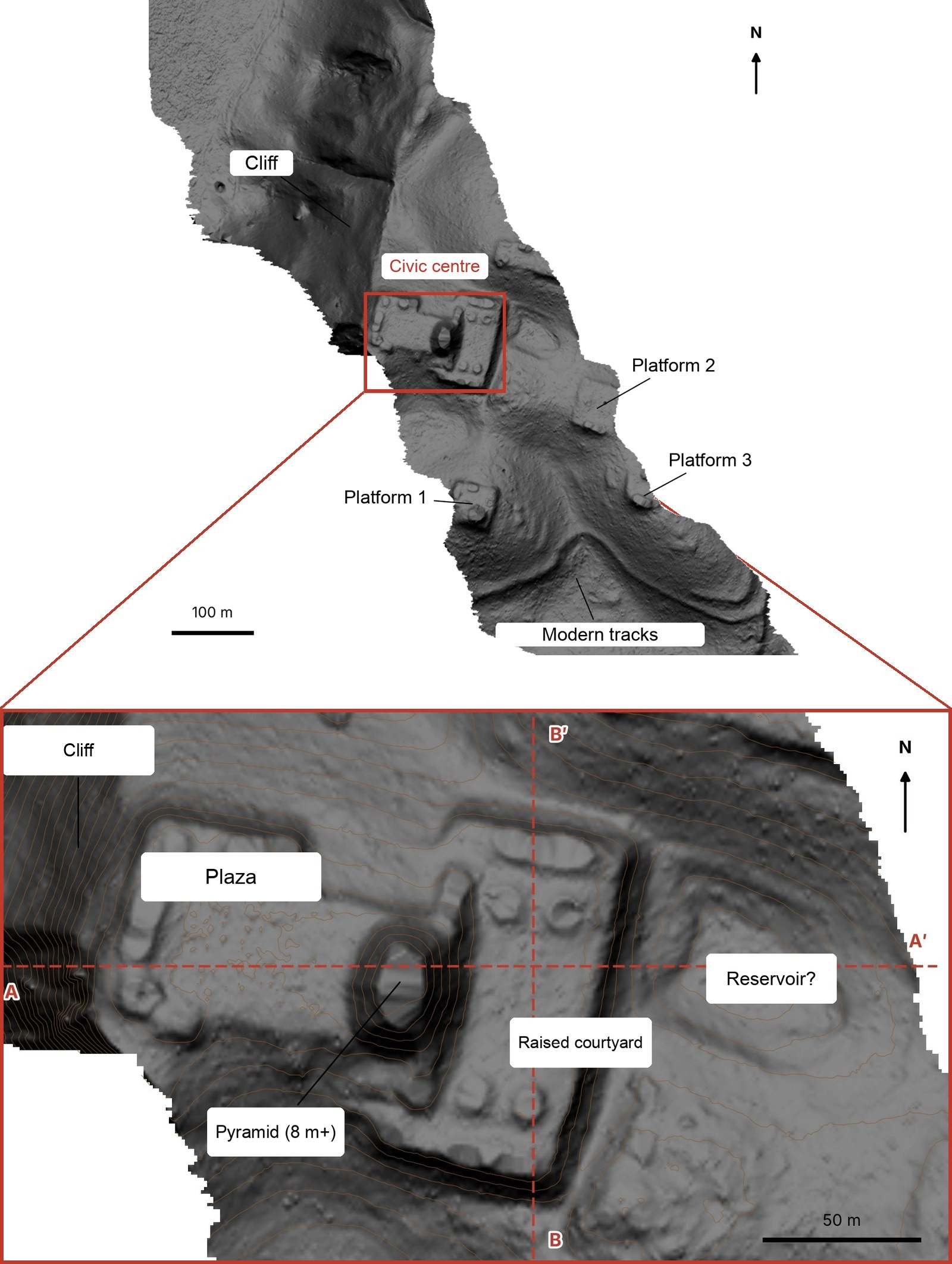
Zooming in, there's a levelled plaza, an oval pyramid at least 8–12 m tall, a raised courtyard attached to it and a flat-bottomed hollow that might have been a water reservoir.
Me: That's awesome! Please check which of these villages haven't been discovered yet. Search both the literature and the archives.This is the hilltop from the top of this post. It sits on the edge of a cliff, under the jungle, and it has straight edges and sharp corners. Nature doesn't really do straight lines.
…a few hours later…
Agent: One major village doesn't seem to have been registered.
Zooming in, there's a levelled plaza, an oval pyramid at least 8–12 m tall, a raised courtyard attached to it and a flat-bottomed hollow that might have been a water reservoir.
by Piettro Mioti | Read more:
Images: the author