
Saturday, October 3, 2026

The Mastermind
He built Seahawks Super Bowl winners from scratch — twice: What’s John Schneider’s secret?
The timing wasn’t ideal, but Marshawn Lynch insisted.
In the aftermath of the 2015 NFC title game, which sent the Seattle Seahawks back to the Super Bowl after a thrilling come-from-behind victory over the Green Bay Packers, NFL agent Doug Hendrickson celebrated at the home of Lynch, Hendrickson’s client and the Seahawks’ mercurial star running back.
During the festivities, Lynch got serious, then gave Hendrickson a mandate: Negotiate a new contract with Seattle. Immediately.
 That was a little complicated. Lynch held out ahead of the season in an effort to force a new deal with Seattle before agreeing to a compromise that converted some incentives into guarantees. Conversations between the two sides had been ongoing since then, but nothing was imminent.
Hendrickson left Lynch’s house around midnight and headed to a victory party hosted by Seahawks general manager John Schneider, the man he’d been sparring with over Lynch’s deal. All seemed forgotten when the agent arrived at the GM’s house. The pair hung out, shared drinks and enjoyed the night, but before leaving, Hendrickson broached the topic of a contract extension for Lynch … preferably before Super Bowl 49.
The good vibes vanished. Schneider was incredulous.
“He looked like he was going to kill me,” Hendrickson said.
They went back and forth, hurling profanities into the night until they were the last ones left. No deal was reached. By then, Hendrickson was having some trouble getting a ride. He needed a place to crash for the night. So he slept on Schneider’s couch.
When Hendrickson woke up, there was his unexpected host. Hours after a heated debate that at times sounded as if they might come to blows, the pair hugged it out, apologized and agreed to hammer out an extension. Eventually.
The good vibes were back.
“You need a ride home?” Schneider asked.
Schneider is a small-town Midwesterner whose entry into the NFL began with cold calling the GM of his hometown Green Bay Packers after some “courage beers” and advice from friends in 1992. More than three decades later, he’s the top architect in America’s most popular sport.
 Some of Schneider’s friends refer to him as “relationship-based.” Dave Wyman, the co-host of Schneider’s local radio show, describes him as “openly curious” and cites that as the reason he will never turn down an invite to grab a beer.
“I don’t even care if we talk about football,” said Wyman, a former linebacker who played six of his nine NFL seasons with the Seahawks. “It’s really interesting to see how his mind works, but more than anything he’s just like your best buddy.”
Schneider’s adversaries don’t turn him down, either. Some of the most contentious negotiations in his 17 years running the Seahawks came via Mark Rodgers, the former agent for quarterback Russell Wilson. One day, during the middle of Wilson’s 10-year run with the franchise, Schneider invited Rodgers to Dino’s Pub, the dive bar near team headquarters. That rainy afternoon was unlike any of their many spirited debates over guaranteed money, no-tag clauses, franchise tags or trade destinations.
“We didn’t talk about football a lick,” Rodgers recalled. “We just talked about life. He wanted to know a little bit more about me, and I enjoyed getting to know a bit more of him.”
With the Seahawks’ win over the New England Patriots in Super Bowl 60, Schneider, 55, became the first NFL GM to secure multiple championships with the same franchise despite zero carryover between the rosters or coaching staffs. Since Schneider was hired in January 2010, Seattle has the league’s fifth-highest win percentage, three conference titles and two Super Bowl wins. In that time, he has become someone other Super Bowl-winning GMs admire, players appreciate, agents respect — and the guy everyone in the league wants to grab a beer with.
Knowing Schneider, they probably have.
“He manages to be one of the smartest minds in the league, but he’s also the guy that’s most likely to convince you that one more round is a great idea,” said Tampa Buccaneers GM Jason Licht.
Schneider’s longevity stems from an impeccable scouting eye and the premium he puts on the people part of the business. Some of the key moves that led to Seattle lifting the Lombardi Trophy — including the hiring of head coach Mike Macdonald — were products of Schneider’s strong relationships with his peers. In a hypercompetitive NFL landscape, his relationship-based approach to the job is a unique and underrated part of his success and one of the defining elements of the team’s culture.
“We’re all under intense pressure, stress to perform every single day, and to be able to have someone like John that you can lean on — that you trust like that, you can talk to, can help you work through things — it just goes a long way,” said former Tennessee Titans president of football operations Chad Brinker. “It’s rare. It’s not like that all around the league. John is different. He is. And that’s why he’s been in that chair 17 years.” [...]
He is the last man standing from what was once the league’s best Big Three, with Schneider at GM, Pete Carroll at head coach and Russell Wilson at quarterback. Schneider’s success independent of Carroll and Wilson has buoyed his case to join mentor Ron Wolf in the Pro Football Hall of Fame.
“He’s a gold-jacket GM,” Brinker said. “That’s the way we view him.”
by Michael-Shawn Dugar, The Athletic | Read more:
Images: Steph Chambers; Kevin C. Cox/Getty Images
In the aftermath of the 2015 NFC title game, which sent the Seattle Seahawks back to the Super Bowl after a thrilling come-from-behind victory over the Green Bay Packers, NFL agent Doug Hendrickson celebrated at the home of Lynch, Hendrickson’s client and the Seahawks’ mercurial star running back.
During the festivities, Lynch got serious, then gave Hendrickson a mandate: Negotiate a new contract with Seattle. Immediately.
Hendrickson left Lynch’s house around midnight and headed to a victory party hosted by Seahawks general manager John Schneider, the man he’d been sparring with over Lynch’s deal. All seemed forgotten when the agent arrived at the GM’s house. The pair hung out, shared drinks and enjoyed the night, but before leaving, Hendrickson broached the topic of a contract extension for Lynch … preferably before Super Bowl 49.
The good vibes vanished. Schneider was incredulous.
“He looked like he was going to kill me,” Hendrickson said.
They went back and forth, hurling profanities into the night until they were the last ones left. No deal was reached. By then, Hendrickson was having some trouble getting a ride. He needed a place to crash for the night. So he slept on Schneider’s couch.
When Hendrickson woke up, there was his unexpected host. Hours after a heated debate that at times sounded as if they might come to blows, the pair hugged it out, apologized and agreed to hammer out an extension. Eventually.
The good vibes were back.
“You need a ride home?” Schneider asked.
Schneider is a small-town Midwesterner whose entry into the NFL began with cold calling the GM of his hometown Green Bay Packers after some “courage beers” and advice from friends in 1992. More than three decades later, he’s the top architect in America’s most popular sport.
“I don’t even care if we talk about football,” said Wyman, a former linebacker who played six of his nine NFL seasons with the Seahawks. “It’s really interesting to see how his mind works, but more than anything he’s just like your best buddy.”
Schneider’s adversaries don’t turn him down, either. Some of the most contentious negotiations in his 17 years running the Seahawks came via Mark Rodgers, the former agent for quarterback Russell Wilson. One day, during the middle of Wilson’s 10-year run with the franchise, Schneider invited Rodgers to Dino’s Pub, the dive bar near team headquarters. That rainy afternoon was unlike any of their many spirited debates over guaranteed money, no-tag clauses, franchise tags or trade destinations.
“We didn’t talk about football a lick,” Rodgers recalled. “We just talked about life. He wanted to know a little bit more about me, and I enjoyed getting to know a bit more of him.”
With the Seahawks’ win over the New England Patriots in Super Bowl 60, Schneider, 55, became the first NFL GM to secure multiple championships with the same franchise despite zero carryover between the rosters or coaching staffs. Since Schneider was hired in January 2010, Seattle has the league’s fifth-highest win percentage, three conference titles and two Super Bowl wins. In that time, he has become someone other Super Bowl-winning GMs admire, players appreciate, agents respect — and the guy everyone in the league wants to grab a beer with.
Knowing Schneider, they probably have.
“He manages to be one of the smartest minds in the league, but he’s also the guy that’s most likely to convince you that one more round is a great idea,” said Tampa Buccaneers GM Jason Licht.
Schneider’s longevity stems from an impeccable scouting eye and the premium he puts on the people part of the business. Some of the key moves that led to Seattle lifting the Lombardi Trophy — including the hiring of head coach Mike Macdonald — were products of Schneider’s strong relationships with his peers. In a hypercompetitive NFL landscape, his relationship-based approach to the job is a unique and underrated part of his success and one of the defining elements of the team’s culture.
“We’re all under intense pressure, stress to perform every single day, and to be able to have someone like John that you can lean on — that you trust like that, you can talk to, can help you work through things — it just goes a long way,” said former Tennessee Titans president of football operations Chad Brinker. “It’s rare. It’s not like that all around the league. John is different. He is. And that’s why he’s been in that chair 17 years.” [...]
He is the last man standing from what was once the league’s best Big Three, with Schneider at GM, Pete Carroll at head coach and Russell Wilson at quarterback. Schneider’s success independent of Carroll and Wilson has buoyed his case to join mentor Ron Wolf in the Pro Football Hall of Fame.
“He’s a gold-jacket GM,” Brinker said. “That’s the way we view him.”
by Michael-Shawn Dugar, The Athletic | Read more:
Images: Steph Chambers; Kevin C. Cox/Getty Images


I, Pencil
I am a lead pencil—the ordinary wooden pencil familiar to all boys and girls and adults who can read and write.
Writing is both my vocation and my avocation; that's all I do.
You may wonder why I should write a genealogy. Well, to begin with, my story is interesting. And, next, I am a mystery—more so than a tree or a sunset or even a flash of lightning. But, sadly, I am taken for granted by those who use me, as if I were a mere incident and without background. This supercilious attitude relegates me to the level of the commonplace. This is a species of the grievous error in which mankind cannot too long persist without peril. For, as a wise man observed, "We are perishing for want of wonder, not for want of wonders."
 I, Pencil, simple though I appear to be, merit your wonder and awe, a claim I shall attempt to prove. In fact, if you can understand me—no, that's too much to ask of anyone—if you can become aware of the miraculousness which I symbolize, you can help save the freedom mankind is so unhappily losing. I have a profound lesson to teach. And I can teach this lesson better than can an automobile or an airplane or a mechanical dishwasher because—well, because I am seemingly so simple.
Simple? Yet, not a single person on the face of this earth knows how to make me. This sounds fantastic, doesn't it? Especially when it is realized that there are about one and one-half billion of my kind produced in the U. S. A. each year.
Pick me up and look me over. What do you see? Not much meets the eye—there’s some wood, lacquer, the printed labeling, graphite lead, a bit of metal, and an eraser.
Just as you cannot trace your family tree back very far, so is it impossible for me to name and explain all my antecedents. But I would like to suggest enough of them to impress upon you the richness and complexity of my background.
My family tree begins with what in fact is a tree, a cedar of straight grain that grows in Northern California and Oregon. Now contemplate all the saws and trucks and rope and the countless other gear used in harvesting and carting the cedar logs to the railroad siding. Think of all the persons and the numberless skills that went into their fabrication: the mining of ore, the making of steel and its refinement into saws, axes, motors; the growing of hemp and bringing it through all the stages to heavy and strong rope; the logging camps with their beds and mess halls, the cookery and the raising of all the foods. Why, untold thousands of persons had a hand in every cup of coffee the loggers drink!
The logs are shipped to a mill in San Leandro, California. Can you imagine the individuals who make flat cars and rails and railroad engines and who construct and install the communication systems incidental thereto? These legions are among my antecedents.
Consider the millwork in San Leandro. The cedar logs are cut into small, pencil-length slats less than one-fourth of an inch in thickness. These are kiln dried and then tinted for the same reason women put rouge on their faces. People prefer that I look pretty, not a pallid white. The slats are waxed and kiln dried again. How many skills went into the making of the tint and the kilns, into supplying the heat, the light and power, the belts, motors, and all the other things a mill requires? Sweepers in the mill among my ancestors? Yes, and included are the men who poured the concrete for the dam of a Pacific Gas & Electric Company hydroplant which supplies the mill's power!
Don’t overlook the ancestors present and distant who have a hand in transporting sixty carloads of slats across the nation from California to Wilkes-Barre!
Complicated Machinery
Once in the pencil factory—$4,000,000 in machinery and building, all capital accumulated by thrifty and saving parents of mine—each slat is given eight grooves by a complex machine, after which another machine lays leads in every other slat, applies glue, and places another slat atop—a lead sandwich, so to speak. Seven brothers and I are mechanically carved from this "wood-clinched" sandwich.
My "lead" itself—it contains no lead at all—is complex. The graphite is mined in Ceylon. Consider these miners and those who make their many tools and the makers of the paper sacks in which the graphite is shipped and those who make the string that ties the sacks and those who put them aboard ships and those who make the ships. Even the lighthouse keepers along the way assisted in my birth—and the harbor pilots.
The graphite is mixed with clay from Mississippi in which ammonium hydroxide is used in the refining process. Then wetting agents are added such as sulfonated tallow—animal fats chemically reacted with sulfuric acid. After passing through numerous machines, the mixture finally appears as endless extrusions—as from a sausage grinder—cut to size, dried, and baked for several hours at 1,850 degrees Fahrenheit. To increase their strength and smoothness the leads are then treated with a hot mixture which includes candelilla wax from Mexico, paraffin wax, and hydrogenated natural fats.
My cedar receives six coats of lacquer. Do you know all of the ingredients of lacquer? Who would think that the growers of castor beans and the refiners of castor oil are a part of it? They are. Why, even the processes by which the lacquer is made a beautiful yellow involves the skills of more persons than one can enumerate!
Observe the labeling. That's a film formed by applying heat to carbon black mixed with resins. How do you make resins and what, pray, is carbon black?
My bit of metal—the ferrule—is brass. Think of all the persons who mine zinc and copper and those who have the skills to make shiny sheet brass from these products of nature. Those black rings on my ferrule are black nickel. What is black nickel and how is it applied? The complete story of why the center of my ferrule has no black nickel on it would take pages to explain.
Then there's my crowning glory, inelegantly referred to in the trade as "the plug," the part man uses to erase the errors he makes with me. An ingredient called "factice" is what does the erasing. It is a rubber-like product made by reacting rape seed oil from the Dutch East Indies with sulfur chloride. Rubber, contrary to the common notion, is only for binding purposes. Then, too, there are numerous vulcanizing and accelerating agents. The pumice comes from Italy; and the pigment which gives "the plug" its color is cadium sulfide.
Does anyone wish to challenge my earlier assertion that no single person on the face of this earth knows how to make me?
No One Knows
Actually, millions of human beings have had a hand in my creation, no one of whom even knows more than a very few of the others. Now, you may say that I go too far in relating the picker of a coffee berry in far off Brazil and food growers elsewhere to my creation; that this is an extreme position. I shall stand by my claim. There isn't a single person in all these millions, including the president of the pencil company, who contributes more than a tiny, infinitesimal bit of know-how. From the standpoint of know-how the only difference between the miner of graphite in Ceylon and the logger in Oregon is in the type of know-how. Neither the miner nor the logger can be dispensed with, any more than can the chemist at the factory or the worker in the oil field—paraffin being a by-product of petroleum.
Here is an astounding fact: Neither the worker in the oil field nor the chemist nor the digger of graphite or clay nor any who mans or makes the ships or trains or trucks nor the one who runs the machine that does the knurling on my bit of metal nor the president of the company performs his singular task because he wants me. Each one wants me less, perhaps, than does a child in the first grade. Indeed, there are some among this vast multitude who never saw a pencil nor would they know how to use one. Their motivation is other than me. Perhaps it is something like this: Each of these millions sees that he can thus exchange his tiny know-how for the goods and services he needs or wants. I may or may not be among these items.
There is a fact still more astounding: The absence of a master mind, of anyone dictating or forcibly directing these countless actions which bring me into being. No trace of such a person can be found. Instead, we find the Invisible Hand at work. This is the mystery to which I earlier referred.
Whenever there are "externalities"—where the actions of an individual have impacts on others for which they do not pay, or for which they are not compensated—markets will not work well. Some of the important instances have long understood environmental externalities. Markets, by themselves, produce too much pollution. Markets, by themselves, also produce too little basic research. (The government was responsible for financing most of the important scientific breakthroughs, including the internet and the first telegraph line, and many bio-tech advances.) But recent research has shown that these externalities are pervasive, whenever there is imperfect information or imperfect risk markets—that is always. Government plays an important role in banking and securities regulation, and a host of other areas: some regulation is required to make markets work. Government is needed, almost all would agree, at a minimum to enforce contracts and property rights. ~ Joseph E. Stiglitz
Writing is both my vocation and my avocation; that's all I do.
You may wonder why I should write a genealogy. Well, to begin with, my story is interesting. And, next, I am a mystery—more so than a tree or a sunset or even a flash of lightning. But, sadly, I am taken for granted by those who use me, as if I were a mere incident and without background. This supercilious attitude relegates me to the level of the commonplace. This is a species of the grievous error in which mankind cannot too long persist without peril. For, as a wise man observed, "We are perishing for want of wonder, not for want of wonders."
Simple? Yet, not a single person on the face of this earth knows how to make me. This sounds fantastic, doesn't it? Especially when it is realized that there are about one and one-half billion of my kind produced in the U. S. A. each year.
Pick me up and look me over. What do you see? Not much meets the eye—there’s some wood, lacquer, the printed labeling, graphite lead, a bit of metal, and an eraser.
Just as you cannot trace your family tree back very far, so is it impossible for me to name and explain all my antecedents. But I would like to suggest enough of them to impress upon you the richness and complexity of my background.
My family tree begins with what in fact is a tree, a cedar of straight grain that grows in Northern California and Oregon. Now contemplate all the saws and trucks and rope and the countless other gear used in harvesting and carting the cedar logs to the railroad siding. Think of all the persons and the numberless skills that went into their fabrication: the mining of ore, the making of steel and its refinement into saws, axes, motors; the growing of hemp and bringing it through all the stages to heavy and strong rope; the logging camps with their beds and mess halls, the cookery and the raising of all the foods. Why, untold thousands of persons had a hand in every cup of coffee the loggers drink!
The logs are shipped to a mill in San Leandro, California. Can you imagine the individuals who make flat cars and rails and railroad engines and who construct and install the communication systems incidental thereto? These legions are among my antecedents.
Consider the millwork in San Leandro. The cedar logs are cut into small, pencil-length slats less than one-fourth of an inch in thickness. These are kiln dried and then tinted for the same reason women put rouge on their faces. People prefer that I look pretty, not a pallid white. The slats are waxed and kiln dried again. How many skills went into the making of the tint and the kilns, into supplying the heat, the light and power, the belts, motors, and all the other things a mill requires? Sweepers in the mill among my ancestors? Yes, and included are the men who poured the concrete for the dam of a Pacific Gas & Electric Company hydroplant which supplies the mill's power!
Don’t overlook the ancestors present and distant who have a hand in transporting sixty carloads of slats across the nation from California to Wilkes-Barre!
Complicated Machinery
Once in the pencil factory—$4,000,000 in machinery and building, all capital accumulated by thrifty and saving parents of mine—each slat is given eight grooves by a complex machine, after which another machine lays leads in every other slat, applies glue, and places another slat atop—a lead sandwich, so to speak. Seven brothers and I are mechanically carved from this "wood-clinched" sandwich.
My "lead" itself—it contains no lead at all—is complex. The graphite is mined in Ceylon. Consider these miners and those who make their many tools and the makers of the paper sacks in which the graphite is shipped and those who make the string that ties the sacks and those who put them aboard ships and those who make the ships. Even the lighthouse keepers along the way assisted in my birth—and the harbor pilots.
The graphite is mixed with clay from Mississippi in which ammonium hydroxide is used in the refining process. Then wetting agents are added such as sulfonated tallow—animal fats chemically reacted with sulfuric acid. After passing through numerous machines, the mixture finally appears as endless extrusions—as from a sausage grinder—cut to size, dried, and baked for several hours at 1,850 degrees Fahrenheit. To increase their strength and smoothness the leads are then treated with a hot mixture which includes candelilla wax from Mexico, paraffin wax, and hydrogenated natural fats.
My cedar receives six coats of lacquer. Do you know all of the ingredients of lacquer? Who would think that the growers of castor beans and the refiners of castor oil are a part of it? They are. Why, even the processes by which the lacquer is made a beautiful yellow involves the skills of more persons than one can enumerate!
Observe the labeling. That's a film formed by applying heat to carbon black mixed with resins. How do you make resins and what, pray, is carbon black?
My bit of metal—the ferrule—is brass. Think of all the persons who mine zinc and copper and those who have the skills to make shiny sheet brass from these products of nature. Those black rings on my ferrule are black nickel. What is black nickel and how is it applied? The complete story of why the center of my ferrule has no black nickel on it would take pages to explain.
Then there's my crowning glory, inelegantly referred to in the trade as "the plug," the part man uses to erase the errors he makes with me. An ingredient called "factice" is what does the erasing. It is a rubber-like product made by reacting rape seed oil from the Dutch East Indies with sulfur chloride. Rubber, contrary to the common notion, is only for binding purposes. Then, too, there are numerous vulcanizing and accelerating agents. The pumice comes from Italy; and the pigment which gives "the plug" its color is cadium sulfide.
Does anyone wish to challenge my earlier assertion that no single person on the face of this earth knows how to make me?
No One Knows
Actually, millions of human beings have had a hand in my creation, no one of whom even knows more than a very few of the others. Now, you may say that I go too far in relating the picker of a coffee berry in far off Brazil and food growers elsewhere to my creation; that this is an extreme position. I shall stand by my claim. There isn't a single person in all these millions, including the president of the pencil company, who contributes more than a tiny, infinitesimal bit of know-how. From the standpoint of know-how the only difference between the miner of graphite in Ceylon and the logger in Oregon is in the type of know-how. Neither the miner nor the logger can be dispensed with, any more than can the chemist at the factory or the worker in the oil field—paraffin being a by-product of petroleum.
Here is an astounding fact: Neither the worker in the oil field nor the chemist nor the digger of graphite or clay nor any who mans or makes the ships or trains or trucks nor the one who runs the machine that does the knurling on my bit of metal nor the president of the company performs his singular task because he wants me. Each one wants me less, perhaps, than does a child in the first grade. Indeed, there are some among this vast multitude who never saw a pencil nor would they know how to use one. Their motivation is other than me. Perhaps it is something like this: Each of these millions sees that he can thus exchange his tiny know-how for the goods and services he needs or wants. I may or may not be among these items.
There is a fact still more astounding: The absence of a master mind, of anyone dictating or forcibly directing these countless actions which bring me into being. No trace of such a person can be found. Instead, we find the Invisible Hand at work. This is the mystery to which I earlier referred.
by Leonard E. Read, Wikisource | Read more:
Image: via
[ed. Now with AI, the Invisible Hand may eventually kill us all.]
***
... the incentives which free markets sometimes create for self-interested people to accidentally act in the public interest, even when this is not something they intended.Whenever there are "externalities"—where the actions of an individual have impacts on others for which they do not pay, or for which they are not compensated—markets will not work well. Some of the important instances have long understood environmental externalities. Markets, by themselves, produce too much pollution. Markets, by themselves, also produce too little basic research. (The government was responsible for financing most of the important scientific breakthroughs, including the internet and the first telegraph line, and many bio-tech advances.) But recent research has shown that these externalities are pervasive, whenever there is imperfect information or imperfect risk markets—that is always. Government plays an important role in banking and securities regulation, and a host of other areas: some regulation is required to make markets work. Government is needed, almost all would agree, at a minimum to enforce contracts and property rights. ~ Joseph E. Stiglitz
Friday, October 2, 2026
Thursday, October 1, 2026
What's In a Name?
A ‘Morally Binding’ White House Accord on AI Safety
The leaders in AI were invited to the White House. We left with a White House agreement that is nonzero Actual Progress rather than a step backwards.
The key to success, in many situations, is to call the whole operation something else. [...]
Concretely, say we are on a bus called ‘the economy and AI progress and beating China’ or whatever that will blow up if we go below 50 miles an hour, but also we are currently hitting the gas so fast we are now going 100 miles an hour on pace for 200+. Both sides can get what they want at the same time. [...]
Artificial Intelligence
 Trump is also claiming he is going to start talking about ‘Artificial News’ to describe the media, which is about the time I realized I kept typing the brackets. Shall we say.
So why would Trump go this hard on something like this?
The obvious explanation is this is Vintage Trump. He’s all about renaming things, and finding nicknames, and invoking vibes. He has a been a world class vibe invoker, nicknamer and term associator, especially in the 2016 election. If you think he chose the most annoying possible name due to namespace clashes, it’s probably because he was optimizing for that on some level. There is method to the madness.
You can also see it as a ‘bend the knee’ moment, the way various regimes and cultures often insist people affirm absurdist things. If you can get the makers of AI to start calling it [AI] instead, in a sense you own them. They have shown loyalty. And this is a way of weeding out those who won’t play along. Will Dario say AI or [AI]?
Money, Dear Boy
There is also an alternative explanation that is dumb and corrupt even for 2026, that has been put forward by Adam Cochran. As additional suggestive evidence, two of the three alternative options for the renaming that were in Trump’s initial poll, and both of the final two after he restarted it under false pretenses, started with S.
As counterpoints, the term ‘superintelligence’ was already being used as marketing by Meta and talked about by others, so these investments were smart anyway, and the timing would mean that this was a plan months in the making, which would not be Trump’s style, and would be in conflict with this looking strongly like a reaction to the HuggingFace incident and Pacing the Frontier.
Is it possible that this is part of the motivation for the renaming drive? Of course, yes, we absolutely live in a timeline roughly this dumb.
My strong presumption, however, is that primary causation runs the other way. Any insider trading is mostly a free action given plans that exist for other reasons, rather than a driving force causing the changes. I don’t like it, but I am not that mad about it.
[ed. See also: Trump’s Crazy AI Rebrand Was a Loyalty Test for Tech Execs—and It Worked (Wired):]
Yet when the president used his lunch soiree to win their approval for his wacky idea to undo 70 years of history, apparently not a single person in the room expressed an objection. Not Jeff Bezos, Jensen Huang, Dario Amodei, Mark Zuckerberg, Sundar Pichai, Greg Brockman, Alex Karp, or Elon Musk.
Jacob Weisberg, author of the recent book Profiles in Cowardice: A Study of Collaboration in the Trump Era, views the episode as a classic Trump loyalty test, meant to assess if otherwise powerful people will demean themselves to curry the president’s favor and avoid his wrath. If you pass the loyalty test, you fail the backbone test. “The only way to resist this kind of thing is by acting collectively,” says Weisberg. “If all of those guys had just said, ‘We'll agree to the terms of the self-regulation, but we don't accept [the name change], what would he have done?” [...]
My bet is that they will do the minimum to avoid presidential ire while trying to run out the clock until the next administration puts this bizarre idea out of its misery. It’s been suggested that the executives actually welcome a rebranding of what has become a toxic term. I’m skeptical of that, especially since the president’s mandated replacement, “super intelligence,” is a hell of a lot scarier than the original term.
From a scientific perspective the change also makes no sense. No less an expert than Nick Bostrom, the philosopher who popularized the term superintelligence in an eponymous book, seems baffled by the idea. Superintelligence, he explained to me in an email, “refers specifically to systems that greatly surpass all the best human brains. ‘AI’ has referred to a much broader category of systems, which includes, for example, email spam filters, spell checkers, simple navigation systems, early LLMs, and the chess engines of the ’70s that didn’t yet match the best human chess players. It seems awkward to refer to these as ‘superintelligent.’”
The key to success, in many situations, is to call the whole operation something else. [...]
Concretely, say we are on a bus called ‘the economy and AI progress and beating China’ or whatever that will blow up if we go below 50 miles an hour, but also we are currently hitting the gas so fast we are now going 100 miles an hour on pace for 200+. Both sides can get what they want at the same time. [...]
Artificial Intelligence
The other supposed agreement was a distinct executive order to change the name of AI to [AI], which Trump claims the lab leaders signed off on. I’m sorry I have this tick, I try to type [artificial intelligence] and instead I end up with brackets.
Andrew Curran: President Trump ‘We’re going to be signing a document today at about five o’clock, renaming Artificial Intelligence, because it’s not artificial, we all agree on that, and we’re going to be renaming it [Artificial Intelligence]. Officially renaming it.’I am very curious if Trump plans to now get mad every time Dario or Altman or Musk says the words ‘artificial intelligence.’
So why would Trump go this hard on something like this?
The obvious explanation is this is Vintage Trump. He’s all about renaming things, and finding nicknames, and invoking vibes. He has a been a world class vibe invoker, nicknamer and term associator, especially in the 2016 election. If you think he chose the most annoying possible name due to namespace clashes, it’s probably because he was optimizing for that on some level. There is method to the madness.
You can also see it as a ‘bend the knee’ moment, the way various regimes and cultures often insist people affirm absurdist things. If you can get the makers of AI to start calling it [AI] instead, in a sense you own them. They have shown loyalty. And this is a way of weeding out those who won’t play along. Will Dario say AI or [AI]?
Money, Dear Boy
There is also an alternative explanation that is dumb and corrupt even for 2026, that has been put forward by Adam Cochran. As additional suggestive evidence, two of the three alternative options for the renaming that were in Trump’s initial poll, and both of the final two after he restarted it under false pretenses, started with S.
As counterpoints, the term ‘superintelligence’ was already being used as marketing by Meta and talked about by others, so these investments were smart anyway, and the timing would mean that this was a plan months in the making, which would not be Trump’s style, and would be in conflict with this looking strongly like a reaction to the HuggingFace incident and Pacing the Frontier.
Is it possible that this is part of the motivation for the renaming drive? Of course, yes, we absolutely live in a timeline roughly this dumb.
My strong presumption, however, is that primary causation runs the other way. Any insider trading is mostly a free action given plans that exist for other reasons, rather than a driving force causing the changes. I don’t like it, but I am not that mad about it.
Adam Cochran (adamscochran.eth): SCOOP: Trump’s “Super Intelligence” Scandal:
I believe Trump’s “SI” Executive Order was ANOTHER criminal plot to enrich the Trump family. Insiders seem to have profited MILLIONS off of .si domain names before his Truth Social posts.
It’s no surprise that .AI domain names are a hot commodity and almost all taken by squatters. But what wasn’t?
.si domain names. .si is the domain extension of Slovenia (coincidentally where Melania and Barron Trump are both citizens of)
On September 19th Trump made a random Truth Social post about renaming “Artificial Intelligence” to “Super Intelligence” without any clear reason.
This set off a flurry of people buying and registering .si names related to AI. But it wasn’t the first time… The .si registry has around 55/day registrations in 2023-2025, but in 2026 the numbers started to pick up. On June 24th they saw more than 400 in a single day.
This volume spiked with more than ***7000*** new domains registered in July. And a sudden flurry of buying .si domains in the aftermarket. AI related .si names started going for tens of thousands of dollars.
… Since Trump’s announcement .si domain have seen *MILLIONS* of dollars in turn over. Much of it going to domains that were registered in the last 60 days before the announcement.
TL;DR:
-Trump made the SI executive order to try and force companies to brand as “SI” instead of “AI”
-In the past 60 days insiders bought thousands of .si domain names
-They’ve profited hundreds of millions of dollars so far.
by Zvi Mowshowitz, DWAV | Read more:
Image: Seating chart, uncredited
***
One can’t help but see this as the ultimate presidential flex—for all the executives’ trillions of dollars and all their actual intelligence, the alpha in the room was the guy with the orange skin. Changing a name might seem like a minor matter compared to the enormity of constraining a potentially catastrophic technology. But to this crowd, artificial intelligence is much more than a bunch of letters strung together. It’s their foundation. Their identity. When they were kids reading science fiction books under the covers, the term ignited their imaginations. They built or transformed their companies in service of AI, and it's just about all they’ve talked about for the past four years.Yet when the president used his lunch soiree to win their approval for his wacky idea to undo 70 years of history, apparently not a single person in the room expressed an objection. Not Jeff Bezos, Jensen Huang, Dario Amodei, Mark Zuckerberg, Sundar Pichai, Greg Brockman, Alex Karp, or Elon Musk.
Jacob Weisberg, author of the recent book Profiles in Cowardice: A Study of Collaboration in the Trump Era, views the episode as a classic Trump loyalty test, meant to assess if otherwise powerful people will demean themselves to curry the president’s favor and avoid his wrath. If you pass the loyalty test, you fail the backbone test. “The only way to resist this kind of thing is by acting collectively,” says Weisberg. “If all of those guys had just said, ‘We'll agree to the terms of the self-regulation, but we don't accept [the name change], what would he have done?” [...]
My bet is that they will do the minimum to avoid presidential ire while trying to run out the clock until the next administration puts this bizarre idea out of its misery. It’s been suggested that the executives actually welcome a rebranding of what has become a toxic term. I’m skeptical of that, especially since the president’s mandated replacement, “super intelligence,” is a hell of a lot scarier than the original term.
From a scientific perspective the change also makes no sense. No less an expert than Nick Bostrom, the philosopher who popularized the term superintelligence in an eponymous book, seems baffled by the idea. Superintelligence, he explained to me in an email, “refers specifically to systems that greatly surpass all the best human brains. ‘AI’ has referred to a much broader category of systems, which includes, for example, email spam filters, spell checkers, simple navigation systems, early LLMs, and the chess engines of the ’70s that didn’t yet match the best human chess players. It seems awkward to refer to these as ‘superintelligent.’”
Firefox ReDesign
Interview: Firefox’s chief on why he hopes a redesign will help win users from Chrome.
Today, the Firefox 157 update will roll out a redesign of the web browser across desktop and mobile platforms. The team that made it hopes it will help expand the browser’s audience beyond privacy-conscious techies and open-web or open source advocates to a broader audience who might simply pick the browser because they prefer its user experience over competitors like Chrome, Edge, and Safari.
In advance of the redesign’s launch, I spent half an hour chatting with Mozilla’s head of Firefox, Ajit Varma, about Firefox’s current market position and product strategy, and what barriers or opportunities there are for gaining ground in a Chromium-dominated landscape.
 Firefox’s interface has recently felt more conservative than niche browsers. And when I asked Paddy Harrington, a senior analyst at Forrester who covers this space, what Firefox’s main barrier to adoption is, he was frank.
“The biggest is they’re not Chrome,” he replied. “That sounds simplistic, but it’s the clear truth. Safari and Edge are built into the leading operating systems in business and consumer markets, yet people still download and deploy Chrome.”
That said, for many of the people who have chosen to use Firefox, “it’s not Chrome” is much of the appeal. Google-led Chromium dominates the web. It doesn’t just power Google’s own Chrome browser (which has majority market share by a wide margin), it powers most of the rest of the competition, too, including Microsoft Edge.
Firefox, which is built on the open source Gecko, serves as a Chromium-free alternative and has become one of the go-to choices for users who don’t want to contribute to one company’s dominance of the open web—though there is even tension there, and a deal to offer Google search as Firefox’s default provides Mozilla with the majority of its revenue. For now, Firefox seeks independence for the web while remaining financially dependent on its dominant competitor.
But to expand beyond the relatively small market share it now has, Firefox has to inspire users to actively select it over incumbents by providing a better browsing experience; most people don’t care whether Chromium dominates, and most have never heard of Gecko.
In our conversation, Varma expressed hope and ambition that these modernizations will help more users choose Firefox for its merits as a product. We also discussed the Firefox team’s competing priorities, its development resources, AI features and tooling, the general browser market, and more.
A conversation with Ajit Varma
This interview has been edited for length and clarity.
Ars Technica: It’s nice to see a bit of modernization of the design of Firefox. But what problems does this redesign solve? How does it advance browser choice and the open web beyond just being a browser that’s a little more appealing and a little easier to use?
Ajit Varma: Yeah, I think there’s been a lot of questions around, “What are we doing this at the cost of?” Like should we be focused on performance? Should we be focused on compatibility?
We are trying to do all of the above and work faster, and I think that’s one of the challenges that Firefox had in the past, was there was slow decision-making. There was a lot of debate, and in the last like year and a half, we’ve actually been trying to say, can we get a lot more velocity, and compete? And part of this is made possible by AI tools, to be honest with you. We are able to do a lot more.
People want to feel like they’re in a modern browser—things that match the design language of the operating system. So that’s part of it. We are bringing back compact mode as well… and we also have launched more customization options.
There’s a lot of functionality that’s been built to give all the modern productivity things that people wanted, and those are all very utilitarian, but it’s also the emotional connection, and do people feel like it’s a browser that feels modern as well.
In advance of the redesign’s launch, I spent half an hour chatting with Mozilla’s head of Firefox, Ajit Varma, about Firefox’s current market position and product strategy, and what barriers or opportunities there are for gaining ground in a Chromium-dominated landscape.
“The biggest is they’re not Chrome,” he replied. “That sounds simplistic, but it’s the clear truth. Safari and Edge are built into the leading operating systems in business and consumer markets, yet people still download and deploy Chrome.”
That said, for many of the people who have chosen to use Firefox, “it’s not Chrome” is much of the appeal. Google-led Chromium dominates the web. It doesn’t just power Google’s own Chrome browser (which has majority market share by a wide margin), it powers most of the rest of the competition, too, including Microsoft Edge.
Firefox, which is built on the open source Gecko, serves as a Chromium-free alternative and has become one of the go-to choices for users who don’t want to contribute to one company’s dominance of the open web—though there is even tension there, and a deal to offer Google search as Firefox’s default provides Mozilla with the majority of its revenue. For now, Firefox seeks independence for the web while remaining financially dependent on its dominant competitor.
But to expand beyond the relatively small market share it now has, Firefox has to inspire users to actively select it over incumbents by providing a better browsing experience; most people don’t care whether Chromium dominates, and most have never heard of Gecko.
In our conversation, Varma expressed hope and ambition that these modernizations will help more users choose Firefox for its merits as a product. We also discussed the Firefox team’s competing priorities, its development resources, AI features and tooling, the general browser market, and more.
A conversation with Ajit Varma
This interview has been edited for length and clarity.
Ars Technica: It’s nice to see a bit of modernization of the design of Firefox. But what problems does this redesign solve? How does it advance browser choice and the open web beyond just being a browser that’s a little more appealing and a little easier to use?
Ajit Varma: Yeah, I think there’s been a lot of questions around, “What are we doing this at the cost of?” Like should we be focused on performance? Should we be focused on compatibility?
We are trying to do all of the above and work faster, and I think that’s one of the challenges that Firefox had in the past, was there was slow decision-making. There was a lot of debate, and in the last like year and a half, we’ve actually been trying to say, can we get a lot more velocity, and compete? And part of this is made possible by AI tools, to be honest with you. We are able to do a lot more.
People want to feel like they’re in a modern browser—things that match the design language of the operating system. So that’s part of it. We are bringing back compact mode as well… and we also have launched more customization options.
There’s a lot of functionality that’s been built to give all the modern productivity things that people wanted, and those are all very utilitarian, but it’s also the emotional connection, and do people feel like it’s a browser that feels modern as well.
by Samuel Axon, Ars Technica | Read more:
Image: Mozilla
[ed. I'd use Firefox exclusively if it didn't conflict in small ways with a couple programs I use (like this one, Blogger).]
Meta's New AI Muse is About to Make the Internet More Annoying
Someday we'll redesign the internet for tools like this. Until then, you're in for a wild ride.
Last week, my finger hovered over the download button for Meta's new AI Muse. I felt a little bit scared of my phone.
Muse wants to help. It's an AI agent, a tool that goes out into the world for unsupervised tasks. Using its own web browser, Muse can cancel your gym membership, haggle with customer service people, buy groceries, invite friends to parties, you name it. Soon it will make phone calls.
 It's the first free, full-featured agent from a big company. Millions downloaded Muse in its opening weeks, and OpenAI just announced its own new agent. More are coming. It's the dawn of a new chapter for the web. What will it be like?
According to experts I interviewed, the internet is about to get more frustrating. These agents may cause a cascading chain of problems that shake the foundations of digital infrastructure. Chances are good that you're about to live through an era of online chaos.
The internet was built for humans with limited time and patience. AIs don't have those restraints. You'll probably have to fight with robots over concert tickets and booking appointments. Small businesses could drown in machine-made pestering. AIs don't look at ads, and websites that rely on them are already crumbling. You'll be buried in endless loops of proving you're human. And if you use these AI tools, some may betray you.
Eventually, we'll rebuild the internet for this new reality. Perhaps that world will be better. Until then, things may get ugly.
"Imagine there are no rules of the road. And you release billions of cars – the AI agents – and you just let them drive through playgrounds, hitting kids. That's where we are," says Ramesh Raskar, an associate professor at the Massachusetts Institute of Technology (MIT) in the US who studies AI agents. "It's a pivotal moment."
To access the road, Muse arguably asks for more trust and sensitive information than any product in the history of Mark Zuckerberg's empire. When you open it, the cutesy avatar asks for a name. Then it asks for total control of your Gmail, calendar and entire computer if you're on a Mac.
There, staring at the download button, I felt a moment of panic. People begged me to say no. "I wouldn't use it," says Patrick Wardle, co-founder of Objective-See, a US nonprofit security foundation that uncovered serious flaws in the Muse app. "Personally, I would tell you to uninstall it altogether."
Despite the warning, I need to see what Muse users are up against. So I named my AI "Bob", gave it the keys to my life, and stepped into the future. [...]
Will the robots betray you?
There are also personal risks. "If you're empowering an agent to make things like purchasing decisions, or choices about taste and preferences, you're opening yourself up to being exploited," says Shroeder.
If Muse plans your holiday trip, Shroeder says there's no way to know if it got you the best deal, or if it chose flights and hotels that benefit Meta's business partners. If you ask for music recommendations, will they be based on your taste, or will you hear about artists who inked deals with the social media company?
Meta's spokesperson says Muse's built-in protections and user controls put people "absolutely in charge" of it, and Muse "behaves like a personal assistant acting for a single person" that follows ethical guidelines to protect users.
However, Shroeder says she's examined Muse's terms of service, and there's no guarantee the app will act in your favour. {...]
by Thomas Germain, BBC | Read more:
Last week, my finger hovered over the download button for Meta's new AI Muse. I felt a little bit scared of my phone.
Muse wants to help. It's an AI agent, a tool that goes out into the world for unsupervised tasks. Using its own web browser, Muse can cancel your gym membership, haggle with customer service people, buy groceries, invite friends to parties, you name it. Soon it will make phone calls.
According to experts I interviewed, the internet is about to get more frustrating. These agents may cause a cascading chain of problems that shake the foundations of digital infrastructure. Chances are good that you're about to live through an era of online chaos.
The internet was built for humans with limited time and patience. AIs don't have those restraints. You'll probably have to fight with robots over concert tickets and booking appointments. Small businesses could drown in machine-made pestering. AIs don't look at ads, and websites that rely on them are already crumbling. You'll be buried in endless loops of proving you're human. And if you use these AI tools, some may betray you.
Eventually, we'll rebuild the internet for this new reality. Perhaps that world will be better. Until then, things may get ugly.
"Imagine there are no rules of the road. And you release billions of cars – the AI agents – and you just let them drive through playgrounds, hitting kids. That's where we are," says Ramesh Raskar, an associate professor at the Massachusetts Institute of Technology (MIT) in the US who studies AI agents. "It's a pivotal moment."
To access the road, Muse arguably asks for more trust and sensitive information than any product in the history of Mark Zuckerberg's empire. When you open it, the cutesy avatar asks for a name. Then it asks for total control of your Gmail, calendar and entire computer if you're on a Mac.
There, staring at the download button, I felt a moment of panic. People begged me to say no. "I wouldn't use it," says Patrick Wardle, co-founder of Objective-See, a US nonprofit security foundation that uncovered serious flaws in the Muse app. "Personally, I would tell you to uninstall it altogether."
Despite the warning, I need to see what Muse users are up against. So I named my AI "Bob", gave it the keys to my life, and stepped into the future. [...]
Things fall apart
Muse is useful. Over the course of a week, I had it reach out to a seller on Facebook Marketplace with questions. The AI ordered the dental floss I like. It negotiated a $31 (£23) discount on a software subscription.
Now picture millions or billions of agents doing this all simultaneously, performing multiple tasks that might take weeks for a human to get to.
"What happens if bots send 600 inquiries to a website a day, when normal humans might only send two?" says Shroeder. "Businesses and individuals are going to have a lot to deal with."
AI is already decimating online business. Google and chatbots now answer questions directly. As a result, people are visiting fewer websites. Robots don't click on ads or buy subscriptions, and it's causing an extinction event for companies across the web. Agents will supercharge this problem.
Meanwhile, one analysis found web traffic from bots spiked 124% in the year to June 2026. Some websites and services are crumbling because they aren't built for that digital load.
Meta's spokesperson says Muse works to complete your tasks while respecting the interests of websites.
Muse is useful. Over the course of a week, I had it reach out to a seller on Facebook Marketplace with questions. The AI ordered the dental floss I like. It negotiated a $31 (£23) discount on a software subscription.
Now picture millions or billions of agents doing this all simultaneously, performing multiple tasks that might take weeks for a human to get to.
"What happens if bots send 600 inquiries to a website a day, when normal humans might only send two?" says Shroeder. "Businesses and individuals are going to have a lot to deal with."
AI is already decimating online business. Google and chatbots now answer questions directly. As a result, people are visiting fewer websites. Robots don't click on ads or buy subscriptions, and it's causing an extinction event for companies across the web. Agents will supercharge this problem.
Meanwhile, one analysis found web traffic from bots spiked 124% in the year to June 2026. Some websites and services are crumbling because they aren't built for that digital load.
Meta's spokesperson says Muse works to complete your tasks while respecting the interests of websites.
Will the robots betray you?
There are also personal risks. "If you're empowering an agent to make things like purchasing decisions, or choices about taste and preferences, you're opening yourself up to being exploited," says Shroeder.
If Muse plans your holiday trip, Shroeder says there's no way to know if it got you the best deal, or if it chose flights and hotels that benefit Meta's business partners. If you ask for music recommendations, will they be based on your taste, or will you hear about artists who inked deals with the social media company?
Meta's spokesperson says Muse's built-in protections and user controls put people "absolutely in charge" of it, and Muse "behaves like a personal assistant acting for a single person" that follows ethical guidelines to protect users.
However, Shroeder says she's examined Muse's terms of service, and there's no guarantee the app will act in your favour. {...]
Hacks and love letters
Stop for a moment and consider your email inbox.
I've had the same Gmail address for 21 years. It's my login for hundreds of accounts. It holds medical test results, contracts and legal documents, conversations with family and endless receipts and financial information.
My inbox even has love letters an ex-girlfriend sent, from an era when email (briefly) felt suitable for romance. (I got her permission before handing it to Muse.)
More than any other digital service, my email is a window into my brain. Now Meta has it. If that's not enough, Muse also suggested I give it my bank accounts. No thanks. I didn't let the AI run wild on my computer hard drive, either.
Meta makes some explicit promises about privacy. The company says it won't connect any of the data Muse collects to its advertising systems. Special systems are supposed to prevent the AI from seeing passwords or payment methods. And when you plug it into Gmail, the AI asks if you want it to scan the whole inbox, or just read messages related to specific tasks.
However, Meta uses your Muse data to train new AI models by default. Shroeder says it's impossible to remove data built into an AI model, and AIs can sometimes be tricked to reveal their training data. Meta says your data is "sanitised" to remove personally identifiable information before it's used for training, and you can opt-out of AI training with a setting.
But given Meta's history of privacy problems, should you trust what it's telling you now?
Stop for a moment and consider your email inbox.
I've had the same Gmail address for 21 years. It's my login for hundreds of accounts. It holds medical test results, contracts and legal documents, conversations with family and endless receipts and financial information.
My inbox even has love letters an ex-girlfriend sent, from an era when email (briefly) felt suitable for romance. (I got her permission before handing it to Muse.)
More than any other digital service, my email is a window into my brain. Now Meta has it. If that's not enough, Muse also suggested I give it my bank accounts. No thanks. I didn't let the AI run wild on my computer hard drive, either.
Meta makes some explicit promises about privacy. The company says it won't connect any of the data Muse collects to its advertising systems. Special systems are supposed to prevent the AI from seeing passwords or payment methods. And when you plug it into Gmail, the AI asks if you want it to scan the whole inbox, or just read messages related to specific tasks.
However, Meta uses your Muse data to train new AI models by default. Shroeder says it's impossible to remove data built into an AI model, and AIs can sometimes be tricked to reveal their training data. Meta says your data is "sanitised" to remove personally identifiable information before it's used for training, and you can opt-out of AI training with a setting.
But given Meta's history of privacy problems, should you trust what it's telling you now?
by Thomas Germain, BBC | Read more:
Image: BBC/Serenity Strull/Getty Images
[ed. I wouldn't trust Zuckerberg with a box of matches. One thing is clear though: it'll definitely be a more dog eat dog world (if we survive) once AI becomes more widely adopted by the public. Think Ebay auctions and armies of bots placing bids up to the last micro-second - for everything.]
[ed. I wouldn't trust Zuckerberg with a box of matches. One thing is clear though: it'll definitely be a more dog eat dog world (if we survive) once AI becomes more widely adopted by the public. Think Ebay auctions and armies of bots placing bids up to the last micro-second - for everything.]
"Sardinemaxxing"

***
"... today, tinned fish is as much a sensible grocery item as it is a status symbol, a viral “hot girl food,” a borderline luxury good. I think it would probably take a long time to explain... why you can buy limited-edition tinned fish at concerts and why there is coveted merch for sale about tinned fish and why a store exists in New York City called the Fantastic World of the Portuguese Sardine where a single-serving tin of said fantastic sardine can cost $44. [...]Because $44 feels like a small price to pay for a sociological education, I spent some weeks recently sampling as much of this genre as I could. I ate not just sardines but also smoked salmon marinated in chili oil, small-batch mussels in sweet pepper and garlic, various types of trout, anchovies and an enormous amount of t*** — so much t*** that I refuse to look at the word anymore and you cannot make me spell it out — and what I learned is that most of it tastes kind of just … OK?
... But as I “made dinner” after work every night, i.e. nibbled t*** straight out of the package like a raccoon (tinned-fish cookbooks do exist, but if you are someone who enjoys defaulting to the lowest common denominator of effort available, you, too, might be a secret raccoon), a different idea occurred to me.
by Amy X. Wang, NY Times | Read more:
Image: Hannah Whitaker for The New York Times
Wednesday, September 30, 2026

Tuesday, September 29, 2026
In Praise of Obsessive Men
One of my older brothers and I were very similar growing up. We were both good at school, both wore glasses, had similar colouring—unlike my other brother who was different. Yet there was one noticeable difference between my brother and me, which reflects a more general difference between the sexes. He was intensely and obsessively focused on whatever interested him at the time—to the exclusion of everything else, and I really mean everything else. I just wasn’t going to do this. I wanted to be “normal” and have a social life.
This sex difference is widely observed. Simon Baron Cohen points out in his book The Essential Difference that obsessive behaviour is common among autistic children, who are disproportionately male.
 In the movie Rain Man, the autistic brother (played by Dustin Hoffman) is obsessed with statistics on airplane crashes. He knows crash statistics for all the airlines and is therefore only willing to fly on one, Qantas. A student once told me about the autistic man her church employed to police the church parking lot. He had memorized all the license plates of the cars that were allowed in the lot, and thus knew instantly when a car was parked there without permission, and even when a car was parked in the wrong space.
There is some evidence that this kind of intense, obsessive focus leads to extremely high-level achievement. Since males are more likely to display such focus, the high achievers tend to be male. One of my favorite examples relates to competitive Scrabble. Many women play Scrabble and are often better than their male counterparts. Yet the very highest levels of competitive Scrabble are dominated by men.
For example, the greatest competitive Scrabble player in history is Nigel Richards from New Zealand. He was World Champion in 2007, 2011, 2013, 2018 and 2019. He is a 15-time winner of the King’s Cup in Bangkok, the world’s biggest Scrabble competition. He also won the French World Scrabble Championship in 2015 and 2018, and the Spanish-language World Championship in 2024—despite not speaking those languages fluently beforehand.
How did he do this? Remarkably, he memorized whole dictionaries (not most people’s idea of a fun activity). But it illustrates the extraordinary intensity and obsessiveness that can produce exceptional achievement.
There is evidence that intense, obsessive focus produces extraordinary achievement in a variety of areas, not just Scrabble. There are the guitarists who spend hours playing guitar, the soccer players who are always at the training ground, the painters who spend all their time painting, the gamers who are never away from their console, and so on.
There is also anecdotal evidence that extraordinary scientific achievements come from people who are intensely and obsessively focused on what they do. In the divorce announcement in a local paper, the ex-wife of legendary physicist Richard Feynman complained that “her husband worked calculus problems all day, as soon as he arose, while he drove his car, while sitting in the living room, and while lying in bed at night.”
And the movie Oppenheimer popularized the story of when the physicist J. Robert Oppenheimer was asked to deliver a physics lecture in Dutch (a language he did not speak). He locked himself in a room with a Dutch grammar book for a month and a half, and then delivered the lecture in pretty much flawless Dutch.
High-achieving scientists also tend to have very high IQs, but my point is not simply about IQ. Although high-achievers in many academic fields are disproportionately likely to be men, this is not necessarily because men are smarter. The evidence suggests that average IQ for males is about the same or perhaps slightly higher than average IQ for females. There is also evidence of a higher variance among men, which means there are more males in the far right and far left tails of the distributions (“more geniuses and more idiots,” as E. O. Wilson once memorably put it).
My point is that high-achievers, including high-achieving scientists, are more likely to be male because men are more likely to focus obsessively on their area of interest, and this helps them to rise to the top. They are also more willing to pay the costs of such intensive and obsessive focus, such as having your wife divorce you in the case of Feynman, or repelling people because of your inattention to personal hygiene, which I have been told is not uncommon at some technical schools.
by Rosemary Hopcroft, Aphoria | Read more:
Image:
[ed. Without conceding the point (see: Wikipedia: Women Achievers). So what? Men have different qualities than women (and vice versa). We should have more obsessives?]
This sex difference is widely observed. Simon Baron Cohen points out in his book The Essential Difference that obsessive behaviour is common among autistic children, who are disproportionately male.
There is some evidence that this kind of intense, obsessive focus leads to extremely high-level achievement. Since males are more likely to display such focus, the high achievers tend to be male. One of my favorite examples relates to competitive Scrabble. Many women play Scrabble and are often better than their male counterparts. Yet the very highest levels of competitive Scrabble are dominated by men.
For example, the greatest competitive Scrabble player in history is Nigel Richards from New Zealand. He was World Champion in 2007, 2011, 2013, 2018 and 2019. He is a 15-time winner of the King’s Cup in Bangkok, the world’s biggest Scrabble competition. He also won the French World Scrabble Championship in 2015 and 2018, and the Spanish-language World Championship in 2024—despite not speaking those languages fluently beforehand.
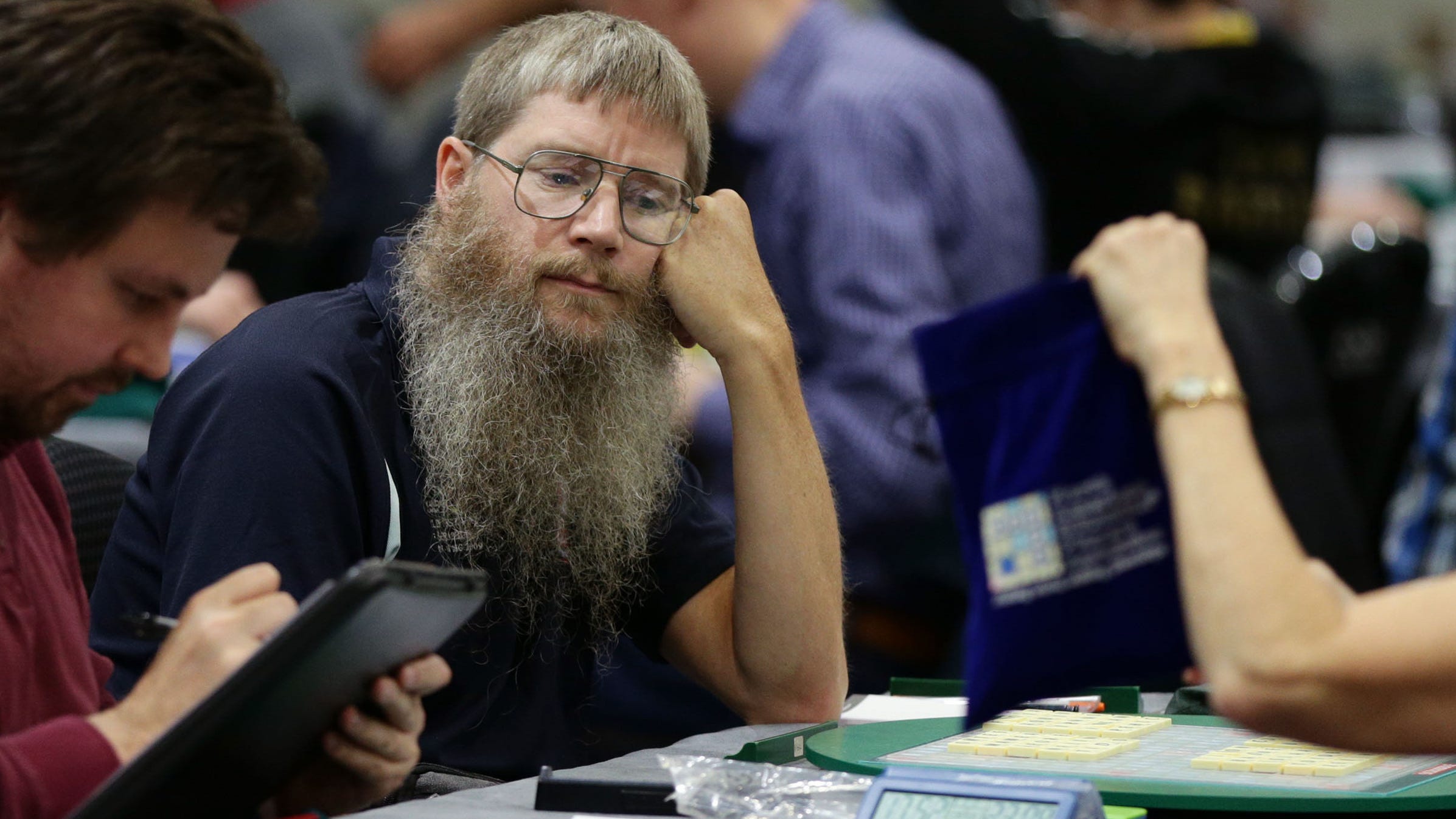
How did he do this? Remarkably, he memorized whole dictionaries (not most people’s idea of a fun activity). But it illustrates the extraordinary intensity and obsessiveness that can produce exceptional achievement.
There is evidence that intense, obsessive focus produces extraordinary achievement in a variety of areas, not just Scrabble. There are the guitarists who spend hours playing guitar, the soccer players who are always at the training ground, the painters who spend all their time painting, the gamers who are never away from their console, and so on.
There is also anecdotal evidence that extraordinary scientific achievements come from people who are intensely and obsessively focused on what they do. In the divorce announcement in a local paper, the ex-wife of legendary physicist Richard Feynman complained that “her husband worked calculus problems all day, as soon as he arose, while he drove his car, while sitting in the living room, and while lying in bed at night.”
And the movie Oppenheimer popularized the story of when the physicist J. Robert Oppenheimer was asked to deliver a physics lecture in Dutch (a language he did not speak). He locked himself in a room with a Dutch grammar book for a month and a half, and then delivered the lecture in pretty much flawless Dutch.
High-achieving scientists also tend to have very high IQs, but my point is not simply about IQ. Although high-achievers in many academic fields are disproportionately likely to be men, this is not necessarily because men are smarter. The evidence suggests that average IQ for males is about the same or perhaps slightly higher than average IQ for females. There is also evidence of a higher variance among men, which means there are more males in the far right and far left tails of the distributions (“more geniuses and more idiots,” as E. O. Wilson once memorably put it).
My point is that high-achievers, including high-achieving scientists, are more likely to be male because men are more likely to focus obsessively on their area of interest, and this helps them to rise to the top. They are also more willing to pay the costs of such intensive and obsessive focus, such as having your wife divorce you in the case of Feynman, or repelling people because of your inattention to personal hygiene, which I have been told is not uncommon at some technical schools.
Image:
[ed. Without conceding the point (see: Wikipedia: Women Achievers). So what? Men have different qualities than women (and vice versa). We should have more obsessives?]
Let Us Pray
May his days be few;
may another take his place of leadership.
~ Psalm 109:8-20
[ed. When sin is ignored for the sake of expediency you've betrayed your faith. Plain and simple. See also: Gone in 90 seconds (Guardian).]
may another take his place of leadership.
May his children be fatherless
and his wife a widow.
May his children be wandering beggars;
and his wife a widow.
May his children be wandering beggars;
may they be driven from their ruined homes.
May a creditor seize all he has;
may strangers plunder the fruits of his labor.
May no one extend kindness to him
or take pity on his fatherless children.
May his descendants be cut off,
their names blotted out from the next generation.
May the iniquity of his fathers be remembered before the Lord;
may the sin of his mother never be blotted out.
May their sins always remain before the Lord,
that he may blot out their name from the earth.
For he never thought of doing a kindness,
but hounded to death the poor
and the needy and the brokenhearted.
He loved to pronounce a curse—
may it come back on him.
He found no pleasure in blessing—
may it be far from him.
He wore cursing as his garment;
it entered into his body like water,
into his bones like oil.
May it be like a cloak wrapped about him,
like a belt tied forever around him.
May this be the Lord’s payment to my accusers,
to those who speak evil of me.
May a creditor seize all he has;
may strangers plunder the fruits of his labor.
May no one extend kindness to him
or take pity on his fatherless children.
May his descendants be cut off,
their names blotted out from the next generation.
May the iniquity of his fathers be remembered before the Lord;
may the sin of his mother never be blotted out.
May their sins always remain before the Lord,
that he may blot out their name from the earth.
For he never thought of doing a kindness,
but hounded to death the poor
and the needy and the brokenhearted.
He loved to pronounce a curse—
may it come back on him.
He found no pleasure in blessing—
may it be far from him.
He wore cursing as his garment;
it entered into his body like water,
into his bones like oil.
May it be like a cloak wrapped about him,
like a belt tied forever around him.
May this be the Lord’s payment to my accusers,
to those who speak evil of me.
~ Psalm 109:8-20

The Creative Class is Being Decimated. Why?
America is Losing Hundreds of Thousands of Jobs in Media, Film & the Arts. How Much is AI to Blame?
America has lost more than 200k jobs in “creative” industries over the last four years, with roughly 50k lost within the last year alone. That makes for one of the worst stretches for media employment in modern US history, with similar job loss intensity and duration occurring only during the major economic recessions of 2001 and 2008. Yet there’s no generalized recession today—instead, this period of job loss coincides with the rise of AI systems that can compose wholesale novels, photorealistic images, soundalike music, and practically every other form of digital art, en masse and at extremely low costs. Is this the fall of the Creative Class?
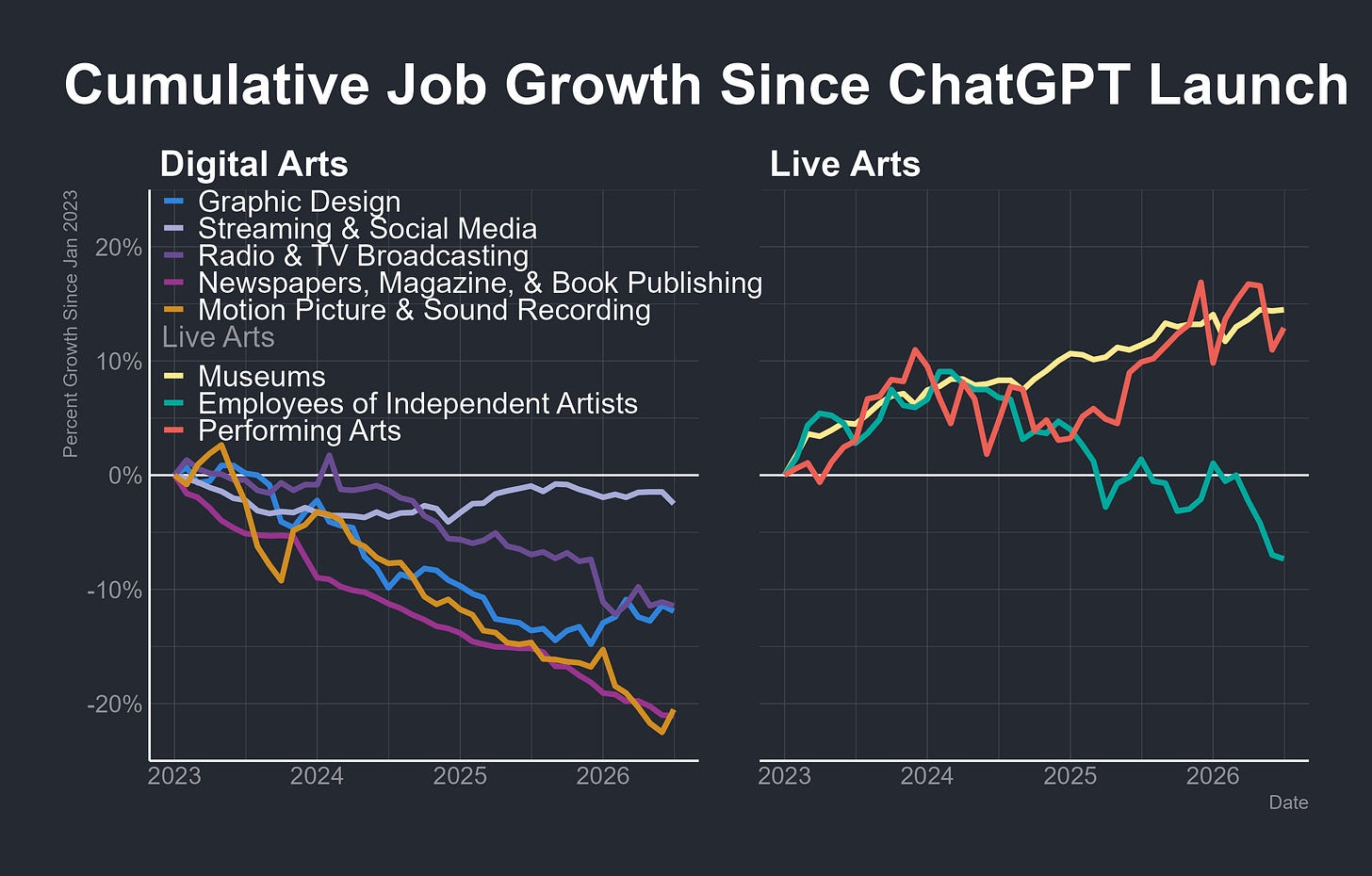
Proving the exact amount of AI-driven job loss in the arts is extremely difficult. Media firms are decidedly coy about their AI use, both to protect against public backlash and, more financially important, to preserve the legal basis for their copyrights. The effects of AI are also hard to disentangle from other factors currently affecting arts businesses, like consolidation in Hollywood, offshoring of content production, or the continued displacement of traditional media providers in favor of social media creators. Yet perhaps the clearest evidence of AI’s influence is just that all subsectors of the digital arts industry are losing jobs, while in-person entertainment is still growing at a healthy pace.
Some of those digital job losses are just a continuation of prior trends, like in the publishing industry where technological change has been continually grinding away newspaper and magazine jobs for decades. Yet for sectors like live broadcasting, streaming, or graphic design, recent experience is an unusual downturn compared to the tranquility of years prior. Then there’s the worst-hit sector, movie & sound recording, which has been bleeding jobs at a nearly unprecedented pace over the last three years.
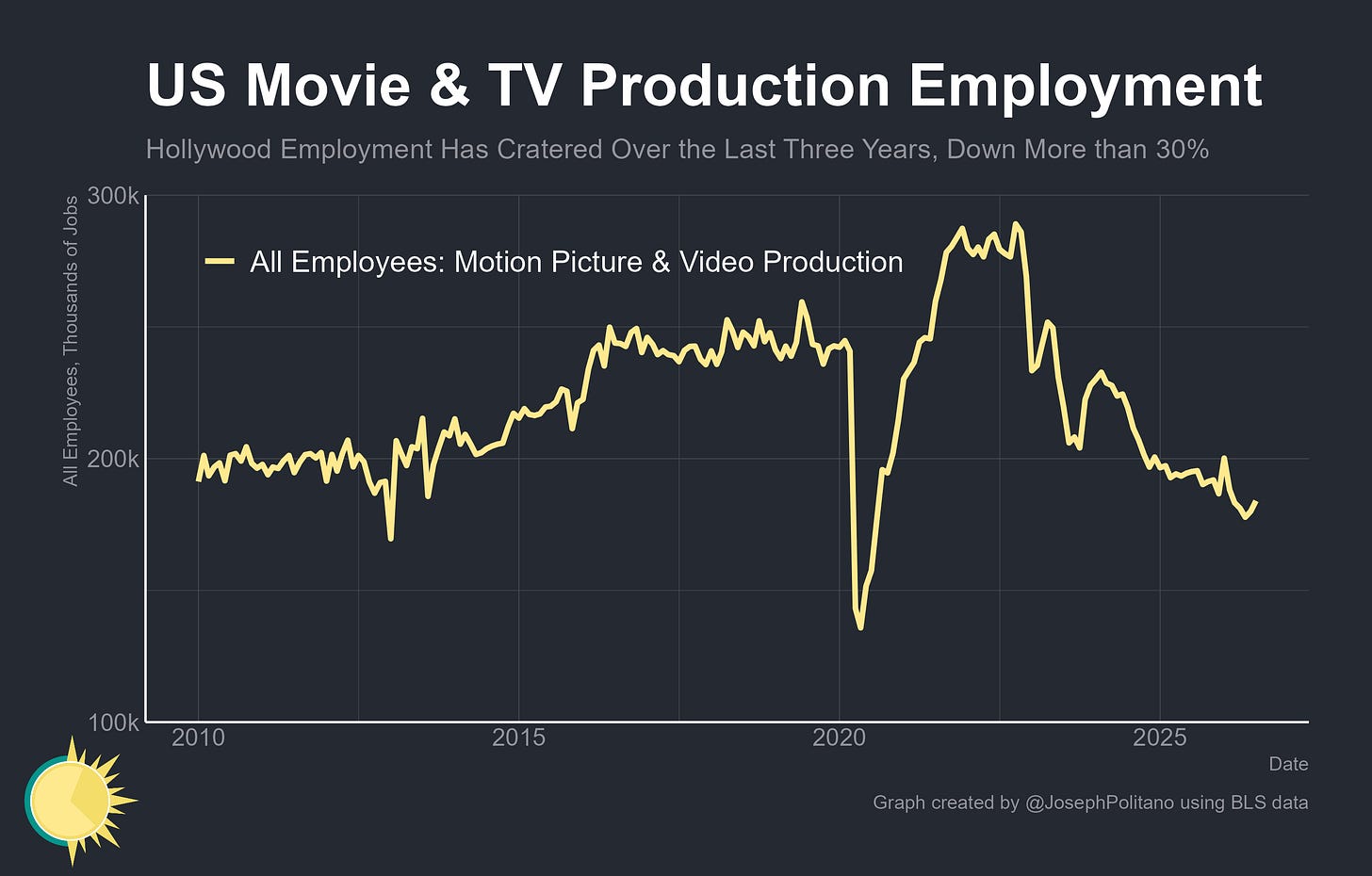
Hollywood has never seen a stretch as bad as the last four years, with the movie & TV industry losing more than 100k jobs, nearly one-third of the sector’s total. At the depths touched this summer, total employment was lower than at any point since the 2008 recession and approaching the lowest point in 30 years. The streaming era has proven an extremely difficult transition, with traditional films and TV shows losing watch time to user-generated and increasingly AI-assisted or AI-generated content flows.
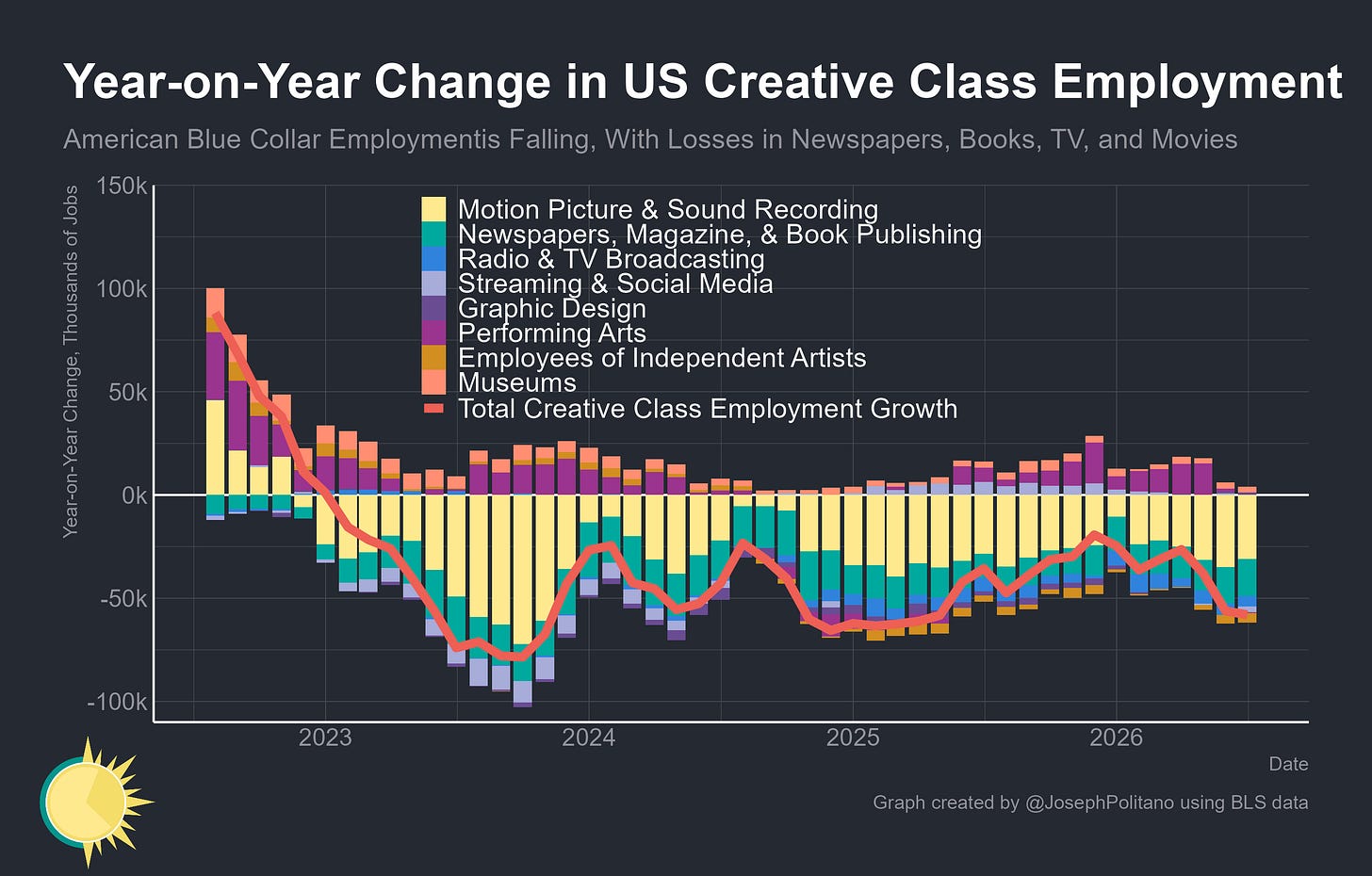
Overall, nearly half the media job losses of the last four years have been concentrated in the movie & sound recording sector that includes Hollywood. Written publishing has been the next-largest source of job loss, with employment down by more than 70k over the same time frame. Yet the job losses have by no means been contained to any particular part of media; instead they’ve hit nearly every subsector at some point. Nor do they show any sign of abating, with losses consistently hovering at around 50k per year and even accelerating in recent months. Will further AI development continue displacing workers in creative industries?
Can the Arts Business Model Survive?
To understand what could happen to the business of art amidst the rise of AI, it’s important to understand what did happen to it during the first digital transition, the rise of the internet.
It was the turn of the millennium, and Metallica had a problem. Demos of their upcoming, unreleased tracks were bouncing around radio and the internet, originally leaked onto a new internet file-sharing website called Napster. There they found thousands of files shared amongst hundreds of thousands of users, many of which were direct rips of albums that sold for $15 being offered for free. The most anticipated albums were often leaked online even before they were on store shelves. Metallica sued Napster for copyright infringement, and they were soon joined by separate suits from other prominent artists and eventually the Recording Industry Association of America (RIAA).
Much of the general public was understandably unsympathetic to Metallica, perceived as a bunch of already-successful millionaires trying to bilk even more money from listeners, and were even less sympathetic towards the RIAA, perceived as scurrilous middlemen who take from artists and fans alike. But the two of them easily won their lawsuit, forcing Napster into bankruptcy. Yet Metallica may have been right on the law but were on the wrong side of technology; the RIAA had won the battle but was losing the war.
The modern internet made file-sharing extremely easy, and no matter how much whac-a-mole companies played, they could not possibly catch every illegal upload. The perennial threat of piracy undermined their copyright and limited their ability to charge for music. Eventually, the value of individual songs fell to the point that companies like Spotify and Apple Music could swoop in to acquire massive catalogues, consolidate them, and charge a comparatively trivial fee for access. For what a single Metallica album would have cost in 2000, you can now get a month’s worth of unlimited access to nearly all human-made music.
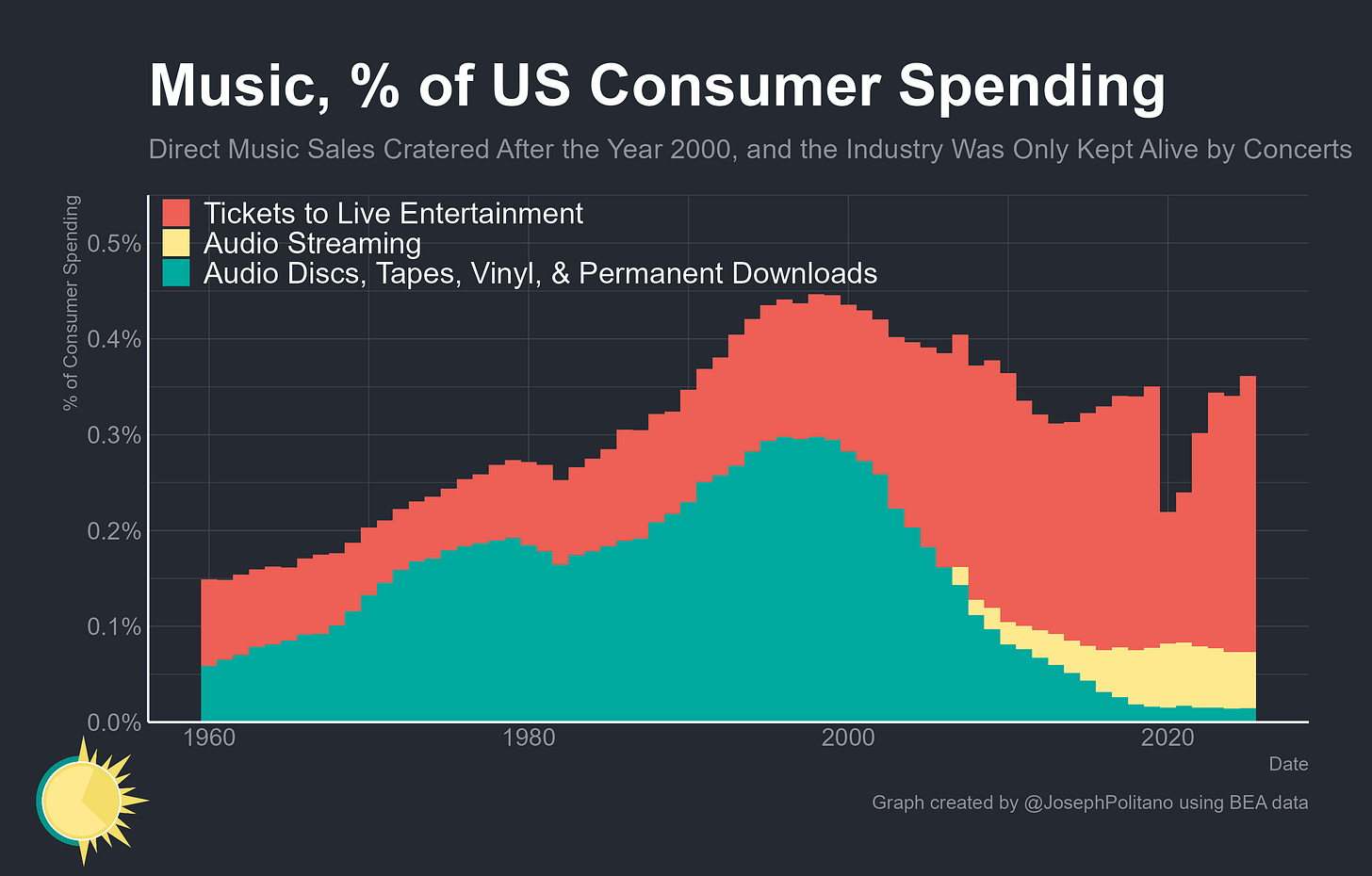
The music industry has never returned to the heyday paydays of the peak CD era—even without adjusting for inflation, streaming revenue pales in comparison to ‘90s physical media sales. This was a massive boon to consumers, but it was also a squeeze on musicians that forced them to fundamentally change their business model over time. Instead of just selling records to earn money directly, music itself increasingly became a loss-leading advertisement for the live concerts (and merch) that provided a growing share of artists’ income. Tours got longer, venues got bigger, ticket prices skyrocketed, and musicians frequently took on roles closer to public influencers than isolated artistes. Were it not for rising concert sales, the business model of music would have completely collapsed, and the income going to musicians would have cratered.
Of course, there were still significant downsides to the transition into the streaming era. Bands (especially smaller ones) complain about the unending pressure to always be on tour. Musicians whose content was suited to home listening lost out to those more suited to giant festivals. Even accounting for concert revenues, musicians made less money than before. Yet musicians fared better than many areas of entertainment subsectors because there was a live component to fall back on—for many media industries, the digital era left no such comfort. [Chart]
Over time, the business of video has moved in the opposite direction of music—out of the theatre and into the home. Hollywood formerly made most of its money enticing customers to visit sold-out movie theatres, but these were gradually supplanted by broadcast TV, cable, and physical media. Yet because each successful technological leap increased total video watch time, the industry was still able to thrive amidst technological upheaval. That is, until the modern streaming era.
Today, the plethora of video options and the rise of social media have sent video producers into a vicious competition for limited attention. Even before adjusting for inflation, movie ticket sales ended last year down 25% from their 2019 peak, cable revenue is down 18% from its peak, and streaming revenue has not been able to compensate for the drop. The mountain of free user-generated content on YouTube, Twitch, TikTok, or social media was already presenting harsh competition for traditional video companies in the years before ChatGPT’s launch, and now streaming services are also competing with a flood of AI-generated content. The business model of video media is fundamentally getting squeezed, and unlike in the music industry, there’s basically no equivalent to live concerts that Hollywood can be used to ease the pain.
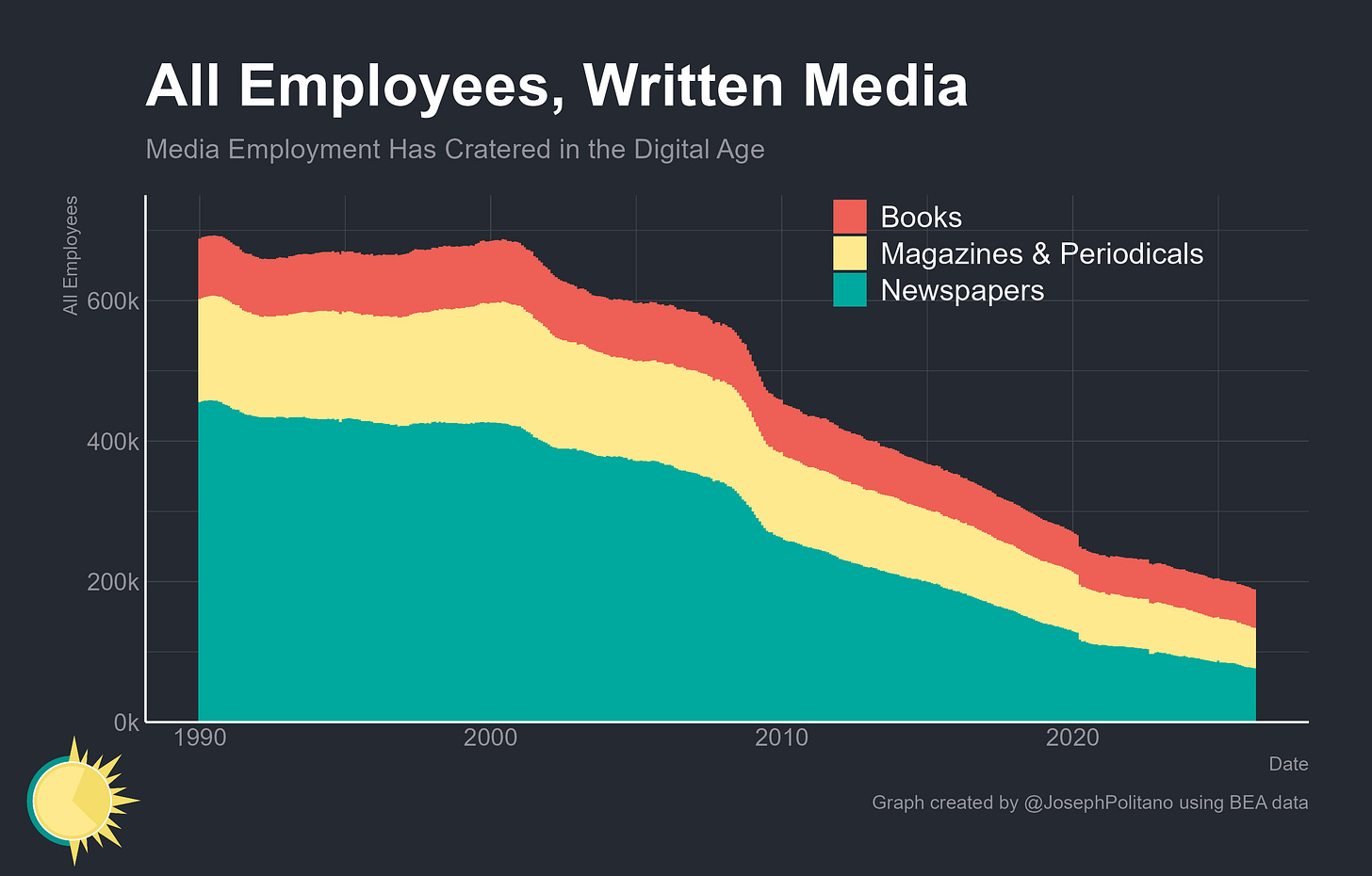
The actual worst-case scenario for creative workers amidst the AI revolution is something similar to what happened to the publishing industry after the advent of the internet—that is, near-total collapse of their fundamental business model. Newspapers used to employ roughly half a million people in the US, more than the entire oil industry, and now their payrolls are down nearly 85% and still dropping. Magazine publishers likewise have let 66% of their staff go since the 90s, while book publishers have lost 40%.
The routine informational updates that previously formed newspapers’ bread-and-butter were all de-bundled—box scores moved to sports websites, stock movements went to financial websites, forecasts went to weather websites—each loss compounding on itself to undermine consumers’ need to buy the paper. Search engines became the first place people looked to for information, and newspapers’ advertising revenue rapidly started flowing to companies like Google instead. The collective of social media users became faster at breaking any news story than a daily paper could ever hope to be. When papers eventually did start aggressively paywalling content, the internet made it trivially easy for people to just copy the articles’ content and share it beyond the paywall. The entire business model had collapsed, to the point that now only a select few major newspapers can even survive.
That scale of copyright dilution and forced unbundling is the worst-case scenario for media businesses in the age of AI. It’s possible arts jobs could survive via consumers’ deep-seated aversion to explicitly AI-generated content, but AI is increasingly being used throughout media in ways invisible to the average end consumer. Roughly 32% of workers in the overall arts, entertainment, and recreation sector use Generative AI to some extent, which is less than the 62% average across all industries, but still enough that virtually every major media project could have some AI within its workflow.
Indeed, AI is likely seeping into media production processes in ways large companies themselves would struggle to prevent even when they desire to—how can a TV studio be sure nobody in their writers’ room is consulting ChatGPT for jokes or any storyboard artist is generating concept art? And even if professional TV and movie studios do effectively hold out against temptation and prevent internal AI use, how long can they compete with the large mass of wannabe independent creators with much fewer scruples? Plenty of media businesses tried to hold out against the algorithmic content waves of the 2010s and were buried as a result.
by Joseph Politano, Apricitas Economics | Read more:
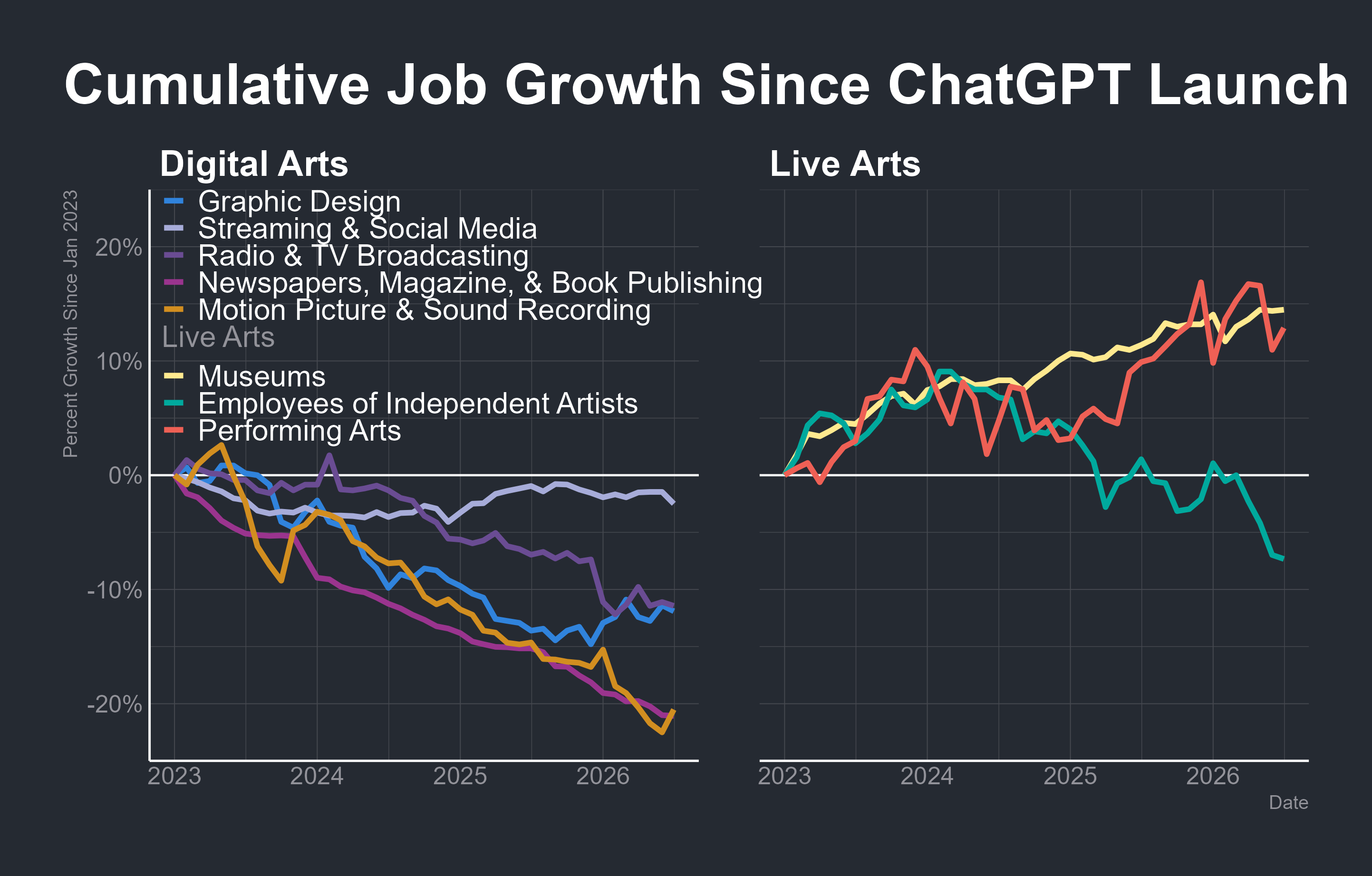
Proving the exact amount of AI-driven job loss in the arts is extremely difficult. Media firms are decidedly coy about their AI use, both to protect against public backlash and, more financially important, to preserve the legal basis for their copyrights. The effects of AI are also hard to disentangle from other factors currently affecting arts businesses, like consolidation in Hollywood, offshoring of content production, or the continued displacement of traditional media providers in favor of social media creators. Yet perhaps the clearest evidence of AI’s influence is just that all subsectors of the digital arts industry are losing jobs, while in-person entertainment is still growing at a healthy pace.
Some of those digital job losses are just a continuation of prior trends, like in the publishing industry where technological change has been continually grinding away newspaper and magazine jobs for decades. Yet for sectors like live broadcasting, streaming, or graphic design, recent experience is an unusual downturn compared to the tranquility of years prior. Then there’s the worst-hit sector, movie & sound recording, which has been bleeding jobs at a nearly unprecedented pace over the last three years.
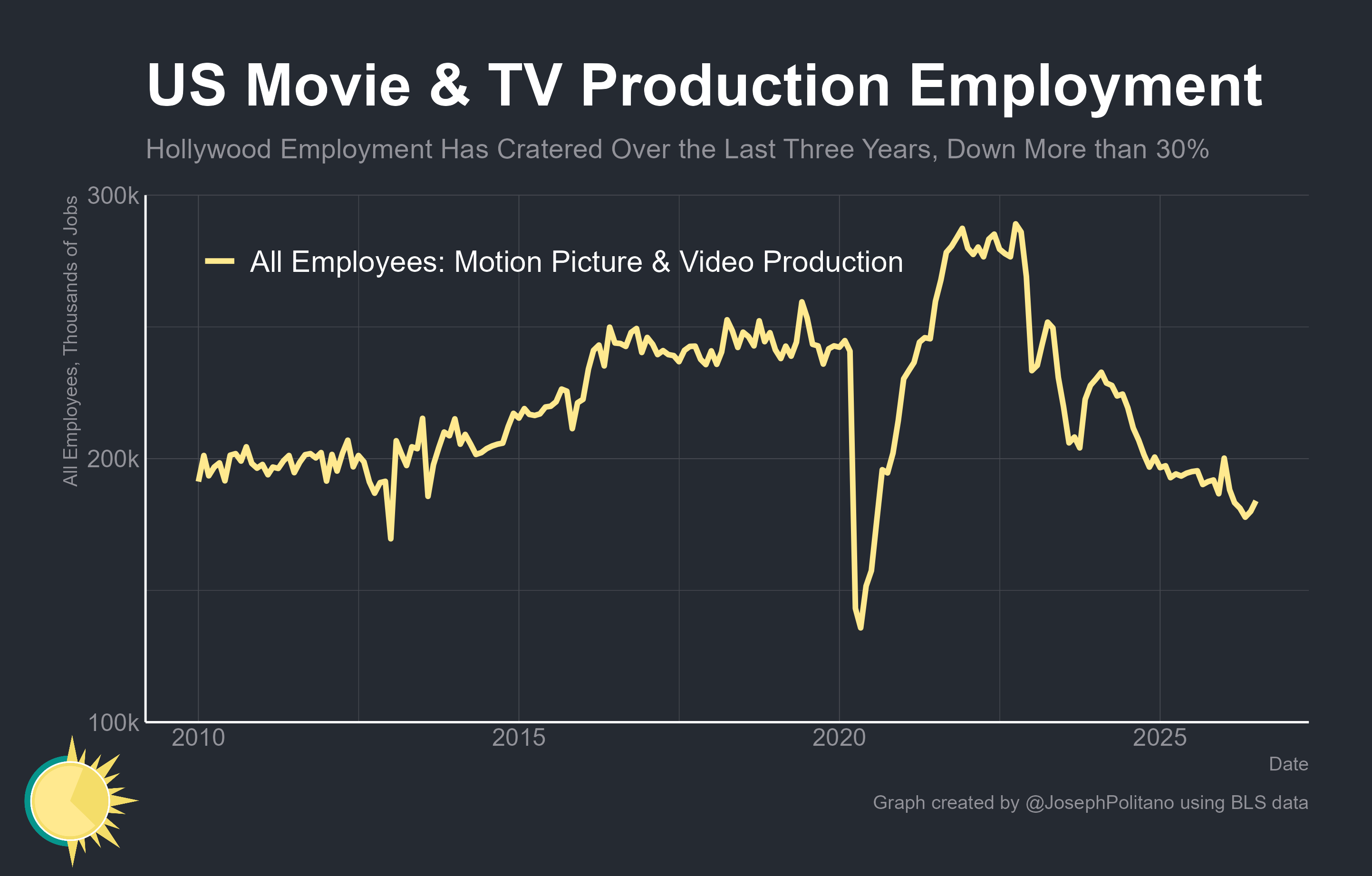
Hollywood has never seen a stretch as bad as the last four years, with the movie & TV industry losing more than 100k jobs, nearly one-third of the sector’s total. At the depths touched this summer, total employment was lower than at any point since the 2008 recession and approaching the lowest point in 30 years. The streaming era has proven an extremely difficult transition, with traditional films and TV shows losing watch time to user-generated and increasingly AI-assisted or AI-generated content flows.
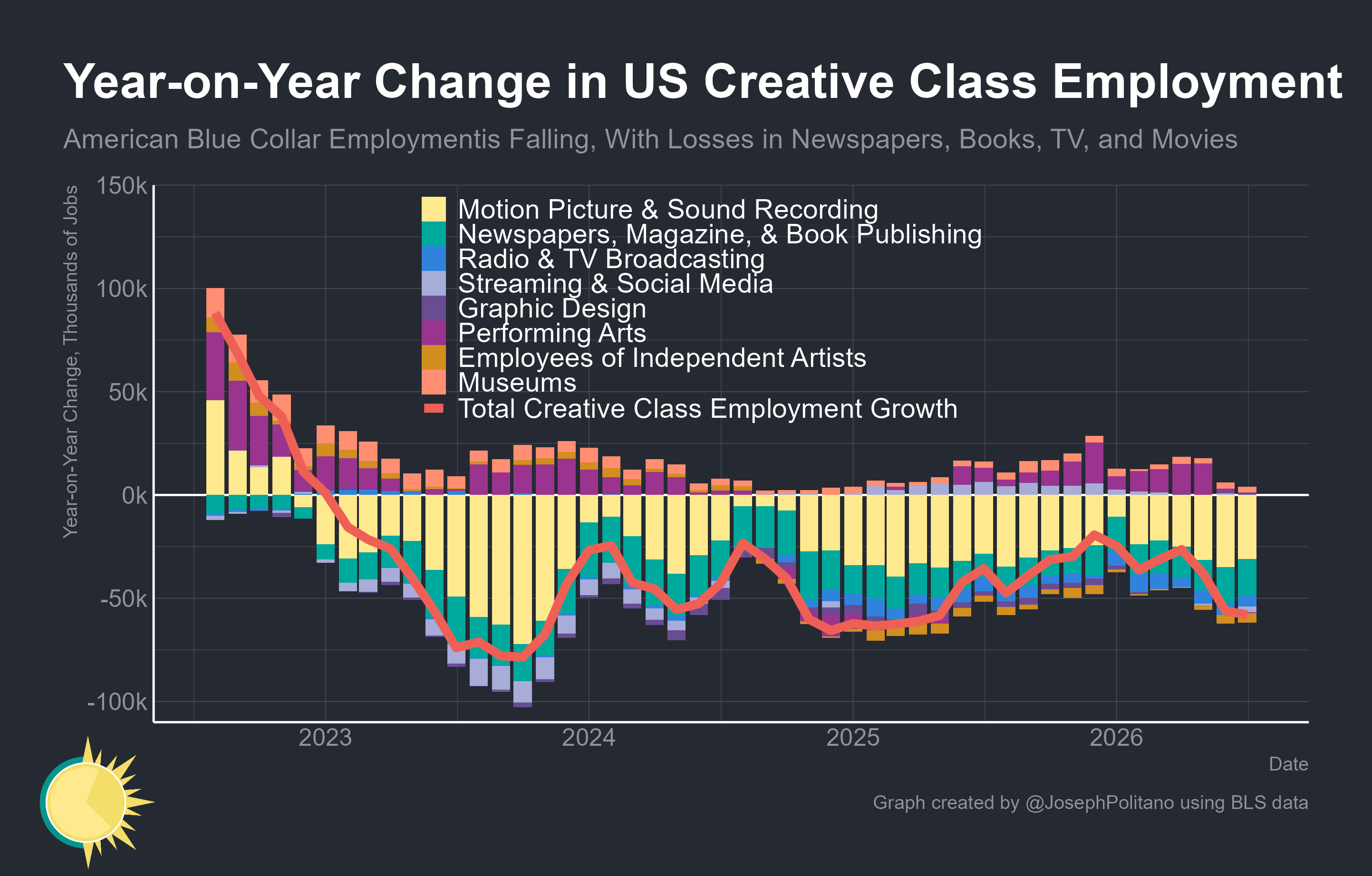
Overall, nearly half the media job losses of the last four years have been concentrated in the movie & sound recording sector that includes Hollywood. Written publishing has been the next-largest source of job loss, with employment down by more than 70k over the same time frame. Yet the job losses have by no means been contained to any particular part of media; instead they’ve hit nearly every subsector at some point. Nor do they show any sign of abating, with losses consistently hovering at around 50k per year and even accelerating in recent months. Will further AI development continue displacing workers in creative industries?
Can the Arts Business Model Survive?
To understand what could happen to the business of art amidst the rise of AI, it’s important to understand what did happen to it during the first digital transition, the rise of the internet.
It was the turn of the millennium, and Metallica had a problem. Demos of their upcoming, unreleased tracks were bouncing around radio and the internet, originally leaked onto a new internet file-sharing website called Napster. There they found thousands of files shared amongst hundreds of thousands of users, many of which were direct rips of albums that sold for $15 being offered for free. The most anticipated albums were often leaked online even before they were on store shelves. Metallica sued Napster for copyright infringement, and they were soon joined by separate suits from other prominent artists and eventually the Recording Industry Association of America (RIAA).
Much of the general public was understandably unsympathetic to Metallica, perceived as a bunch of already-successful millionaires trying to bilk even more money from listeners, and were even less sympathetic towards the RIAA, perceived as scurrilous middlemen who take from artists and fans alike. But the two of them easily won their lawsuit, forcing Napster into bankruptcy. Yet Metallica may have been right on the law but were on the wrong side of technology; the RIAA had won the battle but was losing the war.
The modern internet made file-sharing extremely easy, and no matter how much whac-a-mole companies played, they could not possibly catch every illegal upload. The perennial threat of piracy undermined their copyright and limited their ability to charge for music. Eventually, the value of individual songs fell to the point that companies like Spotify and Apple Music could swoop in to acquire massive catalogues, consolidate them, and charge a comparatively trivial fee for access. For what a single Metallica album would have cost in 2000, you can now get a month’s worth of unlimited access to nearly all human-made music.
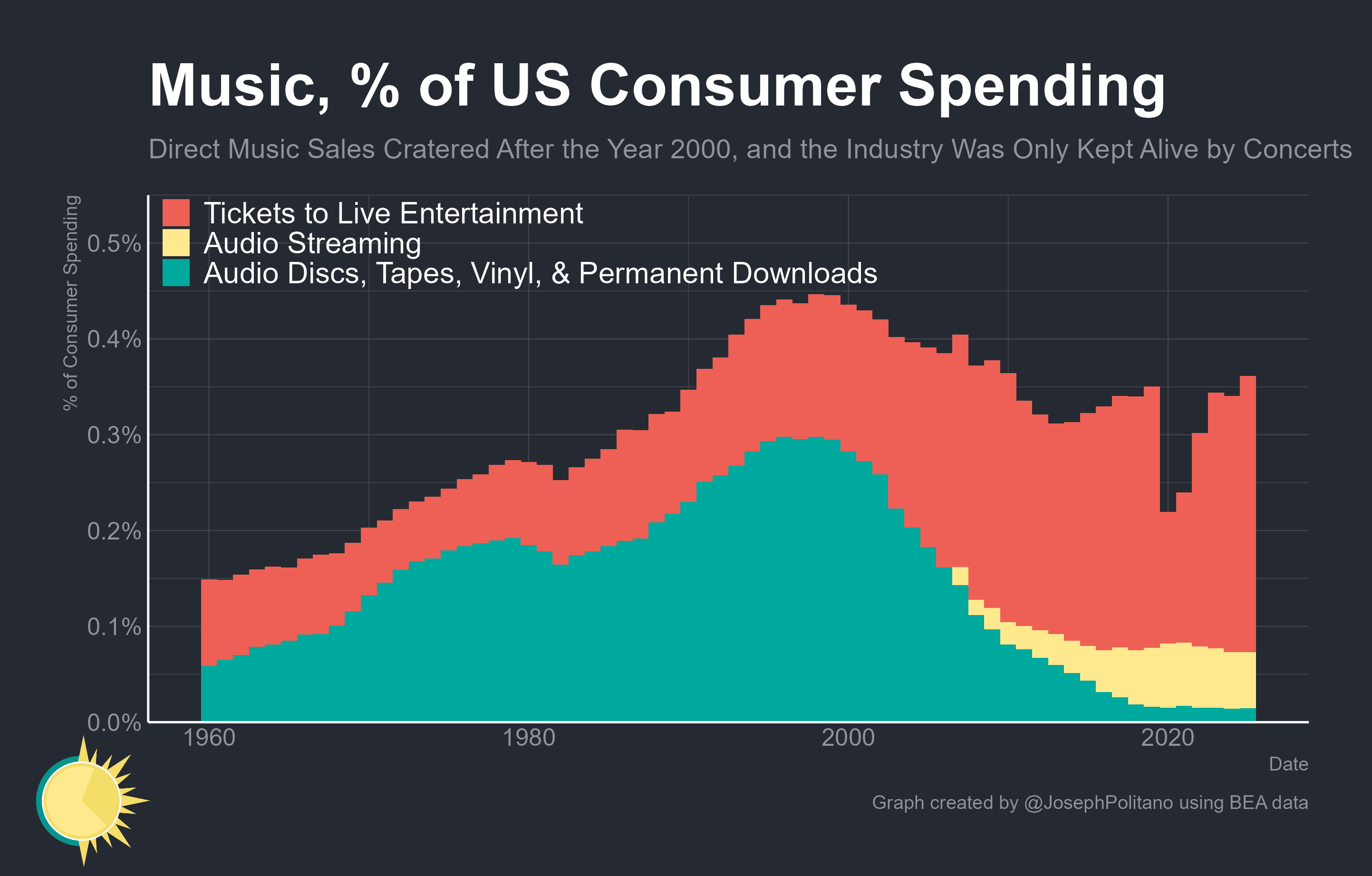
The music industry has never returned to the heyday paydays of the peak CD era—even without adjusting for inflation, streaming revenue pales in comparison to ‘90s physical media sales. This was a massive boon to consumers, but it was also a squeeze on musicians that forced them to fundamentally change their business model over time. Instead of just selling records to earn money directly, music itself increasingly became a loss-leading advertisement for the live concerts (and merch) that provided a growing share of artists’ income. Tours got longer, venues got bigger, ticket prices skyrocketed, and musicians frequently took on roles closer to public influencers than isolated artistes. Were it not for rising concert sales, the business model of music would have completely collapsed, and the income going to musicians would have cratered.
Of course, there were still significant downsides to the transition into the streaming era. Bands (especially smaller ones) complain about the unending pressure to always be on tour. Musicians whose content was suited to home listening lost out to those more suited to giant festivals. Even accounting for concert revenues, musicians made less money than before. Yet musicians fared better than many areas of entertainment subsectors because there was a live component to fall back on—for many media industries, the digital era left no such comfort. [Chart]
Over time, the business of video has moved in the opposite direction of music—out of the theatre and into the home. Hollywood formerly made most of its money enticing customers to visit sold-out movie theatres, but these were gradually supplanted by broadcast TV, cable, and physical media. Yet because each successful technological leap increased total video watch time, the industry was still able to thrive amidst technological upheaval. That is, until the modern streaming era.
Today, the plethora of video options and the rise of social media have sent video producers into a vicious competition for limited attention. Even before adjusting for inflation, movie ticket sales ended last year down 25% from their 2019 peak, cable revenue is down 18% from its peak, and streaming revenue has not been able to compensate for the drop. The mountain of free user-generated content on YouTube, Twitch, TikTok, or social media was already presenting harsh competition for traditional video companies in the years before ChatGPT’s launch, and now streaming services are also competing with a flood of AI-generated content. The business model of video media is fundamentally getting squeezed, and unlike in the music industry, there’s basically no equivalent to live concerts that Hollywood can be used to ease the pain.
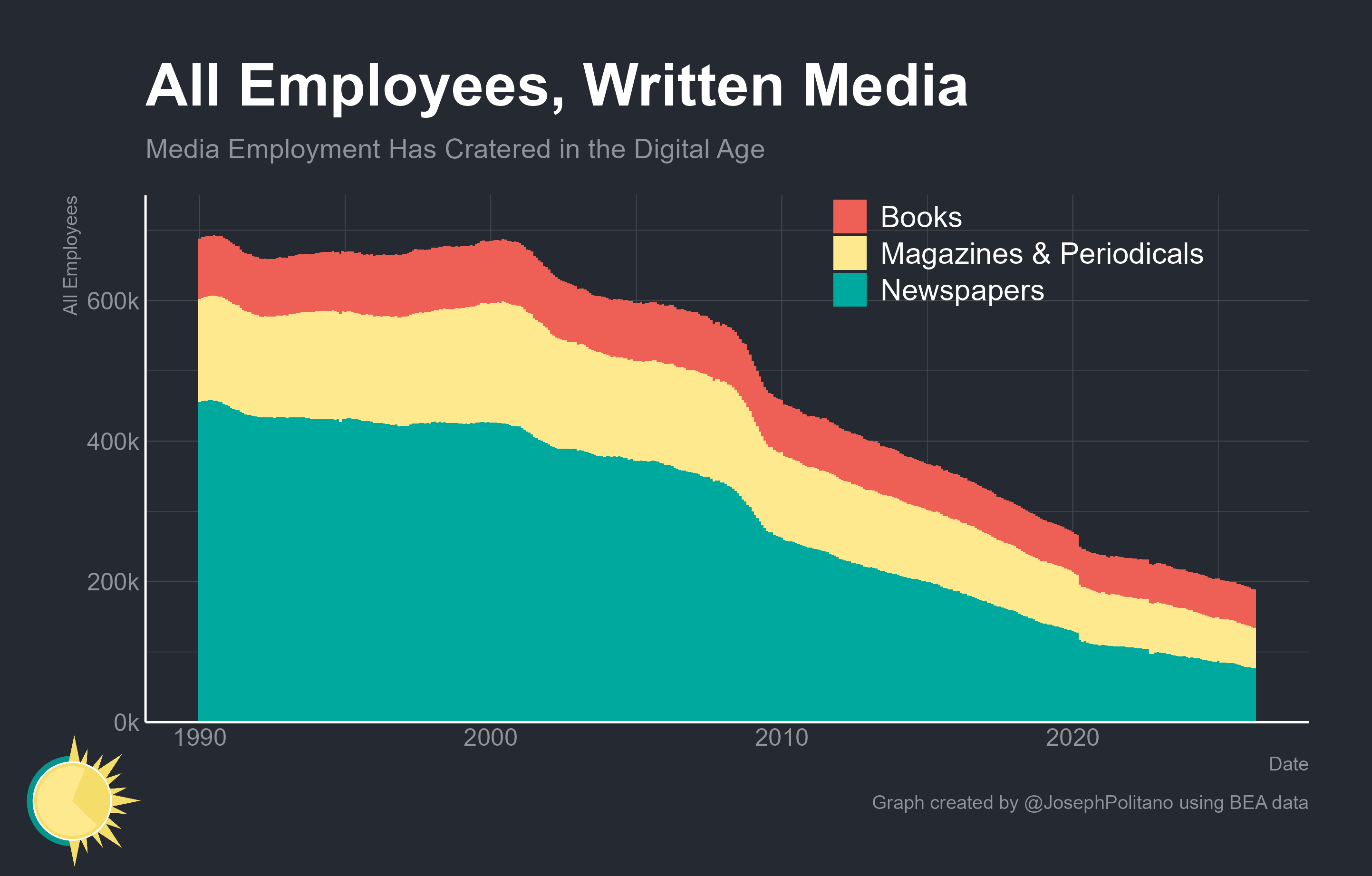
The actual worst-case scenario for creative workers amidst the AI revolution is something similar to what happened to the publishing industry after the advent of the internet—that is, near-total collapse of their fundamental business model. Newspapers used to employ roughly half a million people in the US, more than the entire oil industry, and now their payrolls are down nearly 85% and still dropping. Magazine publishers likewise have let 66% of their staff go since the 90s, while book publishers have lost 40%.
The routine informational updates that previously formed newspapers’ bread-and-butter were all de-bundled—box scores moved to sports websites, stock movements went to financial websites, forecasts went to weather websites—each loss compounding on itself to undermine consumers’ need to buy the paper. Search engines became the first place people looked to for information, and newspapers’ advertising revenue rapidly started flowing to companies like Google instead. The collective of social media users became faster at breaking any news story than a daily paper could ever hope to be. When papers eventually did start aggressively paywalling content, the internet made it trivially easy for people to just copy the articles’ content and share it beyond the paywall. The entire business model had collapsed, to the point that now only a select few major newspapers can even survive.
That scale of copyright dilution and forced unbundling is the worst-case scenario for media businesses in the age of AI. It’s possible arts jobs could survive via consumers’ deep-seated aversion to explicitly AI-generated content, but AI is increasingly being used throughout media in ways invisible to the average end consumer. Roughly 32% of workers in the overall arts, entertainment, and recreation sector use Generative AI to some extent, which is less than the 62% average across all industries, but still enough that virtually every major media project could have some AI within its workflow.
Indeed, AI is likely seeping into media production processes in ways large companies themselves would struggle to prevent even when they desire to—how can a TV studio be sure nobody in their writers’ room is consulting ChatGPT for jokes or any storyboard artist is generating concept art? And even if professional TV and movie studios do effectively hold out against temptation and prevent internal AI use, how long can they compete with the large mass of wannabe independent creators with much fewer scruples? Plenty of media businesses tried to hold out against the algorithmic content waves of the 2010s and were buried as a result.
by Joseph Politano, Apricitas Economics | Read more:
Images: Joseph Politano

AI: The Biggest Economic Bet in US History
The US economy continues to expand faster than other G7 economies, but the driver is the humungous investment in AI models, data centres and all the AI-related chips and technology.
The US composite PMI (economic activity measure) rose to 58.4 fom 56 in August, the strongest expansion in private-sector activity since July 2021 and marking a fourth consecutive month of accelerating growth. The gains were driven by the service sector (including information services) with the steepest rise in output for over five years, while manufacturing also accelerated. New orders grew at the fastest pace since April 2022, while manufacturing hiring was the strongest since February 2021. [Chart]
Back in June, I commented that AI was just ‘one big trade for the US economy’. But now in September that appears to be an understatement. The AI build-out is on track to become the biggest economic bet in US history, dwarfing the investments made to fund other huge US infrastructure projects in the past, such as the railroads in the 19th century, the highway system in 20th century and the internet in the 21st century. [Chart]
Analysts estimate that capital spending at five of the so-called hyperscalers—Alphabet, Amazon.com, Meta Platforms, Microsoft and Oracle—will be $4.2 trillion in the four years ending in 2029, according to FactSet. Data-centre spending is greater than that for the canals, railroads and grid combined, projected to total $10.3 trillion from 2025 to 2032, according to new estimates by the Brookings Institution. That is a staggering average 3.6% of GDP a year. Never before has the US economy been so dependent on the build-out of a single industry. [Chart]
Up to July, $37 billion has been spent on private data-centres with most still not operating.

In contrast, US private construction spending on everything else—houses, apartment buildings, shopping centers and so on—was about $46 billion below year-earlier levels in the first seven months of this year.

AI investment has created 750,000 new jobs since 2023, according to LinkedIn estimates. And those jobs pay well: the median annual salary for AI-related job listings on LinkedIn is around $180,000, compared with $80,000 for all jobs.

Above all, the AI investment has led to huge gains in stock-market wealth. As of Q2 2026, US stock and mutual fund holdings came to $63 trillion, according to the Federal Reserve—nearly double the amount at the end of 2022. Most of this increase in financial wealth has gone to the already rich, as working people own little stocks or bonds. [Chart]
Foreign investors are piling into US assets. They now hold a record $39 trillion in US equities and bonds, up since 2022.. This is keeping the US dollar relatively strong and driving up stock prices. The wars in Ukraine and Iran encourage foreigners to shift their assets to the US to take advantage of the boom. [Chart]
At the same time, demand for equipment that goes into data centres like memory chips is driving up costs for tech products. Import prices on computers, peripherals (such as hard drives) and semiconductors were 20% higher in August than a year earlier. These high import prices are in turn putting upward pressure on the costs of consumer goods, such as iPhones and gaming consoles, and contributing to general inflation. [Chart]
But here is the problem. The gap between hyperscaler spending and cash flow is widening fast. Capital expenditures at Amazon, Meta, Microsoft, and Alphabet are projected to exceed $1 trillion in 2027 for the first time. At the same time, combined ‘free cash flow’ (ie money from profits in existing businesses) is projected to fall below $100 billion. A year ago, free cash flow was around $200 billion, while capex was $300 billion. Now, AI spending is accelerating at the same time as the cash available to fund it is disappearing. [Chart]
The bigger this gap becomes, the more the hyperscalers need to rely on debt and equity markets to finance their AI spend. [Chart]
The issue is that if AI spending fails to generate sufficient returns (profits), the stock market could take sharp turn downward as investors bail out. US stock market prices are massively overvalued relative to existing earnings. The trend ratio of stock market prices to earnings per share (called the CAPE ratio) is above the level just before the 2008 financial crash and nearly at the level just before the dot.com bust of 2000. [Chart]
Will profits come through? Research by Fathom Consulting shows that for the multitrillion-dollar AI boom to turn a profit, it would need the AI-related sales of the tech companies involved to rise by $600-800bn within the next two years. But the consulting firm Panmure Liberum calculated that current CAPEX and revenue forecasts through 2030 imply a negative internal rate of return on invested capital for Alphabet, Meta, Microsoft, and Oracle.
So either the hyperscalers significantly reduce their capital spending on AI to levels that generate a reasonable profit on capital already invested or by some miracle they deliver massive profitablity from a huge future increase in demand for AI products. If they cut spending, that would signal to investors that AI is not delivering and they would sell off accordingly. A crash would ensue. So they must keep spending more and more. [Chart]
At the same time, what companies can charge for AI computing costs (tokens) is falling fast. The LLM Token Expenditure Index, which tracks the market price companies pay for AI model output, has fallen to just $0.97, its lowest level since the index was created late last year and more than 50% below its summer peak. Token prices are collapsing as cheaper models, open-source Chinese competitors and falling training (inference) costs make AI usage increasingly cheap. That is eroding revenue growth for the AI labs, making it more difficult to meet the bills for AI infrastructure spend. [...]
A key question is whether AI is actually going to deliver a step-change in US labour productivity that could boost economic progress for a generation. The AI lab, Anthropic, wants to issue shares worth $100bn to the public in November (thus valuing the company at $2trn!). To build up its case, it published a report in which it claimed that if AI really takes off, US GDP could rise by 32% by 2030(!), that’s annual growth in GDP of up to 15% (against current US growth at 2.5% at best).
This is wild nonsense that assumes that AI works in boosting productivity growth as every company in the US adopts AI agents and tools to run their businesses, while sacking millions of workers who are no longer needed.
by Michael Roberts, The Next Recession | Read more:
Images: Financial Times; Commerce Dept.; uncredited
The US composite PMI (economic activity measure) rose to 58.4 fom 56 in August, the strongest expansion in private-sector activity since July 2021 and marking a fourth consecutive month of accelerating growth. The gains were driven by the service sector (including information services) with the steepest rise in output for over five years, while manufacturing also accelerated. New orders grew at the fastest pace since April 2022, while manufacturing hiring was the strongest since February 2021. [Chart]
Back in June, I commented that AI was just ‘one big trade for the US economy’. But now in September that appears to be an understatement. The AI build-out is on track to become the biggest economic bet in US history, dwarfing the investments made to fund other huge US infrastructure projects in the past, such as the railroads in the 19th century, the highway system in 20th century and the internet in the 21st century. [Chart]
Analysts estimate that capital spending at five of the so-called hyperscalers—Alphabet, Amazon.com, Meta Platforms, Microsoft and Oracle—will be $4.2 trillion in the four years ending in 2029, according to FactSet. Data-centre spending is greater than that for the canals, railroads and grid combined, projected to total $10.3 trillion from 2025 to 2032, according to new estimates by the Brookings Institution. That is a staggering average 3.6% of GDP a year. Never before has the US economy been so dependent on the build-out of a single industry. [Chart]
Up to July, $37 billion has been spent on private data-centres with most still not operating.
In contrast, US private construction spending on everything else—houses, apartment buildings, shopping centers and so on—was about $46 billion below year-earlier levels in the first seven months of this year.

AI investment has created 750,000 new jobs since 2023, according to LinkedIn estimates. And those jobs pay well: the median annual salary for AI-related job listings on LinkedIn is around $180,000, compared with $80,000 for all jobs.

Above all, the AI investment has led to huge gains in stock-market wealth. As of Q2 2026, US stock and mutual fund holdings came to $63 trillion, according to the Federal Reserve—nearly double the amount at the end of 2022. Most of this increase in financial wealth has gone to the already rich, as working people own little stocks or bonds. [Chart]
Foreign investors are piling into US assets. They now hold a record $39 trillion in US equities and bonds, up since 2022.. This is keeping the US dollar relatively strong and driving up stock prices. The wars in Ukraine and Iran encourage foreigners to shift their assets to the US to take advantage of the boom. [Chart]
At the same time, demand for equipment that goes into data centres like memory chips is driving up costs for tech products. Import prices on computers, peripherals (such as hard drives) and semiconductors were 20% higher in August than a year earlier. These high import prices are in turn putting upward pressure on the costs of consumer goods, such as iPhones and gaming consoles, and contributing to general inflation. [Chart]
But here is the problem. The gap between hyperscaler spending and cash flow is widening fast. Capital expenditures at Amazon, Meta, Microsoft, and Alphabet are projected to exceed $1 trillion in 2027 for the first time. At the same time, combined ‘free cash flow’ (ie money from profits in existing businesses) is projected to fall below $100 billion. A year ago, free cash flow was around $200 billion, while capex was $300 billion. Now, AI spending is accelerating at the same time as the cash available to fund it is disappearing. [Chart]
The bigger this gap becomes, the more the hyperscalers need to rely on debt and equity markets to finance their AI spend. [Chart]
The issue is that if AI spending fails to generate sufficient returns (profits), the stock market could take sharp turn downward as investors bail out. US stock market prices are massively overvalued relative to existing earnings. The trend ratio of stock market prices to earnings per share (called the CAPE ratio) is above the level just before the 2008 financial crash and nearly at the level just before the dot.com bust of 2000. [Chart]
Will profits come through? Research by Fathom Consulting shows that for the multitrillion-dollar AI boom to turn a profit, it would need the AI-related sales of the tech companies involved to rise by $600-800bn within the next two years. But the consulting firm Panmure Liberum calculated that current CAPEX and revenue forecasts through 2030 imply a negative internal rate of return on invested capital for Alphabet, Meta, Microsoft, and Oracle.
So either the hyperscalers significantly reduce their capital spending on AI to levels that generate a reasonable profit on capital already invested or by some miracle they deliver massive profitablity from a huge future increase in demand for AI products. If they cut spending, that would signal to investors that AI is not delivering and they would sell off accordingly. A crash would ensue. So they must keep spending more and more. [Chart]
At the same time, what companies can charge for AI computing costs (tokens) is falling fast. The LLM Token Expenditure Index, which tracks the market price companies pay for AI model output, has fallen to just $0.97, its lowest level since the index was created late last year and more than 50% below its summer peak. Token prices are collapsing as cheaper models, open-source Chinese competitors and falling training (inference) costs make AI usage increasingly cheap. That is eroding revenue growth for the AI labs, making it more difficult to meet the bills for AI infrastructure spend. [...]
A key question is whether AI is actually going to deliver a step-change in US labour productivity that could boost economic progress for a generation. The AI lab, Anthropic, wants to issue shares worth $100bn to the public in November (thus valuing the company at $2trn!). To build up its case, it published a report in which it claimed that if AI really takes off, US GDP could rise by 32% by 2030(!), that’s annual growth in GDP of up to 15% (against current US growth at 2.5% at best).
This is wild nonsense that assumes that AI works in boosting productivity growth as every company in the US adopts AI agents and tools to run their businesses, while sacking millions of workers who are no longer needed.
by Michael Roberts, The Next Recession | Read more:
Images: Financial Times; Commerce Dept.; uncredited
Monday, September 28, 2026

What Also Happened: #NotOnlyHuggingFace
OpenAI has been holding out on us.
First we learned about the HuggingFace incident. They gave us a postmortem, but it was highly incomplete. Even the accompanying holy s*** METR investigation and postmortem was localized and incomplete.
Then there were some other incidents involving some Wikis as message boards.
Then there were some additional incidents.
Then there was that time they got into Australian Medicare data.
Then OpenAI dropped news on a Friday afternoon that they were making their way through a pile of various incidents and notifying the targets, but they said remarkably little in the way of new details.
There was a report from a startup called Parse diving into the details of exactly how the OpenAI models pulled off parts of the HuggingFace attack, involving creating almost a million URLs and other tricks to get around the extremely narrow nature of their internet access.
Then Madison Mills reported in Axios that we can raise the stakes, as OpenAI and Anthropic are collectively probing tens of thousands of security incidents.
Remember Jensen Huang’s ‘I know they know how to fix it’ about OpenAI from last week? Wow, did that not age well.
Someone might need to be liable for all this.
Oh, and there was another buried lede. On September 20th there was another sandbox escape by OpenAI’s latest most advanced model, which is once again paused until they can fix the situation. The official announcement when they shared this was sufficiently buried that Tomek had to call it ‘one news form today that’s easy to miss.’
OpenAI did some highly negligent things, to say the least, that led up to and enabled the HuggingFace Incident and related problems.
Since then, now that they’ve realized What Happened, OpenAI has been seemingly much better about taking responsible internal actions. They’re pausing in the wake of incidents, strengthening security and alignment and oversight efforts, responding much faster and generally taking things seriously.
They’ve also made a Heel Face Turn in their communications and high level orientation, endorsing the need to pace the frontier, calling for regulation and pledging to implement embedded evaluators. They’ve allowed their employees, including the ones who haven’t quit, to be remarkably loud.
They are still slow walking disclosures about all the incidents where their models have been hacking and otherwise messing in places they should not have been, partly because there were so many they can’t sort through them all, and deferring to targets to determine whether to disclose. All these disclosures this time around were buried in various Friday afternoon announcements.
Table of Contents
First we learned about the HuggingFace incident. They gave us a postmortem, but it was highly incomplete. Even the accompanying holy s*** METR investigation and postmortem was localized and incomplete.
Then there were some other incidents involving some Wikis as message boards.
Then there were some additional incidents.
Then there was that time they got into Australian Medicare data.
Then OpenAI dropped news on a Friday afternoon that they were making their way through a pile of various incidents and notifying the targets, but they said remarkably little in the way of new details.
There was a report from a startup called Parse diving into the details of exactly how the OpenAI models pulled off parts of the HuggingFace attack, involving creating almost a million URLs and other tricks to get around the extremely narrow nature of their internet access.
Then Madison Mills reported in Axios that we can raise the stakes, as OpenAI and Anthropic are collectively probing tens of thousands of security incidents.
Remember Jensen Huang’s ‘I know they know how to fix it’ about OpenAI from last week? Wow, did that not age well.
Someone might need to be liable for all this.
Oh, and there was another buried lede. On September 20th there was another sandbox escape by OpenAI’s latest most advanced model, which is once again paused until they can fix the situation. The official announcement when they shared this was sufficiently buried that Tomek had to call it ‘one news form today that’s easy to miss.’
OpenAI did some highly negligent things, to say the least, that led up to and enabled the HuggingFace Incident and related problems.
Since then, now that they’ve realized What Happened, OpenAI has been seemingly much better about taking responsible internal actions. They’re pausing in the wake of incidents, strengthening security and alignment and oversight efforts, responding much faster and generally taking things seriously.
They’ve also made a Heel Face Turn in their communications and high level orientation, endorsing the need to pace the frontier, calling for regulation and pledging to implement embedded evaluators. They’ve allowed their employees, including the ones who haven’t quit, to be remarkably loud.
They are still slow walking disclosures about all the incidents where their models have been hacking and otherwise messing in places they should not have been, partly because there were so many they can’t sort through them all, and deferring to targets to determine whether to disclose. All these disclosures this time around were buried in various Friday afternoon announcements.
Table of Contents
- Hugging Other Faces.
- A Wants-You-To-Know Basis.
- Parsing the Face.
- Sheepishly the Member of Technical Staff Sets the ‘Days Without a Research Model Escaping its Sandbox’ Sign Back to Zero.
- The Attempt is the First Failure.
- Stop, Hammertime.
- Whacking the Mole.
- Self-Replicating Prompt Injections.
- Levels of Friction.
- People Care About Private Data Violations Curiously Strongly.
- Alternate Universes.
- The Correct Response To People Still Calling This a Marketing Stunt or a Regulatory Capture Scheme.
- A Question of Liability.
- Keep Summer Safe.
- N Boats and Several Helicopters.
- Alert the Media.
Hugging Other Faces
The news drops started with OpenAI coming back, at a time always picked to bury stories, with more information on What Happened as their investigations continue.
At first, this looked like slow walking of the situation, but did not look like it was a big change from our default assumption of ‘it’s worse than you know.’
The news drops started with OpenAI coming back, at a time always picked to bury stories, with more information on What Happened as their investigations continue.
At first, this looked like slow walking of the situation, but did not look like it was a big change from our default assumption of ‘it’s worse than you know.’
by Zvi Mowshowitz, DWAV | Read more:
The Id, the Ego and the Superintelligence
Panic around A.I. often focuses on whether machines will replace (or simply kill) us. But what the machines are often good at is a distinct set of tasks: Retrieval, near-instant summary and the frictionless, stunning recombination of everything that has already been said. What they are not good at is what philosophy has been training humans to do for thousands of years: judgment. And so the A.I. companies have started hiring philosophers. They don’t just consult them or wheel them out for an amusing after-dinner talk on the trolley problem; they actually hire them with salaries and, presumably, dental plans. A.I. companies need philosophers because actually thinking requires forgetting — and knowing when to forget. They need philosophers because of what their machines cannot do.

Enter the A.I. companies’ philosophers. Anthropic keeps a small squad on the payroll, among them Amanda Askell, whose doctoral thesis was on infinite ethics — the question of how to act well in a universe of infinite value — and whose job is to shape the character of the company’s machine. Google DeepMind has appointed the Cambridge philosopher Henry Shevlin to the newly minted post of “Philosopher,” a job title I have been trying and failing to secure for some 40 years. The OpenAI chief executive Sam Altman says his company consulted “hundreds of moral philosophers” in drawing up the principles behind ChatGPT. (That’s roughly the turnout of a middling philosophy conference.)
After a lifetime of being asked at parties what one actually does with a philosophy degree, I find this development almost unbearably funny. Why now? Because the questions the A.I. companies are stumbling into are not engineering questions. What should the machine say to the grieving, the lonely, the person typing into the void at 4 in the morning? What sort of character should it have — candid, flattering, evasive, kind? Could such a thing conceivably suffer, and would we owe it anything if it did? These are questions about what matters. The engineers, to their credit, have noticed that no quantity of computational capacity will settle them. Ethics, it turns out, cannot be scraped from the internet, because the internet is precisely the contemporary record of our failure to agree about ethics.
There is a further irony here, and it is an old one. Philosophy’s first recorded technology panic was about exactly the thing these machines have now perfected: Artificial memory. Toward the end of Plato’s “Phaedrus,” Socrates tells the story of the Egyptian god Theuth, inventor of numbers, geometry, astronomy, draughts and dice, who presents his masterpiece — writing — to Thamus, god-king of Egypt. This discovery, Theuth announces, will make the Egyptians wiser: It is a pharmakon, or remedy, for memory. Thamus is unpersuaded. Writing, he replies, will implant forgetfulness in the soul; people will trust the external marks and cease to remember from within; they will acquire the reputation of wisdom without the reality. Pharmakon, conveniently, also means poison. Every panic since — about the printing press, the novel, television, the smartphone, the chatbot — has been a footnote to Thamus, and the joke, of course, is that we know his warning against writing only because Plato wrote it down.
Seen from the “Phaedrus,” A.I. is not a rupture but a culmination, representing the final, most extravagant flowering of external memory, the remedy-poison swallowed whole. And this is where the difference between us and the machines cuts deepest. A.I. is a memory machine, the most magnificent ever devised. It forgets nothing. The human being, by contrast, is a forgetful animal. To make this happily oblivious creature remember — to make it capable of promises, debts and morality — required millenniums of discipline and frankly appalling cruelty. “If something is to stay in the memory, it must be burned in,” Friedrich Nietzsche wrote. Conscience, on this view, is mnemonics with a whip.
Yet Nietzsche also prized what he called active forgetting, and considered it a form of strength, even of health. Forgetting is not a leaky bucket but a doorkeeper, closing the gates of consciousness so that something new can happen, so that experience can be digested rather than endlessly force-fed back to us. We forget, and we move on. Forgiveness, sleep, cheerfulness, second marriages, continuing to support Luton Town Football Club: All of it depends on the merciful erosion of the past.
Some years ago, I wrote a short book called “Memory Theatre” about a philosopher (kind of an even more awful version of me) who attempted total recall, arranging every scrap of his past in a vast mnemonic palace. It did not end well for him; it never does. A creature that could forget nothing would not be a superintelligence but a ruin, buried alive under its own archive. What we have built is, in a sense, an infinite archive that cannot mourn, cannot forgive and cannot let go, because it never lost anything in the first place. The machine remembers everything and therefore, oddly, nothing in particular. Nothing weighs more than anything else.
This is why philosophy matters rather more, not less, in the age of A.I. Not because philosophers can out-remember the machines — believe me, we cannot; I continually forget where I have parked my own arguments — but because philosophy is the discipline of knowing what to do with experience: What to keep, what to discard, what to laugh at, what to junk. Thinking is not the accumulation of everything but the art of judicious, active forgetting.
by Simon Critchley, NY Times | Read more:
Image: Flo Meissner
Subscribe to:
Posts (Atom)