Saturday, August 11, 2012

Under Copyright Pressure, Google to Alter Search Results
[ed. Interesting. On the one hand you could say Google is agreeing to censor web search. On the other, it's preempting a media-backed government 'solution' to intellectual property rights. Or it could be facilitating manipulation of search results by encouraging more copyright take down requests (read the last paragraph). What a tangled web we weave. I'm always leery when Big Media applauds anything.]
Big media companies won a battle in the fight to combat online piracy on Friday when Google said it would alter its search algorithms to favor Web sites that offered legitimate copyrighted movies, music and television.
Google said that beginning next week its algorithms would take into account the number of valid copyright removal notices Web sites have received. Web sites with multiple, valid complaints about copyright infringement may appear lower in Google search results.
“This ranking change should help users find legitimate, quality sources of content more easily — whether it’s a song previewed on NPR’s music Web site, a TV show on Hulu or new music streamed from Spotify,” Amit Singhal, Google’s senior vice president of engineering, wrote in a company blog post.
The entertainment industry, which has for years pressured Google and other Internet sites to act against online piracy, applauded the move. (...)
The announcement comes just over six months after a heated battle between big media companies and technology companies, who were sparring over proposed legislation intended to crack down on pirated online content, particularly by rogue foreign Web sites.
In January, media companies like Viacom, Time Warner and the Walt Disney Company backed two antipiracy bills, one in the Senate and the other in the House of Representatives, while Internet activists and companies like Google and Facebook argued the bills would hinder Internet freedom. Buoyed by a huge online grass-roots movement, and aided by Wikipedia’s going black for a day in protest, the bills quickly died.
That tension has decreased somewhat as media companies have met with Silicon Valley executives over how to solve the problem to everyone’s satisfaction. (...)
Google said it had received copyright removal requests for over 4.3 million Web addresses in the last 30 days, according to the company’s transparency report. That is more than it received in all of 2009.
by Amy Chozick, NY Times | Read more:
Big media companies won a battle in the fight to combat online piracy on Friday when Google said it would alter its search algorithms to favor Web sites that offered legitimate copyrighted movies, music and television.
Google said that beginning next week its algorithms would take into account the number of valid copyright removal notices Web sites have received. Web sites with multiple, valid complaints about copyright infringement may appear lower in Google search results.
“This ranking change should help users find legitimate, quality sources of content more easily — whether it’s a song previewed on NPR’s music Web site, a TV show on Hulu or new music streamed from Spotify,” Amit Singhal, Google’s senior vice president of engineering, wrote in a company blog post.
The entertainment industry, which has for years pressured Google and other Internet sites to act against online piracy, applauded the move. (...)
The announcement comes just over six months after a heated battle between big media companies and technology companies, who were sparring over proposed legislation intended to crack down on pirated online content, particularly by rogue foreign Web sites.
In January, media companies like Viacom, Time Warner and the Walt Disney Company backed two antipiracy bills, one in the Senate and the other in the House of Representatives, while Internet activists and companies like Google and Facebook argued the bills would hinder Internet freedom. Buoyed by a huge online grass-roots movement, and aided by Wikipedia’s going black for a day in protest, the bills quickly died.
That tension has decreased somewhat as media companies have met with Silicon Valley executives over how to solve the problem to everyone’s satisfaction. (...)
Google said it had received copyright removal requests for over 4.3 million Web addresses in the last 30 days, according to the company’s transparency report. That is more than it received in all of 2009.
by Amy Chozick, NY Times | Read more:


Friday, August 10, 2012
Under Our Skins

If you don’t own one of these devices yourself, you will perhaps have had the experience of being shown a map of your current location by an iPhone owner. This has happened to me at least half a dozen times: “See, this is where we are.” It doesn’t matter that I thought that I knew where I was. My mental map was no match for the crisp precision of the iPhone’s. From that moment, being in that place meant something different. The concept of presence had been redefined. And I thought it was cool, every single time. With mobile Internet and dynamic maps come a host of location services that collectively provide greater and greater incentives for allowing the phone to constantly track your position and broadcast it to other people in your networks. In this way we keep tags on each other and keep track of each other’s absences. “X hasn’t checked in for a few days. I hope she’s okay.”
Geotagging one’s tweets seem to be especially popular at the moment. I wrote this, and I wrote it here. It is no longer simply an utterance, but an utterance with longitude and latitude. This will enrich communication, somehow.On top of this network of distributed surveillance made up of seemingly benign small brothers and sisters watching (over) one another is another, more traditionally structured layer relating to the adoption of these technologies by companies, families, and schools to track the movements of their employees, children, and students. If I lump these terms together it’s because they are practically interchangeable. Companies track their mobile workers electronically to ensure operational efficiency; families track their children electronically to make sure that they are safe and don’t venture where they are not supposed to; schools track their students electronically to improve security and discourage truancy. But these aren’t different kinds of surveillance. They are all ultimately about controlling bodies in space. They are about enforcing compliance by making the subjects constantly visible and aware that they are being watched.
It doesn’t matter that not all companies, not all families, and certainly not all schools do this. The fact that some of them do, that what 15, 10, perhaps as little as five years ago would have struck us as dystopian fantasies have become routine arrangements, is what we must account for.
by Giovanni Tiso, The New Inquiry | Read more:

[ed. Reminds me of Chihuly's poppies in the lobby of the Bellagio.]
This beautiful installation of umbrellas was recently spotted in Águeda, Portugal by photographer Patrícia Almeida. Almost nothing is known about the artist behind the project or its significance, but it’s impossible to deny the joy caused by taking a stroll in the shadowy rainbow created by hundreds of parasols suspended over this public walkway. (more)
Reviews of White Noise Recordings

The best way—with a few exceptions!—to use white noise at night is with an iPhone or iPod docked in some kind of speaker-thing. Or from your computer to speakers! (As long as everything else is shut off.) Whatever is in the room, it'll work. Don't go crazy. Don't try to "game" the "system." You go to sleep war with the sleep aids that you have. You set that puppy to "repeat one" track and turn off shuffle and boom, done. I personally find that if I turn my speakers away from the bed, so that sound is bouncing off the walls and around the room, I get more out of it. And then I use it on headphones on planes. Here is my guide to everything in my white noise rotation.
Brown Noise
From Simply Noise
Nice, but very flat. Doesn't have gradations in tone. Does a decent standing fan imitation though. But slightly forceful. Their white noise and pink noise are not ideal.
White Noise Blowdryer
From "White Noise"
Do you like hairdryers? Well, here's a heinous, irritating recording of a hairdryer for you!
Victoria Falls
From WhiteNoiseMP3s.com
This has a nice "wide scope" sound. The waterness of it is not distracting. The full 66 minutes of this "quasi-binaural field recording" has both low and high tones, which is important, but is concentrated in the medium spectrum. Because it's "real audio," it is actually random noise, and patternless, which is terrific. Feels like: sleeping in a hammock without all the discomfort and bugs. Downside: you might wake up having to pee desperately. (...)
3 Hour Nap
From White Noise Therapy Volume 2
Oh man. This is deep. It's not good for snorers. But it is great for sleeping on your own. Best possible use for this is actually playing on your iPhone from under your pillow. It's a dreary kind of drone, but when close to your head at low volume, it's extremely soothing—the way you'd imagine a train ride should be, but never is, here in disappointing real life. Can be weird on planes, as it's very similar to wind noise and actually somehow embeds with the plane noise.
Sleepy Jet Cabin
From WhiteNoiseMP3s.com
Speaking of. Ugh! I don't really want my plane to sound MORE like a plane.
Deep Sleep Therapy
From Deeper State: White Noise for Infants
This is like a frosty white cocoon of deep noise. Excuse me I'll be righ zzzzzzzzzzz. Best for sleeping alone. Some of the other cuts on this classic album are decent too. (See also: "Safe and Sound" and "Snugglebug." Avoid "Goodnight Moon" and "Counting Sheep." Too shrill.)
by Choire Sicha, The Awl | Read more:
Gorillaz feat. Andre 3000 and James Murphy
[ed. Converse, I never knew you had in you. The (excellent) Gorillaz song gets lost in the mix, so here's another version.]

Charles Sheeler, Golden Gate, 1955
From the Metropolitan Museum of Art:
During a visit to San Francisco, Sheeler took a number of photographs to use for his paintings. This unusual view of the Golden Gate Bridge, painted a few months after he returned east, resulted from superimposing a number of those 35-millimeter slides.
via:
Future Foods
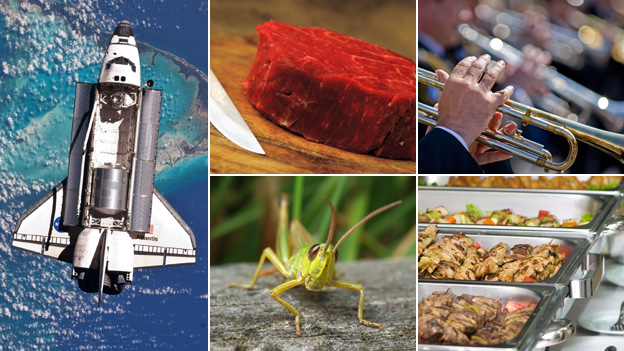
Volatile food prices and a growing population mean we have to rethink what we eat, say food futurologists. So what might we be serving up in 20 years' time?
It's not immediately obvious what links Nasa, the price of meat and brass bands, but all three are playing a part in shaping what we will eat in the future and how we will eat it.
Rising food prices, the growing population and environmental concerns are just a few issues that have organisations - including the United Nations and the government - worrying about how we will feed ourselves in the future.
In the UK, meat prices are anticipated to have a huge impact on our diets. Some in the food industry estimate they could double in the next five to seven years, making meat a luxury item.
"In the West many of us have grown up with cheap, abundant meat," says food futurologist Morgaine Gaye.
"Rising prices mean we are now starting to see the return of meat as a luxury. As a result we are looking for new ways to fill the meat gap."
So what will fill such gaps and our stomachs - and how will we eat it?
Insects
Insects, or mini-livestock as they could become known, will become a staple of our diet, says Gaye.
It's a win-win situation. Insects provide as much nutritional value as ordinary meat and are a great source of protein, according to researchers at Wageningen University in the Netherlands. They also cost less to raise than cattle, consume less water and do not have much of a carbon footprint. Plus, there are an estimated 1,400 species that are edible to man.
Gaye is not talking about bushtucker-style witchetty grubs arriving on a plate near you. Insect burgers and sausages are likely to resemble their meat counterparts.
"Things like crickets and grasshoppers will be ground down and used as an ingredient in things like burgers."
The Dutch government is putting serious money into getting insects into mainstream diets. It recently invested one million euros (£783,000) into research and to prepare legislation governing insect farms.
A large chunk of the world's population already eat insects as a regular part of their diet. Caterpillars and locusts are popular in Africa, wasps are a delicacy in Japan, crickets are eaten in Thailand.
But insects will need an image overhaul if they are to become more palatable to the squeamish Europeans and North Americans, says Gaye, who is a member of the Experimental Food Society.
"They will become popular when we get away from the word insects and use something like mini-livestock."
by Denise Winterman, BBC News | Read more:
Thursday, August 9, 2012
The Meaning of Square

"That's $5."
"I'm Derek Thompson."
"Thanks, you're all set."
... and I'm out the door with my drink.
This is what a cashless society looks like. And it is cool. But, like, how cool really?
Let's count some of the ways it is important: for merchants and for customers. For merchants, point-of-sale technology is awful, outdated, and expensive. Credit cards are a hassle, cash and coins are cumbersome, and payment software can be buggy and complicated. Square is simple. It not only de-kluges the process of ringing somebody up, but also it humanizes the interaction by making the point of contact all about two people's faces rather than a credit card and a swiper. That's nice.
For customers, Square eliminates friction. This is either very good or very dangerous, and maybe both. Paying for stuff shouldn't be such a chore. Some merchants take one credit card, but not another, or they require a $10 minimum payment, or they only take cash, and they've run out of certain bills. These are first world problems, to be sure, but we are living in a world of first world problems and solving them in an elegant way is no small feat. By divorcing paying from any sort of mindful action, frictionless transactions make us forget about money. That's good news if you think customers should spend more money. It's bad news if you think most American families aren't thinking mindfully about money enough, already.
These are innovations of convenience, mostly, but they arguably build a gateway to bigger things: for data, for advertising, and for, yes, society. The data created with millions of digitized interactions could provide deeper records of what people are buying and how much they're paying for it -- the sort of information that would be important to corporate research departments or macro-economists. And the GPS capabilities lend themselves easily to targeted advertising. Wired paints a picture of the future:
You're walking down the street. It's hot. The Starbucks a block away sends you a message that your favorite hot-weather order - venti skinny latte on ice -- is available to you at a dollar off. You accept the offer, and with a few taps, add an almond biscotti to the tab. Then you stroll into the Starbucks. Everything is ready when you arrive - you simply pick it up, the barista checks out your punim, and you're out the door.
When I read the first batch of stories about Square, my reaction was, "This sounds pretty fun. But is it revolutionary? Are we so lazy and pressed for time that disrupting the action of taking out your credit card is a gosh-wow innovative leap?"I think the answer is two-fold: (1) Innovations that save time, even just a little bit of time, are real innovations, because in any advanced economy time and attention are currency and creating more of them can make us all richer; (2) What's important about Square isn't just the transactions it makes more efficient but also the cashless world it pulls closer to the present.
by Derek Thompson, The Atlantic | Read more:
All in a Dream
Space colonies. That’s the latest thing you hear, from the heralds of the future. President Gingrich is going to set up a state on the moon. The Dutch company Mars One intends to establish a settlement on the Red Planet by 2023. We’re heading towards a “multi-planetary civilization,” says Elon Musk, the CEO of SpaceX. Our future lies in the stars, we’re even told.
As a species of megalomania, this is hard to top. As an image of technological salvation, it is more plausible than the one where we upload our brains onto our computers, surviving forever in a paradise of circuitry. But not a lot more plausible. The resources required to maintain a colony in space would be, well, astronomical. People would have to be kept alive, indefinitely, in incredibly inhospitable conditions. There may be planets with earthlike conditions, but the nearest ones we know about, as of now, are 20 light years away. That means that a round trip at 10 percent the speed of light, an inconceivable rate (it is several hundred times faster than anything we’ve yet achieved), would take 400 years.
But never mind the logistics. If we live long enough as a species, we might overcome them, or at least some of them: energy from fusion (which always seems to be about 50 years away) and so forth. Think about what life in a space colony would be like: a hermetically sealed, climate-controlled little nothing of a place. Refrigerated air, synthetic materials, and no exit. It would be like living in an airport. An airport in Antarctica. Forever. When I hear someone talking about space colonies, I think, that’s a person who has never studied the humanities. That’s a person who has never stopped to think about what it feels like to go through an average day—what life is about, what makes it worth living, what makes it endurable. A person blessed with a technological imagination and the absence of any other kind.
As a species of megalomania, this is hard to top. As an image of technological salvation, it is more plausible than the one where we upload our brains onto our computers, surviving forever in a paradise of circuitry. But not a lot more plausible. The resources required to maintain a colony in space would be, well, astronomical. People would have to be kept alive, indefinitely, in incredibly inhospitable conditions. There may be planets with earthlike conditions, but the nearest ones we know about, as of now, are 20 light years away. That means that a round trip at 10 percent the speed of light, an inconceivable rate (it is several hundred times faster than anything we’ve yet achieved), would take 400 years.
But never mind the logistics. If we live long enough as a species, we might overcome them, or at least some of them: energy from fusion (which always seems to be about 50 years away) and so forth. Think about what life in a space colony would be like: a hermetically sealed, climate-controlled little nothing of a place. Refrigerated air, synthetic materials, and no exit. It would be like living in an airport. An airport in Antarctica. Forever. When I hear someone talking about space colonies, I think, that’s a person who has never studied the humanities. That’s a person who has never stopped to think about what it feels like to go through an average day—what life is about, what makes it worth living, what makes it endurable. A person blessed with a technological imagination and the absence of any other kind.
by William Deresiewicz, American Scholar | Read more:


‘I Don’t Want to See Him Go’

He went to Hollywood and wrote scripts. He got married, started a family. He involved himself in a few business deals here and there. For the most part, he left swimming behind. I ask him if he missed swimming, and he says that it did not really dawn on him much. His life was interesting. He felt no aching void. He was still an Olympic champion, and that led to some opportunities, and he kept an eye on swimming from a distance. But for the most part, he was on to the next thing.
Then in 2007, he decided to watch Phelps swim the 200-meter butterfly at the World Championships. Phelps swam it in 1:52.09 — more than three seconds faster than Stewart’s fastest time 16 years earlier — and something thoroughly unexpected happened.
“It was like a religious experience,” Mel says. “I don’t even have the words for it. It was like this guy had just painted the most beautiful 200 meters I had ever seen. It was just gorgeous. And I felt this intimate connection. It’s like he was doing something so amazing and beautiful, and I was maybe one of two or three guys on the planet who could really understand it and appreciate it. … I was unsettled for weeks.”
Mel says it was watching that swim — seeing Michael Phelps’ greatness not the way we as fans see it, but the way that the greatest butterfly swimmer of his time saw it — that made him realize what was missing. He went to his wife, Tiffany, and said, “I want to be involved in swimming again.” Seven months later, he was interviewing Phelps on a pool deck (“I was star-struck,” he says) and doing some swimming writing on the side.
Earlier this year, Mel and his wife started a swimming website — swimswam.com — that he says has received more than 3 million page views and more than 500,000 unique users. He says that unexpected success, like its inspiration, is due to Michael Phelps. But perhaps the greatest gift that Phelps has given Mel is that after all these years he has brought swimming back into his life.
“You know what’s a crazy feeling?” Mel says. “You get into the water and you realize that you’re better in the water than you are walking on land. It’s like you become a fish. You get in the water and it just feels right in your brain.”
by Joe Posnanski, Joe Blog | Read more:
Photo: USA Today Sports
Raging Bulls: How Wall Street Got Addicted to Light-Speed Trading

The 2012 New York Battle of the Quants, a two-day conference of algorithmic asset traders, took place in New York City at the end of March, just a few days after a group of researchers admitted they had made a mistake in an experiment that purported to overturn modern physics. The scientists had claimed to observe subatomic particles called neutrinos traveling faster than the speed of light. But they were wrong; about six months later, they retracted their findings. And while “Special Relativity Upheld” is the world’s most predictable headline, the news that neutrinos actually obey the laws of physics as currently understood marked the end of a brief and tantalizing dream for quants—the physicists, engineers, and mathematicians-turned-financiers who generate as much as 55 percent of all US stock trading. In the pursuit of market-beating returns, sending a signal at faster than light speed could provide the ultimate edge: a way to make trades in the past, the financial equivalent of betting on a horse race after it has been run.
“Between the time the first paper came out in September and last week, a guy in my shop had written two papers explaining how it could be true,” a graying former physicist said ruefully, sipping coffee near an oversize Keith Haring canvas that dominated the room at Christie’s auction house where the conference was held. “Of course, you’d need a particle accelerator to make it work.”
If that were all it took, then by now someone would be building one. One of the major themes of this year’s conference was “the race to the bottom,” the cost-is-no-object competition for the absolute theoretical minimum trade time. This variable, called latency, is rapidly approaching the physical limits of the universe set by quantum mechanics and relativity. But perhaps not even Einstein fully appreciated the degree to which electromagnetic waves bend in the presence of money. Kevin McPartland of the Tabb Group, which compiles information on the financial industry, projected that companies would spend $2.2 billion in 2010 on trading infrastructure—the high-speed servers that process trades and the fiber-optic cables that link them in a globe-spanning network. And that was before projects were launched to connect New York and London by a new transatlantic cable and London and Tokyo by way of the Arctic Ocean, all just to cut a few hundredths of a second off the time it takes to receive data or send an order.
High-frequency traders are a subset of quants, investors who make money the newfangled way: a fraction of a cent at a time, multiplied by hundreds of shares, tens of thousands of times a day. These traders occupy an anomalous position on Wall Street, carrying themselves with a distinctive mixture of diffidence and arrogance that sets them apart from the pure, unmixed arrogance of investment bankers. A pioneering high-frequency trading firm, Tradeworx, has its relatively humble offices two flights up from an Urban Outfitters in a sleepy New Jersey suburb. Twenty people work there, about half of them on the trading floor, monitoring on triple screens the fractions of a penny as they mount up, second by second. Roughly 1.5 percent of the total volume of stocks traded on US exchanges on a given day will pass, however fleetingly, through the hushed, sunlit, brick-walled room.
On the first day of the New York conference, Aaron Brown, a legendary quant and former professional poker player, took the stage in rumpled chinos and a leather jacket to lecture the assembly on game theory. He began his talk by saying, “3.14159,” and then pausing expectantly. From the back of the room came the response: “265358.” Together they made up the first 12 digits of pi—a geek shibboleth. “You won’t see a lot of masters of the universe here,” said Charles Jones, a professor of finance and economics at Columbia Business School. “A lot of these guys, if they’re wearing a tie, it might be the only one they own.”
Faster and faster turn the wheels of finance, increasing the risk that they will spin out of control, that a perturbation somewhere in the system will scale up to a global crisis in a matter of seconds. “For the first time in financial history, machines can execute trades far faster than humans can intervene,” said Andrew Haldane, a regulatory official with the Bank of England, at another recent conference. “That gap is set to widen.”
by Jerry Adler, Wired | Read more:
Photo: Tim Flach/Getty
An E-Mail Service With Lots of Smarts

You don’t hear phrases like that much. Generally, once a hot property becomes a lame has-been, you don’t base your marketing on it.
But you might think that’s what Microsoft is doing with its new free Web-based e-mail service,Outlook.com. “From the company that brought you Hotmail!”
Hotmail is still the world’s largest e-mail service, with 324 million members. But Gmail, only six years old, already has 278 million, and Microsoft was getting nervous.
And there were other good reasons for Microsoft to start fresh: because times have changed and e-mail has changed; because e-mail isn’t the only thing you do online anymore (see also Facebook, Twitter); and, frankly, because lots of people still think of Hotmail as, you know, Hotmail.
That is, Hotmail still suffers from its early image as a cesspool of spam, fake addresses and blinking ads. Even today, a Hotmail address still says “unsophisticated loser” in some circles.
Outlook.com won’t have that problem. It’s clean, white and attractive, even on a cellphone. (It matches the look of the Mail program in the coming Windows 8 and the Outlook program in the coming Office 13.) Somebody put thought into the placement and typography of every element — and tried to get as far away from the Times Square clutter of Hotmail as possible. (...)
Outlook.com represents a rethink of what the basic features should be in an e-mail program. It acknowledges, for example, that a huge proportion of e-mail these days is auto-generated: spam, newsletters, social networking updates.
So Outlook.com has buttons that, with one click, sweep all e-mail from a particular sender into the trash (a feature inherited from Hotmail). It also has a one-click Unsubscribe button that removes you from the mailing lists of legitimate companies, much as Google does. It can even auto-delete all but the most recent message from a company — perfect for daily deals like Groupon.
Outlook.com uses other smarts to categorize your messages. It has auto-detectors that look for messages from social media networks, messages containing photos, messages with package-tracking details, and so on.
Actually, those tracking messages are particularly awesome. Outlook.com inserts, at the top of such a message, the actual location of your package in big type, so you don’t have to trundle off to a Web site to look it up.
by David Pogue, NY Times | Read more:
Illustration: Stewart Goldenberg
Wednesday, August 8, 2012

What Made 'Nasa Mohawk Guy' Such a Successful Meme?

There is no magic formula when it comes to creating memes or making "viral" content. There are certainly ways to stack the deck: content that is humorous, incongruous, and/or part of the zeitgeist is likely to be spread through social networks more often than, say, a boring interview or advert. In looking at the top memes of the past several years, there are few discernible patterns that can be pulled out: some, like LOLCats, have become part of the meme canon; others, like Pepper Spray Cop, became instant phenomena and faded away just as quickly.
Ultimately, memes spread because on some level, they resonate with their audience: people share content that is meaningful to them in one way or another. When it comes to the most popular memes, that underlying meaning often differs across a variety of audiences. In his explanation of Susan Boyle's overnight success and transformation into a meme, Professor Henry Jenkins of USC Annenberg said: "There's no need to identify a single cause for why people spread this content. Different people spread this content for different reasons."
When it comes to Ferdowsi, the reasons why he has struck a chord seem to fall under one of three headings. One is that he is a "hot nerd". A majority of the tweets and coverage featuring Ferdowsi comment on his appearance, or women's reactions to his status as a "sexy scientist", including a plethora of marriage proposals.
Second, there has been a large response from the Persian community. Ferdowsi is of Persian descent, and many Persians and Persian-Americans have tweeted about him, saying how proud they are that he represents their community, providing a positive image of Iranian-Americans.
The third element of the Nasa Mohawk Guy meme that contributes to its popularity is that it provides a framework for cultural commentary and content creation. Ferdowsi's look has provided people with a distinctive and widely recognised image, and the various elements that have resonated with different groups – his attractiveness, his uniqueness – have come to represent certain values. By remixing existing images or creating new ones, Nasa Mohawk Guy provides an alternative medium for discussing societal issues, such as the importance of scientific research in American culture, or that an attractive scientist has gotten more media hype than the mission he was working on.
by Kate Miltner, The Guardian | Read more:

Rites of Passage

My parents, my two siblings, and I pulled up to Eddie and Emily’s house in our blue Caprice station wagon, a species of car that, like certain dinosaurs, had achieved absurd proportions and freakishly specialized features only then to become extinct. The car’s body, the length of a Camry tailgating a Prius, got wider at the end like an ant that had let itself go. The back space would flip up to form two more backward-facing seats, as if the designers at Chevrolet were both encouraging drivers to conceive more children and providing an actual location to do so. In this way-back area, miles from the reach of Dad’s palm, a Wild West,Lord of the Flies subculture would develop. Pinches went unpunished, thigh space was taken through eminent domain. Little things no one would miss, and sometimes socks, were slipped through the pop-out window slits as we drove. Cars behind us were given the thumbs up and then, as we got a little older, mocked for their enthusiastic replies.
We piled out of that airplane hangar of a car and crammed into the neatly decorated living room of Eddie and Emily’s Cape Cod–style house, a place full of doilies, dusted hardwood, and stiff, 1950s-looking couches. Everyone looked at everyone else pleasantly, blinking and occasionally saying words. My mother tried to kindle the conversation, poking at decades-old embers. For me, the slow conversation was nodes on a family tree morphing into real people, the way dots on a map, once visited, become real places where you can get a good burger or picture yourself living—or places you decide are only worth driving through, not worth stopping at again.
The exception to the general stillness was Emily, a slender, energetic woman flitting around the house with hospitality. The sister of a grandfather who had died years before I was born—a man I was always told I resembled—Emily kept singling me out with glances, wistfully saying her dead brother’s name out loud, and then feeding me elaborate meals. It was an arrangement we both accepted immediately. Long after everyone else got full, I kept taking her up on her offers of coffee cake and hot dogs. So we sat, me chewing and her staring, each of our hairstyles a variation on the bowl cut.
“Eddie likes fishing,” my mother said about the World War II bomber pilot staring at me. “Maybe he’ll take you fishing.”
And so, just like that, my father and I committed to waking up nauseatingly early the next morning. As an awkward, hate-filled preteen, I found fishing to be the one hobby timeless and genuine enough to keep me marginally tethered to the world, like when a felon comes out of his cell to do watercolors. I wore my best No Fear T-shirt and a bead necklace with enough black in it to still fit in with the Goth-lite look I was cultivating that summer. Eddie had flown more than 50 high-risk bombing missions over Europe and northern Africa, could play Chopin sonatas on the piano, and referred to staying in bed past 5 A.M. as sleeping in. The highlight of my year was the Vans Warped Tour. We kept our conversation to fishing.
As the outboard on the 17-foot Boston Whaler worked on the light chop, chugging us out to Vineyard Sound, the air was cool, smelling of mist and gasoline. Eddie wore mud boots, a frumpy baseball cap, and a sagging orange jacket. He looked like Walter Matthau doing an impression of Walter Matthau. As he drove, Eddie would periodically glance down at this new device called a GPS, into which he claimed to have fed coordinates. The patches of fog would clear to reveal behind them denser patches of fog. This happened several times until, finally, we came to a place that looked like all the other water we had crossed. Except now, in the distance, sat a single boat, the only object visible anywhere. Eddie looked at the boat, down at his GPS, and then back up at the boat.
“That son of a bitch is in my spot,” he said. My father and I paused, looked at each other, and laughed. Eddie, it turned out, was the man.
If that’s not what made me like him, it was his talent at fishing. “Now we’ll just drift across the top of them,” he would say, and every 10 minutes we pulled winter flounder and fluke up over the chrome guardrails and plopped them onto the boat’s gut-stained deck. Conceptually, I’d known that fluke and flounder were silly, sideways fish, perfect for supporting roles in underwater Disney movies. Up close, they looked like beastly hallucinations, angry pancakes come to life, unhappy they’d been forced to sleep on their side for the duration of their existence. Eddie clubbed one on the head, said, “He won’t be right after that” in the mock voice of a doctor breaking bad news to a family, and tossed it in the cooler. We had a great time that day, and because he was not a grandfather I was required to visit, or a friend I’d call to play street hockey with, I wouldn’t see him again for three years.
by Steve Macone, American Scholar | Read more:
Photo: USFWS
Subscribe to:
Comments (Atom)