Thursday, March 19, 2015

Popcorn Time
Popcorn Time was an instant hit when it launched just over a year ago: The video streaming service made BitTorrent piracy as easy as Netflix, but with far more content and none of those pesky monthly payments. Hollywood quickly intervened, pressuring Popcorn Time’s Argentinian developers to walk away from their creation. But anonymous coders soon relaunched the copyright-flouting software. Today, Popcorn Time is growing at a rate that has likely surpassed the original, and the people behind it say they’re working on changes designed to make the service virtually impervious to law enforcement. (...)
 When Popcorn-Time.se started responding to WIRED’s questions in November, Pochoclin said the reborn project already had 4 million users. But it had taken a serious hit a few months earlier, when Brussels-based domain registrar EURid revoked its website domain, Time4Popcorn.eu. At its new Swedish domain, it’s only recently returned to that earlier adoption rate. (Pochoclin wouldn’t reveal the size of its current user base for fear of drawing more attention from law enforcement or copyright holders.) “[EURid’s domain seizure] was just a small setback … a small but painful kick to the balls,” the spokesperson says. “We’ve grown this project tremendously since we picked it up … The numbers just keep rising.”
For any other year-old startup, those numbers would seem ludicrous. But Popcorn Time is giving away Hollywood’s most valuable content for free, and making that piracy easier than ever. Download Popcorn Time’s app and in seconds you’re offered a slick menu of streaming TV shows and movies at least as easy to navigate as Netflix or Hulu—but with higher-quality video and hundreds of recent movies and TV shows paid services don’t offer.
Popcorn Time isn’t a new kind of piracy so much as an inviting new front-end interface for the BitTorrent underground. The software collects and organizes popular files from existing BitTorrent sources like the Pirate Bay, Kickass Torrents, Isohunt, and YTS. “We’re like Google,” Pochoclin says, “scraping for new content all over the internet.” By integrating its own video player and prioritizing its downloads from the first chunk of the video file to the last, it makes those sites’ files immediately streamable. With Popcorn Time, the complexity of BitTorrent search engines, trackers, clients, seeds, decompression, playback, and storage is reduced to a single click. That’s made this BitTorrent-for-dummies the virtually undisputed future of video piracy.
Pochoclin says Popcorn-Time.se offers this streaming service pro bono. It doesn’t charge for downloads, and neither its app nor its website display ads. “We just did it for the love of this project,” Pochoclin writes. “It was something we believed in. And once it started taking off … as it did from the start, all the love that we were getting from Popcorn Time users made us just keep on going without really stopping to think where this road is taking us.” (...)
Pochoclin says the service doesn’t do anything illegal: It merely organizes preexisting BitTorrent files hosted on other sites. “It’s all automated and all working on existing open source technologies and existing websites online. Therefore, it’s legal. Or better … not illegal,” Pochoclin says. “We all live in a free society, where what is not forbidden is allowed.”
That’s not a defense that’s likely to succeed in an American court. An MPAA spokesperson pointed out in an email to WIRED that previous software like Napster, Grokster, isoHunt, and Limewire didn’t directly host content either, but courts ruled that all of them were infringing on copyrights. Even though it merely helps users stream video files made available elsewhere, Popcorn Time could be accused of “contributory liability,” says University of Richmond intellectual property law professor Jim Gibson. A service whose primary, intended function is aiding copyright infringement doesn’t need to host any files to be illegal. “If they know that they’re actually facilitating the downloading or streaming of copyrighted movies and they continue to do it, they’re in trouble,” Gibson says.
With legal threats looming, Popcorn-Time.se is working on new defenses.
by Andy Greenberg, Wired | Read more:
When Popcorn-Time.se started responding to WIRED’s questions in November, Pochoclin said the reborn project already had 4 million users. But it had taken a serious hit a few months earlier, when Brussels-based domain registrar EURid revoked its website domain, Time4Popcorn.eu. At its new Swedish domain, it’s only recently returned to that earlier adoption rate. (Pochoclin wouldn’t reveal the size of its current user base for fear of drawing more attention from law enforcement or copyright holders.) “[EURid’s domain seizure] was just a small setback … a small but painful kick to the balls,” the spokesperson says. “We’ve grown this project tremendously since we picked it up … The numbers just keep rising.”For any other year-old startup, those numbers would seem ludicrous. But Popcorn Time is giving away Hollywood’s most valuable content for free, and making that piracy easier than ever. Download Popcorn Time’s app and in seconds you’re offered a slick menu of streaming TV shows and movies at least as easy to navigate as Netflix or Hulu—but with higher-quality video and hundreds of recent movies and TV shows paid services don’t offer.
Popcorn Time isn’t a new kind of piracy so much as an inviting new front-end interface for the BitTorrent underground. The software collects and organizes popular files from existing BitTorrent sources like the Pirate Bay, Kickass Torrents, Isohunt, and YTS. “We’re like Google,” Pochoclin says, “scraping for new content all over the internet.” By integrating its own video player and prioritizing its downloads from the first chunk of the video file to the last, it makes those sites’ files immediately streamable. With Popcorn Time, the complexity of BitTorrent search engines, trackers, clients, seeds, decompression, playback, and storage is reduced to a single click. That’s made this BitTorrent-for-dummies the virtually undisputed future of video piracy.
Pochoclin says Popcorn-Time.se offers this streaming service pro bono. It doesn’t charge for downloads, and neither its app nor its website display ads. “We just did it for the love of this project,” Pochoclin writes. “It was something we believed in. And once it started taking off … as it did from the start, all the love that we were getting from Popcorn Time users made us just keep on going without really stopping to think where this road is taking us.” (...)
Pochoclin says the service doesn’t do anything illegal: It merely organizes preexisting BitTorrent files hosted on other sites. “It’s all automated and all working on existing open source technologies and existing websites online. Therefore, it’s legal. Or better … not illegal,” Pochoclin says. “We all live in a free society, where what is not forbidden is allowed.”
That’s not a defense that’s likely to succeed in an American court. An MPAA spokesperson pointed out in an email to WIRED that previous software like Napster, Grokster, isoHunt, and Limewire didn’t directly host content either, but courts ruled that all of them were infringing on copyrights. Even though it merely helps users stream video files made available elsewhere, Popcorn Time could be accused of “contributory liability,” says University of Richmond intellectual property law professor Jim Gibson. A service whose primary, intended function is aiding copyright infringement doesn’t need to host any files to be illegal. “If they know that they’re actually facilitating the downloading or streaming of copyrighted movies and they continue to do it, they’re in trouble,” Gibson says.
With legal threats looming, Popcorn-Time.se is working on new defenses.
by Andy Greenberg, Wired | Read more:
Image: Popcorn Time


The Meteoric Rise of Totchos
If you've heard of totchos, it was probably only in the past few months. If you haven't yet run across this modification of the classic nachos, using middle-school favorite tater tots in place of tortilla chips, you likely will soon. In the last six months, they've gone from slipping in at the occasional dive bar to showing up at every trendy spot in town.
 Suddenly, it seems like totchos are everywhere, conquering menus with a furor usually reserved for kale salad, pork belly, and bacon-wrapped anything. Thinking perhaps it was just me, I checked in with the Seattle-based food website Allrecipes. Julie Mumford, who works on consumer insights for the site, not only affirmed a dramatic spike in searches for tater tot nachos in January, she noted that, so far in 2015, people in Seattle are twice as excited about totchos as the rest of the country. (...)
J. Kenji López-Alt, who writes the Food Lab column on Serious Eats, spends a lot of his time figuring out how to perfect dishes like this. "There are some mash-ups so gut-wrenchingly glorious, so decadently delicious, so damn greasy that they deserve to be tasted, tested, improved, written about, modified, expanded, contracted, broken down, reassembled, broken down again, and possibly reassembled (after lunch) until they've finally emerged in their ultimate form," he wrote in a 2013 post. He considers totchos to be in this category. He also has some insight into what makes them so good: "Just like you can make or break a sandwich depending on how you stack it, proper layering is essential in constructing the perfect tray of totchos." (...)
It's easy to see the appeal, looking through the thick layers of cheddar that top most versions of the dish: It's affordable, gluten-free (as long as the tater tots aren't deep-fried in oil where gluten-y items were), and indulgent. It harks back to childhood, with the base of nostalgia-inducing tater tots. They're crispy and melty, and if you don't agree that those are the two most appealing textures in bar food, it's probably been dry below that rock you're living under. (...)
For all their gooey indulgence, not everyone loves totchos. Aside from the usual complaints of heaviness and unhealthiness, spirits portfolio ambassador Rocky Yeh, whose job brings him to many Seattle bars on a daily basis, says, "Totchos change the nachos from a shareable group snack to a less social, knife-and-fork food."
Suddenly, it seems like totchos are everywhere, conquering menus with a furor usually reserved for kale salad, pork belly, and bacon-wrapped anything. Thinking perhaps it was just me, I checked in with the Seattle-based food website Allrecipes. Julie Mumford, who works on consumer insights for the site, not only affirmed a dramatic spike in searches for tater tot nachos in January, she noted that, so far in 2015, people in Seattle are twice as excited about totchos as the rest of the country. (...)J. Kenji López-Alt, who writes the Food Lab column on Serious Eats, spends a lot of his time figuring out how to perfect dishes like this. "There are some mash-ups so gut-wrenchingly glorious, so decadently delicious, so damn greasy that they deserve to be tasted, tested, improved, written about, modified, expanded, contracted, broken down, reassembled, broken down again, and possibly reassembled (after lunch) until they've finally emerged in their ultimate form," he wrote in a 2013 post. He considers totchos to be in this category. He also has some insight into what makes them so good: "Just like you can make or break a sandwich depending on how you stack it, proper layering is essential in constructing the perfect tray of totchos." (...)
It's easy to see the appeal, looking through the thick layers of cheddar that top most versions of the dish: It's affordable, gluten-free (as long as the tater tots aren't deep-fried in oil where gluten-y items were), and indulgent. It harks back to childhood, with the base of nostalgia-inducing tater tots. They're crispy and melty, and if you don't agree that those are the two most appealing textures in bar food, it's probably been dry below that rock you're living under. (...)
For all their gooey indulgence, not everyone loves totchos. Aside from the usual complaints of heaviness and unhealthiness, spirits portfolio ambassador Rocky Yeh, whose job brings him to many Seattle bars on a daily basis, says, "Totchos change the nachos from a shareable group snack to a less social, knife-and-fork food."
by Naomi Tomky, The Stranger | Read more:
Image: Kelly O
Wednesday, March 18, 2015
Microsoft Drops Internet Explorer Brand
[ed. This just in from the 'who cares' desk. Explorer has always been terrible, right from the get go. They should just kill it. Instead, it's going to be updated and "rebranded".Yay.]
Internet Explorer, the Microsoft browser that is almost 20 years old, is to be killed off and replaced by a new operating system.
 Microsoft has confirmed that its new browser, code-named Project Spartan, that is due to be unveiled later this year, will not use the familiar Internet Explorer name.
How Microsoft 10 can divide up the screen
"We’re now researching what the new brand, or the new name, for our browser should be in Windows 10," the company's marketing chief Chris Capossela told a conference.
Internet Explorer once dominated the market and had more than one billion users but it could not compete when Firefox and Google’s Chrome launched with faster technology and slicker design.
Microsoft is thought to be dropping the brand in a bid to shed “negative perceptions" gathered since its 1995 launch.
The software is known to be slow and has had various security problems.
The company has often talked about changing the browsers’ name to rejuvenate its reputation.
Nearly a decade ago, Dean Hachamovitch, then-head of the Internet Explorer business, is said to have told an industry conference: “We messed up.”
Windows 10 will feature a stripped down, faster browser more suited to multiple devices.
Tom Bedecarre, chairman of Akqa, a digital advertising agency, said the Internet Explorer brand was past its sell-by date.
“In the war of the future, which is mobile, they’re losing,” he told the Financial Times. “Nobody’s going to download Internet Explorer as their mobile browser.”
Internet Explorer, the Microsoft browser that is almost 20 years old, is to be killed off and replaced by a new operating system.
Microsoft has confirmed that its new browser, code-named Project Spartan, that is due to be unveiled later this year, will not use the familiar Internet Explorer name.How Microsoft 10 can divide up the screen
"We’re now researching what the new brand, or the new name, for our browser should be in Windows 10," the company's marketing chief Chris Capossela told a conference.
Internet Explorer once dominated the market and had more than one billion users but it could not compete when Firefox and Google’s Chrome launched with faster technology and slicker design.
Microsoft is thought to be dropping the brand in a bid to shed “negative perceptions" gathered since its 1995 launch.
The software is known to be slow and has had various security problems.
The company has often talked about changing the browsers’ name to rejuvenate its reputation.
Nearly a decade ago, Dean Hachamovitch, then-head of the Internet Explorer business, is said to have told an industry conference: “We messed up.”
Windows 10 will feature a stripped down, faster browser more suited to multiple devices.
Tom Bedecarre, chairman of Akqa, a digital advertising agency, said the Internet Explorer brand was past its sell-by date.
“In the war of the future, which is mobile, they’re losing,” he told the Financial Times. “Nobody’s going to download Internet Explorer as their mobile browser.”
by Victoria Ward, Telegraph | Read more:
Image: EPA

The Irrationality of Alcoholics Anonymous
[ed. See also: Welcome to Moderation Management.]
The debate over the efficacy of 12-step programs has been quietly bubbling for decades among addiction specialists. But it has taken on new urgency with the passage of the Affordable Care Act, which requires all insurers and state Medicaid programs to pay for alcohol- and substance-abuse treatment, extending coverage to 32 million Americans who did not previously have it and providing a higher level of coverage for an additional 30 million.
Nowhere in the field of medicine is treatment less grounded in modern science. A 2012 report by the National Center on Addiction and Substance Abuse at Columbia University compared the current state of addiction medicine to general medicine in the early 1900s, when quacks worked alongside graduates of leading medical schools. The American Medical Association estimates that out of nearly 1 million doctors in the United States, only 582 identify themselves as addiction specialists. (The Columbia report notes that there may be additional doctors who have a subspecialty in addiction.) Most treatment providers carry the credential of addiction counselor or substance-abuse counselor, for which many states require little more than a high-school diploma or a GED. Many counselors are in recovery themselves. The report stated: “The vast majority of people in need of addiction treatment do not receive anything that approximates evidence-based care.”
 Alcoholics Anonymous was established in 1935, when knowledge of the brain was in its infancy. It offers a single path to recovery: lifelong abstinence from alcohol. The program instructs members to surrender their ego, accept that they are “powerless” over booze, make amends to those they’ve wronged, and pray.
Alcoholics Anonymous is famously difficult to study. By necessity, it keeps no records of who attends meetings; members come and go and are, of course, anonymous. No conclusive data exist on how well it works. In 2006, the Cochrane Collaboration, a health-care research group, reviewed studies going back to the 1960s and found that “no experimental studies unequivocally demonstrated the effectiveness of AA or [12-step] approaches for reducing alcohol dependence or problems.”
The Big Book includes an assertion first made in the second edition, which was published in 1955: that AA has worked for 75 percent of people who have gone to meetings and “really tried.” It says that 50 percent got sober right away, and another 25 percent struggled for a while but eventually recovered. According to AA, these figures are based on members’ experiences.
In his recent book, The Sober Truth: Debunking the Bad Science Behind 12-Step Programs and the Rehab Industry, Lance Dodes, a retired psychiatry professor from Harvard Medical School, looked at Alcoholics Anonymous’s retention rates along with studies on sobriety and rates of active involvement (attending meetings regularly and working the program) among AA members. Based on these data, he put AA’s actual success rate somewhere between 5 and 8 percent. That is just a rough estimate, but it’s the most precise one I’ve been able to find.
I spent three years researching a book about women and alcohol, Her Best-Kept Secret: Why Women Drink—And How They Can Regain Control, which was published in 2013. During that time, I encountered disbelief from doctors and psychiatrists every time I mentioned that the Alcoholics Anonymous success rate appears to hover in the single digits. We’ve grown so accustomed to testimonials from those who say AA saved their life that we take the program’s efficacy as an article of faith. Rarely do we hear from those for whom 12-step treatment doesn’t work. But think about it: How many celebrities can you name who bounced in and out of rehab without ever getting better? Why do we assume they failed the program, rather than that the program failed them?
When my book came out, dozens of Alcoholics Anonymous members said that because I had challenged AA’s claim of a 75 percent success rate, I would hurt or even kill people by discouraging attendance at meetings. A few insisted that I must be an “alcoholic in denial.” But most of the people I heard from were desperate to tell me about their experiences in the American treatment industry. Amy Lee Coy, the author of the memoir From Death Do I Part: How I Freed Myself From Addiction, told me about her eight trips to rehab, starting at age 13. “It’s like getting the same antibiotic for a resistant infection—eight times,” she told me. “Does that make sense?”
She and countless others had put their faith in a system they had been led to believe was effective—even though finding treatment centers’ success rates is next to impossible: facilities rarely publish their data or even track their patients after discharging them. “Many will tell you that those who complete the program have a ‘great success rate,’ meaning that most are abstaining from drugs and alcohol while enrolled there,” says Bankole Johnson, an alcohol researcher and the chair of the psychiatry department at the University of Maryland School of Medicine. “Well, no kidding.”
Alcoholics Anonymous has more than 2 million members worldwide, and the structure and support it offers have helped many people. But it is not enough for everyone. The history of AA is the story of how one approach to treatment took root before other options existed, inscribing itself on the national consciousness and crowding out dozens of newer methods that have since been shown to work better.
by Gabrielle Glaser, The Atlantic | Read more:
Image:Dan Saelinger
The debate over the efficacy of 12-step programs has been quietly bubbling for decades among addiction specialists. But it has taken on new urgency with the passage of the Affordable Care Act, which requires all insurers and state Medicaid programs to pay for alcohol- and substance-abuse treatment, extending coverage to 32 million Americans who did not previously have it and providing a higher level of coverage for an additional 30 million.
Nowhere in the field of medicine is treatment less grounded in modern science. A 2012 report by the National Center on Addiction and Substance Abuse at Columbia University compared the current state of addiction medicine to general medicine in the early 1900s, when quacks worked alongside graduates of leading medical schools. The American Medical Association estimates that out of nearly 1 million doctors in the United States, only 582 identify themselves as addiction specialists. (The Columbia report notes that there may be additional doctors who have a subspecialty in addiction.) Most treatment providers carry the credential of addiction counselor or substance-abuse counselor, for which many states require little more than a high-school diploma or a GED. Many counselors are in recovery themselves. The report stated: “The vast majority of people in need of addiction treatment do not receive anything that approximates evidence-based care.”
Alcoholics Anonymous was established in 1935, when knowledge of the brain was in its infancy. It offers a single path to recovery: lifelong abstinence from alcohol. The program instructs members to surrender their ego, accept that they are “powerless” over booze, make amends to those they’ve wronged, and pray.Alcoholics Anonymous is famously difficult to study. By necessity, it keeps no records of who attends meetings; members come and go and are, of course, anonymous. No conclusive data exist on how well it works. In 2006, the Cochrane Collaboration, a health-care research group, reviewed studies going back to the 1960s and found that “no experimental studies unequivocally demonstrated the effectiveness of AA or [12-step] approaches for reducing alcohol dependence or problems.”
The Big Book includes an assertion first made in the second edition, which was published in 1955: that AA has worked for 75 percent of people who have gone to meetings and “really tried.” It says that 50 percent got sober right away, and another 25 percent struggled for a while but eventually recovered. According to AA, these figures are based on members’ experiences.
In his recent book, The Sober Truth: Debunking the Bad Science Behind 12-Step Programs and the Rehab Industry, Lance Dodes, a retired psychiatry professor from Harvard Medical School, looked at Alcoholics Anonymous’s retention rates along with studies on sobriety and rates of active involvement (attending meetings regularly and working the program) among AA members. Based on these data, he put AA’s actual success rate somewhere between 5 and 8 percent. That is just a rough estimate, but it’s the most precise one I’ve been able to find.
I spent three years researching a book about women and alcohol, Her Best-Kept Secret: Why Women Drink—And How They Can Regain Control, which was published in 2013. During that time, I encountered disbelief from doctors and psychiatrists every time I mentioned that the Alcoholics Anonymous success rate appears to hover in the single digits. We’ve grown so accustomed to testimonials from those who say AA saved their life that we take the program’s efficacy as an article of faith. Rarely do we hear from those for whom 12-step treatment doesn’t work. But think about it: How many celebrities can you name who bounced in and out of rehab without ever getting better? Why do we assume they failed the program, rather than that the program failed them?
When my book came out, dozens of Alcoholics Anonymous members said that because I had challenged AA’s claim of a 75 percent success rate, I would hurt or even kill people by discouraging attendance at meetings. A few insisted that I must be an “alcoholic in denial.” But most of the people I heard from were desperate to tell me about their experiences in the American treatment industry. Amy Lee Coy, the author of the memoir From Death Do I Part: How I Freed Myself From Addiction, told me about her eight trips to rehab, starting at age 13. “It’s like getting the same antibiotic for a resistant infection—eight times,” she told me. “Does that make sense?”
She and countless others had put their faith in a system they had been led to believe was effective—even though finding treatment centers’ success rates is next to impossible: facilities rarely publish their data or even track their patients after discharging them. “Many will tell you that those who complete the program have a ‘great success rate,’ meaning that most are abstaining from drugs and alcohol while enrolled there,” says Bankole Johnson, an alcohol researcher and the chair of the psychiatry department at the University of Maryland School of Medicine. “Well, no kidding.”
Alcoholics Anonymous has more than 2 million members worldwide, and the structure and support it offers have helped many people. But it is not enough for everyone. The history of AA is the story of how one approach to treatment took root before other options existed, inscribing itself on the national consciousness and crowding out dozens of newer methods that have since been shown to work better.
by Gabrielle Glaser, The Atlantic | Read more:
Image:Dan Saelinger
Tuesday, March 17, 2015
Permanent Recorder
[ed. See also: The Algorithmic Self.]
 It used to be easy to mock reality TV for having nothing to do with actual reality — the scenarios were contrived and pre-mediated, the performances were semi-scripted, the performers were hyper-self-conscious. These shows were more a negation of reality than a representation of it; part of their appeal seemed to be in how they helped clarify for viewers the genuine “reality” of their own behavior, in contrast with the freak shows they were seeing on the screen. To be real with people, these shows seemed to suggest, just don’t act like you are on television.
But now we are all on television all the time. The once inverted anti-reality of reality TV has turned out to be prefigurative. In a recent essay for the New York Times, Colson Whitehead seizes on the reality TV conceit of a “loser edit” — how a shows’ editors pare down and frame the footage of certain participants to make their incipient failure seem deserved — and expands it into a metaphor for our lives under ubiquitous surveillance.
You could draw a similar conclusion from Facebook’s Timeline, and the year-in-review videos the company has taken to making of one’s raw profile data. These aren’t intrusive re-scriptings of our experience but instructional videos into how to be a coherent person for algorithms — which, since these algorithms increasingly dictate what others see of you, is more or less how you “really” are in your social networks. Facebook makes the winner’s edit of everybody, because everyone supposedly wins by being on Facebook. Everyone gets to be connected and the center of the universe simultaneously. So why not bequeath to it final-cut rights for your life’s edit?
Tech consultant Alistair Croll, in post at O’Reilly Radar, is somewhat less complacent about our surrendering our editing rights. He makes the case that since everyone henceforth will be born into consolidated blanket surveillance, they will be nurtured by a symbiotic relationship with their own data timeline. “An agent with true AI will become a sort of alter ego; something that grows and evolves with you … When the machines get intelligent, some of us may not even notice, because they’ll be us and we’ll be them.”
In other words, our cyborg existence will entail our fusion not with some Borg-like hive mind that submerges us into a collective, but with a machine powered by our own personal data that represents itself as already part of ourselves. The algorithms will be learning how to edit our lives for us from the very start, and we may not recognize this editing as stemming from an outside entity. The alien algorithms ease themselves into control over us by working with our uniquely personal data, which will feel inalienable because it is so specifically about us, though the very fact of its collection indicates that it belongs to someone else. Our memories will be recorded by outside entities so thoroughly that we will intuitively accept those entities as a part of us, as an extension of the inside of our heads. Believing that something that is not us could have such a complete archive of our experiences may prove to be to unacceptable, too dissonant, too terrifying.
Croll argues that this kind of data-driven social control, with algorithms dictating the shape and scope of our lives for us, will be “the moral issue of the next decade: nobody should know more about you than you do.“ That sounds plausible enough, if you take it to mean (as Croll clearly does) that no one should use against you data that you don’t know has been collected about you. (Molly Knefel discusses a similar concern here, in an essay about how kids will be confronted by their permanent records, which reminds me of the “right to be forgotten” campaign.) But it runs counter to the cyborg idea — it assumes we will be able to draw a clear line between ourselves and the algorithms. If we can’t distinguish between these, it will be nonsensical to worry about which has access to more data about ourselves. It will be impossible to say whether you or the algorithms “knew” some piece of information about you first, particularly when the algorithms will be synthesizing data about us and then teaching it to us.
In that light, the standard that “no one should know more about you than you do” starts to seem clearly absurd. Outside entities are producing knowledge about us all the time in ways we can’t control. Other people are always producing knowledge about me, from their perspective and for their own purposes, that I can never access. They will always know “more about me” than I do by virtue of their having a point of view on the world that I can’t calculate and replicate.
Because we find it hard to assign a point of view to a machine, we perhaps think they can’t know more about us or have a perspective that isn’t fully controllable by someone, if not us. Croll is essentially arguing that we should have control over what knowledge a company’s machines produce about us. That assumes that their programmers can fully control their algorithms, which seems to be less the case the more sophisticated they become — the fact that the algorithms turn out results that no one can explain may be the defining point at which data becomes Big Data, as Mike Pepi explains here. And if the machines are just proxies for the people who program them, Croll’s “moral issue” still boils down to a fantasy of extreme atomization — the demand that my identity be entirely independent of other people, with no contingencies whatsoever.
The ability to impose your own self-concept on others is a matter of power; you can demand it, say, as a matter of customer service. This doesn’t change what those serving you know and think about you, but it allows you to suspend disbelief about it. Algorithms that serve us don’t allow for such suspension of disbelief, because they anticipate what service we might expect and put what they know about us into direct action. Algorithms can’t have opinions about us that they keep to themselves. They can’t help but reveal al all times that they “know more about us” — that is, they know us different from how we know ourselves.
Rather than worry about controlling who can produce information about us, it may be more important to worry about the conflation of data with self-knowledge. The radical empiricism epitomized by the Quantified Self movement is becoming more and more mainstream as tracking devices that attempt to codify us as data become more prevalent — and threaten to become mandatory for various social benefits like health insurance. Self-tracking suggests that consciousness is a useless guide to knowing the self, generating meaningless opinions about what is happening to the self while interfering with the body’s proper responses to its biofeedback. It’s only so much subjectivity. Consciousness should subordinate itself to the data, be guided more automatically by it. And you need control of this data to control what you will think of yourself in response to it, and to control the “truth” about yourself.
It used to be easy to mock reality TV for having nothing to do with actual reality — the scenarios were contrived and pre-mediated, the performances were semi-scripted, the performers were hyper-self-conscious. These shows were more a negation of reality than a representation of it; part of their appeal seemed to be in how they helped clarify for viewers the genuine “reality” of their own behavior, in contrast with the freak shows they were seeing on the screen. To be real with people, these shows seemed to suggest, just don’t act like you are on television.But now we are all on television all the time. The once inverted anti-reality of reality TV has turned out to be prefigurative. In a recent essay for the New York Times, Colson Whitehead seizes on the reality TV conceit of a “loser edit” — how a shows’ editors pare down and frame the footage of certain participants to make their incipient failure seem deserved — and expands it into a metaphor for our lives under ubiquitous surveillance.
The footage of your loser edit is out there as well, waiting … From all the cameras on all the street corners, entryways and strangers’ cellphones, building the digital dossier of your days. Maybe we can’t clearly make out your face in every shot, but everyone knows it’s you. We know you like to slump. Our entire lives as B-roll, shot and stored away to be recut and reviewed at a moment’s notice when the plot changes: the divorce, the layoff, the lawsuit. Any time the producers decide to raise the stakes.Whitehead concludes that the important thing is that everyone gets an edit inside their own head, which suggests that the imposition of a reality TV frame on our lives has been clarifying. “If we’re going down, let us at least be a protagonist, have a story line, not be just one of those miserable players in the background. A cameo’s stand-in. The loser edit, with all its savage cuts, is confirmation that you exist.” Reality TV models for us what it is like to be a character in our own life story, and it gives us a new metaphor for how to accomplish this — we don’t need to be a bildungsroman author but instead a savvy cutting-room editor. Accept that your life is footage, and you might even get good at making a winner’s edit for yourself.
You could draw a similar conclusion from Facebook’s Timeline, and the year-in-review videos the company has taken to making of one’s raw profile data. These aren’t intrusive re-scriptings of our experience but instructional videos into how to be a coherent person for algorithms — which, since these algorithms increasingly dictate what others see of you, is more or less how you “really” are in your social networks. Facebook makes the winner’s edit of everybody, because everyone supposedly wins by being on Facebook. Everyone gets to be connected and the center of the universe simultaneously. So why not bequeath to it final-cut rights for your life’s edit?
Tech consultant Alistair Croll, in post at O’Reilly Radar, is somewhat less complacent about our surrendering our editing rights. He makes the case that since everyone henceforth will be born into consolidated blanket surveillance, they will be nurtured by a symbiotic relationship with their own data timeline. “An agent with true AI will become a sort of alter ego; something that grows and evolves with you … When the machines get intelligent, some of us may not even notice, because they’ll be us and we’ll be them.”
In other words, our cyborg existence will entail our fusion not with some Borg-like hive mind that submerges us into a collective, but with a machine powered by our own personal data that represents itself as already part of ourselves. The algorithms will be learning how to edit our lives for us from the very start, and we may not recognize this editing as stemming from an outside entity. The alien algorithms ease themselves into control over us by working with our uniquely personal data, which will feel inalienable because it is so specifically about us, though the very fact of its collection indicates that it belongs to someone else. Our memories will be recorded by outside entities so thoroughly that we will intuitively accept those entities as a part of us, as an extension of the inside of our heads. Believing that something that is not us could have such a complete archive of our experiences may prove to be to unacceptable, too dissonant, too terrifying.
Croll argues that this kind of data-driven social control, with algorithms dictating the shape and scope of our lives for us, will be “the moral issue of the next decade: nobody should know more about you than you do.“ That sounds plausible enough, if you take it to mean (as Croll clearly does) that no one should use against you data that you don’t know has been collected about you. (Molly Knefel discusses a similar concern here, in an essay about how kids will be confronted by their permanent records, which reminds me of the “right to be forgotten” campaign.) But it runs counter to the cyborg idea — it assumes we will be able to draw a clear line between ourselves and the algorithms. If we can’t distinguish between these, it will be nonsensical to worry about which has access to more data about ourselves. It will be impossible to say whether you or the algorithms “knew” some piece of information about you first, particularly when the algorithms will be synthesizing data about us and then teaching it to us.
In that light, the standard that “no one should know more about you than you do” starts to seem clearly absurd. Outside entities are producing knowledge about us all the time in ways we can’t control. Other people are always producing knowledge about me, from their perspective and for their own purposes, that I can never access. They will always know “more about me” than I do by virtue of their having a point of view on the world that I can’t calculate and replicate.
Because we find it hard to assign a point of view to a machine, we perhaps think they can’t know more about us or have a perspective that isn’t fully controllable by someone, if not us. Croll is essentially arguing that we should have control over what knowledge a company’s machines produce about us. That assumes that their programmers can fully control their algorithms, which seems to be less the case the more sophisticated they become — the fact that the algorithms turn out results that no one can explain may be the defining point at which data becomes Big Data, as Mike Pepi explains here. And if the machines are just proxies for the people who program them, Croll’s “moral issue” still boils down to a fantasy of extreme atomization — the demand that my identity be entirely independent of other people, with no contingencies whatsoever.
The ability to impose your own self-concept on others is a matter of power; you can demand it, say, as a matter of customer service. This doesn’t change what those serving you know and think about you, but it allows you to suspend disbelief about it. Algorithms that serve us don’t allow for such suspension of disbelief, because they anticipate what service we might expect and put what they know about us into direct action. Algorithms can’t have opinions about us that they keep to themselves. They can’t help but reveal al all times that they “know more about us” — that is, they know us different from how we know ourselves.
Rather than worry about controlling who can produce information about us, it may be more important to worry about the conflation of data with self-knowledge. The radical empiricism epitomized by the Quantified Self movement is becoming more and more mainstream as tracking devices that attempt to codify us as data become more prevalent — and threaten to become mandatory for various social benefits like health insurance. Self-tracking suggests that consciousness is a useless guide to knowing the self, generating meaningless opinions about what is happening to the self while interfering with the body’s proper responses to its biofeedback. It’s only so much subjectivity. Consciousness should subordinate itself to the data, be guided more automatically by it. And you need control of this data to control what you will think of yourself in response to it, and to control the “truth” about yourself.
by Rob Horning, Marginal Utility, TNI | Read more:
Image: uncredited
Monday, March 16, 2015

Love & Mercy
[ed. I've wondered why no one ever made a movie about Brian Wilson, the Beach Boys' troubled genius. Now they have. I hope it doesn't suck. (God only knows)]
h/t Boing Boing
Oregon is the First State to Adopt Automatic Voter Registration
[ed. The shape of things to come. How did this take so long? (Wait, I think I know).]
Gov. Kate Brown signed a bill that puts the burden of registration on the state instead of voters.
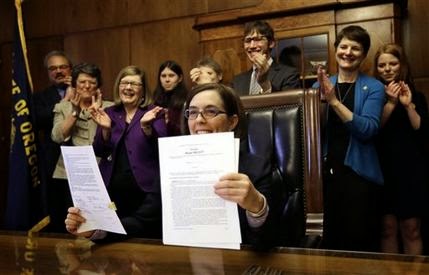 Under the legislation, every adult citizen in Oregon who has interacted with the Driver and Motor Vehicle Services Division since 2013 but hasn't registered to vote will receive a ballot in the mail at least 20 days before the next statewide election. The measure is expected to add about 300,000 new voters to the rolls.
"It just changes expectations for who's responsible for making elections work," said Barry Burden, a professor of political science at the University of Wisconsin in Madison and director of the Elections Research Center. "In every other state it's the responsibility for the voters to make sure it happens."
Some other states have considered such legislation but none has gone as far as Oregon.
Minnesota nearly implemented automatic voter registration in 2009 before the plan was vetoed by Gov. Tim Pawlenty, who said "registering to vote should be a voluntary, intentional act."
Similar concerns were raised by Oregon's minority Republicans.
"Simply because it makes us unique or makes us first does not necessarily mean that it actually improves on what we're doing," said state Sen. Jackie Winters, a Republican from Salem.
Oregon Republicans also voiced worry about potential voter fraud, the cost of implementing the measure, and whether the DMV can ensure personal information remains secure.
Information the DMV has on file, such as age, residential information, signature and citizenship status, will be transferred to the secretary of state, who will then automatically update registration information.
When it came up for a vote in the state Senate last week, all Republicans and one Democrat voted against it. The Democrats hold a 18-12 advantage in the Senate so the bill easily passed. (...)
People eligible to vote will get a postcard saying they've been registered and have three weeks to opt out. They'll be automatically registered as unaffiliated but can select a political party from the postcard and return it to election officials through the mail.
Automatic registration is not uncommon in other countries. A 2009 report by the Brennan Center for Justice says nations where the government takes the lead in enrolling voters have much higher registration rates. Argentina has a 100 percent registration rate, while Sweden, Australia and Canada all have registration rates over 90 percent.
by Sheila Kumar, AP | Read more:
Image: AP Photo/Don Ryan

The Evil Genius of Airlines
It’s a relatively mild winter day in Toronto, but the wind whipping across the tarmac at Pearson International Airport threatens to freeze exposed skin anyway. Beneath the upturned wing of a Hainan Airlines Boeing 787, just in from Beijing, ramp worker Ahmed Osoble appears oblivious to the cold as he unloads luggage from the plane’s cavernous belly, wearing an orange safety vest over his bulky parka and green ear protectors over his black toque. One-by-one, Osoble and another ramp worker guide U-shaped luggage canisters, or “cans,” onto a hydraulic platform so they can be lowered to a waiting train of luggage carts hitched to a tractor. They work quickly. “If this plane is even five minutes delayed, it causes a whole bunch of other headaches,” Osoble yells over the noise of whining jet engines before jumping in the driver’s seat and scooting away.
 For most who arrive or depart from Canada’s busiest airport, that luggage cart is the only glimpse they’ll get of the vast apparatus built to handle the straining suitcases and lumpy gym bags they check in at the departure counter. As passengers shuffle through the bright, airy airplane terminal, ground workers like Osoble shepherd thousands of pieces of luggage into a dimly lit world of grubby conveyor belts, bulky scanning machines and pinball-like flippers that violently shove luggage in the direction of its final destination. The average suitcase takes just 8.5 minutes to wind its way through the 16-km maze of conveyor belts at Pearson’s Terminal 1, and less than one per cent of the tens of millions of bags moved every year in Canada end up lost.
Yet these days airlines are offering passengers a big reason to bypass all that purpose-built infrastructure. Last fall, Air Canada and WestJet followed Toronto’s Porter Airlines and most U.S. carriers by charging economy-class passengers on domestic flights $25 to check a single suitcase (a charge to check a second piece of luggage had already been in place for several years). The move amounted to a doubling-down on the industry’s new fee-based business model, which, at times, appears designed to make parts of the travel experience so uncomfortable that passengers will pay to avoid them. A term has even been coined to reflect what airlines are inflicting on their customers: calculated misery. Want to sit with your family? Pay extra for advance seat selection. Uncomfortable in your economy-class seat? Pay to upgrade to a larger one that was only squeezed in because your original seat was shrunk.
But nowhere has the strategy been as lucrative for airlines’ bottom lines as the decision to charge for checking bags. In addition to asking passengers to pay for a formerly free service, the new fees have helped spawn a whole new family of optional charges related to advance boarding privileges—all the better to beat the rush of passengers lugging swollen carry-on luggage into the cabin and tying up precious overhead bin space.
Of course, all of these new fees and strategies to separate passengers from their money come at a time when the airlines are already benefiting tremendously from falling oil prices. And they’re not planning on passing on the savings if they can help it. “Our plan is not to pass any of it on,” WestJet’s CEO Gregg Saretsky said during a recent conference call to discuss the airline’s record fourth-quarter profit, in 2014, of $90 million. Likewise Air Canada’s CEO Calin Rovinescu—on the heels of recording his airline’s best financial performance in 77 years, with $531 million in profit in 2014—told investors: “We’ll use whatever tools we have at our disposal to drive profitability.”
While the new business model appears to offer the salvation that cash-strapped airlines have been seeking for years—baggage and other fees contributed to nearly US$50 billion in so-called “ancillary” revenues globally in 2014—it also risks unleashing a whole other dimension of hurt down the road, as flying becomes more miserable and cumbersome. In particular, the carry-on crisis spawned by checked-bag fees has bogged down already snail-like boarding times, tied up security screening lines at airports and forced unwilling employees to play the role of reluctant bag police. Even aircraft manufacturers have been dragged into the mess as they rush to redesign their planes to accommodate extra carry-on cargo. Meanwhile, all those kilometres of airport conveyor belts—financed by airport improvement fees, and designed to get planes on their way as fast as possible—threaten to go underutilized. All of these things add hidden costs—both monetary and psychological—to the already trying experience of modern air travel. And, as always, it’s passengers who will ultimately pay the price.
For most who arrive or depart from Canada’s busiest airport, that luggage cart is the only glimpse they’ll get of the vast apparatus built to handle the straining suitcases and lumpy gym bags they check in at the departure counter. As passengers shuffle through the bright, airy airplane terminal, ground workers like Osoble shepherd thousands of pieces of luggage into a dimly lit world of grubby conveyor belts, bulky scanning machines and pinball-like flippers that violently shove luggage in the direction of its final destination. The average suitcase takes just 8.5 minutes to wind its way through the 16-km maze of conveyor belts at Pearson’s Terminal 1, and less than one per cent of the tens of millions of bags moved every year in Canada end up lost.Yet these days airlines are offering passengers a big reason to bypass all that purpose-built infrastructure. Last fall, Air Canada and WestJet followed Toronto’s Porter Airlines and most U.S. carriers by charging economy-class passengers on domestic flights $25 to check a single suitcase (a charge to check a second piece of luggage had already been in place for several years). The move amounted to a doubling-down on the industry’s new fee-based business model, which, at times, appears designed to make parts of the travel experience so uncomfortable that passengers will pay to avoid them. A term has even been coined to reflect what airlines are inflicting on their customers: calculated misery. Want to sit with your family? Pay extra for advance seat selection. Uncomfortable in your economy-class seat? Pay to upgrade to a larger one that was only squeezed in because your original seat was shrunk.
But nowhere has the strategy been as lucrative for airlines’ bottom lines as the decision to charge for checking bags. In addition to asking passengers to pay for a formerly free service, the new fees have helped spawn a whole new family of optional charges related to advance boarding privileges—all the better to beat the rush of passengers lugging swollen carry-on luggage into the cabin and tying up precious overhead bin space.
Of course, all of these new fees and strategies to separate passengers from their money come at a time when the airlines are already benefiting tremendously from falling oil prices. And they’re not planning on passing on the savings if they can help it. “Our plan is not to pass any of it on,” WestJet’s CEO Gregg Saretsky said during a recent conference call to discuss the airline’s record fourth-quarter profit, in 2014, of $90 million. Likewise Air Canada’s CEO Calin Rovinescu—on the heels of recording his airline’s best financial performance in 77 years, with $531 million in profit in 2014—told investors: “We’ll use whatever tools we have at our disposal to drive profitability.”
While the new business model appears to offer the salvation that cash-strapped airlines have been seeking for years—baggage and other fees contributed to nearly US$50 billion in so-called “ancillary” revenues globally in 2014—it also risks unleashing a whole other dimension of hurt down the road, as flying becomes more miserable and cumbersome. In particular, the carry-on crisis spawned by checked-bag fees has bogged down already snail-like boarding times, tied up security screening lines at airports and forced unwilling employees to play the role of reluctant bag police. Even aircraft manufacturers have been dragged into the mess as they rush to redesign their planes to accommodate extra carry-on cargo. Meanwhile, all those kilometres of airport conveyor belts—financed by airport improvement fees, and designed to get planes on their way as fast as possible—threaten to go underutilized. All of these things add hidden costs—both monetary and psychological—to the already trying experience of modern air travel. And, as always, it’s passengers who will ultimately pay the price.
by Chris Sorenson, Macleans | Read more:
Image: uncredited

How TripAdvisor is Changing the Way We Travel
The Koryo Hotel does pretty well on TripAdvisor, all things considered. The Internet never—and I mean never—works. The towels are “thin,” the sheet thread count low, and the milk powdered. Watch out for the “giant mutant cockroach snake hybrid“ in the shower. Guests even have to pay for the pool.
Still, the Koryo, a pair of dull beige towers connected near the top by a sky bridge, is the number-one-rated hotel on TripAdvisor for Pyongyang, North Korea. Despite its many faults, it garners three and a half out of five “bubbles,” in TripAdvisor parlance (so as not to be confused with the star systems that signify quality in hotels and restaurants), across nearly 90 reviews.
 Perhaps this is no surprise. People come expecting the worst, and with expectations so dismally calibrated, something like hot water starts to sound pretty amazing. Reviewers carefully note that many of the hotel’s quirks—you can’t walk out the front door unaccompanied, for instance—are out of the manager’s hands. (You’ll have to take that up with the Supreme Leader.) It may not be the Ritz-Carlton, the sentiment goes, but considering the fact that you are staying in the marquee property in the showcase capital of the world’s most repressive regime, it may be best to, as one reviewer counseled, “just chill out, have some beers, some expired Oreos from the gift shop and make friends with the other tourists.”
The fact that so many people are so earnestly reviewing a hotel that they have not themselves chosen (accommodations are selected by government-sanctioned tour operators), in a situation in which management is hardly likely to care, in a country where the Internet-driven wisdom of crowds is a remote fiction, speaks to the curious power of TripAdvisor, which, in its decade and a half of existence, has changed travel as we know it. The reviews demonstrate the abiding urge to share and the faith that sharing—even for that one-more-grain-of-sand 13,786th reviewer of the Bellagio Las Vegas—will make someone else’s experience, or quite possibly everyone’s experience, that much better.
No matter your destination, you will, at some point in your research, visit TripAdvisor. The company, with the humble mantra “real hotel reviews you can trust,” has become—on a rising tide of 200 million user reviews and counting—a travel-industry Goliath, able to turn obscure hotels into sold-out hot spots, carry new flocks of visitors on digital word of mouth to quiet destinations, even rewrite the hospitality standards of entire nations. For travelers the impact has been equally profound. What begins as a simple search-engine query becomes an epic fact-finding mission that leaves no moldy shower curtain unturned, a labyrinthine choose-your-own-adventure—do you read the one-bubble rant?—in which the perfect hotel always seems just one more click away. For all the power of the service, it raises deep questions about travel itself, including, most pressingly, who do we want—who do we trust—to tell us where to go? “The future,” Don DeLillo once wrote, “belongs to crowds.” Are we there yet?
by By: Tom Vanderbilt, Outside | Read more:
Image: Danka & Peter
The Social Security Maze and Other U.S. Mysteries
In recent years, the Boston University economist Laurence J. Kotlikoff has made something of a game — and then, eventually, an art — of cornering smart people and convincing them that they were leaving tens of thousands of Social Security dollars on the table.
He did it with Glenn Loury, an M.I.T.-trained, Brown University economics professor whose wife, Linda, had recently died of cancer. His spouse was a prominent economics professor herself, but neither of them realized that her survivor’s benefits would be worth more than $100,000 to Mr. Loury until Mr. Kotlikoff told him.
 Philip Moeller, a writer and retirement expert, also had it wrong, though he almost didn’t find out as he stubbornly insisted to Mr. Kotlikoff that he and his wife knew what they were doing. They did not; Mr. Kotlikoff landed them nearly $50,000 extra with some fancy footwork related to spousal benefits.
The pair eventually teamed with a third author, the “PBS NewsHour” correspondent Paul Solman, to write the guide to Social Security “Get What’s Yours,” which came out last month. The overwhelming demand took the publisher by surprise. The book raced to the No. 1 slot sitewide on Amazon, whose inventory of paper books was wiped out for weeks.
But we should not be surprised by this. Social Security is the biggest source of retirement income for many Americans, and even if you’ve made more money than average during your career, that just means that the book’s tricks and tips will be ever more relevant. After all, the more you’ve made, the more you have at stake when it comes to filing for benefits in just the right way at precisely the right moment.
Given that there are 2,728 core rules and thousands more supplements to them according to the authors, it pays, literally, to seek out a guide. The book covers filing and suspending, “deeming” rules that are too complicated to explain here, the family maximum benefit and other head-scratchers that can nonetheless move the financial needle in a significant way.
The book’s success is also, however, symptomatic of something that we take for granted but should actually disgust us: The complexity of our financial lives is so extreme that we must painstakingly manage each and every aspect of it, from government programs to investing to loyalty programs. Mr. Kotlikoff’s game has yielded large winnings for his friends and readers (and several dinners of gratitude), but the fact that gamesmanship is even necessary in the first place with our national safety net is shameful.
Mr. Kotlikoff, 64, did not set out to become Dr. Social Security. Two decades ago, he and a colleague were studying the adequacy of life insurance. To do so, you need to know something about Social Security. Soon, Mr. Kotlikoff was developing a computer model for various payouts from the government program and realized that consumers might actually pay to use it.
From that instinct, a service called Maximize My Social Security was born, though it wasn’t easy to do and get it right. “We had to develop very detailed code, and the whole Social Security rule book is written in geek,” he said. “It’s impossible to understand.”
Because of that, most people filing for benefits have to get lucky enough to encounter a true expert in their social circle, at a Social Security office or on its hotline. They are rare, and this information dissymmetry offends Mr. Kotlikoff. “We have a system that produces inequality systematically,” he said. It’s not because of what the beneficiaries earned, either; it’s simply based on their (perhaps random) access to those who have a deep understanding of the rules.
He did it with Glenn Loury, an M.I.T.-trained, Brown University economics professor whose wife, Linda, had recently died of cancer. His spouse was a prominent economics professor herself, but neither of them realized that her survivor’s benefits would be worth more than $100,000 to Mr. Loury until Mr. Kotlikoff told him.
Philip Moeller, a writer and retirement expert, also had it wrong, though he almost didn’t find out as he stubbornly insisted to Mr. Kotlikoff that he and his wife knew what they were doing. They did not; Mr. Kotlikoff landed them nearly $50,000 extra with some fancy footwork related to spousal benefits.The pair eventually teamed with a third author, the “PBS NewsHour” correspondent Paul Solman, to write the guide to Social Security “Get What’s Yours,” which came out last month. The overwhelming demand took the publisher by surprise. The book raced to the No. 1 slot sitewide on Amazon, whose inventory of paper books was wiped out for weeks.
But we should not be surprised by this. Social Security is the biggest source of retirement income for many Americans, and even if you’ve made more money than average during your career, that just means that the book’s tricks and tips will be ever more relevant. After all, the more you’ve made, the more you have at stake when it comes to filing for benefits in just the right way at precisely the right moment.
Given that there are 2,728 core rules and thousands more supplements to them according to the authors, it pays, literally, to seek out a guide. The book covers filing and suspending, “deeming” rules that are too complicated to explain here, the family maximum benefit and other head-scratchers that can nonetheless move the financial needle in a significant way.
The book’s success is also, however, symptomatic of something that we take for granted but should actually disgust us: The complexity of our financial lives is so extreme that we must painstakingly manage each and every aspect of it, from government programs to investing to loyalty programs. Mr. Kotlikoff’s game has yielded large winnings for his friends and readers (and several dinners of gratitude), but the fact that gamesmanship is even necessary in the first place with our national safety net is shameful.
Mr. Kotlikoff, 64, did not set out to become Dr. Social Security. Two decades ago, he and a colleague were studying the adequacy of life insurance. To do so, you need to know something about Social Security. Soon, Mr. Kotlikoff was developing a computer model for various payouts from the government program and realized that consumers might actually pay to use it.
From that instinct, a service called Maximize My Social Security was born, though it wasn’t easy to do and get it right. “We had to develop very detailed code, and the whole Social Security rule book is written in geek,” he said. “It’s impossible to understand.”
Because of that, most people filing for benefits have to get lucky enough to encounter a true expert in their social circle, at a Social Security office or on its hotline. They are rare, and this information dissymmetry offends Mr. Kotlikoff. “We have a system that produces inequality systematically,” he said. It’s not because of what the beneficiaries earned, either; it’s simply based on their (perhaps random) access to those who have a deep understanding of the rules.
by Ron Lieber, NY Times | Read more:
Image: Robert Neubecker
Sunday, March 15, 2015



Subscribe to:
Comments (Atom)