Thursday, August 1, 2019

A World of Electric Children

There is an old puzzle that goes like this: When you get to heaven, how will you know which man is Adam? The answer is that Adam will be the one man without a navel—he was never connected to an umbilical cord.

In the 1850s, evidence was mounting that life on Earth had existed longer than the six or seven thousand years that could be extracted from the Bible. Naturalist Philip Henry Gosse was a man of science as well as a committed Christian, and although he couldn’t deny this accumulation of facts, his allegiance to the Bible made it impossible for him to accept a multi-million-year evolution. His solution was to assert that God had brought the world into being entire on that first biblical morning, and with it the whole backstory of life on Earth: the Neanderthal skeletons in German caves, the sabertooths in California tar pits, all the countless remains of extinct shellfish, all the strata that only apparently took millennia to be laid down as seas rose and shrank away—and also the navel on a grown-up just-awakened Adam, and the beard on his face for that matter. God could do that, and he did. Why? Perhaps to challenge our faith: credo quia absurdum, as the early Christians could say about the weird things they were offered in sacred teachings—I believe it because it’s impossible. Gosse called the book in which he laid out this notion Omphalos, Greek for “navel.” And of course it can neither be proved nor disproved; no facts can be proffered that make it impossible, and none that can sustain it.

Ted Chiang, best known for the story that formed the basis of the Academy Award–winning film Arrival (2018), has brought out a new volume of stories called Exhalation, and in it is a story called “Omphalos”, which takes up Gosse’s paradox and reverses it. In Chiang’s story, Adam indeed had no navel—or rather the earliest human bodies, made in the beginning by God and recently discovered mummified and complete, have no navels. Ancient trees that God brought into being full-grown have not experienced the seasons, droughts, and injuries that create the rings by which their age can be calculated. Only after their instantaneous creation did they begin to produce those rings. Other lifeforms exhibit the same effect: they came to be full-grown, and only began to change in time. The proof of God’s love for his creations, including human beings, is found in close study of such natural phenomena. So this is not our world, and a scientist who works in it addresses her questions about it to God himself in prayer; like Gosse she is a careful, thorough, dedicated researcher. Nothing she knows or learns in her work can suggest any doubts to her, and she is right not to doubt. When doubts come, they come from discoveries in astronomy, not biology: God, it seems, has other worlds he is interested in.

Chiang used to worry if he could make it as a writer because of how slowly he works—as it stands, all his published stories fit in two slim volumes, Exhalation and his first collection, Stories of Your Life and Others (2002). Yet from the first stories he published, Chiang established a style of storytelling that is his alone. Many of the stories turn on a possibility in physics or mathematics or biology that either creates a world unlike ours, or shows us that our own world is not what we think it is. In science fiction (SF)—which is what Chiang writes, though sometimes just barely—the science-fictional things are what bear the meaning and produce the emotional force of the story, and Chiang’s science-fictional things are like no other writers’, even when they turn on much-used (and abused) concepts such as quantum mechanics, time reversals, or alien contact.

Take the title story in Exhalation, which describes an enclosed universe of beings living lives entirely different from and yet precisely like our own. “It has long been said that air (which others call argon) is the source of life,” a narrator begins. “This is not in fact the case.” In (on?) this world it will turn out to be not the case, but for the beings of this world it might as well be. They are apparently metallic, and their “air” comes to them from tanks, called “lungs” herein, which are installed in their bodies and, when emptied each day, must be removed and replaced with full ones, available at public stations, where they also meet neighbors and chat. The argon (for that’s what it actually is) is piped up from a vast underground reservoir—“the great lung of the world.” When this is established for the reader, the biology gets stranger. These durable people rarely die; their titanium skins cover elaborate and delicate systems of rods and pistons by which they move and act. Brains, however, are more difficult to study, and the narrator of the story has to remove the plate at the back of his head, and with mirrors look in wonder and delight into the mechanism. At the same time (there is often an at-the-same-time in Chiang’s stories), inexplicable slowings of time are being observed; the differences of air pressure within persons and air pressure outside, which allow motion and even thought, are inching, through entropy, toward equivalence, thus death: there is no stopping it. The narrator is setting down his personal account of this for a probably imaginary future visitor, to whom he writes that “the tendency toward equilibrium is not a trait peculiar to our universe but inherent in all universes.” The same fate faces us. (...)

Chiang’s SF differs from most SF in many ways, but the most striking—and pleasing—difference is that there are almost no villains in his stories. He shares this with Ursula K. Le Guin, who wrote: “Herds of Bad Guys are the death of a novel. . . . Whether they’re labeled politically, racially, sexually, by creed, species, or whatever, they just don’t work.” The only true villain in this collection is Morrow, deceitful dealer in “paraself” technology in “Anxiety is the Dizziness of Freedom,” a story which could be called noir. Mostly Chiang’s characters tend to think, intensely; they explore, go wrong, puzzle out, work through—not only science problems but personal ones, though many of the latter are the result of the former.

by John Crowley, Boston Review |  Read more:
Image: Jiuguang Wang

Drunk Pilot


[ed. Kyle Franklin.]

The Swerve

On the morning of journalist Rachel Syme's 36th birthday, she took to Twitter to ask: "I feel like 33-38 is a really tough age for a lot of women I know; feels like so many big decisions and future plans have to be squeezed into this lil window; just me?

"It's not just a baby decision which, yes, is huge in those years and looms over everything. It feels like all my friends this year are doing this huge re-evaluation of everything. It's a time of lurches and swerves."

It turned out, that no, it was not just her.

Instead, she had touched a nerve and was sent an avalanche of shared experiences and advice by a swathe of strangers from around the world who understood exactly how she felt. There were hundreds of responses, just under 1,000 retweets and 9,000 likes.

Rachel told the BBC: "The messages, both private and public, just don't stop coming.

"I felt like somewhere in my youth, I decided that 36 was my 'scary age' but now it feels like I'm here and while things are coalescing both in good ways professionally and personally, it's also in a scary way."

She added that the people contacting her were "describing how they were 'going through the swerve' so that's what I'm now calling it".

Rachel said she would look around and see her friends who were in the same age bracket all experiencing this "unspoken period of change" involving major life decisions.

Some were new mums, others were breaking up with their long-term partners and others were moving across the country.

"I feel like nobody talks to you about what it's like to be this age. We have the youth; spunk, energy, beauty, and there's so many things people feel like they must do - but where are the conversations about all of the big decisions we need to make?"

Although the New Yorker hoped her vulnerability on Twitter would be a "generative exercise", she never expected it to spark such a global conversation.

"I read so many articles about people who live with their parents for longer than before, while we also know our generation has such little job security," she said.

She added that people take longer to settle down, live longer and have more choice. "Basically there is just so much going on."

by Dhruti Shah, BBC | Read more:
Image: Rachel Syme
[ed. Certainly was a swerve time for me.]

The Best Show on TV Is Fleabag

Looks directly into camera: Did you really think we’d choose another show?

No, but seriously. We considered other very good series for this honor but kept coming back to Fleabag, the same way Fleabag, the character created and played by the magnificent Phoebe Waller-Bridge, keeps going back to the Priest during the perfect second season of this fantastic series. The attraction can’t be denied.

The six episodes that comprise season two landed on Amazon Prime on May 17, two months after its initial U.K. airing on BBC, and the same weekend that the Game of Thrones finale aired. After a couple days of GOT-ending outrage and disappointment, Fleabag took over the TV discourse. The most massive show on television, one with dragons and battles that take days to shoot and has millions upon millions of viewers, was quickly overshadowed by a series about a woman resisting her feelings for a priest.

When people finished bingeing that second season, it was as if they wanted to shout their love for it from rooftops. The day after one of my best friends made her way through it, she texted me, “I finished Fleabag. Nothing will ever be that good again.” It didn’t even sound like hyperbole.

So what makes Fleabag season two elicit such responses at a time when it’s harder than ever for a single work of television to capture public attention? If I had to single out one thing, aside from Andrew Scott, a.k.a. the Hot Priest, it’s how unbelievably tight the show is. There are just six episodes of Fleabag. Each one lasts 27 minutes or less. From the very beginning, it drops us into a moving car and never lets up on the gas. In an extremely efficient kickoff, it recaps the major moments of the first season, advises in a single title card that season two begins exactly 371 days, 19 hours, and 26 minutes after that previous season ended, and shows us Fleabag in a bathroom, wiping a bloody nose for reasons we don’t yet understand. “This,” Fleabag explains, breaking the fourth wall in her signature fashion, “is a love story.” We don’t yet know why her face is bloody, or why there’s another bleeding woman in the bathroom with her, or who is standing right outside the door asking, “Can I do anything?” Smiles. Charm. Off we go.

Mainstream comedy tends to move at a much quicker clip than it did even a decade ago, the result, perhaps, of shorter attention spans, and the influence of lickety-split television like Arrested Development and 30 Rock. But some sitcoms move quickly simply to prove they can exceed the speed limit. Fleabag, on the other hand, has its own rhythms and invites us to keep up. Season two is really a dance, between Fleabag and her sister Claire, Fleabag and the audience, Fleabag and the Priest.

Oh, lordy, the Priest. The fascination with his character can seemingly be explained in the simplest of terms — he’s hot — but that doesn’t quite capture it. It’s the way that Scott and Waller-Bridge, who have enough chemistry to ignite several biology labs’ worth of Bunsen burners, relate to each other that makes him sexy. As he and Fleabag become more intimate, we, as viewers, palpably feel like we are part of this relationship as well. That’s a testament to the performances of the two actors, but it also speaks to the way that Waller-Bridge has orchestrated our relationship to Fleabag.

By turning us into her confidantes, she draws us into her reality, and therefore her new relationship, too. As the only person who notices that Fleabag regularly winks and comments to some unseen presence, the Priest also becomes aware of us. And because both Fleabag and the Priest are aware of us, we feel seen, in a way that few television shows ever see us. What might have been a clever little narrative device on another show suddenly has much deeper resonance because Waller-Bridge uses it with such smart and specific intent. She has made her two leads fall in love with each other, but she’s also made us fall in love with them and a whole season of television she’s created.

Life teaches us not to expect perfection. No relationship is perfect. No job is perfect. No movie or TV show is perfect. But then along comes something like Fleabag that says, actually, every once in a while, you get to have this. You get to have perfect.

by Jen Chaney, Vulture |  Read more:
Image: Luke Varley/BBC/Two Brothers/Luke Varley
[ed. If you haven't seen Fleabag yet (what's the matter with you?) do click on the 'read more' link for more about this groundbreaking series (with videos). See also: How the Pure, Staggering Power of Fleabag’s Smallest Moments Make It the Best Show on TV (Paste) and Fleabag’s Sian Clifford and Phoebe Waller-Bridge ‘Fantasized’ About Playing Sisters for Years (Vulture). I just watched a few episodes of something that appears to be the precursor to Fleabag (on Netflix or maybe it was Prime), unfortunately I can't remember the name of the show (I'll update here once I figure it out.) Update: It's called Crashing on Netflix (and very good).]

Surprisingly Speedy Soft Robot Survives Being Stepped On


Soft robots are getting more and more popular for some very good reasons. Their relative simplicity is one. Their relative low cost is another. And for their simplicity and low cost, they’re generally able to perform very impressively, leveraging the unique features inherent to their design and construction to move themselves and interact with their environment. The other significant reason why soft robots are so appealing is that they’re durable. Without the constraints of rigid parts, they can withstand the sort of abuse that would make any roboticist cringe.

In the current issue of Science Robotics, a group of researchers from Tsinghua University in China and University of California, Berkeley, present a new kind of soft robot that’s both higher performance and much more robust than just about anything we’ve seen before. The deceptively simple robot looks like a bent strip of paper, but it’s able to move at 20 body lengths per second and survive being stomped on by a human wearing tennis shoes. Take that, cockroaches. (...)

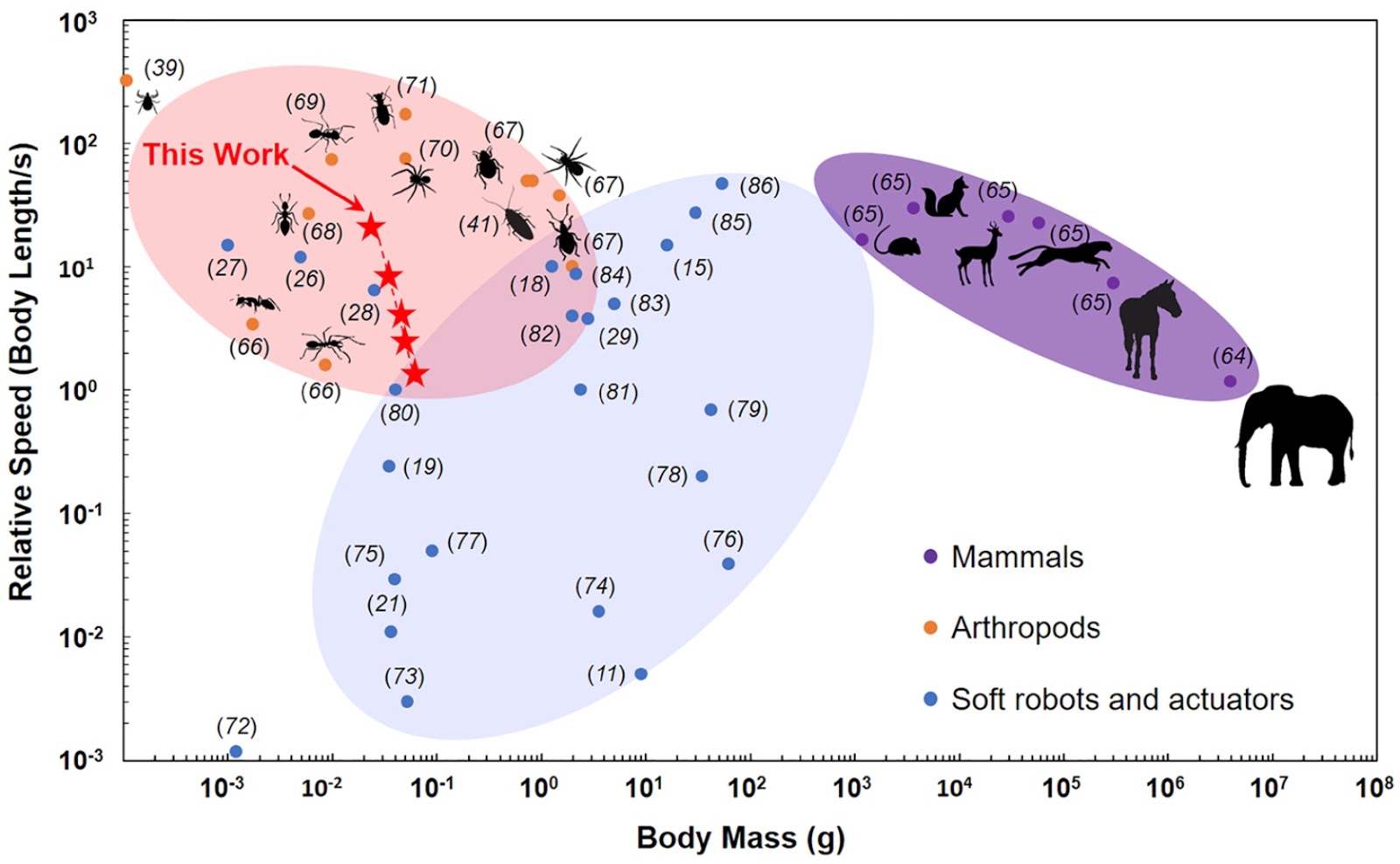
To put the robot’s top speed of 20 body lengths per second in perspective, have a look at this nifty chart, which shows where other animals relative running speeds of some animals and robots versus body mass:


This chart shows the relative running speeds of some mammals (purple area), arthropods (orange area), and soft robots (blue area) versus body mass. For both mammals and arthropods, relative speeds show a strong negative scaling law with respect to the body mass: speeds increase as body masses decrease. However, for soft robots, the relationship appears to be the opposite: speeds decrease as the body mass decrease. For the little soft robots created by the researchers from Tsinghua University and UC Berkeley (red stars), the scaling law is similar to that of living animals: Higher speed was attained as the body mass decreased.

If you were wondering, like we were, just what that number 39 is on that chart (top left corner), it’s a species of tiny mite that was discovered underneath a rock in California in 1916. The mite is just under 1 mm in size, but it can run at 0.8 kilometer per hour, which is 322 body lengths per second, making it by far (like, by a factor of two at least) the fastest land animal on Earth relative to size. If a human was to run that fast relative to our size, we’d be traveling at a little bit over 2,000 kilometers per hour. It’s not a coincidence that pretty much everything in the upper left of the chart is an insect—speed scales favorably with decreasing mass, since actuators have a proportionally larger effect. (...)

The researchers also put together a prototype with two legs instead of one, which was able to demonstrate a potentially faster galloping gait by spending more time in the air. They suggest that robots like these could be used for “environmental exploration, structural inspection, information reconnaissance, and disaster relief,” which are the sorts of things that you suggest that your robot could be used for when you really have no idea what it could be used for.

by Evan Ackerman, IEEE Spectrum | Read more:
Image: Science Robotics
[ed. Because the world needs a better cockroach.]

Wednesday, July 31, 2019

Amazon As Experiment

I sometimes think that if you could look in the safe behind Jeff Bezos’s desk, instead of the sports almanac from Back to the Future, you’d find an Encyclopedia of Retail, written in maybe 1985. There would be Post-It notes on every page, and every one of those notes has been turned into a team or maybe a product.

Amazon is so new, and so dramatic in its speed and scale and aggression, that we can easily forget how many of the things it’s doing are actually very old. And, we can forget how many of the slightly dusty incumbent retailers we all grew up with were also once radical, daring, piratical new businesses that made people angry with their new ideas.

This goes back to the beginning of mass retail. In Émile Zola’s Au Bonheur des Dames, a tremendously entertaining novel about the creation of department stores in 1860s Paris, Octave Mouret builds a small shop into a vast new enterprise, dragging it into existence through force of will, inspiration, and genius. In the process, he creates fixed pricing, discounts, marketing, advertising, merchandising, display, and something called "returns." He sends out catalogs across the country. His staff is appalled that he wants to sell a new fabric at less than cost; "that’s the whole idea!" he shouts. Loss leaders are nothing new.

Meanwhile, the other half of the story follows the small, traditional shopkeepers in the area, who are driven out of business one by one. Zola sees them as part of the past to be swept away. They’re doomed, and they don’t understand—indeed, they’re both baffled and outraged by Mouret's new ideas. Here’s the draper Baudu:
The place would soon be really ridiculous in its immensity; the customers would lose themselves in it. Was it not inconceivable? In less than four years they had increased their figures five-fold… They were always swelling and growing; they now had a thousand employees and twenty-eight departments. Those twenty-eight departments enraged him more than anything else. No doubt they had duplicated a few, but others were quite new; for instance a furniture department, and a department for fancy goods. The idea! Fancy goods! Really those people had no pride whatever, they would end by selling fish.
Mouret had a catalogue, but it was Sears Roebuck that used catalogs to transform retail again. The pages below come from the retailer's 1908 catalog; white label and private label products are not new either, and you can bet that Sears was using sales data to decide what market segments to enter next.


Amazon, of course, is the Sears Roebuck of our time, but it’s more than that. Amazon is systematically going through every branch of the idea tree around what retail is, and doing it without any pride. It’s trying everything that anyone has ever tried before, and anything else that it can think of that might make sense, as well. There is no-one saying "that’s a good idea, but we’re a website so we wouldn’t do that."

The clearest place to see this is in Amazon’s moves into physical retail. This is the opposite of pride or "principle." Amazon’s job is "to get you the thing," not "to be a website," so what are the best ways to do it? What else might work? The project to make a convenience store with no human checkout process is an obvious experiment, now that machine learning and computer vision offer a route to make it work. (There are a number of startups pursuing all the possible vectors to doing this.)

More interesting, though, are the Amazon Four-Star stores, physical retail stores —currently in New York and Berkeley, California—that only sell products rated highly by users on its site. I joked on Twitter that they feel as though they were designed by very clever people who have seen shops in Google Street View, but never actually been inside one. There's a sense of cognitive dissonance: the selection of products appears to be completely random. There’s a rice cooker, a Harry Potter Lego set, a cushion, a Roomba, a mixing bowl, a book about trees... It makes no sense. (In the words of Zola's Baudu, “Those people have no pride!”)

Of course, sometimes "it makes no sense" is the right reaction (remember the Fire Phone, after all). But when clever people do things that make no sense, it can be worth looking twice. Is this a new discovery model? A different way to change how people think about purchasing? Well, it’s another experiment.

All of this reminds me of stories about early Google, and how the company systematically rethought everything from first principles. Sometimes this was just a painful waste of time, as it learned the lessons everyone else had already learned, but sometimes the result was Gmail or Maps.

Sometimes the experiment is still in progress: though Amazon has managed to put Alexa into more than 50 million homes, it’s not yet clear what strategic value it will gain (I wrote about this here). But it’s better to own the experiment and get the option value than to sit on the business you already have and watch someone else try something new.

On the other hand, it’s interesting that Amazon seems to be doing as much experimentation as possible around the logistics model—from stores to drones to warehouse robots of every kind—but much less around the buying experience, other than small-scale tests of the Four-Star stores. After all, historically, department stores were about pleasure as much as they were about convenience or price. They changed what it meant to "go shopping" and helped turn retail into a leisure activity.

by Benedict Evans |  Read more:
Image: Sears

Putin Denies Mitch McConnell Is Russian Asset: “He Has Never Been an Asset to Any Country”

MOSCOW - Pushing back against charges that Senator Mitch McConnell is a Russian asset, the Russian President, Vladimir Putin, said on Tuesday that McConnell “has never been an asset to any country.”

“You can scour the four corners of the globe, and you will not find a nation that would ever in a million years consider Mitch McConnell an asset,” Putin said.

The Russian President urged pundits who have called McConnell a Russian asset “to look up the word ‘asset’ in the dictionary.”

“You will find that ‘asset’ means a useful or valuable thing,” Putin said. “The only part of that definition that fits McConnell is ‘thing.’ ”

Pressing his case further, he said that it was debatable whether McConnell was even an asset to his home state of Kentucky. “Maybe compared to Rand Paul he is, but that’s setting the bar ludicrously low,” he said.

Concluding his remarks, Putin said that people who ask, “Who does Mitch McConnell work for?” are asking the wrong question. “The question should be ‘When has Mitch McConnell ever worked?’ ” he said.

by Andy Borowitz, New Yorker |  Read more:
Image: Mark Wilson / Getty

Tuesday, July 30, 2019

Slash and Burn

Meet The Right-Wing Consultant Who Goes From State To State Slashing Budgets

A few days after a powerful earthquake hit the state last November, Alaska Gov. Mike Dunleavy (R) issued an order increasing the power of the state’s budget office, led at the time by a woman who had lived in Alaska a mere two weeks.

In her newly empowered role, Donna Arduin — an infamous budget-slashing expert — and Dunleavy went on cut to hundreds of millions from the state budget. They aim to trim even more in her second year in the remote state.

It’s hardly Arduin’s first rodeo. The budget consultant has served in several Republican-led governor’s offices, slashing state expenses while cutting or resisting efforts to increase tax revenue. (...)

Since arriving in Alaska last year, Arduin has led the governor’s attempt to cut a whopping $1.6 billion in spending from education, social services, the arts, and nearly every other corner of state government. Between legislative cuts and line-item vetoes, Dunleavy has so far cut “almost $700 million” from the budget in his first year, Arduin said in an interview earlier this month, despite a failed recent attempt by the legislature to override his vetoes.

“We’re about halfway solved,” she said. “We’re going to be looking towards reducing the budget another $700 million next year.”

The University of Alaska’s Board of Regents, at a meeting in which they declared financial exigency last week, sounded less enthusiastic. The institution has been “crippled,” its president said, by the governor cutting roughly 40% of the school’s state funding — over $130 million. Thousands of students across the state found their state-funded scholarships suddenly defunded with the school year looming. “We will not have a university after February if we don’t make a move,” one regent noted.

Another Alaskan who had scheduled a dentures appointment four weeks after having his teeth extracted was left with gums flapping in the wind, after the governor eliminated Medicaid dental coverage for adults. That saved the state $27 million.

But the steep cuts aren’t surprising to Americans in several other states. Following an internship in the Reagan-era Office of Management and Budget and stints at Morgan Stanley and elsewhere, Arduin has crisscrossed the country slashing state budgets left and right.

“I have no sympathy for people who want handouts from the government,” Arduin told Duke Magazine for a 2006 profile.

It shows. (...)

As then-Florida Gov. Jeb Bush’s budget director, Arduin pushed a plan that would have empowered a statewide board of appointed doctors, pharmacists and others to decide which drugs could be prescribed using Medicaid funds. To make her point, Arduin pointed to HIV-positive men receiving Viagra prescriptions. “If it were up to me, the state wouldn’t pay for it at all,” she said.

In the process of cutting $8.1 billion over five years in Florida, the Los Angeles Times later reported, “Florida eliminated money for eyeglasses, hearing aids and dentures for poor seniors and forced 55,000 low-income children onto health insurance waiting lists.”

At that point, Arduin was “on loan,” from Bush’s office to then-California-governor-elect Arnold Schwarzenegger’s as an unpaid budget expert, and then as the state’s full-time budget director. Arduin ultimately left California after 11 months as Schwarzenegger’s adviser. An initial budget proposed under Arduin’s leadership cut $274 million from programs for developmentally disabled people, the Los Angeles Times later reported, until furious protest led the governor to reconsider. Overall, the budget deficit she’d sought to tackle only got worse.

“We didn’t solve the problem. We made it worse,” Michael Genest, who worked with Arduin when she was California Department of Finance director and later held the same post, told the Anchorage Daily News in a profile of Arduin last week. “That was the tradeoff.”

One of her partners at the consulting firm, Moore, commented at the time to the Los Angeles Times, “I think that her attitude is, I’ve come and rescued California, and pretty soon it’s time to pass the baton to someone else and go back to Florida or privatize herself in some way.”

Later, in Illinois, Arduin spent just eight months as Republican Gov. Bruce Rauner’s budget adviser, receiving an estimated $165,000 for her work after failing to come up with a budget the Democratic legislature found palatable. Rauner called Arduin “the smartest state government budget person in America.” (He was subsequently defeated in a reelection bid.)

Just as Arduin’s bids to slash budgets in California and Illinois met resistance outside the governor’s office, many Alaskans are frustrated with her lack of familiarity with their unique state.

The leader of a tribal consortium, Melanie Bahnke, told Arduin not to “use the word ‘our’ when referring to our people, our state and our issues” at an event sponsored by Americans For Prosperity, the Anchorage Daily News noted.

That might sound withering, but by now, Arduin has grown used to such critiques, as she noted to Duke Magazine in 2006.

“I joined government to shrink it,” she said.

by Matt Shuhan, Talking Points Memo |  Read more:
Image: Screenshot/YouTube, "Governor Perry"
[ed. Alaska is a complete mess right now. Even the ferries are out of commission due to strikes. All this because a new governor promised to dole out more money each year to residents from the state's Permanent Fund (an oil royalty savings account) while cutting state services. See also: The lunacy of the PFD fight (ADN).]

Monday, July 29, 2019

How Science Got Trampled in the Rush to Drill in the Arctic

Every year, hundreds of petroleum industry executives gather in Anchorage for the annual conference of the Alaska Oil and Gas Association, where they discuss policy and celebrate their achievements with the state’s political establishment. In May 2018, they again filed into the Dena’ina Civic and Convention Center, but they had a new reason to celebrate. Under the Trump administration, oil and gas development was poised to dramatically expand into a remote corner of Alaska where it had been prohibited for nearly 40 years.

Tucked into the Tax Cuts and Jobs Act, a bill signed by President Donald Trump five months earlier, was a brief two-page section that had little to do with tax reform. Drafted by Alaska Senator Lisa Murkowski, the provision opened up approximately 1.6 million acres of the vast Arctic National Wildlife Refuge to oil and gas leasing, a reversal of the federal policy that has long protected one of the most ecologically important landscapes in the Arctic.

The refuge is believed to sit atop one of the last great onshore oil reserves in North America, with a value conservatively estimated at hundreds of billions of dollars. For decades, the refuge has been the subject of a very public tug of war between pro-drilling forces and conservation advocates determined to protect an ecosystem crucial to polar bears, herds of migratory caribou, and native communities that rely on the wildlife for subsistence hunting. The Trump tax law, for the first time since the refuge was established in 1980, handed the advantage decisively to the drillers.

One of the keynote speakers at the conference that afternoon was Joe Balash, a top official at the Department of the Interior. Balash, who grew up in a small town outside Fairbanks and describes himself as “a local kid,” referred to the Arctic National Wildlife Refuge as a “jewel,” and predicted that the entire North Slope region was “about to change in some pretty astounding ways.” The executives were there to hear him talk about what was going to come next: Before development could begin, Interior needed to complete a review of potential environmental impacts, and then get the first leases sold to industry. He recounted for the audience that on his second day on the job—right around when the tax bill was passed—then-Deputy Secretary David Bernhardt sat him down and told him that he would be “personally responsible” for completing the legally complex environmental review process for the wildlife refuge and “having a successful lease sale.”

“No pressure,” Balash said to audience laughter.

The pressure, in fact, couldn’t be greater.

Today, Bernhardt is the secretary of the Interior, driving energy policy in the Arctic and beyond. And although the tax bill gave DOI four years to complete the first sale, top officials at the department, including Bernhardt and Balash, are determined to get it done in half that time, before the end of 2019.

The only thing standing in the way of establishing an oil and gas leasing program is the environmental review process, which includes an assessment of the proposed seismic surveys and an evaluation of the impacts of leasing and future development on the refuge. Environmental reviews are a standard part of oil and gas drilling elsewhere in Alaska, and normally, such impact statements for ecologically sensitive and undeveloped land would take at least two to three years—or even longer, according to three former DOI officials interviewed for this article. Instead, the administration is compressing it into just over one year. The environmental impact statement for leasing commenced in April 2018, and the final results, already publicly available in draft form, are expected to be published next month. (...)

Geoff Haskett, who served as regional director for the Alaska Region of the Fish and Wildlife Service during the Obama administration, said the rush to lease has undermined the scientific integrity of the review process. “In the time they’ve allotted there’s no way they can meet all the legal requirements to do an [environmental impact statement] that’s this complicated and this big and this important,” Haskett said. “They’re going to make mistakes and there will be legal ramifications.”

Why the hurry? Observers point out that the tax bill’s drilling provision is at huge political risk: If Trump is defeated next year, a Democratic administration would almost certainly move to reverse any effort to drill in the wildlife refuge, which is a far easier task if no leases have been granted. In fact, the Democrat-controlled House of Representatives has already introduced legislation repealing the section of the 2017 tax bill that opens the refuge. Getting a lease issued quickly may be the only opportunity to achieve what no other Republican administration has been able to do: secure leases for drilling in the refuge.

“Balash is there to follow through on the Murkowski legislation and to get at least one lease sale done in ANWR so that whatever else happens in the future with policy, there will be pre-existing rights,” a former DOI official who knows Balash told me. (...)

Even without drilling, the Refuge is already undergoing profound changes.

Climate change is warming the Arctic nearly twice as fast as anywhere else in the world, setting in motion changes that have alarmed scientists who study the region. As sea ice has diminished greater numbers of polar bears have been forced to come inland to den along the coastal plain. This has led to more encounters between humans and bears and the deterioration of the overall health of the bear population. The southern Beaufort Sea population was listed as a threatened species in 2008, which is part of the reason that FWS has resisted approving permits for ecologically risky seismic surveys. Over the next 30 years, scientists fear that the population could be driven to extinction.

In early February, I flew to Kaktovik, population 250, to attend a public hearing on the draft Environmental Impact Statement for leasing the coastal plain. The much-anticipated document had been published on December 20, two days before the government shut down.

Like the environmental assessment for seismic surveys, the draft EIS for leasing, which evaluates the potential impact of leasing on everything from polar bears and caribou to water resources and vegetation, had been produced with unusual speed, in about eight months. The required public hearings commenced less than one week after DOI announced that they were taking place so there was very little advance notice. Robert Thompson, a polar bear guide in Kaktovik and an outspoken opponent of oil and gas development who follows the issue closely, learned about the meeting when I called him a few days before the hearing. “How do you have this meeting if no one knows about it?” he said.

I had attended the first hearing in Fairbanks the day before, when activists holding Defend the Sacred placards protested that the format for the hearings reflected the department’s lack of transparency and its desire to stifle public participation. DOI had announced that the meetings would be “open house” style with subject matter experts on hand and that comments would be taken only by court reporters or in writing. I watched as activists seized the podium and, for the next two and a half hours, I listened to dozens of speakers, all of them opposed to developing the refuge, make their case. At one point, Balash, who in his introductory remarks acknowledged that there were “strong feelings on both sides of the issue,” conceded that DOI had lost control of the meeting.

by Adam Federman, Politico |  Read more:
Image: Nathanial Wilder

Michael Hudson Explains Money


[ed. Click on any part of this interview and find yourself nodding in agreement. See also: Michael Hudson: The Coming Savings Writedowns (Naked Capitalism).]

Sunday, July 28, 2019

Enrico Pieranunzi


[ed. Interesting (and new to me) jazz interpretation of Erik Satie's Gymnopédie No.1.]

Antonello Silverini - Proust
via:

Stacey Kent


[ed. Photography by Steven Meisel.]

Hipster Elegies

The death and life of the great American hipster offers an alternative history of culture over the last quarter century.

On the college campus where I have been living, the students dress in a style I do not understand. Continuous with what we wore fifteen years ago and subtly different, it is both hipster and not. American Apparel has filed for bankruptcy, but in cities and towns across the US the styles forged a decade ago at the epicenters of bohemia still filter out. Urban Outfitters is going strong. In Zürich, on the banks of the Limmat, elaborate tattoos cover the bodies of the children of Swiss bounty. The French use Brooklyn as a metonym for hip. In this context, in such saturation, hipster can no longer stand for anything, except perhaps the attempt or ambition to look cool. But since coolness venerates its own repudiation most of all, every considered choice bears hipster’s trace. Hipster is everything and nothing—and so it is nothing.

Yet even before hipster petered out, confusion dogged its meaning. Starting in 2009, Mark Greif and his colleagues at n+1 undertook the most serious attempt to date to understand and situate the hipster in context. This realized itself in essays and panel discussions and ultimately a book, What Was the Hipster? Admirable as these efforts were—and Greif’s essay of the same name remains the high-water mark in hipster criticism—something elusive always troubled the boundaries of the concept. As Rob Horning wrote for PopMatters after one such panel, “The participants never really made much of an effort to establish a stable definition of what a hipster is,” a failure that may reflect the impossibility of the task.

Still, if hipster eludes strict definition, one can nonetheless diagnose the confusion that vexed its discussion and, in so doing, back one’s way into an understanding of the phenomenon. The problem always arose in the incongruity of the use of the term and the reality of the type. The word meant to describe the figure, of course, but since the word always carried a pejorative connotation—since those recognized as hipsters would never so self-designate—no one could ever achieve clarity on what, if anything, made up hipster’s authentic core. The term registered inauthenticity. But did it describe latecomers and poseurs, second-wave adopters who appropriated an authentic style (in which case first-wave hipsters might employ it themselves as a term of abuse), or was it always an outgroup epithet for something viewed as exclusionary and pretentious (in which case first-wave hipsters were its object)? This uncertainty repeated itself in a second ambiguity: Did hipster begin as an authentic style, later co-opted by outsiders, or was it always at heart a style of co-optation, as many have argued (tracing its appropriative sweep to punk, queer, skater, hip-hop, and working-class fashions)?

Unpacking the discrepancies between the history of the term and the history of the type sheds some light on these confusions. It also drives at deeper questions about what separates a subculture from a style, and what role a subculture plays in the culture writ large. (...)

This history matters because it emphasizes the semantic crux of hipster, which like hippie always worked as an outsider designation. Those within the group did not self-reflexively adopt the term, except perhaps ironically. This dictated an overwhelmingly negative usage. To call someone a hipster or hippie meant to dismiss or deride that person, and so everything the term evoked—not just individuals, but the paraphernalia and fashion by which such individuals were classified—took on a negative cast. What fell under the “hipster” umbrella was ipso facto inauthentic, lame.

The idiom of hip bifurcated in the 1980s, first attaching to the burgeoning hip-hop movement in the South Bronx. Hipster, which begins its slow resurgent ascent in the second half of the ’90s, peaking in 2004, appears to represent a different, distinctly pejorative spur. Articles on the revitalization of Brooklyn’s Williamsburg from 2000, in the New York Times and Time Out New York, describe “bohemians” and “arty East Village types,” but neither, tellingly, uses hipster. Just three years later, when Robert Lanham’s The Hipster Handbook appears, the term has found its way into widespread use and some consensus on its meaning has emerged.

Genealogy of the Type

The figure of the hipster may well be an example of polygenesis too. No coherent origin story has emerged, and as with any significant current in culture and fashion, multiple tributaries appear to flow together. One could, for instance, envision hip-hop and punk influences in the Lower East Side; Hispanic and skater culture in East L.A.; an Americana element in South Austin; queer and surfer aesthetics in the Bay Area; and suburban irony in East Portland and Capitol Hill, Seattle. Take each of these inflections and weave them together, as people migrate and mass media bring news of the latest styles, and one can imagine a composite fashion as liberally appropriative as hipster emerging in the late ’90s from several decades of subcultural style preceding it.

This story leaves out much nuance, but—obvious though this may be—it reminds us that the style and type precede the rehabilitated term. A new fashion or subgroup necessarily exists before the culture gives it a name and, in so doing, fixes it in the mind as something that can be thought about and discussed. The picture always gets more complicated after the name emerges, since the name introduces a meta layer—the understanding of the thing—which overlaps imperfectly with the thing itself and inaugurates a secondary discourse around authenticity. To name a thing is not necessarily to kill it, but to spark a never-ending tussle between the reality and the concept.

The ur-hipster—the turn-of-the-millennium character outfitted in aviator glasses, “wife beater” undershirt, and trucker hat—looked like your typical ironic urban scrounger at the moment when ’70s and ’80s “white trash” leftovers dominated thrift and vintage stores. The birth of hipster has always been indistinguishable from the advent of contemporary gentrification. As Greif notes, hipsterism marked the turning of a tide when, after a period of white flight to the suburbs, the children of those who had left returned to low-rent (but attractively situated) city neighborhoods that hung on as minority and working-class enclaves. For “mysterious reasons to the participants,” writes Greif, the trappings of ’70s suburban whiteness “suddenly seemed cool for an urban setting.”

But one might probe more deeply whether nostalgia in fact lay behind the aesthetic and whether the new logic of cool truly mystified its exponents. You can certainly argue that hipsters resurrected the iconography of their childhoods out of a disaffected nostalgia, ironic rather than romantic, but the ultimate catholic reach of their stylistic foraging places a certain weight on opportunism. If the style drew force from retro and referential gestures, what hipsters chose to curate their lives may simply have reflected what broader society had cast off: literally, what showed up in secondhand shops and family storage. Fifties-inspired nerd chic had little to do with the ’70s-porn look, after all, although both fed into hipsterism. One side of the style evoked the grainy, sepia-tone aesthetic of the Beastie Boys’ 1994 video for “Sabotage”; another entirely showed up in Weezer’s “Buddy Holly,” also from 1994, whose music video used footage from Happy Days, a ’70s sitcom set in the ’50s.

In such cultural artifacts one sees the first stirrings of the new hipster. By 1996, in recordings such as Beck’s Odelay (and video for the track “Where It’s At”) and Wes Anderson’s film Bottle Rocket, an element of kitschy Americana had joined the mix. (Richard Linklater’s 1993 film Dazed and Confused evinced affection for the ’70s filtered through the prism of the ’90s South Austin flâneur.) The ground for hipster was effectively laid.

by Greg Jackson, The Hedgehog Review |  Read more:
Image: via

Brian and Thomas Owens


[ed. Blues Sunday.]

Bert Hardy, Down the Bay [aka Street shelter], 1950
via:

Nothing Matters: It’s Like the Whole Market Has Gone Nuts

You see, Tesla is different. It just reported another doozie, a loss of $408 million in the second quarter, after its $702 million loss in the first quarter, for a total loss in the first half of $1.1 billion. In its 14-year history, it has never generated an annual profit.

It has real and popular products and surging sales, but it subsidizes each of those sales with investor money. And here’s where it’s different this time: investors don’t care. They dig how the company has been consistently overpromising and underdelivering. They dig the chaos at the top. They dig everything that should scare them off.

Yeah, its shares plunged [TSLA] 11% afterhours today, but that takes those shares only down to where they’d been on May 1. Big deal. Shares are down 32% from the peak. But their peak should have been a small fraction of that. Even today, the company is still valued at over $40 billion.

Tesla lacks a viable business model in the classic sense. Its business model is a new business model of just burning investor cash that it raises via debt and equity offerings on a near-annual basis because investors encourage it to do that, and love it for it, and eagerly hand it more money to burn, and they’re rewarding each other by keeping the share price high. It’s just a game, you see. And nothing else matters.

Then there is Boeing [BA]. It just reported the largest quarterly loss in its history of $2.9 billion due to a nearly $5-billion charge related to its newest bestselling all-important 737 Max, two of which crashed, killing 346 people, due to the way the plane is designed. The flight-control software that is supposed to mitigate this design issue is not working properly. And a software fix that is acceptable to regulators remains elusive.

The plane has been grounded globally since March. No one, especially not the regulators, can afford a third crash. So today, Boeing announced that it may further cut production of the plane or suspend it altogether if the delays continue to drag out. This is big enough to start impacting US GDP.

The entire 737 Max episode has been tragic from the first minute, and the cost in human lives has been huge, and it has cost and continues to cost billions of dollars to deal with, among calls that the plane should never fly again.

And what does Boeing’s share price do? It dipped 3% today and is up 2% from a year ago, before all this happened. In essence, two crashes and the grounding of its bestselling plane, and the potential suspension of production of this plane, and its uncertain future … and the stock has ticked up over a 12-month period.

Instead of spending the resources necessary to design a modern plane from ground up, Boeing kept basing its new models on versions of its many-decades-old 737 airframe that wasn’t designed at all for what it is being used for today. This was a decision Boeing made to save some money and pump up its share price.

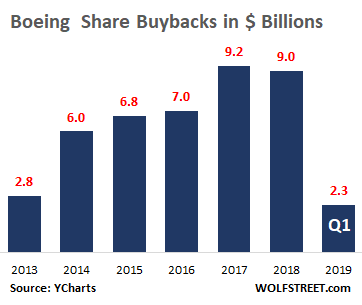
But here we go: From 2013 through Q1 2019, Boeing has blown a mind-boggling $43 billion on share buybacks (buyback data via YCharts):


Blowing these $43 billion on share buybacks has caused Boeing to have a “total equity” of a negative $5 billion. In other words, it has $5 billion more in liabilities than in assets. This company is out of wriggle room. If it can’t borrow enough money to make payroll, it’s over.

But nothing matters.

If Boeing had invested some of this money that it blew on share buybacks to design a new modern plane from ground up to replace the ancient 737 airframe, these tragedies could have been prevented, and Boeing wouldn’t have this nightmare on its hands. But the corporate cost-cutters and financial engineers, rather than real engineers, had the final word.

Markets don’t care about any of this. They don’t care about real engineers either. They love corporate cost-cutters and financial engineers. They want share buybacks, and if something bad happens, they’ll overlook the $5 billion to pay for the fallout because it’s just a “one-time item.”

And now Boeing still has this plane, instead of a modern plane, and the history of this plane is now tainted, as is its brand, and by extension, that of Boeing. But markets blow that off too. Nothing matters.

Companies are getting away each with their own thing. There are companies that are losing a ton of money and are burning tons of cash, with no indications that they will ever make money. And market valuations are just ludicrous.

by Wolf Richter, Wolf Street |  Read more:
Image: YCharts and Wolf Street
[ed. See also: The Companies with the Most Debt in America (Wolf Street).]