Saturday, September 16, 2023

Olivia Rodrigo's 'Guts'

Last month, Billboard published a gloomy survey of record-label executive sentiment about the state of the music industry. Many of those interviewed lamented one unsettling shift in particular—a shift that the label executives themselves were no doubt complicit in creating. They noted that it had become near-impossible to “break” new stars. The sources explained that they could successfully sign loads of new talent and even create digital-era hits that generate millions—if not billions—of streams. The bigger challenge, though, was to find young artists who could break through the noise of the Internet and create the sort of genuine, lasting fandom that turns them into household names and sells out arenas. “Each person I talk to in the industry is more depressed than the person I talked to before them,” one manager said. Given the nature of streaming, and of the TikTok algorithm in particular, the music business has never seemed more gameable—but the ability to create a viral smash on TikTok has also, perversely, led to an oversaturated landscape in which everything feels especially fleeting.

One rare exception to this dispiriting paradigm shift is the twenty-year-old former Disney star and vocal powerhouse Olivia Rodrigo. Rodrigo became a bona-fide pandemic-era success with her début single, “Drivers License,” from 2021, a piano power ballad that is both sweeping and finger-snappy, a post-breakup rumination rendered with unusual clarity. It’s a song that deeply satisfies the core requirement of great pop music—and pop music’s youthful fans—which is to make the mundane feel cinematic: “Yeah, today I drove through the suburbs / And pictured I was driving home to you,” Rodrigo sings.

The song quickly broke streaming records, clocking the single highest number of streams during a single day (holiday music excluded) on Spotify. Rodrigo followed up “Drivers License” with two more hit singles, and then a début album called “Sour,” released in the spring of 2021. “Sour” landed at No. 1 on the Billboard album chart and established Rodrigo as one of the finest purveyors of breakup songs in the modern era. (It also won her three Grammys.) Bolstered by her musical-theatre expressiveness, a dynamic soprano, and a sharp lyrical specificity, the eighteen-year-old became not a vanishing sensation but an emotional firebrand and a new generational avatar. She was seemingly anointed to lead the post-Lorde and post-Billie Eilish wave of alternative-leaning female pop stars. Today, with hindsight, in such an evidently desperate moment for radio pop, “Sour” is being viewed not merely as a breakout star’s début but as perhaps the final successful star-making endeavor in pop history.

And so Rodrigo’s new record, “Guts,” is loaded not only with the customary sophomore-album expectations but with ideas about the health of an entire industry. The young star, now twenty, has spoken about being paralyzed by these expectations, and feeling frozen as she sat down to write songs. But “Guts,” the new record, does not betray any of that trepidation. If “Sour” was a single-minded project designed to publicly nurse the specific wound from one romantic betrayal, “Guts” is a transitional record on which Rodrigo begins to turn the mirror away from her exes and playfully, brashly toward herself. Rodrigo is at her best, perhaps owing to her acting background, when delivering screeds in a kind of hyper-self-aware, spoken-word register. “Yes, I know that he’s my ex, / But can’t two people reconnect?” she poses with an almost audible wink on “Bad Idea Right?” a song on which she contemplates the self-destruction of rekindling an old romance. “I only see him as a friend / The biggest lie I ever said,” she adds, always shrewdly one step ahead of herself.

Novelty is a critical aspect of any pop sensation’s rise. Part of what made Rodrigo feel fresh was that she was more indebted to various strains of rock music from the late nineties and two-thousands than to the hip-hop influences that had, for many years, become so enmeshed in the pop universe. Rodrigo cites the White Stripes’ Jack White as one of her biggest inspirations, and her music is a canny fusion of piano balladry and retro pop-punk, layered with flavors of grunge and emo. It’s a careful selection of styles that work harmoniously with the attitudinal thrust of her music, which sways between cheeky defiance and melodramatic longing. So much of her music sounds like the soundtrack to an early-two-thousands teen drama, each line delivered with an eye roll. And while her music, stylistically, is inherently nostalgic, Rodrigo is a quintessentially modern star in other ways. If pop stars of previous eras attempted to perform sexual maturity beyond their ages, Rodrigo is constantly offering reminders of her adolescent status—or, at least, the idea of adolescence—and revelling in juvenile poses. Lest anyone suspect that she has moved beyond normalcy, she paints a lucid image of bumbling teen-aged relatability: “I laughed at the wrong time, sat with the wrong guy,” she sings on “Ballad of a Homeschooled Girl.” “Searching ‘how to start a conversation’ on a Web site.”

In the early days of her success, Rodrigo confessed to being the “biggest Swiftie in the world.” She had already indicated as much in April of 2020, when she recorded an impassioned, stripped-down piano cover of Taylor Swift’s song “Cruel Summer.” Later, Rodrigo acknowledged that “Cruel Summer” had such an influence on her own single “Deja Vu” that Swift would be added to its credits as a co-writer. Swift’s influence can certainly be heard throughout Rodrigo’s work, particularly when she sings—as she almost always does—about romantic betrayal. Rodrigo, like Swift, has mastered the narrative art of dressing down her past loves while rendering herself equal parts victim and victor: “I wanna kiss his face with an uppercut,” she sings on “Get Him Back!,” the lively pop-rock centerpiece of “Guts,” a song with the sweet pep of Toni Basil’s “Mickey” layered with a menacing, vengeful glower. “I wanna meet his mom / Just to tell her her son sucks,” Rodrigo utters, more spewing than singing.

by Carrie Battan, New Yorker | Read more:
Image: YouTube
[ed. More impressed with every album she puts out. See also: Olivia Rodrigo 'Bad Idea, Right?; and, Every Olivia Rodrigo Song, Ranked. Two albums, both classics. Let's celebrate a budding rock & roll legend (RS)]

'All I did was try my best. This the kinda thanks I get. Unrelentlessly upset. They say these are the golden years. But I wish I could disappear. Ego crush is so severe. God, it’s brutal out here.

I feel like no one wants me. And I hate the way I’m perceived. I only have two real friends. And lately I’m a nervous wreck. ‘Cause I love people I don’t like. And I hate every song I write. And I’m not cool and I’m not smart. And I can’t even parallel park'

The Real Stakes of the Google Antitrust Trial

The year 1998 was a pivotal one in the history of technology: Apple’s introduction of the iMac helped set the company back on the path to success after it nearly went bankrupt earlier in the decade; Google was founded by two Stanford students, Larry Page and Sergey Brin; and Microsoft introduced Windows 98, an improved version of its popular computer operating system. That May, Microsoft also became the target of a historic antitrust lawsuit lodged by the Department of Justice and twenty states, accusing it of anticompetitive behavior in two domains: attempting to maintain its monopoly in computer operating systems and trying to monopolize a new market, that of Internet browsers.

At the time, residential Wi-Fi connectivity was rapidly expanding across America, and, in the quaintly titled “browser wars,” Netscape Navigator, a popular browser released by Mosaic Communications Corporation in 1994, fought Microsoft’s Internet Explorer for the growing class of Web-connected consumers. Microsoft, the D.O.J. alleged, had attempted to crush Netscape by making deals with Internet-service providers that prioritized Explorer access at Netscape users’ expense. The trial began that fall, and included seventy-six days of testimony that took place over more than eight months, during which a government witness alleged that a Microsoft executive had pledged to “cut off Netscape’s air supply” (which a Microsoft attorney denied). The government also showed a video deposition of Bill Gates, then the company’s C.E.O., in which he was so evasive of many of the questions posed by David Boies, the Justice Department’s lead attorney, that people in the courtroom laughed. In 2000, the judge ruled in the government’s favor and ordered that Microsoft be broken up into two companies—one producing operating systems, another producing software. (In the end, the company was never disassembled—an appeals court reversed the breakup order—but an eventual settlement required Microsoft to drastically change some of its business practices.)

Although the case was much discussed within the tech industry and in the press, the Justice Department’s clampdown on anticompetitive behavior did not become the norm. Instead, for much of the past twenty years, Microsoft and other major tech companies have been allowed to expand as policymakers and regulators have struggled to confront the challenges posed by rapidly changing technology. This has only begun to change in the past half decade, as the effects of these companies’ dominance have come to be seen as negative by the public and by a new cadre of regulators, including Lina Khan, the young legal expert known for her critiques of Amazon and who became the chair of the F.T.C. in 2021. On Tuesday, the most significant antitrust trial since the 1998 case is set to begin in Washington, D.C. The trial stems from a case that was filed in December, 2020, by the Justice Department and attorneys general of eleven states, alleging that, much as Microsoft did when seeking to establish Internet Explorer as most users’ browser of choice, Google has maintained its dominance of the search and search-advertising markets by arranging deals with smartphone manufacturers and the creators of Internet browsers that make Google the default search engine almost everywhere a consumer might encounter one. Every year, it has been estimated that Google pays up to twelve billion dollars to Apple, and billions more to a number of other companies, including Samsung and Verizon, to make Google the default browser on their platforms. In some cases, the company’s agreements also prohibit its partners from preinstalling similar software made by its competitors.

According to the complaint, Google accounts for nearly ninety per cent of general search-engine queries in the U.S., a fact that led the government to dub the company a “gatekeeper for the internet.” As long as Google maintains its lock on this market, the complaint argues, it can take the billions in monopoly profits it makes and continue to share them with other companies in exchange for help maintaining its monopoly, in a potentially endless cycle. According to the government, Google’s current annual revenue is more than a hundred and sixty billion dollars, the majority of which is derived from search and search ads. With so many billions at stake, the company has been responding to the case aggressively: as its top lawyer told the New York Times, dozens of staff lawyers and three law firms have been dispatched to prepare for the trial.

According to sources on Google’s legal team, the defense the company plans to present will rely on the idea that Google’s market dominance is the result of offering a superior product. Kent Walker, Google’s president of global affairs, made this point in a recent blog post, writing, “browser and device makers have a choice, and they choose Google.” Comparing Google’s current predicament to the case from 1998, the company argued that user preference was a key distinction: in Microsoft’s case, most users preferred to use Netscape, not Explorer, but, with Google, consumers are getting what they actually want. The company also plans to argue that it’s relatively easy to download another search engine, such as Bing or DuckDuckGo, if one doesn’t want to use Google, which many phones and computers use by default.

There are signs that Google faces a steep battle. For years, antitrust watchdogs considered trying to restrain the company’s growth, but failed, standing by as it bought out other tech companies (such as YouTube, which it acquired in 2006) and expanded into new businesses, including map applications, e-mail, mobile phones, and self-driving cars. This era has come to an end. ​​By some estimates, Google is now the most investigated company in the world, with three antitrust suits launched against it in 2020 alone. One is the case initiated by the Justice Department that is going to trial this week. Another was filed by thirty-eight attorneys general, which alleged similar complaints, as well as additional allegations about Google making it hard for users to find more specialized search engines, such as Yelp, which lists restaurants and other businesses, and Expedia, which lists hotels and flights. (This case was later combined with the D.O.J. case; many elements of it were dismissed in early August.) A third case, filed by ten attorneys general, accused the company of using anticompetitive behavior in order to become the dominant company in the online-advertising market, allegedly employing some of the same kinds of strategies described in the search-engine case. This January, the Justice Department joined with eight other states to file a case over similar issues. Google has also faced multiple antitrust probes in Europe, where it has paid billions of dollars in fines. (In 2020, the online news site the Markup reported that Google’s parent company, Alphabet, had begun training its employees to mind their language. “Alphabet gets sued a lot,” one document read. “Assume every document will become public.” The company’s discouraged words and phrases included “market,” “barriers to entry,” and “Get ahead of competitors.”) (...)

The outcome of the Google trial similarly has implications that will go well beyond online advertising and search engines. In the past year, major tech companies and upstart competitors have been in a race to commercialize new A.I. technologies, which offer transformative possibilities in many domains—including search. In a newly released policy brief, Matt Stoller, the director of research at the American Economic Liberties Project, an anti-monopoly think tank, and his colleague Sahaj Sharda argue that, if the judge in the case leaves Google intact, the company’s continued dominance of the online-search market could stymie companies creating new search products that integrate novel A.I. technologies as these potential competitors conclude that it’s too difficult to try to break into the search market.

by Sheelah Kolhatkar, New Yorker | Read more:
Image: Shira Inbar
[ed. See also: The Google Monopoly Trial as a Morality Play; and, Big Tech On Trial (BIG):]

If you read my earlier preview of the Google trial – or have been reading coverage of it elsewhere — you know how important this trial is. It could determine the future of artificial intelligence, search, newspapers, antitrust law, and innovation. It will set precedent for monopolization cases in a lot of other industries. And of course, the bad guys know it. The rumor is Google is putting together a war room with dozens of PR professionals to spin the outcome, and I’ve heard from reporters that they are being lavished with attention like never before. Dozens of media outlets are previewing the trial. As just one example, I was quoted in the New Yorker today discussing its impact on the deployment of AI.

And Google’s PR team is already earning its pay, planting a story in the New York Times by Steve Lohr about how Google isn’t the big bad guy that Microsoft was in the 1990s, and besides, these days no one really cares about this case. Lohr covered the Microsoft case, and seems singularly unaware that there in fact has been a much larger cultural argument about big tech and monopolies over the last ten years than there ever was around Microsoft.

But this coverage matters, because the fight is as much about how the public and members of Congress understand the trial as it is the legal outcomes themselves.

In other words, this trial isn’t just important because of the potential outcome, but also because the public and lawmakers are paying close attention. We’re going to learn a lot about how the internet itself was shaped, advertising, the coercion and power plays in board rooms, the ugly deals between Google and Apple to divide up the world between them, and how billionaires fight with each other when all the money in the world is at stake. So regardless of the final verdict, the facts that come out at trial will help shape the future direction our elected leaders and judges take in addressing our increasingly monopolistic order. The point is, there’s a lot of bullshit in politics, but this trial is the big one, where the debates over big business that have gone on for years meet the law.

Friday, September 15, 2023

Joni Mitchell/Taylor Swift

[ed. See also: An Open Letter to Taylor Swift (HB):]

You have also shown your willingness to take on the system. Even better, you have gone to battle against power brokers in the music business—and have won!

And that’s just a start. You’re also proving that live music not only can survive, but actually flourish in the digital age. Other superstars have taken the easy way out—playing shows for high rollers in Las Vegas or setting up shop on Broadway for tourists and elites.

But you didn’t do that, Taylor Swift. You’re bringing live music everywhere, creating the most popular music tour in history. The numbers blow my mind. You’re taking your music to five continents, showing people in a hundred cities that a concert can be the biggest entertainment event of the year.


Your total tour revenues are more than the GDP of most nations. In Singapore alone, more people tried to buy concert tickets than the entire population of the country. In the US, 2.4 million people purchased tickets the first day they went on sale—that’s never happened before.

By the time your tour ends, you will have generated more demand for live music than any artist in history—with huge beneficial effects for everybody. When you show up in town, it gives a Super Bowl-sized boost to the entire local economy.

Along the way, you have made so many other contributions to the music ecosystem. You treat everyone generously—paying out $50 million in bonuses to your team. Even truck drivers got $100,000 bonuses. You’ve also made donations to food banks, employed locals, and have even purchased carbon credits at twice the level of the emissions of your tour.

You also revitalized physical music media by convincing a million or so fans to buy their first vinyl album—boosting demand for LPs to levels not seen since the last century. You’ve actually done more to help record stores than the record business.

Nobody else is doing these kinds of things with such impact. It’s not even close.

So I feel that destiny has blessed us.

For the first time in ages, the superstar musician at the top of the hierarchy is brave, independent, generous, and willing to take a hard stand in changing the system. You stand up for artist rights. You stand up for live music. You stand up for people. And you do all this with a grass roots power base that nobody can match—no politician, no billionaire technocrat, and certainly no other performer.

Musicians have never had that kind of visionary leader.

by Ted Gioia, Honest Broker |  Read more:
Images: YouTube/ Michael Hicks)

Thursday, September 14, 2023

The One Thing Everyone Should Know About Fall COVID Vaccines

The simplest way to think about them—everyone should just get one—is arguably the best.

Paul Offit is not an anti-vaxxer. His résumé alone would tell you that: A pediatrician at Children’s Hospital of Philadelphia, he is the co-inventor of a rotavirus vaccine for infants that has been credited with saving “hundreds of lives every day”; he is the author of roughly a dozen books on immunization that repeatedly debunk anti-vaccine claims. And from the earliest days of COVID-19 vaccines, he’s stressed the importance of getting the shots. At least, up to a certain point.

Like most of his public-health colleagues, Offit strongly advocates annual COVID shots for those at highest risk. But regularly reimmunizing young and healthy Americans is a waste of resources, he told me, and invites unnecessary exposure to the shots’ rare but nontrivial side effects. If they’ve already received two or three doses of a COVID vaccine, as is the case for most, they can stop—and should be told as much.

His view cuts directly against the CDC’s new COVID-vaccine guidelines, announced Tuesday following an advisory committee’s 13–1 vote: Every American six months or older should get at least one dose of this autumn’s updated shot. For his less-than-full-throated support for annual vaccination, Offit has become a lightning rod. Peers in medicine and public health have called his opinions “preposterous.” He’s also been made into an unlikely star in anti-vaccine circles. Public figures with prominently shot-skeptical stances have approvingly parroted his quotes. Right-leaning news outlets that have featured vaccine misinformation have called him up for quotes and sound bites—a sign, he told me, that as a public-health expert “you screwed up somehow.”

Offit stands by his opinion, the core of which is certainly scientifically sound: Some sectors of the population are at much higher risk for COVID than the rest of us. But the crux of the controversy around his view is not about facts alone. At this point in the pandemic, in a country where seasonal vaccine uptake is worryingly low and direly inequitable, where health care is privatized and piecemeal, where anti-vaccine activists will pull at any single loose thread, many experts now argue that policies riddled with ifs, ands, or buts—factually sound though they may be—are not the path toward maximizing uptake. “The nuanced, totally correct way can also be the garbled-message way,” Anthony Fauci, the former director of the National Institute of Allergy and Infectious Diseases, told me.

For the past two years, the United States’ biggest COVID-vaccine problem hasn’t been that too many young and healthy people are clamoring for shots and crowding out more vulnerable groups. It’s been that no one, really—including those who most need additional doses—is opting for additional injections at all. America’s vaccination pipeline is already so riddled with obstacles that plenty of public-health experts have become deeply hesitant to add more. They’re opting instead for a simple, proactive message—one that is broadly inclusive—in the hope that a concerted push for all will nudge at least some fraction of the public to actually get a shot this year.

On several key vaccination points, experts do largely agree. The people who bear a disproportionate share of COVID’s risk should receive a disproportionate share of immunization outreach, says Saad Omer, the dean of UT Southwestern’s O’Donnell School of Public Health.

Choosing which groups to prioritize, however, is tricky. Offit told me he sees four groups as being at highest risk: people who are pregnant, immunocompromised, over the age of 70, or dealing with multiple chronic health conditions. (...)

Offit, had he been at the CDC’s helm, would have strongly recommended the vaccine for only his four high-risk groups, and merely allowed everyone else to get it if they wanted to—drawing a stark line between those who should and those who may. Fauci, meanwhile, approves of the CDC’s decision. If it were entirely up to him, “I would recommend it for everyone” for the sheer sake of clarity, he told me.

The benefit-risk ratio for the young and healthy, Fauci told me, is lower than it is for older or sicker people, but “it’s not zero.” Anyone can end up developing a severe case of COVID. That means that shoring up immunity, especially with a shot that targets a recent coronavirus variant, will still bolster protection against the worst outcomes. Secondarily, the doses will lower the likelihood of infection and transmission for at least several weeks. Amid the current rise in cases, that protection could soften short-term symptoms and reduce people’s chances of developing long COVID; it could minimize absences from workplaces and classrooms; it could curb spread within highly immunized communities. For Fauci, those perks are all enough to tip the scales.

by Katherine J. Wu, The Atlantic |  Read more:
Image: Getty
[ed. See also: What to Know About Fall COVID Vaccines (a discussion of Ms Wu's article - Atlantic).]

Old Friends Are Better Than New Clothes

And, don't step on a rake twice.

A WhatsApp message to me early this morning from WION, the Indian English-language global broadcaster, prompted me to pay special attention to the visit to Russia of the North Korean Supreme Leader Kim Jong Un, which I was asked to comment upon. I put on my thinking cap and came up with a couple of observations that should guide our appreciation of what Kim may accomplish and why the West should be worried.

First, not much has been said in major media about the timing of Kim’s visit. He is arriving in Vladivostok on the second day of the three-day Eastern Economic Forum in Vladivostok. He will not be taking part in that event, to be sure, but all of the Russian government and business leaders with whom his delegation should meet to discuss a comprehensive deepening of relations are on the spot in Vladivostok. The very wording with which Press Secretary Peskov described arrangements for the visit is a tip-off: he said that Putin and Kim will have one-on-one talks “if necessary.” This summit event is thus very different from the Trump-Kim meetings of several years ago which were focused on a very few issues and were held with no one but translators present. Moreover, though the talks may be behind closed doors, the Russian-North Korean negotiations are not surreptitious; they are going on under the noses of global media.

The second question given me by the program host from WION was what does this meeting mean for the West given that the accent is likely to be on arms sales.

Allow me to quote a relevant interpretation of the meeting’s sense by today’s online New York Times:
“North Korea could provide Russia with much-needed ammunition. In return North Korea is seeking food aid and some advanced technology.”
The widespread assumption that Russia needs North Korean ammunition for its ongoing war in Ukraine is just plain wrong. The other type of military supply which Russia is said to seek in North Korea is medium range ballistic missiles, which some analysts say are among the best and least vulnerable to air defenses in the world. There, too, I say that the Russian interest is not to deploy such missiles in the Ukraine campaign.

Instead, I believe the Russians are seeking the aforementioned military materiel from North Korea to add to their weapons inventory in preparation for a direct war with NATO if that comes. In such eventuality this materiel can be of crucial importance. In the meantime, conclusion of agreements for supply from North Korea allows the Russians to be more liberal in their deployment of their own top-of-the-line hardware as they shift in coming weeks from defense to offensive operations on the ground in Ukraine. By way of example, I note that Russian use of their Iskander hypersonic missiles in Ukraine thus far has been very sparing. But most recent news suggests that Russia is placing large numbers of Iskander in the field for use when it goes on the offensive. These missiles cannot be produced in great numbers quickly. Therefore, it will be very handy for Russia to have a back-up in the form of Korean medium range missiles. (...)

Update: Post-meeting

As for the meeting with Putin, Russian news carried video images of the exchange of toasts by the heads of state during a festive banquet that preceded the departure. We were told that all-in-all the two sides met for two hours of talks with all key officials present and for an additional hour of tête-à-tête talks between Kim and Putin.

What could they possibly achieve in this brief get-together, you may ask? However, that would be to miss the point highlighted by Russian commentators on state television, namely that over the past year the number of staff at the Russian embassy in Pyongyang more than doubled and was filled with experts who surely were preparing all the agreements which were officially signed during the visit.

Why was the meeting held in the Vostochny space launch complex, or cosmodrome? Firstly, because such a visit was a mirror image of what Russian Defense Minister Shoigu was shown in Korea during his visit there this spring – the Koreans’ latest achievements in missile technology.

The Russians are immensely proud of the Vostochny site which has been replacing their main launch site at Baikonur from Soviet days. Baikonur is in Kazakhstan. Vostochny is on Russian land. At Vostochny they can show off their state of the art military and civilian space technologies. This addresses the known Korean pursuit of assistance in launching military spy satellites, where so far they have failed on their own. More broadly, it underlines the fact that cooperation in the “military technical” sphere is the driving force of Russian-Korean partnership.

The term “military technical” entered the vocabulary of Russia observers at the start of the Special Military Operation when it was used by Defense Minister Shoigu to describe what the Russians would be deploying to vanquish the Ukrainians and their Western backers. At the time, nearly all Western pundits were scratching their heads over the term.

Now we know better. “Military-technical” puts the accent on military hardware as opposed to warm bodies in uniform, and Shoigu was confident that the latest Russian equipment now in serial production would prove its worth against anything that the West supplied to Kiev. Watching the videos of German Leopard tanks, British Challenger II tanks and American Bradley armored personnel carriers burning to ash after being struck by Russian artillery and the killer drone known as “Lancet,” we understand today that he was right.

“Old friends are better than new clothes.” This bit of folk wisdom was part of Vladimir Putin’s toast at the festive banquet. But are the Russian-Korean relations something more than friendship?

by Gilbert Doctorow, International Relations/Russian Affairs |  Read more: here and here
Image: Sputnik/Reuters via
[ed. See also: Vladimir Putin: The Early Years (BTW).]

Wednesday, September 13, 2023

A Template for America: What Republicans Are Doing to Wisconsin

If you need a reminder that the Republican party’s problem with democracy extends beyond the antics of Donald Trump, look no further than Wisconsin. A battle is under way there which began before the January 6 insurrection was even a twinkle in Trump’s eye, and which will do much to determine the future of democracy in America whether Trump ultimately answers for his crimes or not. It’s no exaggeration to say that Wisconsin and its state capitol, Madison, are now the front line of the battle to save American democracy.

In 2011, Republicans gerrymandered Wisconsin’s state legislature so badly that the party can win supermajorities despite losing the popular vote, as it did in 2018. Voters have fought back, and earlier this year they elected Janet Protasiewicz to the state supreme court, ushering in a new liberal majority which looked poised to finally overturn the gerrymander and bring democratic regime change to Madison.

But Wisconsin Republicans have no intention of seeing their undeserved power slip away. They’re proposing to impeach Protasiewicz on spurious charges before she has ruled on a single case, paralyzing the court and leaving the gerrymander intact.

When Trump argued that he was the real winner of the election because the votes of people living in Democratic-leaning urban areas were somehow fraudulent and should not count, he was repeating arguments that Wisconsin Republicans had already honed. The speaker of the state assembly, Robin Vos, has explained that the state’s gerrymander is fair because “if you took Madison and Milwaukee out of the state election formula, we would have a clear majority”. Because Madison and Milwaukee are the parts of the state with the largest concentration of non-white voters, Vos has revealed what the Wisconsin gerrymander is really about: race.

There is a long history in the United States of skewed electoral systems being used to suppress the voices of minority voters, and Wisconsin’s is only the latest example. Like their predecessors in other states, Wisconsin Republicans have been remarkably frank about their intention of ensuring that minorities stay in their place. When Democratic gubernatorial candidate Tony Evers powered to victory in 2018 with massive wins in Madison and Milwaukee, the Republican legislature used a lame-duck session to strip him of much of his power. Not content with that, Evers’ Republican opponent in 2022, Tim Michels, promised that if he was elected then Republicans in Wisconsin “will never lose another election”.

The latest target of this raw, racist power politics is the Wisconsin’s electorate new choice for the state supreme court. Protasiewicz won by more than 10% on record turnout, which was spurred by widespread voter dissatisfaction with the fruits of Republican rule. In particular, voters oppose the state’s harsh anti-abortion law, which makes abortion illegal unless it is necessary to save the life of the mother, with no exceptions for other medical problems or rape. A majority of Wisconsinites wanted a liberal state supreme court which would overturn that law, and they voted accordingly.

By linking abortion rights to questions of democracy, Protasiewicz came up with a playbook that can be used across America to push back against attacks on basic constitutional rights, be they in the doctor’s office or the voting booth. That’s why Republicans are so scared of her and desperate to find a way to stop her from succeeding.

Republicans’ plan to impeach Protasiewicz is nakedly hypocritical: They argue that Protasiewicz, who received Democratic campaign donations, cannot give unbiased rulings in gerrymandering cases – despite the fact that numerous other Wisconsin state supreme court justices, including Republicans, have also received party donations and ruled on cases with political implications.

Their plan also bends democratic norms, in this case by impeaching Protasiewicz and then simply leaving her in limbo, legally unable to hear cases. Because the plan wouldn’t actually formally kick her from office, it denies the state’s Democratic governor the opportunity to replace her with another liberal. Democrats are fighting back, but their chances of success hinge on their ability to convince Republicans in the gerrymandered assembly to do the right thing.

As Wisconsin goes, so goes America. Although sometimes referred to as a “moderate” state, it is more accurate to view Wisconsin as one very conservative state and one very liberal state jammed together. The fact that it is narrowly divided between the two parties is precisely why Republicans have resorted to constitutional and political skullduggery to give themselves an unfair advantage.

The same is true of many other states, and indeed of America as a whole. What happens in Wisconsin is a crucial test case of whether the most brazen attempts to turn competitive elections into uncompetitive one-party control will fly.

by Andrew Gawthorpe, The Guardian | Read more:
Image: Morry Gash/AP
[ed. See also: The Authors of ‘How Democracies Die’ Overestimated the Republicans (NYT).]

Tuesday, September 12, 2023

Aaron Rodgers Gave the Jets Reason to Believe

Is There Any Hope Without Him?

Before Monday Night Football, ESPN aired a segment in which tennis legend John McEnroe interviewed Aaron Rodgers, the New York Jets’ new quarterback. The interview was charming, but as Rodgers repeatedly talked about winning the Super Bowl, McEnroe, a diehard Jets fan, kept squirming in his seat. Clearly scarred by the last 50 years of his Jets fandom, McEnroe was so visibly uncomfortable with Rodgers discussing a championship that Rodgers called out McEnroe’s pessimism.

“You’re a Jets fan!” Rodgers said.

“Exactly,” McEnroe said.

Rodgers rejected New York’s negativity and preached how he believed in manifesting what is in your heart. Rodgers sounded like Ted Lasso, if Ted Lasso took (more) hallucinogens and subscribed to Joe Rogan’s podcast.

“Once we start believing and start playing the right way, you’ll see everyone else like yourself start believing,” Rodgers said. “And you won’t be saying shit like ‘What if it doesn’t go right?’ And then when everybody else is believing in this city, there is a never-ending unstoppable wave of positivity and energy that we’re going to take all the way.”

As if to emphasize Rodgers’s point, a storm swirled over the stadium before the game. Fans were warned to shelter in place two hours before kickoff. But as kickoff approached, the clouds were replaced by a double rainbow. It was as if the heavens themselves were pleading with Jets fans to believe.

But rainbows are tricks of the light. In the most Jets thing that has ever Jets’ed in the history of the Jets, Rodgers was injured four plays into his New York career. While the severity of the injury has yet to be confirmed pending an MRI on Tuesday, Jets head coach Robert Saleh confirmed after the game that they fear Rodgers suffered an Achilles injury, which could be not only season-ending but could be career-threatening for a quarterback who turns 40 later this year. As the fans say in Ted Lasso, it’s the hope that kills you.

But in the least Jets thing that has happened since Joe Namath guaranteed and delivered a Super Bowl III victory (another guy who believed in speaking positivity into existence), the Jets ended up beating the three-time defending AFC East division champ Buffalo Bills anyway. At the risk of being caught in the moment, it feels fair to say this might go down as the single wildest game of this season.

by Danny Heifetz , The Ringer | Read more:
Image: Getty/AP/Ringer Illustration
[ed. What hype, what expectations, what commercials, interviews, choreography, over the top pre-game analyses... everything. It felt like a Super Bowl. Then this happens. Would've loved to see a montage of executive faces when Rodgers got carted off the field: NFL, upper management, agents, ad and tv execs, everyone financially and psychologically invested in the myth-making of the moment. Then the Jets go off and win it anyway. In a thriller. Wow. Update: Rodgers’s Jets Season Ends Early With Torn Achilles’ Tendon (NYT).]

Byron Birdsall, Anchorage '83
via:

Monday, September 11, 2023

Byron Birdsall, Hawaii Night
via:

Sorry Pal, This Woo is Irreducible

Years ago, I attended a wedding that should not have happened.

The couple had been with each other forever, held together by nothing but inertia, a sort of living monument to the sunk cost fallacy. The bride was goofy; the groom was grim. She wanted kids; he didn’t. They fought constantly. In their vows, they gravely promised to be together through the bad times; conspicuously, they didn’t mention good times.

And yet, they married! She wore a dress and he wore a suit and a priest bound them in eternity before God. Friends gave speeches and everyone clapped. We ate and danced and wrote them checks and wished them everlasting happiness.

I left a little shaken. It felt like you shouldn't be able to do that, like the machinery of matrimony shouldn’t move unless it's powered by true love. If you’re marrying the wrong person, shouldn’t the wedding dress burst into flames? Shouldn’t the priest get struck by lighting? Shouldn’t someone at least say something?

I was younger then, and more naive; I didn't realize it was possible to make such a bad decision with so much premeditation. (...)

Sorry I forgot to mention the part where the teens kill each other in the woods.

There is a way to become more ignorant through learning, a wicked feedback loop that can send you spinning in precisely the wrong direction. The genesis of that loop, the big dumb conundrum, is that most human experience is ineffable.

As I wrote in You can't reach the brain through the ears, we've got this kaleidoscopic inner life: emotions! thoughts! images! But your brain does not offer screen-sharing. If you want to convey what's inside your head, all you can do is waggle your tongue and hope to vibrate other people's ear-bones at a frequency that makes them understand.

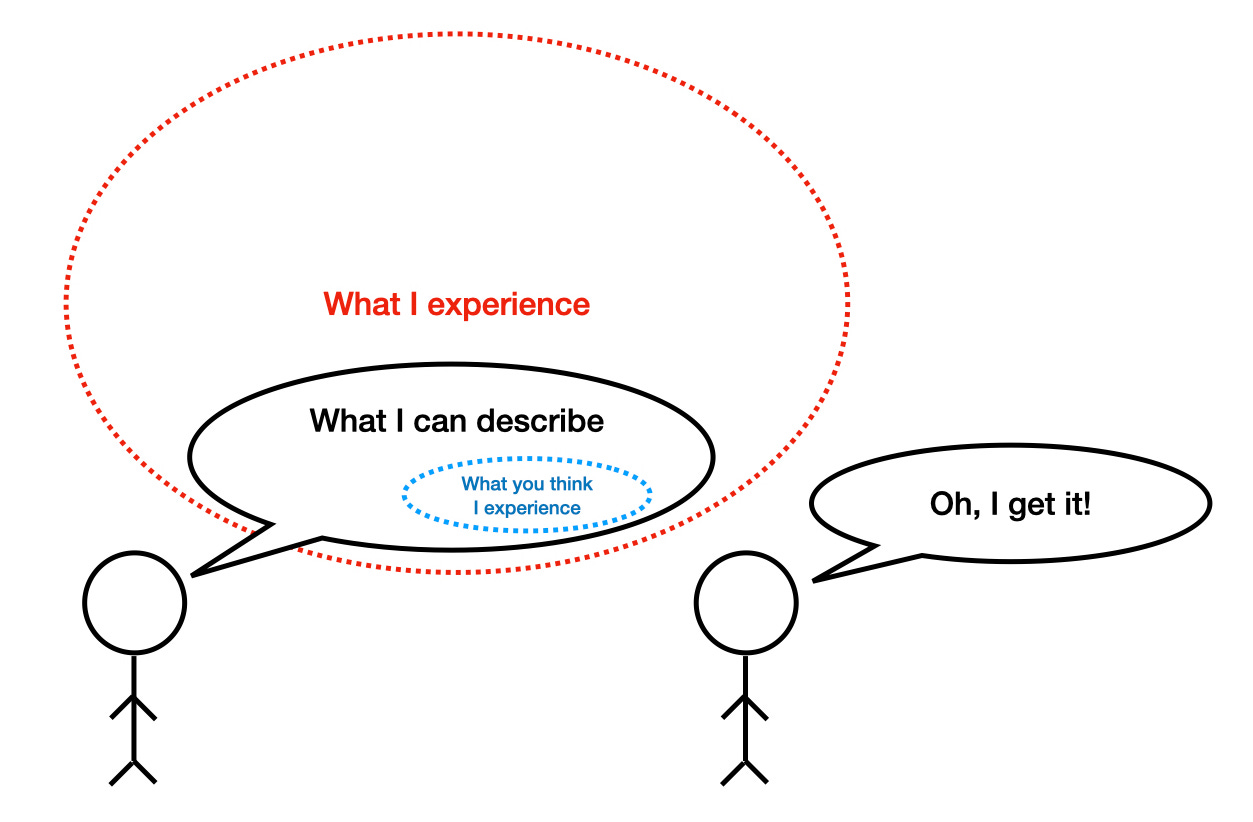
This doesn't work all that well, and that's a problem, but it gets worse. Not only are we stuck describing a small part of our experience—it's a weird little non-representative part, and other people assume that part is all there is. Like this:


In a situation like this, there's no way the blue circle could ever expand to fill the red circle. At best, it can only reach the borders of the speech bubble—you can come to understand everything that someone is saying to you, but you can never understand the things they can't say. It’s like trying to throw a dart at a bullseye with your eyes closed, and the only feedback you get is someone shouting at you, and even when you’re a little left of the target, they keep shouting “A little more to the left!”

Here's a story I think about a lot, one that illustrates this problem well. Once, long ago, my friend's mom went to the library looking for a book for her kids. “Do you recommend this Hunger Games book?” she asked a librarian. “Oh yes,” the librarian replied. “It's about a world that's divided into districts, and each district makes something different: one makes grain, another makes energy, and so on. Your kids will really like it.” This is, of course, factually true about The Hunger Games, but it misses the point, which is that the book is actually about a bunch of teenagers being forced to kill each other in the woods.

The more you talk to this librarian, then, the less you will understand The Hunger Games. “District 8 makes textiles! District 10 makes livestock!” As you acquire more of these pointless facts, you'll probably feel like you're becoming a Hunger Games expert when you're actually becoming a Hunger Games dummy. (...)

Which brings us back to the wedding that should not have happened, because nowhere is this problem greater than in love—the human experience that is most discussed, but least understood. In fact, the more you discuss it, the less you might understand it, because the real heart of it, the what-it’s-like of it, can’t be put into words, and yet that’s pretty much the main thing we try to put into words.

That makes sense—we all want to know what love is. We're all asking, what is love?

And we hear: love is a crazy little thing, a battlefield, a drug, my drug, all you need, a secondhand emotion, something you can find in a hopeless place and that you can't help falling in, but that also lifts you higher and higher. It makes you want to write love songs and to not write love songs. It also makes you want to go to the mailbox. Love will keep us together and love will tear us apart. Some of the things that can make you fall in love are a movement, a shape, a way, a DJ, being a fool, the way someone lies, and a tractor.

If you want to know, could it be I'm falling in love? How will I know? Some signs are:

You can't keep your mind on nothin' else
You can't feel your face
The moon hits your eye like a big pizza pie
There's no white flag upon your door
You are an Argentine without means
You are in an elevator
It's Friday

And yes, love is all of those things. But it's not only those things. There's a part that's more than words, a part that cannot be broadcast via radio waves, depicted in pixels, or embodied in ink. It can only be felt. That's why, at a happy wedding, the couple looks like they know a secret that no one else knows, a secret that no one else can know.

This is, of course, a big problem for people who are trying to figure out whether they should spend their lives together. It’s easy to think, “Hey, our love is a battlefield, it lifts us higher, we can’t keep our minds on nothing else, maybe we should get some rings and make this official.” It’s also easy to think, “Well, we can feel our faces just fine, maybe we ought to call it off.” And both might well be mistakes.

So what do you do? How do you know that you know the secret that no one else knows? This problem is most fraught in love, but appears anywhere that our ability to experience outpaces our ability to describe, which is everywhere: how do you know you’re living a good life, choosing the right career, having enough fun?

by Adam Mastroianni, Experimental History |  Read more:
Image: uncredited

Sunday, September 10, 2023

Found: One of the Largest Potential Lithium Deposits on the Planet

At first glance, the McDermitt Caldera might feel like the edge of the Earth. This oblong maze of rocky vales straddles the arid Nevada-Oregon borderlands, in one of the least densely populated parts of North America.

But the future of the modern world depends on the future of places like the McDermitt Caldera, which has the potential to be the largest known source of lithium on the planet. Where today’s world runs on hydrocarbons, tomorrow’s may very well rely on the element for an expanding offering of lithium-ion batteries. The flaky silver metal is a necessity for these batteries that we already use, and which we’ll likely use in far greater numbers to support mobile phones, electric cars, and large electric grids.

Which is why it matters a ton where we get our lithium from. A new study, published in the journal Science Advances today, suggests that McDermitt Caldera contains even more lithium than previously thought and outlines how the yet-to-be-discovered stores could be extracted. But these results are unlikely to ease the criticisms about the environmental costs of mining the substance.

By 2030, the world may require more than a megaton of lithium every year. If previous geological surveys are correct, then the McDermitt Caldera—the remnants of a 16-million-old volcanic supereruption—could contain as many as 100 megatons of the metal.

“It’s a huge, massive feature that has a lot of lithium in it,” Tom Benson, one of the authors of the new paper and a volcanologist at Columbia University and the Lithium Americas Corporation.

One high-profile project, partly run by Lithium Americas Corporation, proposes a 17,933-acre mine in the Thacker Pass, on the Nevada side of the border at the caldera’s southern edge. The project is contentious: Thacker Pass (or Peehee Mu’huh in Northern Paiute) sits on land that many local Indigenous groups consider sacred. Native American activists are continuing to fight a plan to expand the mine-exploration area in court.

But not all of the lithium under McDermitt’s rocky sands ranks the same. Most of the desired metal there comes in the form of a mineral called smectite; under certain conditions, smectite can transform into a different mineral called illite that can sometimes also be processed for lithium. Benson and his colleagues studied samples of both smectite and illite drilled from the ground throughout the caldera. “There’s lithium everywhere you drill,” he says.

Previously, geologists assumed that you could find both smectite and illite in a wide distribution across the caldera, but the authors only found the latter in high concentrations in the caldera’s south, around Thacker Pass. “It’s constrained to this area,” explains Benson.

That’s important. Benson and colleagues think that the caldera’s illite formed when lithium-rich fluid, heated by the underlying volcano, washed over smectite. In the process, the mineral absorbed much of the lithium. Consequently, they project the illite in Thacker Pass holds more than twice as much lithium than the neighboring smectite.

by Rahul Rao, PopSci | Read more:
Image: Carolyn Cole / Los Angeles Times via Getty Images
[ed. Funny how we seem to find just what we need when we need it.]

The U.S. Set the Stage For a Coup in Chile. It Had Unintended Consequences at Home

Fifty years ago in Chile, the United States worked to end the presidency of an elected Marxist and, in turn, helped usher in an authoritarian right-wing dictatorship.

During the ensuing 17-year rule of Gen. Augusto Pinochet, more than 3,000 people would be disappeared or killed and some 38,000 would become political prisoners — most of them victims of torture.

The brutality in Chile, thousands of miles away, would have repercussions back in the U.S.

When the U.S. role in Chile's democratic collapse became known, activists took action. So did lawmakers. In effect, the coup in Chile led to human rights concerns and Congress taking on a larger role in U.S. foreign policy.

In America, the coup of Sept. 11, 1973, "galvanized public opinion in a way that no other activity, no other coup, no other military dictatorship in Latin America did," says Joe Eldridge, a longtime human rights advocate who was in Chile when it happened. "It was the suddenness, the abruptness in a country that had a long tradition of honoring democratic governance. Chile galvanized, it crystallized in the minds of so many, what was wrong with U.S. foreign policy."

But first, it's necessary to explain what happened. What follows is a history of what led the U.S. to have a hand in the coup, how it occurred, and what happened afterward.

The campaign against Salvador Allende


The U.S. had been meddling in Chile's politics for years by the time 1973 rolled around. U.S. interventions in Latin America go back more than a century.

During the mid-20th century, the Cold War shaped much of policymakers' thinking. Fidel Castro's 1959 revolution in Cuba alarmed Washington about communism and threats of Soviet influence in the Western Hemisphere.

U.S. officials were especially concerned about Salvador Allende, a self-proclaimed Marxist and a member of Chile's Socialist Party who ran for president multiple times and was a leading contender in the 1964 election. He had pledged to nationalize the mostly U.S.-owned copper companies, a large industry in Chile.

The U.S. spent massively on anti-communist propaganda and support for Allende's opponent in 1964. The influence proved effective: Allende lost.

But Allende ran again in 1970. Richard Nixon was now the U.S. president and Henry Kissinger his assistant for national security affairs. They perceived Allende as a threat to U.S. interests and as a friend of the Soviet Union. (Allende's campaign did receive $350,000 from Cuba, according to CIA estimates, and at least $400,000 from Moscow, according to one book on the history of the KGB's foreign operations.) Kissinger was especially concerned about the example it would set for Western European countries to have a socialist freely elected.

In the months before the election, the U.S. spent hundreds of thousands on a "spoiling operation," much of it propaganda aimed at preventing Allende from taking power. International businesses, most notably International Telephone and Telegraph, were involved as well, passing funds to Allende's main opponent.

Still, Allende narrowly won in a three-way contest in early September 1970. Under the constitution at the time, the decision then went to Chile's Congress to vote between the top two finishers.

Nixon instructed top U.S. officials to do whatever they could to prevent Allende from taking office.

by James Doubek, NPR |  Read more:
Image: AP
[ed. Making America Great Again (over and over and over..). Really worth the time to learn more about Salvadore Allende, his accomplishments, and the forces aligned against him during his short time in office. (Wikipedia). An amazing leader. A people's leader. Further background on the coup can be found here: United States Intervention in Chile (Wikipedia). Other links of interest: (Nixon's role); and here: (Austrailia and CIA). Finally, see also: To Galt’s Gulch They Go; and, Liberalism and Empire (previous Duck Soup posts). Interesting fact: the number of US military bases worldwide 750; Russia 10; China 1.]

Joseph Campbell: Follow Your Bliss/The Eternal Principle

[Invisible hands: 2:58]

[ed. See also: What really exists | under the surface - Jim Carrey]

What The World Looks Like to the Super-Wealthy

One guy I talked to had written a book on philanthropy, and told me that the people currently on the list, except for one or two, are all richer than when they signed the pledge. How are you giving away half your wealth, and you’re richer now than 20 years ago? Very few people are giving their money away at a sizable enough clip.

Now, MacKenzie Scott is a good a shining example of how to do it. She’s just shoveling it out as fast as she can. Instead of creating some foundation and in perpetuity, she is just got a bunch of smart people around to help her vet whom to get this money to make a more equitable future for the rest, and then also figure out how much money they can handle. Because you can’t just dump $100 million on a small nonprofit. It’ll destroy them just as it would destroy a person. (...)

And for a lot of them, philanthropy is a strategy. It’s part of a whole mix of things like reputation and burnishing tax breaks. How can we give away the right amount of money so it will make us look good, but we don’t really have to give up anything substantial? In Silicon Valley, the big thing is the donor advised funds. It’s like a tiny foundation that is just like a parking place for charitable money, which you put in this account when it’s convenient for you.

When you need to take a big tax break, you put a chunk in this account, and the federal government has no requirements that you have to pay it out at any particular time. Foundations right now only have to pay out 5% of their total assets per year, and that includes overhead. Overhead would include sending your board of directors to Ibiza for a week-long board meeting at a fancy hotel.

So, you could have a foundation that is accumulating money because it’s all invested anyway. It’s just piling on more and more money, and you can keep expanding it and buying new buildings for it. And you could have members of your own family working there at pretty high salaries. What wealthy people get away with are just legion. I know some of them are totally on the up and up and this is a charitable foundation, we want to do good, we’re going to spend it down in 50 years, and that’s great. Congress really blew it when it came to setting up the rules around foundations. As I talked about in the book, John D. Rockefeller first went to Congress trying to get a charter for the first general purpose charitable foundation. Congress was like, forget you, dude. This is back when there was a lot more hostility towards these super wealthy people. Teddy Roosevelt was ripping on him, and people testified that this was just incredibly undemocratic. And it is undemocratic.

So if, let’s say, your marginal top tax rate is 37% on your income, and you give away $100 million, that means 37% of that 100 million is covered by the US taxpayers. If you’re not spending that money on things in the public interest, basically you’re just having taxpayers subsidize whatever your priorities are. And that is another form of flexing power. It’s the opposite of democratic. People will say that the government is a lousy charity and it’s inefficient. That’s true. But the government is not a charity. That’s not its role and not what it is supposed to be doing, and there’s no doubt there are things that private interests can do better and more efficiently, but they can do that without government help.

ROBINSON

I read the Wall Street Journal‘s “Mansion” section every Friday, and I’m continuously appalled by excess upon excess. There was a feature in the Times the other day about the increasing cost of high-end toddler birthday parties that can run $75,000 or more now, and they’re getting increasingly complicated. You saw a lot of the really absurd and of how wealth is deployed by people who don’t even know how to spend their money. Could you give us a little insight into the mindset of someone who has spent $75,000 on a child’s birthday party?

MECHANIC

The mindset is that it’s play money and is meaningless to you. That $75,000 could do a wealth of good for some poor families. But instead, we’ll just throw it away here. I think there’s this attitude of “I earned this, and I can use it however I want,” and if it’s frivolous, it’s frivolous. Screw you if you’re going to criticize me because I can do it. You can get whatever you want.

There was a part where I was talking about the Centurion Card, the Black Card, and someone who had one. It’s an American Express card that’s only given by invitation to very wealthy people, or people who spent at least $350,000 a year or something on their credit card. They wanted the actual horse that Kevin Costner rode in Dances with Wolves. And so, they asked the concierge to find it for them. So the Black Card concierge goes and tracks down the horse in Mexico, buys it and delivers it to the guy. Another Black Card holder wanted some sand from the Dead Sea for his child to use in a school project in London. And so, they sent a courier to the Dead Sea, got some actual sand, and had it shipped to London.

These things are just silly. They’re silly, and they’re excessive, but they’re also just a slap in the face of people to people who are hurting and struggling. That’s the other side of it. You can say, this is harmless, it’s their money. But to watch people almost literally burn their money for stupid things and things that people would ridicule them for. Kim Kardashian, in the middle of the pandemic, was Instagramming about how she took all these friends of hers to this island for this getaway so they could pretend things were normal. She’s bragging about this, and everybody else is locked in their houses, out of work and out of school, and people are really suffering. That’s the bubble. That’s pretty distasteful. I would think, even in the bubble, it’s distasteful. It was a clueless move.

by Nathan J. Robinson and Michael Mechanic, Current Affairs |  Read more:
Image: Simon & Schuster

Saturday, September 9, 2023

via:

My Generation

I recall having breakfast at a hotel in Brussels in 2017 and sitting across from Douglas Coupland, the author of Generation X: Tales for an Accelerated Culture, the 1991 book that gave my generation a sort of name that was really only a placeholder for a name. I wanted to tell him how much I resented him for this, but I couldn’t muster the courage to be disagreeable. (...)

It was around the time of that breakfast in Brussels that everything began to sink in for me, even if I still refused to see it. I was well into my forties, and dimly aware that there were by now a few billion people in the world leading full lives of their own, who would consider anything I had to say irrelevant simply by virtue of the fact that it was coming from an “old” person. And yet I was still stubbornly churning out thoughts as if they had some absolute meaning independent of the age and the perceived generational affiliation of the person they were coming from. I had not yet fully admitted to myself that the world belonged to young people now—who plainly did not belong to my universe of values and did not share my points of reference—and that from here on out my presence was, at best, to be tolerated.

Five years later I experience my life, most of the time, as a ghost. I see my psychiatrist and try to convince him that I am suffering symptoms of what is clinically known as “derealization.” I sit at home, and I read and write, and I literally have trouble comprehending that the world still exists. Sometimes I put on headphones and listen to music, and that brings it back again. But that transcendent world and this low one, the one in which this ghost continues to dwell, do not overlap.

My psychiatrist tells me this feeling is normal, that it is at worst a “midlife crisis” and not a full-fledged psychotic break. But it is significant that I and others of my generation have had to bear the peculiar double load of arriving at this treacherous period of the life cycle at precisely the same moment that people of all ages recognize to be a time of great cultural and political upheaval. Personal biography and world history have aligned in what seems far too perfect an annihilation of almost everything that once oriented us: a belief inherited from our hippie parents that our libidinous selves were nothing to be ashamed of, and that we would be free to live out our days, as Czesław Miłosz put it, “under orders from the erotic imagination”; a more or less confident acceptance of the durability of liberal democracy; a belief in the eternal autonomy of art as a source of meaning independent of its quantifiable impact, its virality, or its purchase price; a belief in the ideal of self-cultivation as a balance between authenticity and irony; a belief that rock and roll would never die.

I mean that last bit literally. I want to talk about my generation, but in order to do that I must first talk about music. For I can find no other way in.

It is perhaps our first and most primitive experience of time: an ordering of moments on the downbeat. Nor, it seems to me, could there be any memory of the past without memory of musical experience, nor any coming to consciousness without musical consciousness. Could I have begun to think the thoughts that I do had I not first apprehended the structure of the world in song? (...)

One thing about music, at least when you’re young, is that it’s never just music. My father was an adult, which meant in part that he just liked “music that’s good,” while my shift from passive inheritance to active cultivation involved a great many blind spots, and a great deal of parochialism and posturing. The musical totemism by which postwar youth consolidated their identities through affiliation with some genre or other was as real as any other social fact. Bobby-soxers, teddy boys, mods, rockers, punks, new wavers, and metalheads were governed by no board of directors or elected representatives, but these taxa constrained our range of choices nonetheless, and defined our sense of self as fully as any professional guild or political party. Circa 1985, the East German secret police compiled a full taxonomy of youth musical subcultures. An illustrated chart gave the typical age, appearance, and political orientation of their members. The skinheads had “partly neofascist tendencies,” the punks could be known by their “ ‘Iroquois’ haircut” and their “criminal conduct and asocial lifestyle,” and the goths were noteworthy for their “total political and social disinterest.”

The Stasi should perhaps be commended for taking the youth as seriously as the youth took themselves. Back home in Central California, we had to work the taxonomy out on our own. At the rear of the semi-rural house where my mother stayed after the divorce, a defunct chicken farm passed down by her parents, our property abutted the lot of a new Pentecostal church, separated from us by a barbed-wire fence. The pastor had daughters who used to come up to the fence to talk to us, intent on laying out the reasons we were bound for hell. When some friends of mine came over, we got the idea to go out to the field to see the girls, and to bring along a soundtrack. We had no portable electronics other than a set of Radio Shack walkie-talkies, so we placed one in front of a cassette player inside the house, and brought the other out with us—and in this way the girls who preached hellfire, channeling their dad, got a dim and squeaky rendition of Ozzy Osbourne’s Bark at the Moon channeled back at them.

The heavy-metal posture was a onetime thing for me, dictated by circumstance. For the most part my efforts at sculpting a musical identity were fueled by an esotericism that disdained common and easily accessible genres. I can see now that this was all largely epiphenomenal to a deeper and “more real” navigation of class identity. I was surrounded in those years mostly by poor white metalheads—a Judas Priest T-shirt, feathered hair, and acne were the default traits of the human male—while at the same time belonging to a white middle-class family perched dangerously close to the lower-class boundary, ever in danger of slipping beneath it. Musical cultivation, in this context, was a sort of currency by which one might hope to maneuver into an imagined aristocracy through seeking out the most obscure representatives of the narrowest genre niches. (...)

Over the course of the Eighties we witnessed the completion of a process of transformation by which hippies became yuppies, as memorialized in 1983’s The Big Chill, and the parallel evolution of Sixties counterculture into the culture of what was starting to be denoted, synecdochically, as “Silicon Valley.” Stewart Brand is perhaps the most perfect embodiment of this transition: from his beginnings as publisher of the Whole Earth Catalog, which in the Seventies I brought down from the upper shelves (next to the eight-tracks) in order to look at pictures of nudist colonies and home births, he would help to shape the organizational principles of the nascent internet culture, and, most importantly, of Apple. The fact that capitalism’s most advanced experiments by the end of the twentieth century were spearheaded by people with a lingering sense of countercultural identity helped this economic order to become particularly adept at reuptake, at incorporating cultural expressions that were first made in some sort of spirit of opposition. In 1987, the Beatles’s “Revolution” was featured in an advertisement for Nike. By 1995, Janis Joplin’s ghost voice was made to sing “Lord won’t you buy me a Mercedes-Benz” in a Mercedes-Benz commercial. And somehow, by then, Apple had managed to trademark the legacy of the Sixties as a key element of its corporate image.

It seems, now, that the historical meaning of Gen X’s famous aversion to selling out cannot really be understood without considering the world that was being actively created by our parents in the years of our generation’s formative experiences. We were, it seems to me now, doing our best to preserve postwar youth culture (and even interwar youth culture, as we’ve seen) against the rising force that would, soon enough, cast us into whatever came next: the world whose most important narratives are shaped by algorithms, and in which the horror of selling out no longer has any purchase at all, since the ideal of authenticity has been switched out for the hope of virality. We tried, and we failed, to save the world from our parents—that is, to reverse or at least slow down the degeneration of the hopes that they themselves had once cherished. And because we failed, we have been written out of history.

It is often remarked that there will never be a Gen X president of the United States. No one wants us to lead, or cares what we think. In political polling, American news outlets frequently move right from the boomers to the millennials. Though Coupland certainly could not have anticipated this meaning of X in 1991, it turns out that our name, or our lack of a name, fits perfectly with our general condition of invisibility. Generation X is the generation that someone might get around to assigning a real name later. Except that it’s already been more than thirty years, and the world has moved on.

by Justin E. H. Smith, Harper's |  Read more:
Image: Jimmy Turrell

Friday, September 8, 2023

The Plane Crashed and Nobody Checked the Bodies

I’m So Sorry For Psychology’s Loss, Whatever It Is (Experimental History)
Image: Adam Mastroianni
[ed. On an ambiguous, self-conscious science/profession:]

"This is really weird. Imagine if someone told you that 60% of your loved ones had died in a plane crash. Your first reaction might be disbelief and horror—“Why were 60% of my loved ones on the same plane? Were they all hanging out without me?”—but then you would want to know who died. Because that really matters! The people you love are not interchangeable! Was it your mom, your best friend, or what? It would be insane to only remember the 60% statistic and then, whenever someone asked you who died in that horrible plane crash, respond, “Hmm, you know, I never really looked into it. Maybe, um, Uncle Fred? Or my friend Clarissa? It was definitely 60% of my loved ones, though, whoever it was.”

So if you hear that 60% of papers in your field don’t replicate, shouldn't you care a lot about which ones? Why didn't my colleagues and I immediately open up that paper's supplement, click on the 100 links, and check whether any of our most beloved findings died? The answer has to be, “We just didn't think it was an important thing to do.” We heard about the plane crash and we didn't even bother to check the list of casualties. What a damning indictment of our field!
"

Just Do It

Steve Jobs Freaked Out A Month Before First iPhone Was Released And Demanded A New Screen

Charles Duhigg and Keith Bradsher of the New York Times have written an excellent article about why Apple makes iPhones and iPads in China instead of the United States.

One of the key points is this:

Chinese factories are far more nimble than American factories.

The story Duhigg and Bradsher used to illustrate this will only add to the iPhone lore.

Just over a month before the first iPhone was to be released in 2007, the authors report, a frustrated Steve Jobs summoned his senior team.

Steve had been using a prototype iPhone for a few weeks, carrying it around in his pocket. When his lieutenants were assembled, he pulled the prototype out of his pocket and pointed angrily to dozens of scratches on its plastic screen.

People would carry their phones in their pockets, Steve said. They would also carry other things in their pockets--like keys. And those things would scratch the screen.

And then, with Apple just about to ramp up iPhone production, Steve demanded that the iPhone's screen be replaced with unscratchable glass.

“I want a glass screen," Steve is quoted as saying. "And I want it perfect in six weeks.”

The glass itself would come from Corning, an American company. But the only way for Apple to meet Steve's deadline would be to find an empty glass-cutting factory, a huge amount of glass to experiment on, and a team of mid-level engineers to figure out how to cut the glass into millions of screens.

An executive at the meeting knew that the only place Apple might be able to find these things would be in China. So he flew to Shenzhen, where a bid for the work quickly arrived from a Chinese company.

Before they even won Apple's business, the Chinese company started building a new factory building in which to cut the glass. (The Chinese government was providing subsidies, and the company took advantage of them--"just in case.") The company provided Apple with a team of cheap engineers, as well as spare glass for Apple to experiment with, the latter for free. The company's engineers were housed in dormitories, so they were available to Apple 24 hours a day.

Apple hired the company to cut the hardened glass for the screens, and after a month of experimentation, the engineers figured out how to do it. They quickly sent the first shipment of screens to Foxconn's assembly plant in Shenzhen, where they arrived in the middle of the night. Foxconn's managers woke up thousands of workers and immediately began assembling iPhones.

Three months later, Apple had sold 1 million iPhones. Four years later, Apple has sold ~200 million of them.

by Henry Blodget, Business Insider |  Read more:
Image: People flooded Foxconn Technology with résumés at a 2010 job fair in Henan Province, China. Donald Chan/Reuters
[ed. Old news now I guess (from 2012) but never heard it before. What is new, however: Huawei's new Mate 60 Pro phone with 7 nanometer processor (Apple's $200 billion valuation wipeout may foreshadow a post-US tech future (BI). Apparently quite a technological achievement despite US sanctions and export controls. See also: Is Intellectual Property Turning into a Knowledge Monopoly? (Naked Capitalism).]

What Old Money Looks like in America, and Who Pays for It

It’s the cut of the jacket that’s the dead giveaway. The graceful arc it draws above the woman’s waistline looks architecturally engineered, its hourglass effect enhanced by tastefully wide peaked lapels. The fabric, too, looks sumptuous. Cashmere? Probably. There’s nothing flashy about the gray-and-beige-clad subject of Buck Ellison’s “Mama” (2016), with her pulled-back hair and her prim manicure, but she radiates an air of wealth quietly, like the footfall of a Stubbs & Wootton slipper on a plush Persian carpet. No doubt somewhere in the pages of Emily Post’s “Etiquette” it says: new money shouts, old money whispers.

You could say that the lives and tastes of so-called old money—old, that is, in the American sense—are the subject of Ellison’s staged photographic tableaux and cheeky, deadpan still-lifes. The markers we’ve come to associate with a particular brand of buttoned-up, Ivy League, East Coast Waspish wealth are omnipresent. His subjects seem to have stepped out of the pages of a J. Crew catalogue, and look as though they probably have names like Bunny and Tripp. They are white and often blond and are situated among gleaming Land Rovers, rolling golf courses, and pristine marble kitchens. The photographs appear, in other words, to be a part of the robust artistic tradition of depictions of the beneficiaries of fabulous dynastic wealth, with the Vineyard Vines fleece taking the place of baroquely ruffled lace and velvet as a mark of distinction. And they would be, if only his subjects were who they seem to be.


Ellison, who is based in Los Angeles, almost exclusively hires local actors and models to play the ersatz bluebloods who populate his pictures, and he inserts them into rigorously stage-managed scenarios that he devises beforehand. (...)

It’s often been pointed out that, in our current socioeconomic landscape, the rich are no longer simply rich. They are preposterously rich, incomprehensibly rich, possibly even catastrophically rich. Thomas Piketty, the famed French economist, made a memorable observation about this state of affairs in his book “Capital in the Twenty-First Century” (2014), eerily presaging our paranoid, conspiracy-addled age. “For millions of people,” he wrote, “ ‘wealth’ amounts to little more than a few weeks’ wages in a checking account or low-interest savings account, a car, and a few pieces of furniture. The inescapable reality is this: wealth is so concentrated that a large segment of society is virtually unaware of its existence, so that some people imagine that it belongs to surreal or mysterious entities.”

by Chris Wiley, New Yorker |  Read more:
Images: Buck Ellison