Wednesday, November 5, 2025

Toshihiko Okuya, 210106
via:
[ed. First date.]

When Helicopter Parents Touch Down—At College

On an August Sunday 35 years ago, I moved into my freshman-year college dorm. My parents, who had traveled with me from Southern California to New England, took me to buy my first winter coat and snow boots, along with a houseplant that the store clerk described as “hard to kill,” and then we made our way to campus. My new roommate invited me to go shopping for Blu Tack so that we could hang posters in our room. I hugged my parents goodbye and headed out.

This was a fairly typical beginning to 1980s college life. Parents waved from the curb, cried in the parking lot, and maybe sent a care package two weeks later. I scheduled weekly calls with my parents for Sunday evenings, phoning from our room’s landline before heading to dinner. The college experience was marked by rupture, the sometimes messy yet necessary transition from dependence to independence.

These days, the break looks different. And in some cases it doesn’t look like a break at all.

A new term has entered the lexicon of college administrators: the trailing parent. These are the mothers and fathers who follow their children to campus—not just metaphorically, with daily texts about grades, outfits, or friendship drama, but physically. They rent an apartment in Atlanta, Austin, or Boston for four years, a pied-à-terre to facilitate frequent visits. They buy a condo in Washington, D.C., or Los Angeles so that their sophomore can have a place to crash—and so that they can drop by their kid’s place with soup when the sniffles arrive. Some parents trail their study-abroad kids across the world, moving for a semester to Florence or Barcelona to be close by “just in case.”

College administrators and other education colleagues in my circle have told me that although such stories used to be noteworthy, they’re now so common as to barely raise an eyebrow. One recalled that the mom of an Ole Miss first-year stayed in the family’s new campus-adjacent apartment last fall to provide logistical and moral support during sorority rush, lending her daughter a hand in fixing hair or nursing a hangover. A Colorado couple whose daughter had a rocky freshman year told the Associated Press that they bought an apartment in Portland, Oregon, and moved there to live with their daughter while she attended college.

The paradigmatic helicopter parent hovered from a distance and in most cases didn’t follow their child to college. The trailing parent touches down. Danielle Lico, who spent two decades working in student affairs at George Washington University, told me about a mom who several years ago rented a downtown-D.C. condo near campus to live with her daughter, whom she even walked to class. “We had to tell the mom that she wasn’t actually permitted to sit next to her kid in class,” Lico said. “She would sit outside of the classroom, and then they would walk back to the apartment together every day for four years.”

Not all college students love having their parents close by. The administrator of a study-abroad program told me about a mom who moved to France for proximity to her daughter. For weeks, the mother phoned the program’s office, asking to arrange a visit. The daughter refused and didn’t return her mother’s calls. Eventually, the mother gave up and flew home to the United States. Reddit is full of similar accounts: One commenter shared an anecdote about a kid who transferred colleges to get away from his parents, after they bought a home next to his campus.

Some colleges appear to be subtly trying to head off parental overengagement. Brie McCormick, who runs residential life at Northeastern University, told the campus publication Northeastern Global News that she encourages families not to let their kids visit home early in the school year. An overseas-study program on whose board I serve asks moms and dads not to visit until the winter holidays, explaining that children need to establish roots in their new country, uninterrupted. Jason Campbell-Foster, the dean of students at Boston University, wrote in a school publication that he urges parents to trust the scaffolding they’ve built, to “have confidence that you’ve chosen a place that cares for your child, that wants them to be successful, and that will give them the space and support that they need to learn from mistakes.” (...)

Every generation finds new ways to parent, and every generation frets about it. Maybe the trailing parent is simply the next logical step in an era when adolescence stretches longer. Or maybe it’s something more worrisome: an inability to let go, to allow children the gift of separation. An important step toward adulthood is the experience of stumbling—sometimes badly—and discovering that you can stand on your own. It might be hard for an undergraduate to develop independence if their parents are constantly available, helping them navigate every crisis. “We would certainly have parents call anytime we did sorority or fraternity rush and somebody didn’t get into the chapter they wanted,” Danielle Lico told me, and parents would hire “high-powered lawyers to get their kids out of trouble.” If a student is in a spat with a roommate or doesn’t get into a class they want to take, that’s a chance for them to learn to cope with conflict and setbacks—which they won’t get to do if they jump to asking for direction from home. (...)

An unspoken message from the trailing parent is: We don’t think you can handle college on your own. A 20-year-old who grows accustomed to dropping off laundry with a parent each weekend might conclude that they’re not yet ready for the world. But college is, among other things, an exercise in independence. As much as it’s important for students to learn Russian history and statistics, it’s even more important for them to learn to be adults.

by Russell Shaw, The Atlantic |  Read more:
Image: Jon Lovette / Getty
[ed. This was a significant issue in my last relationship before the term "helicopter parent" ever existed. I couldn't understand why my partner couldn't see how she was creating a sense of learned helplessness in her child, and an impediment to her fledging. When her daughter eventually left for college it only took a couple weeks before she started complaining about her roomate and rooming issues (like smoke outside her window aggravating her asthma) so my partner (the girl's mother) somehow convinced the administration to allow a freshman off-campus exemption (I don't know how she did it), then set her up in an apartment of her own, furnished it, and even bought her a cat. So there she sat, alone, totally divorced from college life. She lasted two sememesters. The girl, who's probably now in her mid-thirties, is still living at home with her mother as far as I know, and both are probably completely happy with that.]

Raymond Depardon, Glasgow, 1980
via:

Machines of Loving Grace

I think and talk a lot about the risks of powerful AI. The company I’m the CEO of, Anthropic, does a lot of research on how to reduce these risks. Because of this, people sometimes draw the conclusion that I’m a pessimist or “doomer” who thinks AI will be mostly bad or dangerous. I don’t think that at all. In fact, one of my main reasons for focusing on risks is that they’re the only thing standing between us and what I see as a fundamentally positive future. I think that most people are underestimating just how radical the upside of AI could be, just as I think most people are underestimating how bad the risks could be.

In this essay I try to sketch out what that upside might look like—what a world with powerful AI might look like if everything goes right. Of course no one can know the future with any certainty or precision, and the effects of powerful AI are likely to be even more unpredictable than past technological changes, so all of this is unavoidably going to consist of guesses. But I am aiming for at least educated and useful guesses, which capture the flavor of what will happen even if most details end up being wrong. I’m including lots of details mainly because I think a concrete vision does more to advance discussion than a highly hedged and abstract one. (...)

Basic assumptions and framework

To make this whole essay more precise and grounded, it’s helpful to specify clearly what we mean by powerful AI (i.e. the threshold at which the 5-10 year clock starts counting), as well as laying out a framework for thinking about the effects of such AI once it’s present.

What powerful AI (I dislike the term AGI) will look like, and when (or if) it will arrive, is a huge topic in itself. It’s one I’ve discussed publicly and could write a completely separate essay on (I probably will at some point). Obviously, many people are skeptical that powerful AI will be built soon and some are skeptical that it will ever be built at all. I think it could come as early as 2026, though there are also ways it could take much longer. But for the purposes of this essay, I’d like to put these issues aside, assume it will come reasonably soon, and focus on what happens in the 5-10 years after that. I also want to assume a definition of what such a system will look like, what its capabilities are and how it interacts, even though there is room for disagreement on this.

By powerful AI, I have in mind an AI model—likely similar to today’s LLM’s in form, though it might be based on a different architecture, might involve several interacting models, and might be trained differently—with the following properties:
  • In terms of pure intelligence, it is smarter than a Nobel Prize winner across most relevant fields – biology, programming, math, engineering, writing, etc. This means it can prove unsolved mathematical theorems, write extremely good novels, write difficult codebases from scratch, etc.
  • In addition to just being a “smart thing you talk to”, it has all the “interfaces” available to a human working virtually, including text, audio, video, mouse and keyboard control, and internet access. It can engage in any actions, communications, or remote operations enabled by this interface, including taking actions on the internet, taking or giving directions to humans, ordering materials, directing experiments, watching videos, making videos, and so on. It does all of these tasks with, again, a skill exceeding that of the most capable humans in the world.
  • It does not just passively answer questions; instead, it can be given tasks that take hours, days, or weeks to complete, and then goes off and does those tasks autonomously, in the way a smart employee would, asking for clarification as necessary.
  • It does not have a physical embodiment (other than living on a computer screen), but it can control existing physical tools, robots, or laboratory equipment through a computer; in theory it could even design robots or equipment for itself to use.
  • The resources used to train the model can be repurposed to run millions of instances of it (this matches projected cluster sizes by ~2027), and the model can absorb information and generate actions at roughly 10x-100x human speed5. It may however be limited by the response time of the physical world or of software it interacts with.
  • Each of these million copies can act independently on unrelated tasks, or if needed can all work together in the same way humans would collaborate, perhaps with different subpopulations fine-tuned to be especially good at particular tasks.
We could summarize this as a “country of geniuses in a datacenter”.

Clearly such an entity would be capable of solving very difficult problems, very fast, but it is not trivial to figure out how fast. Two “extreme” positions both seem false to me. First, you might think that the world would be instantly transformed on the scale of seconds or days (“the Singularity”), as superior intelligence builds on itself and solves every possible scientific, engineering, and operational task almost immediately. The problem with this is that there are real physical and practical limits, for example around building hardware or conducting biological experiments. Even a new country of geniuses would hit up against these limits. Intelligence may be very powerful, but it isn’t magic fairy dust.

Second, and conversely, you might believe that technological progress is saturated or rate-limited by real world data or by social factors, and that better-than-human intelligence will add very little. This seems equally implausible to me—I can think of hundreds of scientific or even social problems where a large group of really smart people would drastically speed up progress, especially if they aren’t limited to analysis and can make things happen in the real world (which our postulated country of geniuses can, including by directing or assisting teams of humans).

I think the truth is likely to be some messy admixture of these two extreme pictures, something that varies by task and field and is very subtle in its details. I believe we need new frameworks to think about these details in a productive way.

by Dario Amodei, Anthropic |  Read more:
Image: via:
[ed. See also: What's up with Anthropic predicting AGI by early 2027? (Redwood Research); and, Machines of Loving Grace: A Thought-provoking Essay by Dario Amodei, CEO of Anthropic (AI Spectator).]

The Trillion-Dollar Space Race

Check-in on NASA (1:28)

The Chinese tend to do what they say they’re going to do on the timeline that they say they’re going to do it. That said, they haven’t gone to the moon . . . It’s really hard.

Pethokoukis: As someone — and I’m speaking about myself — who wants to get America back to the moon as soon as possible, get cooking on getting humans to Mars for the first time, what should I make of what’s happening at NASA right now?

They don’t have a lander. I’m not sure the rocket itself is ready to go all the way, we’ll find out some more fairly soon with Artemis II. We have flux with leadership, maybe it’s going to not be an independent-like agency anymore, it’s going to join the Department of Transportation.

It all seems a little chaotic. I’m a little worried. Should I be?

Davenport: Yes, I think you should be. And I think a lot of the American public isn’t paying attention and they’re going to see the Artemis II mission, which you mentioned, and that’s that mission to send a crew of astronauts around the moon. It won’t land on the moon, but it’ll go around, and I think if that goes well, NASA’s going to take a victory leap. But as you correctly point out, that is a far cry from getting astronauts back on the lunar surface.

The lander isn’t ready. SpaceX, as acting NASA administrator Sean Duffy just said, is far behind, reversing himself from like a month earlier when he said no, they appear to be on track, but everybody knew that they were well behind because they’ve had 11 test flights, and they still haven’t made it to orbit with their Starship rocket.

The rocket itself that’s going to launch them into the vicinity of the moon, the SLS, launches about once every two years. It’s incredibly expensive, it’s not reusable, and there are problems within the agency itself. There are deep cuts to it. A lot of expertise is taking early retirements. It doesn’t have a full-time leader. It hasn’t had a full-time leader since Trump won the election. At the same time, they’re sort of beating the drum saying we’re going to beat the Chinese back to the lunar surface, but I think a lot of people are increasingly looking at that with some serious concern and doubt. 

For what it’s worth, when I looked at the betting markets, it gave the Chinese a two-to-one edge. It said that it was about a 65 percent chance they were going to get there first. Does that sound about right to you?

I’m not much of a betting man, but I do think there’s a very good chance. The Chinese tend to do what they say they’re going to do on the timeline that they say they’re going to do it. That said, they haven’t gone to the moon, they haven’t done this. It’s really hard. They’re much more secretive, if they have setbacks and delays, we don’t necessarily know about them. But they’ve shown over the last 10, 20 years how capable they are. They have a space station in low earth orbit. They’ve operated a rover on Mars. They’ve gone to the far side of the moon twice, which nobody has done, and brought back a sample return. They’ve shown the ability to keep people alive in space for extended periods of times on the space station.

The moon seems within their capabilities and they’re saying they’re going to do it by 2030, and they don’t have the nettlesome problem of democracy where you’ve got one party come in and changing the budget, changing the direction for NASA, changing leadership. They’ve just set the moon — and, by the way, the south pole of the moon, which is where we want to go as well — as the destination and have been beating a path toward that for several years now.

Losing the Space Race (5:49)

. . . the American flags that the Apollo astronauts planted, they’re basically no longer there anymore. . . There are, however, two Chinese flags on the moon

Have you thought about what it will look like the day after, in this country, if China gets to the moon first and we have not returned there yet?

Actually, that’s a scenario I kind of paint out. I’ve got this new book called Rocket Dreams and we talk about the geopolitical tensions in there. Not to give too much of a spoiler, but NASA has said that the first person to return to the moon, for the US, is going to be a woman. And there’s a lot of people thinking, who could that be? It could be Jessica Meir, who is a mother and posted a picture of herself pregnant and saying, “This is what an astronaut looks like.” But it could very well be someone like Wang Yaping, who’s also a mother, and she came back from one of her stays on the International Space Station and had a message for her daughter that said, “I come back bringing all the stars for you.” So I think that I could see China doing it and sending a woman, and that moment where that would be a huge coup for them, and that would obviously be symbolic.

But when you’re talking about space as a tool of soft power and diplomacy, I think it would attract a lot of other nations to their side who are sort of waiting on the sidelines or who frankly aren’t on the sidelines, who have signed on to go to the United States, but are going to say, “Well, they’re there and you’re not, so that’s who we’re going to go with.”

I think about the wonderful alt-history show For All Mankind, which begins with the Soviets beating the US to the moon, and instead of Neil Armstrong giving the “one small step for man,” basically the Russian cosmonaut gives, “Its one small step for Marxism-Leninism,” and it was a bummer. And I really imagine that day, if China beats us, it is going to be not just, “Oh, I guess now we have to share the moon with someone else,” but it’s going to cause some national soul searching.

And there are clues to this, and actually I detail these two anecdotes in the book, that all of the flags, the American flags that the Apollo astronauts planted, they’re basically no longer there anymore. We know from Buzz Aldrin‘s memoir that the flag that he and Neil Armstrong planted in the lunar soil in 1969, Buzz said that he saw it get knocked over by the thrust in the exhaust of the module lifting off from the lunar surface. Even if that hadn’t happened, just the radiation environment would’ve bleached the flag white, as scientists believe it has to all the other flags that are on there. So there are essentially really no trace of the Apollo flags.

There are, however, two Chinese flags on the moon, and the first one, which was planted a couple of years ago, or unveiled a couple of years ago, was made not of cloth, but their scientists and engineers spent a year building a composite material flag designed specifically to withstand the harsh environment of the moon. When they went back last summer for their farside sample return mission, they built a flag, — and this is pretty amazing — out of basalt, like volcanic rock, which you find on Earth. And they use basalt from earth, but of course basalt is common on the moon. They were able to take the rock, turn it into lava, extract threads from the lava and weave this flag, which is now near the south pole of the moon. The significance of that is they are showing that they can use the resources of the moon, the basalt, to build flags. It’s called ISR: in situ resource utilization. So to me, nothing symbolizes their intentions more than that. (...)

SpaceX and the Falcon 9, the reusable rocket, has dropped launches down. It used to be if you got 10, 12 orbital rocket launches in a year, that was a good year. SpaceX is launching about every 48 hours now. It’s unprecedented what they’ve done. You’re seeing a lot of new players — Blue Origin, Rocket Lab, others — driving down the cost of launch.

That said, the main anchor tenant customer, the force driving all of this is still the government, it’s still NASA, it’s still the Pentagon. There is not a self-sustaining space economy that exists in addition or above and beyond the government. You’re starting to see bits of that, but really it’s the government that’s driving it.

by James Pethokoukis and Christian Davenport, Faster, Please | Read more:
Image: uncredited
[ed. Weaving lava on the moon?! Launches every 48 hrs?!]

Tuesday, November 4, 2025


Caspar Jade

Andrew Wyeth, Airborne
via:

To Readers


Bill Watterson, Calvin and Hobbes
via:
[ed. I'd like to apologize for all the political junk on this blog lately. Unfortunately so many bad things are happening these days that celebrating normal life seems almost impossible. For my sanity and yours, I'll try to keep it all to a minimum (but still highlight important issues as needed). Please bear with me, we'll get through this.]

The Democratic Establishment Is a Dead Man Walking

[ed. Post of the day. A bit long but definitely worth a close read. It captures perfectly how I and many other democrats and independents feel. Until the party rejects rich donors (and their self-serving agenda's), zeros in on everyday middle class issues, works tirelessly to highlight and protect constitutional rights, and quits kowtowing to unpopular fringe advocacy groups (pronouns, trans anything, defunding the police, abolishing prisons, porous immigration and enforcement policies, etc. etc.) the Democratic party will truly be a dead man walking. Case in point, check this out: Deciding to Win a Democratic blueprint recently put out by party leaders and consultants that perfectly captures everything this essay is talking about.]
***
Hakeem Jeffries thinks the path back to power for Democrats is focusing on “kitchen table issues,” waiting for Trump to self-destruct, and avoiding challenging Trump on his increasing constitutional violations in immigration enforcement, the deployment of military to cities. These are “distractions” and “losing issues.” It’s causing a revolt in the base.

Jeffries’ approach to politics seems to rest on the assumption that MAGA will flame out, and voters will come crawling back to the 2015 technocratic order. Which is, quite frankly, insane.

Less than 48 hours after Trump’s inauguration, Jeffries held a closed-door meeting with House Democrats to issue a warning: The new administration was going to “flood the zone,” and Democrats couldn’t afford to chase every single outrage—or nothing was going to sink in for the American people. Focus on cost of living, he told them. Border security. Community safety. Don’t get distracted by the noise.

The “noise” he’s referring to: Federal agents conducting warrantless mass detentions of American citizens. ICE announced for Super Bowl to intimidate Latino cultural celebration. Stephen Miller calling judicial review “insurrection.” Military operations over civilian infrastructure against state objections. The systematic dismantling of constitutional constraints on executive power.

All of it—noise. Distractions. Losing issues that don’t poll well with swing voters.

Adam Schiff, who built his entire first-term Trump resistance on constitutional defense, now agrees. “I think we have to pick our fights and not chase after every crazy squirrel,” he said. “The renaming of the Gulf of Mexico and other absurdities like that we just let go.”

Notice what gets lumped together: Silly culture war provocations (Gulf naming) and constitutional violations (everything else). They’ll fight “mass deportations that are going to raise food prices” and “trade wars that are going to raise costs”—but only to the extent they affect grocery prices. Not because warrantless detentions violate the Fourth Amendment. Not because using ICE as cultural enforcement is authoritarian. Only when it has measurable economic impact that polls well.

This is the Democratic establishment’s plan for 2026: Read the focus groups. Workshop the talking points. Stay disciplined on kitchen-table messaging. Wait for Trump to overreach so badly that voters have no choice but to return Democrats to power.

It’s not going to work. And somewhere deep down, they know it. But they’re trapped in a framework that prevents them from doing what would actually work—because doing it would destroy the arrangements keeping them in power.

The Dead Framework Walking

Here’s what the establishment learned from 2024: “Defending democracy” didn’t win. Economic issues polled better. Therefore: focus on economics, ignore constitutional violations, wait for Trump to self-destruct.

This is management thinking in pure form. Find what polls well. Optimize messaging around it. Avoid what tests poorly. Minimize risk. Trust that competent execution of focus-grouped strategy will eventually be rewarded.

There’s just one problem: This is the exact framework that lost in 2016, lost the popular vote in 2024, and has been losing ground for a decade while producing increasingly sophisticated explanations for why it keeps losing.

The framework is dead. It died somewhere between 2008’s financial crisis response that bailed out banks while abandoning homeowners, and 2016’s shocking discovery that working people would rather vote for a demagogue than for another round of expert management.

But the people operating within the framework can’t see it’s dead. Because seeing it would require acknowledging that their entire approach—their careers, their positions, their comfortable arrangements—has been fundamentally wrong.

So they keep optimizing. Better polling. More disciplined messaging. Smarter candidate recruitment. All of it variations on the same dead framework: Treat politics as technical problem requiring expert management rather than as power struggle requiring democratic combat.

The result: Jeffries telling Democrats to ignore constitutional violations because they don’t poll well. Schiff saying mass deportations only matter if they raise food prices. Brian Schatz promising “we are going to talk every day and every week about what a rip-off this whole enterprise is”—while depending on the people doing the ripping to fund the talking.

This is what dead frameworks produce: increasingly sophisticated management of decline, wrapped in the language of strategy, executed by people too invested in the framework to admit it stopped working years ago.

What They’re Actually Afraid Of

Let’s be precise about what “tune out the noise” actually means.

The Democratic establishment raises money from concentrated wealth. Real estate interests. Financial sector. Corporate monopolies. Tech oligarchs. Wealthy homeowners. Private equity. Venture capital. These aren’t cartoon villains—they’re often people with progressive social views who donate to Democrats while benefiting enormously from current economic arrangements.

To actually fight Trump’s authoritarianism would require naming what’s happening: Concentrated economic power has captured democratic government. When wealth concentrates to the degree it has, when oligarchs can buy political influence, when corporate monopolies face no countervailing force—democracy becomes fiction. The constitutional framework exists but no longer constrains the powerful.

This isn’t socialism. It’s the founding insight of American republicanism: concentrated power of any kind—governmental or economic—threatens self-governance. The Founders feared monarchy and aristocracy not because they hated rich people, but because concentrations of power—whether in a king’s hands or in hereditary wealth—make democratic self-governance impossible.

FDR called this “economic royalism” and fought it as a threat to the republic itself. Not because he wanted to abolish private property or market economics, but because when economic power concentrates sufficiently, it purchases political power. And when political power can be purchased, you no longer have democracy—you have oligarchy with democratic aesthetics.

Fighting this requires using democratic power to break concentrations that threaten democracy itself. Antitrust enforcement. Labor power as counterweight to capital. Progressive taxation preventing dynastic wealth. Housing policy that serves people who work rather than people who own. Financial regulation preventing extraction. Not because markets are evil, but because unconstrained economic power destroys the very framework that makes legitimate markets possible.

But doing this would alienate the donors funding Democratic campaigns. The real estate developer who’s given $50,000 to the DSCC stops when you propose policies that serve renters over owners. The financial services executive who hosts fundraisers stops when you talk about regulating extraction. The tech CEO reconsiders when you propose serious antitrust enforcement.

So Jeffries has a choice: Fight concentrated economic power and lose the funding. Or keep the funding and manage decline.

He’s choosing managed decline. Not because he’s stupid or evil, but because his institutional position depends on maintaining relationships with concentrated wealth. The DSCC infrastructure, the campaign funding, the think tank fellowships, the consultant networks—all of it funded by people who would stop funding if Democrats actually threatened their power.

“Tune out the noise” means: Don’t make us choose between defending constitutional principles and maintaining donor relationships. Don’t make us fight power when we’ve built careers managing it. Don’t make us risk comfortable positions by actually threatening the people whose wealth threatens democracy itself.

This is sophisticated cowardice. Fear dressed as strategy. Management dressed as leadership. The dead framework shambling forward because the people operating it can’t imagine an alternative that doesn’t destroy their positions within it.

The Focus Group Fallacy

The establishment treats focus groups as if they reveal truth about what voters want. But focus groups don’t reveal truth—they measure reaction to what already exists.

When you ask focus groups “Do you care more about grocery prices or constitutional violations?” you’re measuring reaction to the Democrats they’ve experienced. And the Democrats they’ve experienced defend democracy through careful statements while doing nothing about the economic concentrations that captured it.

So they answer: grocery prices. Because constitutional defense without fighting economic royalism feels like elite concern while working people struggle.

But here’s what focus groups can’t do: They can’t tell you whether voters would follow a leader who actually offers something different. They can’t measure response to vision that’s never been articulated. They can’t reveal whether people would rally behind someone willing to fight concentrated power instead of managing it.

FDR didn’t focus-group the New Deal. He had a vision—that republican self-governance required fighting concentrated economic power—and he sold it. He named his enemies: “economic royalists” who treated democracy as obstacle to their dominance. He welcomed their hatred. He built the broadest coalition in American history not by finding the optimal position between competing interests, but by fighting for the proposition that democracy cannot survive when oligarchs can purchase government.

This wasn’t socialism. This was liberalism defending itself against the concentrations of power that threaten it. This was republicanism recognizing that self-governance requires preventing any faction—governmental or economic—from accumulating enough power to dominate everyone else.

The focus groups would have told him it was too divisive. Too risky. That attacking concentrated wealth would alienate donors and moderate voters. That he should soften the message, seek consensus, avoid making enemies.

He did the opposite. And won four terms.

The establishment can’t learn from this because learning from it would require something they’ve eliminated from their approach: vision. Not “vision” as marketing slogan or aspirational rhetoric, but actual conviction about what republican self-governance requires and willingness to fight for it regardless of what polls say.

Jeffries doesn’t have vision. He has focus groups telling him what voters say they want based on the options they’ve been given. Schumer doesn’t have vision. He has consultants optimizing candidate selection based on name recognition and fundraising potential. The establishment doesn’t lead—it manages. It doesn’t build coalitions through vision—it optimizes them through data analysis.

When Schatz promises “we are going to talk every day and every week about what a rip-off this whole enterprise is,” that’s not vision—it’s messaging strategy. The difference: Vision would require actually fighting the concentrated power doing the ripping, risking donor relationships, threatening the funding infrastructure. Messaging strategy means talking about fighting while depending on the concentrated wealth you’re supposedly fighting to fund the talking.

FDR had vision and fought for it. The Democratic establishment has focus groups and manages based on them. One built transformative coalition by defending republicanism against economic royalism. The other produces sophisticated explanations for managed decline.

You cannot focus-group your way to vision. You cannot optimize your way to leadership. You cannot workshop talking points that substitute for actual willingness to fight concentrated power. Either you have conviction about what republican self-governance requires and courage to defend it—or you read polls, follow data, manage decline, and wonder why voters keep choosing demagogues over managers.

The Structural Trap

Here’s the part nobody wants to say explicitly: The Democratic establishment cannot take the path that would win without destroying the funding infrastructure keeping them in power.

Fighting concentrated wealth means threatening the people providing the concentrated wealth funding campaigns. Not just individual donors—entire networks. Real estate developers and financial executives and tech oligarchs and the consulting firms they fund and the super PACs they support and the think tanks they endow.

This isn’t hypothetical. It’s why Bernie Sanders built small-donor operation outside party infrastructure. It’s why Elizabeth Warren’s fundraising struggled when she attacked private equity. It’s why any Democrat proposing serious challenges to concentrated power gets marginalized by establishment figures who suddenly discover they’re “unelectable.”

The gatekeeping that political observers defend exists partly to ensure candidates don’t threaten donor interests. Not through explicit conspiracy—through structural incentives so obvious nobody needs to state them.

When the DSCC recruits a 77-year-old governor for Maine Senate over a 40-year-old oyster farmer with grassroots energy and working-class credentials—that’s not about electability analysis. That’s about funding compatibility. The governor can raise from established networks. The oyster farmer represents threat if his model spreads to candidates who might actually fight concentrated interests. (...)

The Base Revolt They’re Ignoring

While Jeffries optimizes messaging and Schumer recruits establishment candidates, something is happening that focus groups can’t measure and consultants can’t model: The base is organizing outside the framework.

Protests growing from 80 events in February to 1,300 simultaneous actions by April—sixteen-fold increase. Not coordinated by party infrastructure. Not funded by establishment donors. Not messaged by Democratic consultants. Grassroots organizing building power through participation in actual fights, not through optimization of focus-grouped appeals. (...) [ed. eg. No Kings rallies]

This is the base revolt. Not against Democrats as people. Against Democrats as managers. Against the framework treating politics as optimization problem rather than as power struggle. Against establishment figures who’d rather lose managing decline than risk fighting power. (...)

What 2026 Will Look Like

Democrats will lose races in 2026 while having “good message discipline on kitchen-table issues.” They’ll focus-group their way to defeat. They’ll workshop talking points about Republican plans to cut Medicare while ignoring constitutional violations. They’ll accommodate authoritarianism because swing-district members need cover.

Trump will conduct increasingly brazen violations. Democrats will call them “distractions.” The base will rage while leadership says “stay focused on cost of living.” The gap between what voters need (leadership fighting power) and what they’re offered (management optimizing messaging) will grow.

Afterward, establishment figures will produce sophisticated analyses. The focus groups validated their approach. The consultants confirm they executed correctly. The data shows they did everything right according to the framework.

What they won’t admit: The framework is dead. It died years ago. They’re just still walking because admitting it would require acknowledging their entire approach—their careers, their positions, their comfortable arrangements with wealth—has been wrong.

They’ll blame the voters for not responding to their carefully crafted appeals. They’ll blame the media for not covering their economic message. They’ll blame Republicans for being too extreme. They’ll blame everything except the obvious: You cannot fight economic royalism while depending on economic royalists. You cannot defend democracy while accommodating the concentrations of wealth that capture it. You cannot win through management when voters are desperate for someone to actually fight.

The Alternative They Can’t See

There is a path forward. Liberal populism: Constitutional defense combined with fighting economic concentrations that threaten constitutional democracy. Not socialism—republicanism defending itself against the economic royalism that would capture it.

It worked for FDR, who won four terms not by promising to abolish capitalism but by fighting to preserve democratic capitalism against the oligarchs who would transform it into feudalism. The model exists. The opening is there—Trump’s authoritarian overreach plus establishment paralysis equals desperate need for someone who’ll actually fight.

The liberal tradition has always recognized this: Concentrated power threatens liberty whether that power is governmental or economic. You cannot have democratic self-governance when oligarchs can purchase government. You cannot have legitimate markets when monopolies face no countervailing force. You cannot have republican citizenship when economic precarity makes people dependent on the powerful.

Fighting economic royalism isn’t socialism—it’s liberalism defending the conditions that make liberal democracy possible. It’s republicanism recognizing that self-governance requires preventing concentrations of power that would dominate the many for the benefit of the few.

But taking this path requires what the establishment cannot do: Fight your own donors. Risk your position. Choose voters over funders. Lead instead of manage. Say what needs saying even when it doesn’t poll well. Fight fights that need fighting even when concentrated wealth objects. Build coalitions through combat rather than managing them through accommodation.

This is the choice the dead framework prevents making: actual defense of republican self-governance versus sophisticated management of its decline. Real leadership versus optimized messaging about leadership. Democratic combat versus technocratic choreography.

The establishment keeps choosing management, optimization, choreography. Not because they’re stupid or evil, but because their institutional position depends on maintaining relationships with concentrated wealth. Because fighting economic royalism would destroy the funding keeping them in power. Because the framework is dead but they’re still walking through it, unable to imagine alternatives that don’t destroy their positions within it.

The Verdict

Hakeem Jeffries is a dead man walking. Not personally—he seems like a decent person. Institutionally. His framework is dead. His approach is dead. His assumption that voters will come crawling back to 2015 technocratic order after Trump flames out is dead.

But he doesn’t know it yet. So he keeps optimizing. Keep focus-grouping. Keep workshopping messages. Keep managing decline while calling it strategy. Keep waiting for Trump to self-destruct while ignoring that Trump’s authoritarianism is symptom of the oligarchic capture the establishment won’t fight because fighting it would destroy their funding.

Chuck Schumer is dead. Adam Schiff is dead. The entire Democratic establishment infrastructure built on donor dependency and focus-group optimization and managing coalitions through accommodation—all of it dead.

Still walking, though. Still holding meetings. Still recruiting candidates. Still producing strategy memos. Still convincing themselves that better execution of the dead framework will produce different results this time.

Meanwhile, the base organizes outside the framework. Protests multiply. Boycotts impose costs. Grassroots energy builds around candidates the establishment opposes because they represent actual threat to concentrated interests. The revolt grows while leadership says “tune out the noise and focus on kitchen-table issues.”

The choice is clear. Democratic combat or managed decline. Fighting power or optimizing within constraints set by power. Leadership or management. Life or death.

The establishment has chosen. They’ve chosen their donors over their voters, their positions over principles, managed decline over risky combat. They’ve chosen to be dead men walking—still moving, still talking, still executing strategy, but fundamentally incapable of doing what would actually work because doing it would destroy the arrangements keeping them comfortable while they lose.

by Mike Brock, Notes From the Circus |  Read more:
Image: uncredited
[ed. A couple of final thoughts. One, I'd suggest sending this essay to every democratic congressperson in your state; and two, rich donors are not going anywhere. We've seen this dynamic over and over again - money flows to whoever has momentum and a good chance of winning. See also: A year after Trump won, why won’t Democrats change their playbook? (Guardian); and, before anyone gets too cute, splitting the baby is not going to cut it: Democrats need a new billionaire strategy (Nate Silver): ]

But Martin (new head of the DNC) also said this:
There are a lot of good billionaires out there that have been with Democrats, who share our values, and we will take their money. But we’re not taking money from those bad billionaires.
This is a message that might persuade the 0.001 percent of Americans who attend DNC meetings and approximately no one else. (...)

Being a mere hundred-thousandaire or even a millionaire is a long cry from being a billionaire. You don’t have to be Elizabeth Warren to be concerned about the concentration of wealth and power in the very few. Still, this situation calls for what I describe as a raise-or-fold strategy: either Democrats should be with the billionaires or against them. The Martin-esque middle ground of separating the world into naughty and nice billionaires is probably the worst option.

SNAP 2025

Starving People Over Politics

I do want to take some time today to talk about the Supplemental Nutrition Assistance Program (SNAP, formerly known as food stamps), because over the weekend the Trump administration essentially decided to turn the program off.

During an appropriations lapse, most of the government’s discretionary programs shut down, but programs like Social Security, Medicare, and Medicaid that are funded on an ongoing basis rather than through annual appropriations continue.

SNAP is one such program, which is why it wasn’t impacted when appropriations originally lapsed. However, administering the program requires a modest amount of spending over and above the expenditure on the benefits, and the appropriations for that administration ran out at the end of October.

The White House could — but chose not to — tap an emergency fund that exists to keep the program running.

There’s going to be litigation as to whether Trump truly has discretion here or is just breaking the law. But SNAP benefits won’t be paid this month unless judges intervene. And while the non-payment is in a sense because of the shutdown, it was not a forced move. The White House believes that cutting off SNAP payments will increase pressure on Democrats to cave, because they believe that Democrats care a lot about the safety net and the lives of poor people.

An interesting quirk of American politics is that lower-income states tend to be more conservative so, in a sense, the economic hit of sharply curtailed low-end consumption falls harder on red America. (...)

So the politics of firing this gun may not play out exactly how Republicans hope.

That said, what I actually want to talk about today is the substance of SNAP. It’s hard, journalistically, to cover static facts about the world, but SNAP is a big important program that makes a real difference in people’s lives. Trump shutting it down is a good time to talk about that, and also a good time to mention GiveDirectly’s program where you can give money to Americans directly impacted by this situation.

SNAP is a really big deal

SNAP is a large program, but most people don’t think about it very much, to the extent that one of the most common reactions I saw to news of looming cuts was incredulity that nearly 12 percent of the population could really be receiving food assistance benefits. And a lot of that spiraled into conspiratorial thinking about massive underestimates of the immigrant population or benefits fraud.

But the poverty rate in the United States is either 10.6 or 12.9 percent, depending on which measure you use, so the scale of food assistance shouldn’t be surprising. And the demographics of SNAP are similar to other American anti-poverty programs: the biggest groups of enrollees are children, the elderly, and the disabled, and the program skews significantly toward single mothers and their kids rather than two-parent households.

In general, I think people tend to underrate both the fact that the United States is a very rich country — not just in the sense of billionaires or the top 1 percent, but that our median living standards are much higher than in Europe or Asia — and also that it’s a really hard place to be poor. The prosperity of the country tends to make things a little expensive here, because you’re either hiring the labor of residents of a rich country or bidding against the residents of a rich country for scarce goods.

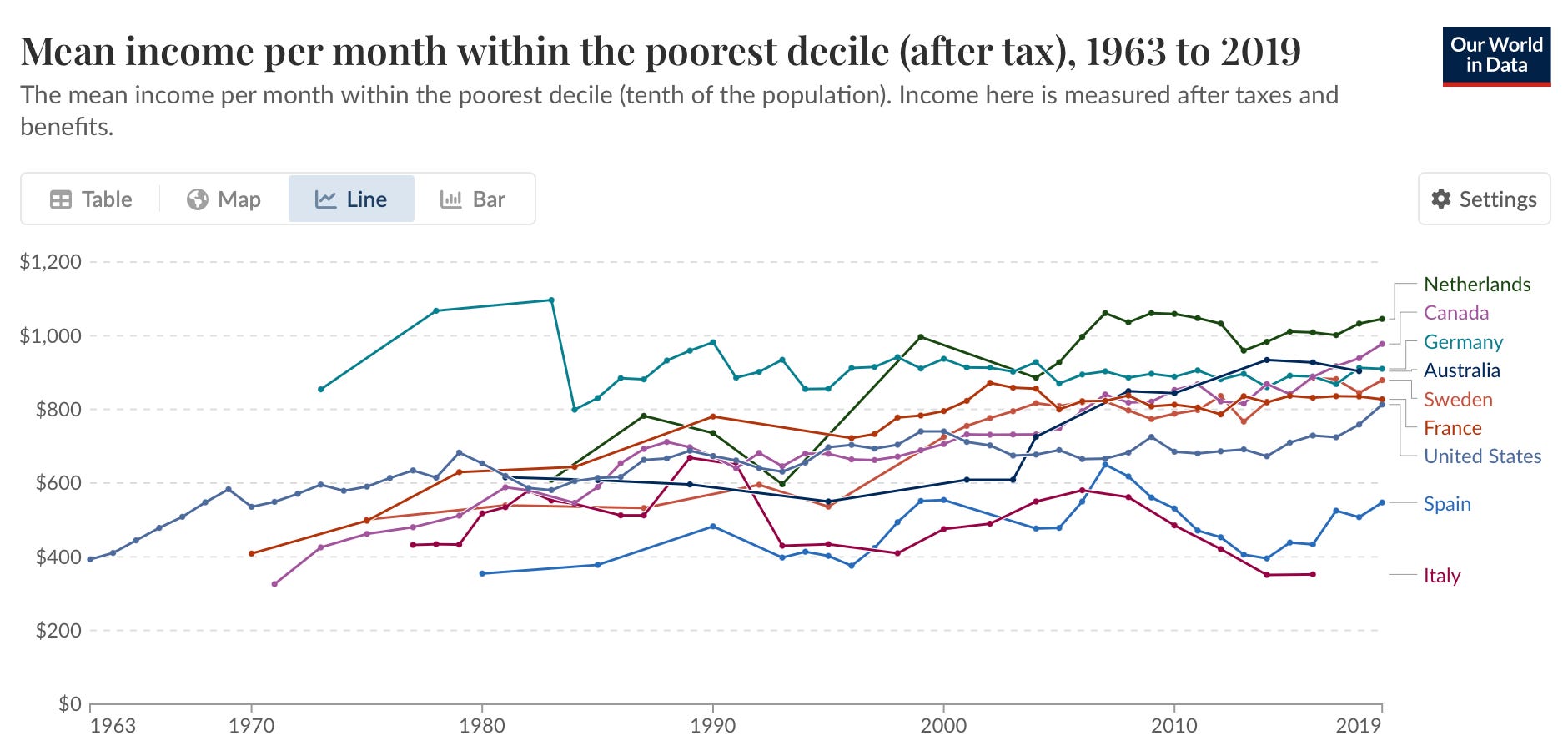
If you look at living standards in the poorest 10 percent of the population, the bottom decile of Americans is doing worse than the bottom decile of Canadians or Australians or residents of northern Europe.


Reasonable people can disagree as to what to make of that, but it’s one of the most important structural facts of American life.

Somewhat flexible help for the poor

On average, SNAP recipients receive $187 per month, but poorer families get more and less-poor ones get less. It’s not a particularly generous program. But relative to the rest of the American safety net, it’s a flexible program in that it takes a fairly expansive view of what counts as groceries. When I was a kid and recipients had to bring actual food stamps to the grocery store to get their benefits, their use of the program was quite obvious to anyone behind them in the checkout line. But in the modern world, benefits are administered via an Electronic Benefits Transfer card that looks and functions like a debit card or a credit card, so it’s easy to miss — perhaps one reason people seemed to be surprised by the scope of the program.

by Matthew Yglesias, Slow Boring |  Read more:
Image: Hispanolistic
[ed. Poor people being used as political pawns again. Starting with burdensome new Medicaid application, work and reporting requirements; suspended H-2A worker programs which provided visiting workers for essential agricultural and dairy support jobs (that Americans won't do); ICE arresting anyone that looks poor and brown, and now this - just outright starving them. See also: Trump’s deportations are causing farm labor issues... with no viable, long-term solution (Investigate Midwest); and Wages of Citizenship (PW):]
***
"The Trump Administration’s crusade to transform the US immigration system has included sweeping changes to increase the state’s capacity to locate and remove noncitizen residents. The administration has empowered immigration agents to enter formerly “sensitive” spaces like schools and churches, suspended due process for legal noncitizens, and established immigration jails outside national borders. It made a deal with the Internal Revenue Service (IRS) to use once off-limits tax data to locate up to seven million undocumented workers. Dramatic deportation operations are now underway across the country, with the Department of Homeland Security (DHS) boasting 113,000 arrests and “north of” 100,000 deportations since Trump took office in January. The numbers include a rise in “collateral” arrests and deportations and are likely to rise after Immigration and Customs Enforcement’s (ICE) March 25 repeal of work authorization for 530,000 legal migrants of Cuba, Nicaragua, Haiti, and Venezuela, who have thirty days—until April 24—to depart before they too will be targeted for arrests and deportations.

Draconian methods were to be expected. Less clear is whether the promised crackdowns threaten the uneasy alliance between the federal government and employers in agriculture, construction, and food and hospitality industries. Despite the “war on terror” redefining the outer limits of executive power to surveil and detain foreign nationals, the workplace has over the past two decades remained largely insulated. The resilience of this arrangement reflects a clear hegemonic interest in cheap and docile labor, which allows for both lower prices and higher profits; a critical supply of health and childcare workers; a vital source of future labor; and close to $100 billion annually in state, local, and federal tax revenues. This is the perspective of US employers, expressed by the notion of “sanctuary businesses,” in which the legal segmentation of the labor market has propelled business growth."

Clam Control

via:

Monday, November 3, 2025

L. K. Zaiser. “INDICATEUR DE VITESSE” (speed indicator). Poster. SABENA/RAPIDITE. 1938.
via:

Kai Schaefer. Dual 1219 - The Beatles - Abbey Road, 2011
via:

Politicized Stupidity

The Atlantic’s David Frum opens with reflections on the new Trump administration’s pattern of “politicized stupidity”: the willful refusal to understand abuses of power, including the destruction of the White House’s East Wing and the perceived sale of government influence disguised as private donations.

Then Frum speaks with his Atlantic colleague Tom Nichols, an expert on civil-military relations and a longtime scholar of U.S. defense policy, about President Donald Trump’s efforts to turn the military into a personal instrument of power. Nichols explains how the capture of the Justice Department, the firing of Pentagon lawyers, and the use of the National Guard against civilians are eroding the rule of law, and how a president can launch wars without congressional consent.
***
There’s so many outrages in the Trump years, there’s so many abuses that maybe it’s petty to fix on minor irritants, but there is a minor irritant that got caught in my craw, and I just want to ventilate a little bit about it. One of the more annoying and more pointless aspects of the Trump era is what I call politicized stupidity. Politicized stupidity is a kind of aggressive not getting the point by people who are otherwise perfectly well equipped to getting the point. Genuine stupidity is a misfortune and is distributed by God, but the politicized stupidity is chosen, and it’s chosen for reasons.

Let me give you an example of what I mean. So President [Donald] Trump has just demolished the East Wing of the White House. He did this without any form of consultation, as if the White House were his personal property, and in order to build a giant ballroom that there’s no demonstration of need for and that, again, he’s treating as a point of personal property. He’s choosing the design; there’s no process of respect for historical or cultural integrity. And he’s financing this whole project. We have no idea how much it will cost—or President Trump originally said $200 million; now he’s suggesting $300 million. But who knows what the cost will be. There weren’t drawings. There weren’t plans. It’s being done on a kind of ad hoc basis, and the cost could well climb beyond the startling figure of $300 [million] to much more.

And he is proposing to pay for this project—that is chosen entirely by himself with no consultation—by accepting donations from corporations and wealthy individuals. He has people who have business before the government, who seek favors before the government: Some of them have mergers that they’re hoping for approval. Others are in the crypto industry that has received a massive government favor in the form of the GENIUS [Act] and who are hoping for more favors. Others of whom are in business with members of the Trump family. If the country needed a ballroom, then there should have been a review process, a design process, and Congress should pay for it out of public revenues because it’s the People’s House, not Donald Trump’s house.

Okay, you get that. But there are people who insist on not getting it. There are people who say, Well, are you against ballrooms? Don’t you think the White House ever needs renovation? Other presidents have renovated the White House in the past. The point is not that you are for or against renovations, of course; the point is you are for or against not treating the White House as a person’s property. But there’s a kind of deliberate refusal to get the point, and you see this in many places in our public media. It’s the same when Donald Trump delivers a pardon to a crypto criminal, a convicted crypto criminal, who has helped to enrich his family.

Now, there have been other doubtful pardons by presidents in the past, and President [Joe] Biden apparently used an autopen to sign some of his pardons, and maybe that’s not ideal. But no one has ever pardoned people because they gave money to his family, his sons, his relatives. No one has ever delivered pardons because he just seems to have a general attitude of being pro-white-collar criminals. No one has ever said, I’m pardoning this convicted fraudster congressman because he always voted for my political party and always supported me, and that is the one and only grounds and basis of my pardoning this figure. But people insist on not getting that point: Biden used an autopen; isn’t that the same? No, it’s not? Well, I refuse to understand why it’s not. (...)

So presidents have done it before, but no one has made it the basis of his policy. And no one has ever said, I’m imposing tariffs on one of America’s closest allies, Canada, because I’m upset that they made a TV ad that implied that Ronald Reagan was a better president than I am. And indeed, Donald Trump is not 1/1,000,000th the president Ronald Reagan that was, and so it, obviously, it cuts to the bone. But again, there are people saying, Well, foreign countries shouldn’t criticize American policy on American TV. They don’t get the point. The stupidity is politicized.

Now, where does this come from? Well, part of the, I think, the reason for not getting the point is because the actual point is too big and too scary. Nobody wants to face what Donald Trump is and what he’s doing to the United States. Even those of us who talk about it all the time, we don’t wanna face it—it haunts our nightmares. But even though the point is big and scary, the point has to be faced and not denied through clever evasions.

Sometimes people don’t get the point because their boss demands they not get the point. If your job depends on writing an editorial saying that the destruction of the East Wing and its replacement by a ballroom financed by favor-seekers is just the same as President [Barack] Obama replacing the wiring and water in the main White House with money appropriated by Congress, if your boss says you have to do that or lose your job, there are people who, unfortunately, will do as told rather than lose their job. (...)

I can be concerned by the things that the universities are doing that are bad without having to come up with some clever, counterfactual, counter-imaginative justification for things that are obviously outrageous. We’re all going to like something, but we have to keep our sense of proportion. We have to understand that the main thing is the main thing. And, as I said, if God inflicted stupidity on you, it’s not your fault, but don’t choose it. That’s just annoying. (...)

[ed. Next up: Tom Nichols]

Frum: So you wrote this very important article for The Atlantic about the coming crisis in civil-military relations. This is a subject you’ve devoted so much of your academic life to. I wanna ask you to sit on the other side of the table for a moment. Imagine yourself—I don’t know that such a thing could ever happen—but imagine yourself a malign and criminally intended president who wanted to remake the U.S. military as a tool of personal power. How would you go about doing it?

Nichols: In this system of government in the United States, the first thing I would do is seize the Justice Department. And by seize, I don’t mean being elected and nominating an attorney general; I mean flushing out all of the people committed to the Constitution, the rule of law—you know, the lawyers. It’s almost a trope now to do the Merchant of Venice line, but you start with getting rid of the lawyers, if you’re going to do these kinds of things, and you replace it with your cronies. You replace it with people that are going to be loyal to you. You basically undo everything that’s been done with the Justice Department over 50 years.

Frum: So the first move at the Pentagon is not at the Pentagon; it’s across the river at the Justice Department.

Nichols: Exactly. Because if you’re a military officer, the people that you’re gonna want an opinion from are lawyers—which is the next step, which is you not only get rid of the lawyers at the Justice Department; you do what Trump’s already done: You get rid of the top lawyers of the Pentagon.

And look, the rule of law requires lawyers and people to interpret the law, and the first people you have to get rid of are anybody who says, My loyalty is to the rule of law, the statutes as written, the Constitution, and not to Donald Trump.

Frum: Because our hypothetical military officers will want advice about what is illegal and what is an illegal order, and—

Nichols: They’re already asking.

Frum: —and who do they turn to? If you have—

Nichols: Yeah, that’s already happening.

Frum: If you’re a three-star or a four-star general and you have a question, Is this a legal or an illegal order?, who do you ask?

Nichols: Well, you would ask the top legal service adviser in your branch, but [Secretary of Defense Pete] Hegseth and Trump have fired them all. So now you’ve got guys—there are people doing that job, but you and I both know from working in government, when your boss has been canned and you’re the acting guy, or you’ve been suddenly elevated because people above you have been fired, that’s not a signal to you to be brave and innovative and daring about standing up for the Constitution. You’re sitting in a desk that somebody else had who tried that and got fired. So you might ask them—I can imagine some of these very senior officers are talking to friends or family attorneys or somebody. Because what’s going on, we’ll be talking about—I guess this is the hand-wave “all this”—but all of this, I think, is not legal.

So you capture the Justice Department, you fire the military lawyers, you insist on loyalty from the top commanders—which Trump thinks he has, apparently, with somebody like [Chairman of the Joint Chiefs of Staff General] Dan Caine—and then you make sure to neuter the intelligence community so that foreign threats or plots or any other things that could interfere with elections in your favor are left undiscovered or uninvestigated.

Frum: Yeah. So you don’t have to remake the officer corps from top to bottom. You don’t even have to start looking for sympathetic two-star generals to replace the three-stars and sympathetic three-stars to replace the four-stars. You just cut them off from information and rely on natural bureaucratic inertia to make them obey you?

Nichols: And the chain of command. Because remember that officers are required to begin from the presumption of legality with an order. The system is designed to make sure that the chain of command functions effectively so that if you’re a colonel or a one-star or a two-star, you have to assume that if the order has come down from the president to the secretary, the advice of the chairman—the chairman’s not actually in the chain of command, but he gives advice—and by the time it gets to you, the assumption is: Well, this must be legal because all these other guys wouldn’t have ordered me to do it.

Frum: So if you get an order to blow up a fishing boat in the Caribbean or the Pacific, you would start with, Well, somebody must have signed off on this. They must have—

Nichols: Somebody signed off, exactly. And the place it should have stopped, of course, is: The attorney general, the secretary of defense, the chairman of the Joint Chiefs should all be standing in the Oval Office, saying, You can’t do this. This isn’t legal. This is a violation of both American and international law. And if the president says, Well, go ahead, just do it, well, by the time it gets to that lieutenant commander in a helicopter or piloting a drone, he or she’s already saying—well, as you just said, David—Somebody must have signed off on this. (...)

Frum: So I wanna go back: Who has the mission? So the South Carolina or Texas National Guard is called up, sent to a blue state, and is told something like, We think a lot of the people in this lineup in this swing suburb are probably illegal aliens. And we think they should be detained for 12, 14, 16 hours, or ’til whenever the polls close. Your order is to go detain these people we believe are illegal aliens—I mean, they’re Democrats; they might as well be illegal aliens—detain them and hold them until the polls close. Who has the mission to say, That sounds like kind of an illegal order to me?

Nichols: Well, but they’re being much more clever about it than that. The mission to detain those people and to disrupt those operations goes to ICE. And then the president says, This being a federal agency, I’m not using the military to detain any of these people. I’m simply using the military to protect these other federal agencies while they do their job

Frum: —of detaining everyone in the voting line

Nichols: Of detaining everybody in line. It’s very clever. They say, We’re not doing domestic policing. We’re simply securing federal installations, protecting federal employees because the state or the local municipality either can’t or won’t do it. (...)

Nichols: I often think that the states and the cities can say, with a show of force, to say, Our police have this. We’re good. We don’t need you here, that our state cops—we’re good. Because I think part of Trump’s project here—and the way they’re just dragooning people into ICE who have no qualifications, really, is another tell and creating this kind of paramilitary goon squad out of ICE. I always thought of myself as an immigration hawk, and I’m kind of reaching the “Defund ICE” level at this point.

But I think part of Trump’s plan is simply to have these military forces during the elections so visible that people just stay home, that they’re just intimidated out of the public square, that you don’t even have to arrest them. You don’t have to have a big display of force. That the goal of all of this political activity, the goal of everything Trump is doing, is to drive people out of the public square, to say, The Wi-Fi is still working. There’s still 150 channels on TV. Beer is cheap. Gas is affordable. I don’t wanna deal with this. I don’t wanna deal with all of this, and it doesn’t really matter. ’Cause the other thing, I think, that’s the undertone of all this is, Look—it doesn’t really matter who’s in office. They’re all bad. Everybody’s corrupt. And so rather than use the military to inflict violence to stop the elections—you know, gerrymandering and voter suppression work in marginal elections, not huge-turnout elections. And so what they’re really trying to avert is a large Democratic turnout in places where they can pull that off.  (...)

Nichols: I was talking with friends who have to teach this stuff at both military and civilian institutions, and it’s like, how do you teach the American national security process now? There isn’t one. It’s whatever Donald Trump—it’s all vibes, right? It’s whatever Donald Trump feels at any given moment. And the problem is that he has—it’s a problem for us; it’s an advantage to him—that he surrounded himself with people who say, I am anticipating that he wants to do this. I will always have a plan ready to say, “You bet, boss. I got a plan for striking Venezuela.”

And I don’t think they’ve thought it through. I don’t think they care about thinking it through, David. I think they wanna be able to say, America’s at war. Anybody who opposes the president is a traitor.

by David Frum and Tom Nichols, The Atlantic |  Read more:
Image:Paul Morigi/Getty

Sunday, November 2, 2025

Resist


[ed. I was thinking about this the other day, why more people don't ask for basic ID, a warrant, some official paperwork, film everything? I'd definitely do what this guy does - tell these assholes that if they want to continue harassing or even arresting me, they and their supervisors can expect to be buried in paperwork, social media attention, and possibly legal filings faster than they can imagine. RESIST. It's your rights and I'd even say obligations under the constitution. See also: an alternative approach.]

Image: via:

The Plan to Subvert Elections Is Already Under Way

Our election system is reaching a breaking point. Here's how it'll likely happen.

Imagine for a moment that it’s late on Election Day, November 3, 2026. Republicans have kept their majority in the Senate, but too many House races are still uncalled to tell who has won that chamber. Control seems like it will come down to two districts in Maricopa County, Arizona. ICE agents and National Guardsmen have been deployed there since that summer, ostensibly in response to criminal immigrants, though crime has been dropping for several years. The county is almost one-third Hispanic or Latino. Voting-rights advocates say the armed presence has depressed turnout, but nonetheless, the races are close. By that evening, the Republican candidates have small leads, but thousands of mail and provisional ballots remain uncounted.

Donald Trump calls the press into the Oval Office and announces that the GOP has held the House—but he warns that Democrats will try to steal the election, and announces plans to send a legal team to Arizona to root out fraud. He spends the rest of the night posting threats and allegations on Truth Social. In the morning, Republican lawyers file to stop vote counting, arguing that any votes counted after Election Day are illegal under federal law. Attorney General Pam Bondi sends a letter to Adrian Fontes, Arizona’s Democratic secretary of state, and the county board of supervisors, instructing them to retain all documents and warning that the Department of Justice may intervene if it suspects anything untoward. On X, FBI Director Kash Patel reposts false rumors about fraud and announces plans to lead a group of agents to Phoenix. Meanwhile, Democratic candidates have pulled ahead in both races by Wednesday afternoon, but the margin is just 143 votes in the Eighth District, with many votes still not tallied.

By now, conservative outlets are running wall-to-wall coverage alleging fraud, offering tales of immigrants being bused to voting locations and accusing Democrats of treason. MAGA has learned its lesson since 2020, and Rudy Giuliani and Sidney Powell are nowhere near the cameras. Instead, administration officials like Bondi are the face of the allegations on TV. Behind the scenes, Trump is making phone calls. He’s unable to reach any county supervisors, whose lawyers have warned them not to speak with him, but he gets through to the county recorder, a MAGA loyalist elected as part of the backlash to the 2020 election. No one knows quite what is said—the call isn’t taped—but when Trump hangs up, he posts that the county has agreed to hand over control of voting machines to the Department of Homeland Security.

Fontes and the board of supervisors rush to court to block the move, and a judge quickly grants an injunction. But Trump declares a national emergency that he says supersedes the order; helicopters are en route from a Marine air base in Yuma to take control of the voting machines. By the time Supreme Court Justice Elena Kagan, who is assigned to hear emergency matters from Arizona, issues an order blocking this, Marines have already commandeered ballots and machines. Patel, having just arrived in Phoenix, holds a press conference and announces, without providing evidence, that votes have been tampered with. He proclaims the Republican candidates the winners.

Despite Marines on the street, small but fierce protests erupt in Phoenix and elsewhere; Trump uses them as a pretext to invoke the Insurrection Act and announces “martial law in Democrat-run cities.” Who actually won the election can never be determined—the Marines and Patel have broken the chain of custody, as well as some of the machines themselves—but the state names the two Democrats as winners. House Republicans reject Arizona’s certification and instead seat the GOP candidates. Trump’s allies keep the House in a profoundly illegitimate election rejected by many Americans.

This is just one possible scenario. Is it too pessimistic? Perhaps. But at this stage of the election cycle in 2019, no one expected a crowd of Trump supporters to storm the U.S. Capitol on January 6, 2021. No one expected the president himself to explicitly lend his support to their efforts to “Stop the Steal.” Certainly no one expected that there would be calls to hang the vice president for his refusal to subvert the democratic process. If anything, when it comes to 2026, I worry more about the limits of my imagination than about the hazards of speculation.

Trump has made his intentions clear. At a rally last summer in West Palm Beach, Florida, he offered his supporters a promise. “Christians, get out and vote, just this time. You won’t have to do it anymore. Four more years, you know what, it’ll be fixed, it’ll be fine. You won’t have to vote anymore, my beautiful Christians,” he said. “We’ll have it fixed so good, you’re not gonna have to vote.”

We’ll have it fixed so good. It’s not hard to guess what Trump might do to fulfill this promise. He has, after all, already attempted to disrupt and overturn an election. In 2020, those efforts involved questioning results, asserting widespread fraud without evidence, pressuring local officials to overturn outcomes, filing spurious lawsuits, and ultimately inciting supporters to sack the Capitol. Now that he’s back in the White House, he will draw from this playbook again—perhaps adding new maneuvers, such as deploying armed troops. (...)

Trump and his allies will have before them less an orderly set of instructions than a buffet of options. Some of these options will go untested, or amount to nothing. But elections are a game of margins. Only a handful of Senate seats and a few dozen House races may be seriously contested, thanks to maps drawn to guarantee safe seats for one party or the other. Of those, some may be very close. In 2024, 18 House races were decided by fewer than 10,000 votes. Democrats won 11 of those.

To understand the threat to democracy, and how it might be stopped, I spoke with experts on election administration, constitutional law, and law enforcement. Many of them are people I have known to be cautious, sober, and not prone to hyperbole. Yet they used words like nightmare and warned that Americans need to be ready for “really wild stuff.” They described a system under attack and reaching a breaking point. They enumerated a long list of concerns about next year’s midterms, but they largely declined to make predictions about the 2028 presidential election. The speed of Trump’s assault on the Constitution has made forecasting difficult, but the 2026 contests—both the way they work, and the results—will help determine whether democracy as we know it will survive until then.

by David A. Graham, The Atlantic | Read more:
Image: Carl Godfrey
[ed. Post of the week. It's all here, from pre-to-post election tactics. Hopefully everyone who values election integrity and democracy itself - whether Democrat, Conservative, or Independent - will be prepared to recognize and counter all this.]