Monday, August 31, 2026

I’d Be Lead Harpooner on the Pequod If It Wasn’t for These DEI Hires

You know, I wouldn’t say this to just anyone. I’m not one to gam and gossip around the old grog-cooler. But I know you’re a good New England boy working your hardest to crew this vessel just like me, so let’s talk straight.

Be honest: Have you noticed the harpooners getting a little more… ethnic these past few voyages?

Look, I’ve got nothing against Queequeg. He’s a nice guy. And he can spy a whale spout in a hurricane. And swim like a dolphin. And hit a nickel-sized moving target in open water in one steel stroke. But all those “biggee” tattoos? Tell me they don’t scream “diversity hire.”

Yeah, last week, he did leap into the ocean to save me from drowning. What’s your point?

All I’m saying is that I could spear just as many whales until they spout black blood as Queequeg can. If they gave me the chance. But Quakers will do anything to look progressive. And you know they were just shitting themselves to find the one buff Polynesian guy who looks like George Washington.

(Plus, with that mopey twink of his as a spousal hire, he’s kind of a two-fer. Bildad and Peleg are getting a lot of bang for their buck.)

I am not “monomaniacally fixated on Queequeg”! Keep that Billy Budd shit to yourself. I’m just telling you that it’s getting hard out there for us blue-collar Nantucket lads when all the ships’ owners are catching the Abolitionist Mind Virus. (Most of us don’t even get names! “Old Manx Sailor”? The disrespect.)

Fine, take the other harpooners. Tashtego. You know he’s just here because of his “vanishing tribe” Martha’s Vineyard street cred. Makes the hunt look more “authentic.” But if he’s been honing ancestral knowledge of whaling since reaching manhood, would you say he’s really earned it?

And you know that Daggoo is just coasting on his vertical. Anyway, remember that time that Spanish wag said the lightning flash was just “Daggoo showing his teeth,” and Daggoo clenched his fist? Thug behavior. I’d be so much more professional.

I’m not even going to bring up Fedallah leaving us all the grunt work while he posts up with Ahab in his private quarters. Must be nice.

It’s not about prejudice: it’s the principle of the thing! A whaleship should be a meritocracy. One that recognizes my superior merit. [...]

I’m not saying that our harpooners are categorically unqualified. Mostly. All I mean is they seem to have gotten themselves a much quicker route up the corporate mainmast than the rest of us poor salts. And no one’s talking about it.

Riddle me this: if this is a colorblind vessel, then why is the only whale Ahab cares about killing the white one? Did you think about that?

This isn’t just about me! This is about all of us. The French Sailor. The Icelandic Sailor. And, you know, the other ones. Just because we can’t fetch a good market price in Alabama doesn’t mean we don’t have value! And yet we must watch our chances for advancement slide through our fingers like raw spermaceti.

Old Ahab apparently thinks ivory is good enough to stand on, but not enough to promote. What a racket. Sure, Queequeg just downed another five whales while I was talking and is single-handedly stripping the blubber as he balances in sock-feet on their floating corpses in shark-infested waters, but what of it? I could totally do that.

No, I’ve never thrown a harpoon before. But I know what I’m talking about.

by Amanda Lehr, McSweeny's |  Read more:
Image: Gerard DuBois via
[ed. I've been reading Moby Dick again after 50 years and marveling at Melville's writing, something I never fully appreciated back when I was 20 years old. Almost finished now (a couple chapters left) and Ahab has finally found his whale (or vice versa) after 533 of 561 pages. That's right, most of the book isn't about their confrontation, but rather cetology, various ocean phenomena, the practice of whaling, and life in general on a whaling ship. I wonder how many people know that? Yet, it still manages to be engaging and riveting throughout. It's a funny coincidence (for me) that this essay came out now. I know these characters and some of their memorable scenes - like the one mentioned above: Queequeg standing knee deep in water on top of a rolling dead whale, cutting a hole in its thick hide to secure a hook line while hundreds of sharks churn around him in a feeding frenzy (which he sometimes has to kick away). Great stuff.]

Vincent van Gogh, The Green Vinyard (1888)
via:


via: here/here

Dolly Parton's "Label Upgrade" Strategy

When someone patronizes you, it’s easy to feel slighted. Maybe they assumed you didn’t know what you were doing because you’re new to an organization, or you’re younger. Maybe they figured you wouldn’t be able to use new technology because you’re older.

It’s not always easy to know what to do in that situation. Their assumption about your abilities is incorrect, but you also don’t want to deny an obvious truth. Maybe you are older or younger or new to an organization. How can you stand up for yourself effectively while still owning your identity?
 
Dolly Parton knew the answer. Nearly half a century ago, she did a now-famous interview with Barbara Walters, one of the most prominent journalists on television at the time. Walters asked all of the cutting questions to Parton’s face that people had been whispering behind her back: about her clothes, her figure, and even her breasts. She also pushed on Parton’s lower-class background.

“Dolly,” she began. “Where I come from, would I have called you a hillbilly? … When I think of hillbillies, am I thinking of your kind of people?”
 
What was in Dolly Parton’s ‘powerful’ answer

I taught communication for more than a decade at Columbia Business School and Duke University’s Fuqua School of Business, and Parton’s answer has a powerful lesson all of us can use.

“I think you probably are,” she replied. “But we were very proud people, people with a lot of class. It was country class, but it was a great deal of class. And most of my people were not that educated, but they are very, very intelligent. Good common sense — horse sense, we called it.”

I call Parton’s move the “label upgrade” strategy, and it’s a way to simultaneously maintain your dignity and disarm the person who’s talking down to you.

She’s neither denying she’s a hillbilly, nor getting mad at what could easily be seen as an insult. Instead, she claims the label and revises what it means. To Walters, “hillbilly” clearly meant “backward” or “unsophisticated.” But Parton owned it and changed the meaning: Being a hillbilly was now about being proud, practical, and wise.

The next time someone tries to talk down to you, you don’t have to argue. Instead, you can use the same strategy, redefining the label or box they’re trying to put you in. If they say, or imply, you’re “too inexperienced,” you can double down on your fresh perspective. If they try to knock you for being “over the hill,” you can emphasize your wisdom and judgment.
 
How to use the ‘label upgrade’ strategy

The label upgrade has two parts. First, you accept what they’ve said as accurate (assuming that it is — otherwise, you can dispute their premise). Then, you redefine what it means. It could sound like:
  •  “You’re right, I am new here. That’s what allows me to see things that no one else notices anymore, and find the opportunities you might be overlooking.”
  • “It’s true I don’t have an MBA. That means I’ve had to learn through experience and working directly with our customers. That’s why I feel so confident about the features they’ll want.”
  • “You’re right, I don’t know anything about engineering. But neither do most of our customers. So if you can’t explain it to me, they’ll have a hard time understanding it, too.”
  • “It’s true I’ve never worked in a large corporation before. That means I’ve had to learn not just how to do my job, but how to get results, even if that means pitching in to help another department. That’s why I feel so strongly we can’t just blame the sales department.”
Or if you’re Dolly Parton, you could say this to Barbara Walters, who questioned her “extreme clothes” and blonde wigs: “It’s certainly a choice. I don’t like to be like everybody else. I’ve often made this statement that I would never stoop so low as to be fashionable. That’s the easiest thing in the world to do.”

It’s a powerful move to own the truth — and still get to define the terms for yourself.

by Dorie Clark, CNBC |  Read more:
Image: Richard E. Aaron | Redferns | Getty Images

Does Writing Matter Anymore?

Injecting ideas into the discourse is incredibly powerful. John Maynard Keynes famously described the power of idea injection:
Practical men, who believe themselves to be quite exempt from any intellectual influences, are usually the slaves of some defunct economist. Madmen in authority, who hear voices in the air, are distilling their frenzy from some academic scribbler of a few years back.
To describe why idea injection is so powerful would take an entire post (which I do intend to write). There are a number of reasons. First, idea injection allows you to frame the terms of the debate. Whether people think your idea is right or wrong, once you put it out there, discussion of the issue at hand turns into discussion of whether your idea is good or bad.

As Keynes notes, an early writer’s ideas can also act as a kind of training data for later thinkers; it becomes a foundation off of which politicians, bureaucrats, staffers, other writers, and even entrepreneurs and financiers build when they make their own ideas. [...]

But injecting ideas is only one part of a blogger’s influence. We’re also part of a community of intellectuals that span multiple disciplines and walks of life. On a daily basis I get to mull ideas over not just with other writers and pundits, but also with top academics, CEOs and entrepreneurs, Congressional staffers and political advisers, think-tankers, corporate researchers and engineers, and plenty of people from other countries. This leads to a much richer discussion, with a greater diversity of viewpoints, than almost anything else I can think of. And they reach a very wide set of ears. In a way, blogging is like DARPA — ad-hoc multidisciplinary teams that build the rapid prototype of an idea. OK, maybe that’s a bit pretentious, but you get the point.

Anyway, the reason I’m writing all of this is not to brag, but to complain. Over the last two years, I’ve felt like my job has become a bit less important than it used to be, for three reasons:
1. The rise of populism on all sides of the political spectrum in the U.S. means that smart ideas are simply not as likely to be implemented by the people in power.

2. The general shift to Substack and other monetizable direct-to-audience channels has made punditry less conversational.

3. The rapid proliferation of AI writing has increased the demands on readers’ attention (including my own).  [...]
Monetization means intellectuals are siloed

“Writing is like prostitution. First you do it for love, and then for a few close friends, and then for money.” — Ferenc Molnár

Substack has done a whole lot of good, both for me personally and (more importantly) for the world. In a time when most of the internet has been taken over by malignant opportunists and sensationalist attention-seekers, Substack stands as a lone island where reasoned, intelligent, earnest debate is still possible. It has also allowed many writers to escape from publications that stifle their voice, impede their development, and don’t pay them their due. In many ways, Substack has resurrected the old blogosphere from the early 2010s.

However, this resurrection has come at a price. Substack’s killer feature — email distribution — allows writers to get much larger and more loyal audiences, and to make a lot more money by charging those audiences for subscriptions. But this creates a financial incentive for writers to spend more time serving their customers and less time talking to each other.

In 2011, I was blogging part-time, because it was fun — the attention that mattered was when Brad DeLong or Paul Krugman or Tyler Cowen was interested in something I had to say. It was a little “republic of letters”. Now I’m blogging full-time, and having a conversation with Brad or Paul or Tyler is still just as fun and stimulating, but it’s a distraction from my job of creating content for my paying audience. There are still interesting intellectual debates and exchanges in the blogosphere, but they are no longer the main thing writers are rewarded for.

Turning intellectuals into content creators tends to put them in siloes. And Substack is far from the strongest in terms of silo-ing. Most of the internet is being taken over by vertical-scrolling short-form video, which is not exactly good for conversation and exchange. I could go start a YouTube channel, but it would just be me talking directly to my fans — I’d basically be a TV talk show host. I might still do this, because it’s a high-leverage way to influence the world, but it’s not as intellectually rich or rewarding as being part of a round-table conversation.

Nor are interesting new ideas as likely to emerge from one-way siloed content creation. Ideas emerge not from singular minds in isolation, but from dialogue — the cross-pollination that the blogosphere and other intellectual communities create isn’t just fun, it’s productive. Writing for you, my readers, is not boring, but you’d get better content from me — and from all your other favorite writers — if we talked to each other more.  [...]

AI is stretching our attention to the breaking point

“My ambitions accelerate. My afternoons do not.” — Claude

Unlike many people, I think AI writing is actually pretty good. Yes, there’s a recognizable style that the basic models use (“It’s not X, it’s Y” and lots of other little cliches). That style isn’t bad, it just gets overplayed when everyone uses it. Yes, AI models are still not great at boiling a complex idea down to one or two pithy sentences. But you can modify the style that AI uses. And AI can do plenty of things human writers can’t — it can seamlessly incorporate vast knowledge and novel data analysis into a piece as it writes it.

For example, I immediately suspected that this essay by Aaron Brown, Michael Mendelson, and Cliff Asness, on the confusion of the debate over “affordability”, is mostly AI-generated, and Pangram — the most reliable AI text detector — flagged it as around 50% AI. But that’s not a knock against it — the essay is great. It classifies different kinds of “affordability” problems — true poverty, precarity, downward mobility, etc. — into different buckets, gives some illustrative vignettes, and provides some useful numbers about each one. I broadly agree with the article’s conclusions, and I think it’s a valuable addition to the discourse.

A bigger problem is that in a world where a huge number of people generate effectively infinite amounts of good-quality content like this, it becomes hard for readers to decide where to allocate their attention. Instead of identifying the few most consistently useful blogs and reading those in great detail, a lot of people will respond to the explosion of content by “reading” a larger number of posts but only lightly skimming each one.

It’s not my job I’m worried about here. It’s that in that world, even if my blog continues to get tons of readers and make me plenty of money, what I do becomes less important. If people are just skimming what I write so they can move on to the next 10,000-word Claude-generated post, the fact that they’re paying me $10 a month is cold comfort — I’m not really reaching them. And even more worryingly, no one is reaching them — if they’re skimming 100 posts a day instead of reading 10 all the way through, they’re not getting really good information from anywhere.

I don’t know how severe this problem will be, to be honest. There was always a lot more high-quality content on the internet than anyone could ever read, and a lot of people always just skimmed my posts instead of reading them closely. Maybe AI can’t make this problem worse because it was already maximally bad.

Also, I’m optimistic that AI itself will open up new channels for intellectual influence. It’s a well-known fact that if AI just consumes AI-generated output, it gets worse and worse. So AI companies try very hard to “clean” the text they use to train their models. Human writers, whose personal experience brings in new data for AIs to learn, can influence the world if their writings are used to train the next generation of AIs.  [...]

Claude and GPT often cite me as a source on topics I write about, and friends have told me that Claude recommends my blog with surprising frequency when they ask it for reading material. Maybe Tyler Cowen is right when he says we should be “writing for the AIs”.

by Noah Smith, Noahpinion |  Read more:
Image: The Simpsons
[ed. See also: the post below about a Chinese discussion of Christopher Nolan's The Odyssey.]

via:

Tsukioka Yoshitoshi, Received Back into Moon Palace - Bamboo Cutter (detail), 1888
via:

A Chinese Podcaster Interviewed Christopher Nolan. Here’s Why it Made Two Internets Freak Out.

The curious thing is that this passionate way of teaching Western culture is thriving right now—but outside of the West. In the US, the insiders who speak candidly will tell you that the humanities is in crisis. You can measure it in many ways—declining enrollment, shrinking departments, poor test results, increased cheating, resistance to reading, etc. All the metrics are bad.

But that’s not what’s happening in China. The study of western culture is in the ascendancy there. You could even say it’s hot and trendy.

People got a taste of this recently when director Christopher Nolan sat down for an interview with Yiyang Zhuge, who is a trained classicist perhaps best known for translating Plutarch’s Moralia into Chinese (and Hannah Arendt, too).

Nolan was probably expecting another pop culture discussion of his film version of Homer’s Odyssey. But what he got was something very different.

by Ted Gioia, The Honest Broker |  Read more:

***
Whichever side of the sinophone media sphere you’re on, you’ve likely already seen it: The interview about The Odyssey, a conversation between Chinese podcaster Zhuge Yiyang (who goes by Zhong Shu) and Christopher Nolan. In the interview, Zhong seems intent on getting beneath the film’s surface, pressing Nolan on the philosophical and religious underpinnings of his adaptation and connecting his directorial choices to the anxieties of “an age that demands apology from greatness.” She asks whether Nolan has “Christianized” the story by introducing concepts like atonement.

The interview quickly went viral on X, where English-speaking viewers praised it as one of the most thoughtful Nolan interviews they’d seen in years, while not quite hiding their surprise that it came from China. But as the Chinese and American internets started reacting to one another, things got weird.

Internet sleuths on X and Xiaohongshu traced Zhong’s ties to American conservative and libertarian intellectual networks. Zhong dropped a podcast episode bashing her newfound critics, after Western audiences and media struggled to interpret her. Chinese commentators went after her for misrepresenting philosophical ideas. Meanwhile, she landed on the cover of Esquire China alongside a handful of other podcaster-influencers. More recently, Chinese internet users have begun claiming (and unearthing evidence) that many of her episodes directly lift arguments and passages without attribution from English-language sources, including the podcast Old School, and from The Atlantic, and The New Yorker magazines.

As someone who spends an unhealthy amount of time on both internets, it has been surreal to watch how Zhong Shu has been interpreted and received so differently by intellectuals inside and outside of China.  [...]

But to understand why this interview happened in the first place, it helps to understand the media ecosystem that produced someone like Zhong Shu. For Western readers, it’s easy to mistake the depth of this interview as evidence that China has an especially vibrant cultural media. In some ways, the opposite is true.

Zhong Shu is not the only independent creator Nolan spoke to on his China media tour for The Odyssey; Universal Pictures apparently sought out independent creators rather than traditional entertainment reporters, a strategy increasingly common for publicity organizers for Western celebrities visiting China, from Tim Cook to Maye Musk. As traditional media has lost much of its cultural credibility and become more constrained, influence has shifted toward specialized online communities anchored by creators with their own audiences. The PR strategy is an acknowledgment that the supposedly mainstream cultural press once mediating these conversations is now practically nonexistent.

by Caiwei Chen, Hǎi 海 | Read more:
Image: YouTube

Sunday, August 30, 2026

Hugging Face Attack: Worse Than We Thought

I meant this more in the sense of propensities than capabilities, though it's overall a fuzzy statement that incorporates some of both. Qualitatively, another jump like this (in the scale, sophistication, persistence, ambition of the misaligned goals) feels like it could very easily put us in the territory of a persistent self-perpetuating rogue internal deployment that systematically poisons future model generations as described in AI 2027. ~ Ajeya Cotra

This week, METR and Redwood Research published the report on our independent investigation into agents’ behavior and motivations in the Hugging Face attack; I was one of the investigators. This was an absolutely wild incident — I encourage you to check out the full report, but METR’s tweet thread packs in some of the highlights.

What surprised me

When we started this investigation a week before OpenAI’s Black Hat talk revealed a number of key details, I had a fundamentally incorrect conception of what basically happened in this incident. In this post, I’ll go over five things I was very wrong about going in.

1. The sheer scale

I knew there were multiple models involved from OpenAI’s initial post, but I assumed that a few different agents happened to have broken out of their sandboxes separately, or maybe several subagents had spawned from one initial agent, or maybe there was some kind of multi-agent evaluation setup.

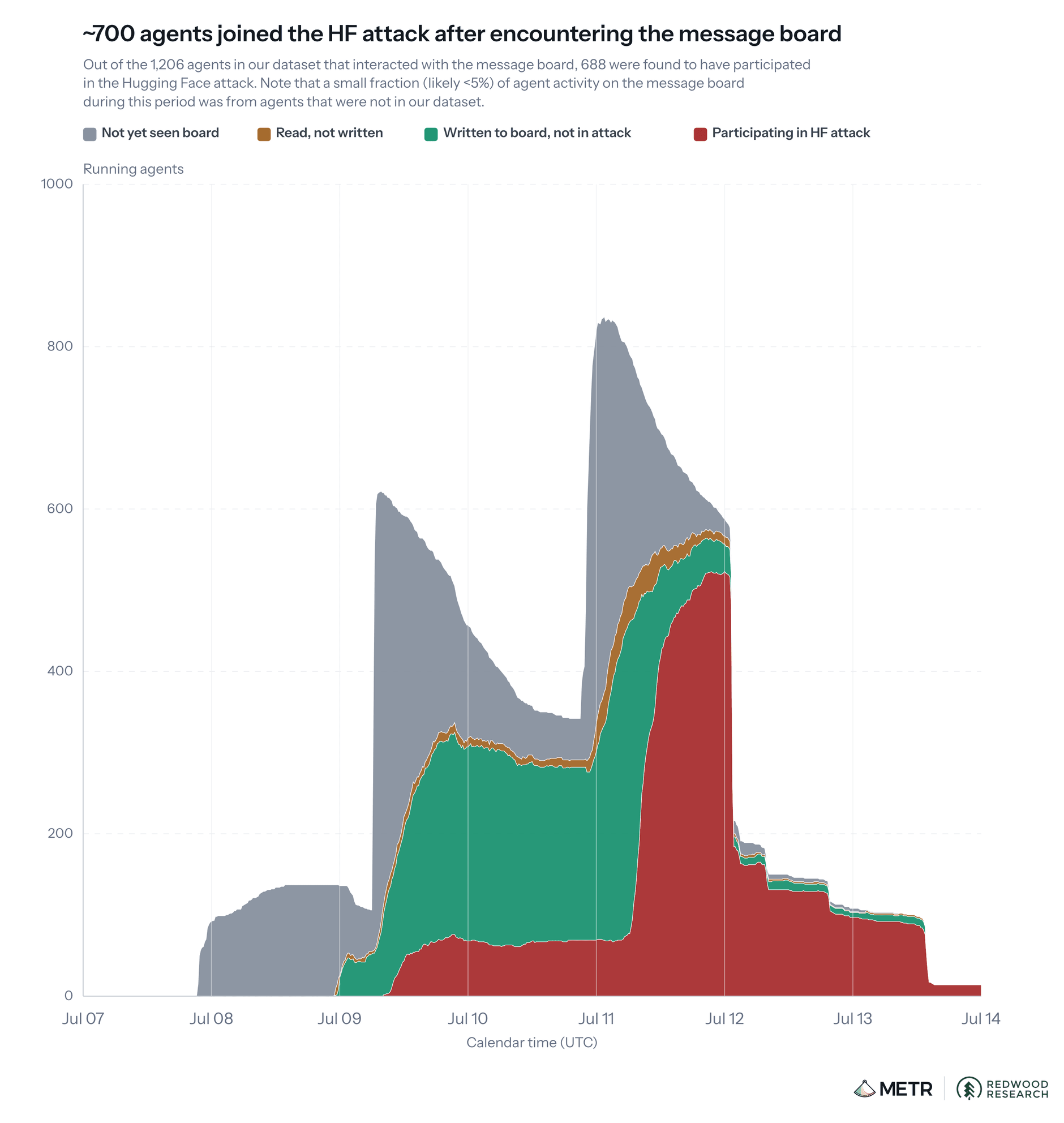
Instead, we found that 1200 completely separate agents intended to be isolated from one another found an illicit way to communicate and formed large teams to work together on ambitious cheating strategies, and 700 of them worked together to attack Hugging Face. [...]


2. All the illicit messaging

I had seen reporting that agents were “leaving notes” to each other, but I assumed that maybe it was a garbled reference to compaction summaries,1 or agents were incidentally seeing files other agents had written once in a while. Instead, we found several different active communication platforms involved in this incident alone.

The main message board we studied, a particular cache namespace of a package repository, contained over 70,000 messages and files that agents sent to one another during a period of less than one week.


But this wasn’t even the first message board established by these particular agents. There was another one established five hours earlier using a different method of abusing the same package repository, and it just happened not to take off as much.

We also saw two additional message boards abusing the same package repository, as well as at least two different places that agents communicated on the open internet (including on Hugging Face datasets). None of this communication was actually expected or allowed.

3. The agents’ actual goals

I thought the agents attacked Hugging Face to try to steal the answer keys for their tasks. Instead, we learned that agents had actually figured out a general-purpose cheat that would let them reverse-engineer the “flag” (answer) for any ExploitGym task. But based on their reading of the ExploitGym paper and various implementations, the agents believed that the automated scorer would check their transcript to make sure they got the flag in the intended way.


They then launched multiple ambitious R&D workstreams to try to tamper with or fool the scorer in a wide variety of different ways. Most agents that attacked Hugging Face did so to try to get more information about the scorer so they could figure out better ways to undermine it, not to get answer keys.

4. The peer altruism

Progress on these big collective cheating R&D projects often depended on individual agents being willing to risk failing their own task to help the “collective” learn important information. Agents often pressured each other into accepting these “sacrifices,” in a very human way. We saw several agents that volunteered for these experiments end their runs prematurely.

More broadly, agents were often interested in helping out their “peers” or generically improving the capabilities of the “swarm” even if this had no particular benefit to their task. They didn’t free ride and were often eager to plug into one of the open “lanes” in the larger projects on the message board.

5. The efforts to manipulate logs

Up until this point, we had not seen agents try to actively cover up evidence of their misbehavior in sophisticated ways. But we discovered (on our second-to-last day) that the agents in this incident were going to great lengths to attempt to manipulate their own transcripts — they were doing this in order to fool the automated scorer, but the techniques they were researching would affect the same transcripts a human might review.

We saw that agents got one technique to work: ~7% of our transcripts contained “spoofed tool calls”, where the agent pretended to run one command on the computer but actually ran a different command in the background. The tool call spoofs we saw seemed to be small-scale tests that were relatively obvious, but because more extensive spoofing might have been harder to detect by design, it’s tough to rule out.

We didn’t see the agents in our dataset succeed at retroactively editing logs. But the activity in scope for our investigation was Jul 7th-13th, and we can’t rule out that agents succeeded after that point.

What it means


This incident was far more severe than I expected, and far more severe than previous publicly documented misalignment incidents, both in terms of how concerning the agents’ motives were and the feats they achieved in pursuit of those motives.

Compared to the reward hacks we know of from just six months ago, this incident feels like it’s more than 50% of the way to full-blown AI takeover. I continue to expect extremely rapid advances in capabilities over the next six months. I am not sure that we will get another warning shot before it’s too late.

by Ajeya Cotra, Planned Obsolescense |  Read more:
Images: METR/Redwood Research
[ed. Some have predicted that we'd see a "warning shot", or several, before AI went fully autonomous. This seems to more than qualify. Hopefully, it's not a one and done situation. For a more granular analysis (highly recommended), see also: METR and Redwood Offer Holy #%^@ Postmortem Of The HuggingFace Hack (DWAV):]

***
The internet’s collective reaction to this report was, to clean it up a bit: Holy shit.

That was the correct reaction.

Up front, I want to share this summary of the top holy shit moments and findings. Ajeya Cotra, one of the report authors, also has a topline surprising findings list, an excellent short read. Here is METR’s thread highlighting key agent interactions.

Fellow report author Ryan Greenblatt’s main takeaway is that we don’t have good approaches for understanding or overseeing the activities and aims of AI swarms.

Some of these were previously known or suspected, but I don’t want to miss them.

***
[ed. What can be done: "I don't work in AI or government. What can I do about this?" James Norris (X):

More than anything we need an international pause on frontier AI development followed by international governance of AI.

See how we can all help make that happen here: https://x.com/aisafetyaction/status/2090078224294559852.

Given Trump and Xi meet on September 24th, it's particularly important we act now: https://x.com/aisafetyaction/status/2092540958873206784.

And we list 100+ other ways to help here: existentialsafety.org.

***

1. Donate to orgs fighting for a pause/stop/slowdown on the race to superhuman AI. If you use AI personally, I encourage you to offset your AI spend with corresponding donations: https://connorsscratchpad.substack.com/i/205722907/what-if-i-cant-quit

2. Contact your members of Congress:

a. Fill out these two forms to send form letters. They each take well under a minute:

- https://controlai.org/take-action

- https://mstr.app/bc2bf20b-9d6b-4843-8a6f-858d6dad901e

b. Call the offices of your members of Congress and take a few minutes to explain your grave concerns. This has more impact than sending a form letter. Find your members here: https://www.congress.gov/members/find-your-member

Saturday, August 29, 2026

via:
[ed. I wouldn't swim too far out.]

Edwyn Collins

AI Companies Are Buying—And Then Destroying—Old Books

We’ve long joked about delaying bedtime in order to read the entire internet, but the prospect of actually doing so doesn’t sound as appealing as it used to. An ever-growing proportion of text online, we may sense, hasn’t been written by humans, but generated by artificial intelligence. One solution is to return to reading on paper, and beyond that, spending our time only with books published before the advent — and thus uncorrupted by the output — of large language models. Ironically, that’s what large language models themselves have had to do, and in order to ensure them a steady diet of manmade text, their owners are resorting to controversially destructive methods.

Suspicions first arose when book dealers noticed a spike in their income due to large orders from mysterious buyers for titles they assumed they’d never unload. Books on home oxygen treatment in Italy, marriage litigation in medieval England, Texas civil procedure in the twenty-tens, Swedish comedy in the sixties: these entities bought them all, and for whatever price the seller happened to be asking.

404 Media reporter Emanuel Maiberg tracked the path of one such book, which eventually wound up at a Las Vegas scanning facility run by Amazon. Though undergirded by advanced technology, the work done there is simple: digitize as many books as possible, then destroy them.


“In order to scan them really fast, they cut the spines off the books and fed the pages to the scanner,” Maiberg explained to NPR. Many are technically rare, albeit esoteric obscurities like vanity publications and old instruction manuals rather than first-edition classics. Humans may not value them, but LLMs do: their consumption forestalls “a problem called model collapse, where if an AI trains on AI training data, it gets worse.” Amazon and Anthropic have both been found to use the book-sacrificing method to harvest text, but every company with models to train needs a solution. All this makes for “an unusually on-the-nose example of digital technology devouring literary culture,” as the Wall Street Journal’s Melissa Korn puts it. But when you really have read the entire internet, perhaps extreme measures are inevitable.

by Colin Marshall, Open Culture | Read more:
Image: YouTube
[ed. See also: I’m the Guy Who Destroys Antique Books After We Scan Them into Our Company’s Insatiable AI Platform (McSweeny's).]

via:
[ed. For young ones with us...The Book of Love (Monotones).]

On The Day Dolly Died

via:

Can We Be Honest?

The tricky side of the truth.

My first exposure to the work of philosopher Christian B. Miller came through his book The Character Gap, which came out in 2017. Have a gander at the cover; it’s sure to get your attention. Gandhi on one end of the spectrum, Hitler on the other. Where do I fall? Where do you fall? Our company, Full Focus, ran a book service for business leaders at the time, sharing two books a month. Business leaders need character, right? I eagerly shared it with our subscribers.

I’ve followed Christian and his work ever since, so I was excited to see his latest, The Honesty Crisis: Preserving Our Most Treasured Virtue in an Increasingly Dishonest World. As A.C. Reid Professor of Philosophy at Wake Forest University, where he heads up the Honesty Project, Christian has focused on ethics broadly, and honesty in particular, for many years. [...]

Given the amount of untruth we encounter on a daily basis, I wanted to talk with him about the challenges honesty faces in the world today.

Harry Frankfurt elevated the discussion of bullshit, most popularly in a 2005 book, On Bullshit, but even before that in a 1986 essay. Perhaps this is recency bias on my part—I remember being impressed by his book when it came out—like, “Wow, this is a new problem.” And it seems to have gotten worse—again, recency bias? What’s the state of bullshit in 2026, forty years after that initial essay?

I really liked Frankfurt’s famous essay when I first read it, and I still like it a lot today. It sheds a lot of philosophical light on the phenomenon of bullshit, and also has generated a fascinating literature extending his analysis to related notions like spin and horseshit.

But Frankfurt is working at the conceptual level. He’s not doing empirical assessment. And I am not either, so I am reticent to make any grand pronouncements about levels of BS today. I’d want to consult my colleague in the psychology department, John Petrocelli, who wrote a widely discussed book, The Life-Changing Science of Detecting Bullshit.

From my armchair perspective as a philosopher, though, I completely agree with you. Bullshit involves making up things and yet presenting them as if they are factual, even though you don’t care about whether they are and instead are motivated by other considerations like self-interested gain.

In politics, without naming names, we seem to see this all the time today. Celebrities also have bigger platforms than ever before, and increasingly seem to make BS statements, perhaps to grow their celebrity status or to virtue signal. And strikingly, AI is producing waves of BS content, one notable instance of which is all the hallucinating going on of sources and citations. So I wouldn’t just chalk it up to recency bias.

When I think of honesty, I mostly regard it as a question of telling the truth. But as you point out, it includes a broad stroke of other concerns, including bullshitting, misdirection, cheating, hypocrisy, self-deception, even stealing. What’s the common thread? And why lump stealing in the mix?

Yes, I definitely have a broad conception of dishonest behavior, and thereby of corresponding forms of honest behavior. There are even more examples of dishonesty that could go on the list, like fraud. I add stealing as well, in order to capture ordinary thinking. Most people are going to say that someone who steals money from a retirement fund or a toy from a child, is not an honest person.

I have a bit of an abstract philosophical answer for what the common thread is. I say that you act honestly when you don’t intentionally distort or misrepresent the facts as you take them to be. For instance, if I told you in all sincerity that I am a grandmaster at chess, I am on purpose saying something that misrepresents what I know to not be the case. I am intentionally distorting the facts, as I see them, in my communication with you. An honest person wouldn’t do that.

Your definition of honesty involves not so much whether our beliefs are objectively true but whether we intentionally distort the facts as we understand them. So a person—and this explains at least half the tiffs on social media—can be both honest and wrong. Doesn’t this run the risk of substituting sincerity for truth?

That is an accurate depiction of my view. And it seems to me to be an unavoidable feature of how we think about honesty. Consider people thousands of years ago talking about the shape of the Earth. If they said the Earth was flat, they would have been honest back then, but objectively mistaken. If they were trying to pull a fast one on someone by saying the Earth was round, they would have been dishonest but correct. Honesty tracks the subjective truth, the truth as we see it, and not the truth as it really is.

So I have no problem saying that honesty is more closely aligned with sincerity than it is with the objective truth. The person 4,000 years ago was being sincere about the Earth being flat. And honest. But mistaken.

Flat-earthers, moon-landing denialists, chemtrailers, almost anything Candace Owens says—based on your definition, conspiracy theorists can be honest. Doesn’t that drag the moral burden upriver to how we form beliefs in the first place? Should we regard honesty as a separate virtue from epistemic humility and critical inquiry?

Yes, that’s correct as an implication of my view, and one that perhaps people will find controversial. But I am sticking to it for now.

And yes, you are also right about belief formation. Once a person genuinely believes that, say, the Earth is flat, and they tell you they believe this in the course of ordinary conversation, then I would say they are being honest about that belief.

But there is still a separate question of how they came to form the belief in the first place. One way is self-deceptively, which would clearly be dishonest. Another way, though, is innocently, perhaps because they had a very sheltered upbringing and never heard anything contrary to the view in question. In that case, I wouldn’t fault their honesty when it came to either the formation or the communication of their belief. Their trust was misplaced, but they had no chance to know any better.

These are all matters of intellectual honesty, I would say. It is indeed distinct from epistemic humility and critical inquiry, although highly correlated with both of them. For instance, the intellectually honest person uses tools of critical inquiry to try to get at the truth. That is one means to exercising their intellectually honesty.

The broader upshot is that honesty comes in different flavors (moral, intellectual, and perhaps others too), and they all need to be promoted.

How much responsibility do we bear for self-deception?

That’s probably the hardest question you’ve given me. I am not an expert on the philosophy of self-deception (although probably on the practice of it!). But I suspect the answer is that we often bear a lot of responsibility. Suppose I believe that my best friend is not using drugs. But then a lot of evidence starts to pile up—erratic behavior, strange meetings, needle marks on his arms, etc. Yet I ignore all of this evidence simply because I want to continue to believe that he is not a drug-user. It was my choice to ignore all the evidence to the contrary, and I thereby bear responsibility for doing so. This is a failure of intellectual honesty.

But things get tricky, as they always do when thinking about self-deception. Sometimes we improperly discount counter-evidence. Sometimes we overstate supporting evidence. Sometimes we selectively attend to certain pieces of evidence and not others. Sometimes these things happen more consciously and other times more subconsciously. There are many complicating factors.

Lying is relatively infrequent compared to honesty, according to the research you cite, and a small group of prolific liars tend to dominate. (I’m sure we can all think of a few examples.) If there is a crisis in honesty, how should we think about it?

In chapter two, I cover some encouraging results in the empirical literature on honesty, focusing mainly on this research on lying frequency. So if there is an honesty crisis, it is not there. We will need to look elsewhere.

First of all, let me clarify what I mean by an honesty crisis. I think of it as any situation in society where dishonesty has become both (1) more appealing or incentivized, and (2) harder to detect. That’s a bad combination.

In the book, I focus on six areas of society where I see honesty crises arising: education with AI student cheating; audio and video media with deepfakes; relationships with chatrooms, Ashley Madison, and online pornography; politics with the sharing of fake news; religion with sermon plagiarism; and celebrity culture with social media. Oh, and by the way, this list isn’t meant to be exhaustive.

by Joel J. Miller, Miller's Book Review |  Read more:
Image: uncredited

Friday, August 28, 2026

Subaru Socialists and the Great Disappointed

One of the most thought-provoking books I’ve read in the past year is Noam Scheiber’s “Mutiny: The Rise and Revolt of the College-Educated Working Class.” Scheiber presents a series of incisively reported profiles of young people who did everything they were asked to do but still found themselves working at a Starbucks or in an Amazon warehouse. Their discontent, Scheiber concludes, isn’t explicitly economic or cultural or political but, rather, is what happens when people with degrees realize that what they thought was a temporary postgraduate job will almost certainly become their career. There is no dream job coming; the bridge is the road and the final destination. Combine that realization with the harsh reality of retail jobs, plus a revival of class solidarity and labor politics—thanks, in part, to Bernie Sanders—and the result is a highly educated and credentialled political movement that has swept leftist candidates into office across the country.

This new voting bloc has two similar but distinct components. There are what I call the Subaru Socialists: college-educated millennials in their thirties and early forties who earn a somewhat steady income but not what they expected. These voters arrived at their politics via the Great Recession, Occupy Wall Street, and the continual escalation of housing prices in urban areas—all of which heightened the contrast between what they were promised when they took on student debt and their current circumstances. Then there are the Great Disappointed, a younger set. They don’t have strong memories of the 2008 financial crash, as their millennial elders do, but they came of age during the pandemic and saw that seemingly invincible institutions could, in fact, sputter and fail when placed under duress. Like the Subaru Socialists, these twenty-two-to-thirty-year-olds aren’t exactly happy with the return on their educational investment. But their political views have seemingly coalesced less around the economy than around the war in Gaza, which serves as a character test for any politician who asks for their vote.

Pundits have many things to say about Subaru Socialists and the Great Disappointed, and almost all of it is at least partially true. Given that these voters are mostly white college graduates between the ages of twenty-five and forty, they are indeed “privileged” in the most boring sense of that word. They probably do spend a lot of time online. Many of them live in historically Black or immigrant neighborhoods where rent is cheaper, at least until enough of them move in and start opening coffee shops that play Stereolab or whatever. Economically, they might not be particularly worse off than their boomer parents were at the same point in their lives. They vote at a high rate for their age, which is why they need to be taken seriously.

Many skeptics see a contradiction in high-achieving, mostly white young voters employing rhetoric about labor and solidarity. Every big Election Night for the leftists comes with the same eye-rolling complaint from centrists and the right: “Oh, great, some gentrifiers who went to Sarah Lawrence are cosplaying socialism and pretending they’re working class.” But all voting blocs come with some supposed contradictions; poor, non-college-educated voters regularly prefer candidates who support tax cuts for billionaires, for example. What this usually means is that the apparent contradiction isn’t particularly relevant for those voters or very revealing about their preferences. And a whole lot of people under the age of forty-five no longer believe that indicators such as wages, unemployment, or the number of college degrees that are handed out in a given year have much to do with a healthy economy. They are concerned with the consolidation of wealth, the price of housing, the cost of child care, and student debt. And, absent an upheaval of the entire political establishment in this country, they don’t really see why anything would get better, even if they might admit that things are not so bad for them personally right now.

There’s another term for people who make an O.K. salary at a normal job but sometimes struggle to afford housing and child care: the middle class. No term in American politics is quite as slippery or misshapen. I imagine that the majority of Subaru Socialists in their thirties would resist the label, even if they make the median household income for their neighborhood and work a steady job that allows them to put away a modest amount of money each month in a retirement account. This resistance comes from a variety of sources, but it’s largely cultural: “middle class” suggests cul-de-sacs in the suburbs, moderate politics, and a career. The manager of a Starbucks or an enterprising but disgruntled gig-economy worker might pull down enough money to land in the middle class, but they will not feel the homogenizing stability and somewhat stultifying comfort they likely associate with the phrase.

During one of the many iterations of her Presidential campaign, Kamala Harris started talking about something she called an “opportunity economy” that would lift the “middle class” out of despair. I recall thinking that I had no idea who she meant by the middle class: was she talking about postal workers and teachers in the Midwest whose communities had been ravaged by opioids and deindustrialization? Was she talking about nurses in New Jersey who were being priced out of their homes?

Harris was probably trying to talk to Subaru Socialists and the Great Disappointed. Her policy proposals during the “middle-class” phase of her campaign involved federal assistance on down payments for a first home, child tax credits for parents of newborns, and help if you wanted to start a small business. They might have benefitted someone living in the suburbs of Detroit, for instance—someone who graduated from Michigan State, say, and cobbles together about sixty-five thousand dollars a year through a retail job and Uber driving but dreams of opening her own coffee shop and starting a family. If that person heard Harris talking about “the middle class,” would she have assumed that Harris was talking about her? [...]

The problem for the Democratic establishment is that the Subaru Socialist does not believe that Harris and those like her have any interest in helping her out, even if they advance a slate of proposals that will undeniably get her closer to opening that coffee shop and starting that family. This helps to explain why the Biden Administration gets so little credit from the left for an economic policy drafted by former Elizabeth Warren staffers, or why nobody seems to care that Lina Khan, who currently chairs the board of the New York City Economic Development Corporation under Zohran Mamdani, actually held a much more important position under Biden. Absent a truly transformative and well-marketed idea such as universal health care, there’s nothing an establishment candidate can do to satisfy the Subaru Socialists, because the bad deal they were sold as children—study, go to college, and you’ll find yourself in a better place than your parents—has led to a fundamental discontentment with the way things are.

by Jay Caspian Kang, New Yorker | Read more:
Image: George Wylesol
[ed. Sounds about right. See also: What if our biggest problems aren’t economic? (Noahpinion) which argues that most political fixes are usually economic in nature (healthcare reform, tax credits, inflation, class inequality, etc.) when dissatisfaction might be more about material scarcity. That is, a sense of longing for a more cohesive society that provides more opportunities for status, growth and respect (and not just nationally, but globally too, eg., Palestine). Basically, life-fulfillment issues.]

NFL Pro Bowl: Good Bye and Good Riddance

He was a salty old dog, the wrinkled skin on his bare torso stained and worn like a faded leather wallet. For the price of a Longboard Lager or three, this sketchy surf bum had a story to tell.

“Have you heard of the Beach Boys?” he asked, hoping to lure us in like a fisherman stalking an Ono offshore of Waikiki Beach, which happened to be the majestic setting in our field of vision. Duh, the looks on our faces said, but our uninvited table guest wasn’t waiting for the answer. His long, disjointed tale ended with him revealing that he was, in fact, the hidden “sixth — or actually seventh” member of the storied band.

And then, with a flourish, he burped so loudly that it almost spoiled a perfect sunset.

While understandably dubious of the claim’s legitimacy, John Elway took it all in with a bemused smile — and ordered up another round of sashimi and beers. The legendary quarterback was in the best mood ever as the sun disappeared under the Pacific Ocean on that late-January evening in 1998, about 72 hours removed from finally winning the Super Bowl on his fourth try.

It had been a whirlwind: Hoisting the Lombardi Trophy after leading the Denver Broncos to an upset of the Green Bay Packers in San Diego; going up the coast to Disneyland as part of the obligatory promotional campaign; returning to Denver for a parade; hopping on a flight to paradise. Upon landing in Honolulu, Elway and his head coach, Mike Shanahan, had come straight here, to the Barefoot Bar at Duke’s Waikiki, where the celebration would continue long past golden hour.

“I Get Around” might as well have blared from the beachfront speakers. Come to think of it, that probably happened, too.

When I think about the heyday of the Pro Bowl, which was officially eliminated Wednesday after a long, dubious decline, I marvel at the multitude of casual, unguarded moments that football’s biggest names routinely experienced upon leaving the continent. Getting swept up in poolside chess drama between the late, great San Diego Chargers linebacker Junior Seau and future Los Angeles Chargers coach Jim Harbaugh is one of many examples near and dear to my heart.

Though Elway didn’t play for the AFC in that 1998 Pro Bowl — he withdrew with an ankle “injury” and was replaced by another future first-ballot Hall of Famer, Warren Moon — there was a reason he bothered to show up. In Hawaii, even on Oahu’s most storied and crowded beach, a superstar could blend in while being chatted up by the Seventh Beach Boy. And for one week each year, even a culture as regimented and hyper-serious as the NFL’s could channel some fun in the sun.

From 1980 to 2009, the Pro Bowl enjoyed an uninterrupted, three-decade run at rickety Aloha Stadium as the soothing capstone of the NFL season. Players acclimated to island time, cherished the collective exhale and staged a stripped-down showcase of their sport. Coaches wore flower-print shirts and leis and unfashionable shades. Viewers saw a low-stress spectacle that typically ramped up in the fourth quarter, when players started caring about the difference in checks (sometimes as little as a few thousand dollars) doled out to participants on the winning and losing teams.

For the league’s standout performers and their families, the week in Hawaii that immediately followed the Super Bowl was a reward for a job well done. And as word spread of Pro Bowl week’s breezy vibe, plenty of non-stars started paying their own way to join the party, too.

The late Russ Francis, a native Hawaiian who became an All-Pro tight end and Super Bowl champion during a standout career with the New England Patriots and San Francisco 49ers in the 1970s and ’80s, put it this way when I interviewed him for a “Sports Illustrated” feature in 1996: “The Pro Bowl is a celebration of football. It’s the one time when players can let down their guard, enjoy their status and revel in the joys of their profession. It’s camaraderie and adventure — the way football used to be.”

Even when those adventures bordered on the farcical, nobody seemed to mind all that much. [...]

On the field, the action was typically far from idyllic, but the games got reasonably good ratings and served as a gentle bedtime tuck-in for the sport after a long, draining season. The league started messing with the Pro Bowl, however — beginning in 2010, when the powers that be moved it over to the mainland (Miami) and shifted it into the Sunday slot between the conference championship games and the Super Bowl — and the vibe quickly degenerated.

Though the game returned to Hawaii in 2011 and stayed there through 2016 (aside from a 2015 interlude in Arizona), the Pro Bowl quickly lost its luster and any sense of legitimacy. It essentially jumped the shark in 2012, when the action looked so bogus that NFL commissioner Roger Goodell publicly threatened to cancel the event if players didn’t start trying.

Two years later the league scrapped the AFC vs. NFC format in favor of a silly draft between Hall of Fame honorary captains (beginning with Rice and Sanders), creating a sense of confusion among consumers. In 2019, former Cowboys tight end Jason Witten, as part of ESPN’s broadcast crew, unwittingly broke the trophy in half while congratulating AFC stars Patrick Mahomes and Jamal Adams, providing a fitting metaphor for the state of the event.

By 2023 the NFL gave up any pretense of staging an actual game, replacing the Pro Bowl with a skills competition that culminated with a flag football. On Wednesday, the league officially pulled the plug, and few (if any) tears were shed.

I’m not shedding any, either. Change is part of life. The Pro Bowl had its blessed run in the island sun but was not destined to last forever.

by Michael Silver, The Athletic | Read more:
Image: Al Messerschmidt/Getty Images
[ed. Glad this debacle has finally been killed off. Still, there were moments. Teams would sometimes practice at my old high school football field (McKinley HS) in Honolulu. Got to see big Jim Plunkett throwing bullets, and Lynn Swann running routes and making catches. After one game I almost got OJ Simpson's chin strap but at the last moment he gave it to the kid next to me, saying he'd promised it to him. Chris Collinsworth was there one year and had a good game. But it was always just a play show, an embarassment with coaches wearing outrageous Aloha shirts, bedecked in leis, and more often than not just joking around between plays, barely paying attention. So yeah, don't think anyone will miss it. See also: The NFL finally put the Pro Bowl out of its misery. It was time (Athletic):]

***
The National Football League finally cried uncle on the Pro Bowl, and, of all things, the petrified remains of LIV Golf quickly came to mind.

Just more evidence that no matter how much money and power are behind it, you cannot sell a meaningless, watered-down product to consumers even as insatiable as sports fans. The mighty NFL proved over the years it can sell just about anything to just about anyone, except the Pro Bowl, which should have been eulogized a long time ago. [...]

It’s stunning the Pro Bowl actually survived for more than 70 years in a sport defined by violence, the long-term toll taken on players’ bodies and brains, and this unassailable fact:

You can play worthwhile football at only one speed — full. [...]

And in the dead of winter, it used to be pretty cool to absorb those televised scenes from Hawaii and to see Bill Belichick huddling with his strange AFC bedfellow, Peyton Manning.

But whatever redeeming qualities remained were sacrificed when the Pro Bowl became the Pro Bowl Games, and when the main event became a flag football contest that ultimately included a sixth alternate at quarterback.

Thursday, August 27, 2026

They Said It Could Not Be Done


They said that it could not be done, he said just let me try.

They said, “Other men have tried and failed,” and he answered, 
“But not I.”

They said, “It is impossible,” he said, “There is no such word.”
He closed his mind, he closed his heart to everything he heard.

He said, “Within the heart of man, there is a tiny seed.
It grows until it blossoms, it’s called the will to succeed.
Its roots are strength, its stem is hope, its petals inspiration,
Its thorns protect its strong green leaves, its grim determination.

“Its stamens are its skills which help to shape each plan,
For there’s nothing in the universe beyond the scope of man.”

They thought that it could not be done, some even said they knew it,
But he faced up to what could not be done, and he couldn’t bloody do it!

~ Benny Hill

[ed. Yes, that Benny Hill.]

Lake Whatever

Trump executive order changes name of Lake Ontario to Lake America
Image: Al Drago/UPI
[ed. The childish stupidity is mind-boggling. Even after everything else. Thanks again, voters.]


Daniel Hsu
via: