Tuesday, November 4, 2025

SNAP 2025

Starving People Over Politics

I do want to take some time today to talk about the Supplemental Nutrition Assistance Program (SNAP, formerly known as food stamps), because over the weekend the Trump administration essentially decided to turn the program off.

During an appropriations lapse, most of the government’s discretionary programs shut down, but programs like Social Security, Medicare, and Medicaid that are funded on an ongoing basis rather than through annual appropriations continue.

SNAP is one such program, which is why it wasn’t impacted when appropriations originally lapsed. However, administering the program requires a modest amount of spending over and above the expenditure on the benefits, and the appropriations for that administration ran out at the end of October.

The White House could — but chose not to — tap an emergency fund that exists to keep the program running.

There’s going to be litigation as to whether Trump truly has discretion here or is just breaking the law. But SNAP benefits won’t be paid this month unless judges intervene. And while the non-payment is in a sense because of the shutdown, it was not a forced move. The White House believes that cutting off SNAP payments will increase pressure on Democrats to cave, because they believe that Democrats care a lot about the safety net and the lives of poor people.

An interesting quirk of American politics is that lower-income states tend to be more conservative so, in a sense, the economic hit of sharply curtailed low-end consumption falls harder on red America. (...)

So the politics of firing this gun may not play out exactly how Republicans hope.

That said, what I actually want to talk about today is the substance of SNAP. It’s hard, journalistically, to cover static facts about the world, but SNAP is a big important program that makes a real difference in people’s lives. Trump shutting it down is a good time to talk about that, and also a good time to mention GiveDirectly’s program where you can give money to Americans directly impacted by this situation.

SNAP is a really big deal

SNAP is a large program, but most people don’t think about it very much, to the extent that one of the most common reactions I saw to news of looming cuts was incredulity that nearly 12 percent of the population could really be receiving food assistance benefits. And a lot of that spiraled into conspiratorial thinking about massive underestimates of the immigrant population or benefits fraud.

But the poverty rate in the United States is either 10.6 or 12.9 percent, depending on which measure you use, so the scale of food assistance shouldn’t be surprising. And the demographics of SNAP are similar to other American anti-poverty programs: the biggest groups of enrollees are children, the elderly, and the disabled, and the program skews significantly toward single mothers and their kids rather than two-parent households.

In general, I think people tend to underrate both the fact that the United States is a very rich country — not just in the sense of billionaires or the top 1 percent, but that our median living standards are much higher than in Europe or Asia — and also that it’s a really hard place to be poor. The prosperity of the country tends to make things a little expensive here, because you’re either hiring the labor of residents of a rich country or bidding against the residents of a rich country for scarce goods.

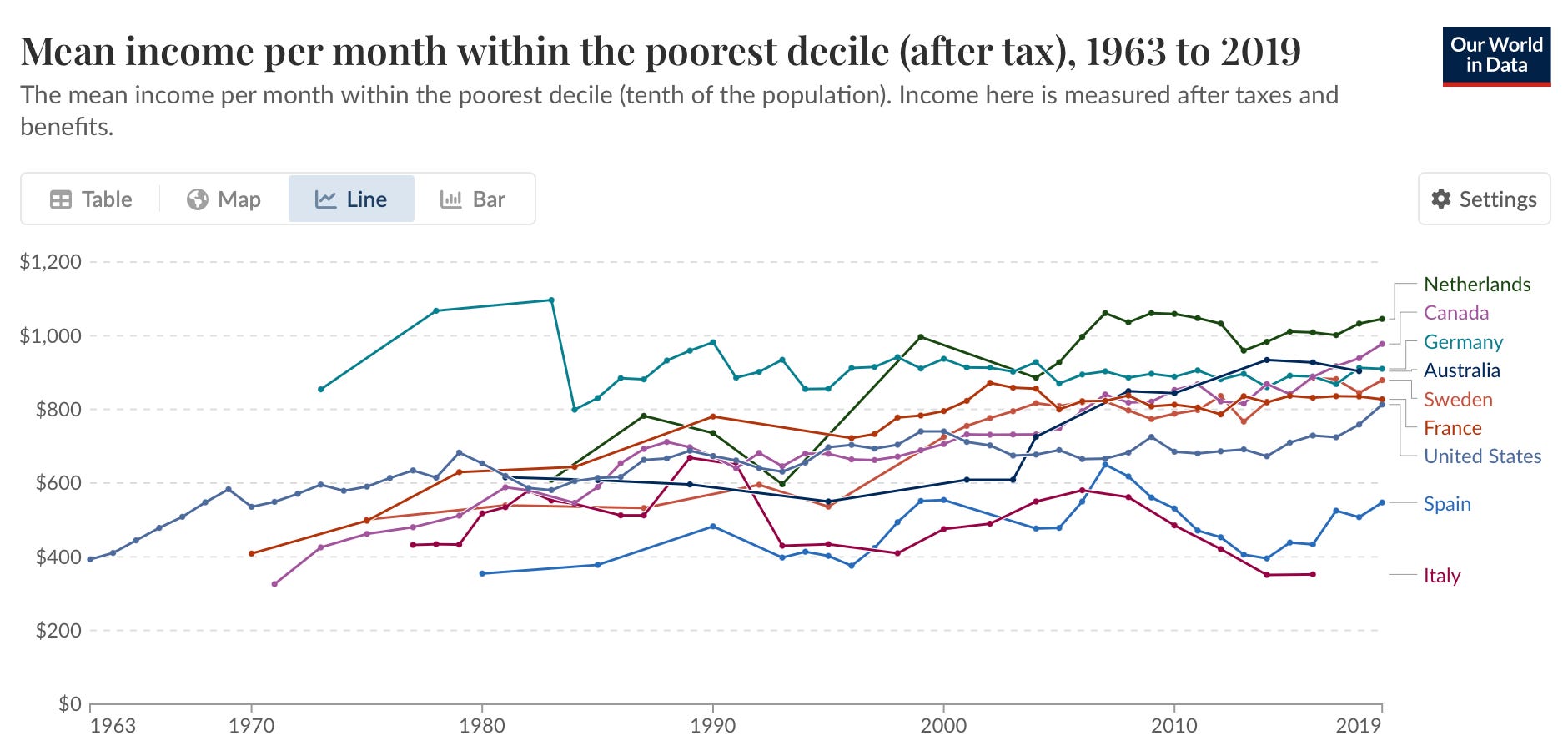
If you look at living standards in the poorest 10 percent of the population, the bottom decile of Americans is doing worse than the bottom decile of Canadians or Australians or residents of northern Europe.


Reasonable people can disagree as to what to make of that, but it’s one of the most important structural facts of American life.

Somewhat flexible help for the poor

On average, SNAP recipients receive $187 per month, but poorer families get more and less-poor ones get less. It’s not a particularly generous program. But relative to the rest of the American safety net, it’s a flexible program in that it takes a fairly expansive view of what counts as groceries. When I was a kid and recipients had to bring actual food stamps to the grocery store to get their benefits, their use of the program was quite obvious to anyone behind them in the checkout line. But in the modern world, benefits are administered via an Electronic Benefits Transfer card that looks and functions like a debit card or a credit card, so it’s easy to miss — perhaps one reason people seemed to be surprised by the scope of the program.

by Matthew Yglesias, Slow Boring |  Read more:
Image: Hispanolistic
[ed. Poor people being used as political pawns again. Starting with burdensome new Medicaid application, work and reporting requirements; suspended H-2A worker programs which provided visiting workers for essential agricultural and dairy support jobs (that Americans won't do); ICE arresting anyone that looks poor and brown, and now this - just outright starving them. See also: Trump’s deportations are causing farm labor issues... with no viable, long-term solution (Investigate Midwest); and Wages of Citizenship (PW):]
***
"The Trump Administration’s crusade to transform the US immigration system has included sweeping changes to increase the state’s capacity to locate and remove noncitizen residents. The administration has empowered immigration agents to enter formerly “sensitive” spaces like schools and churches, suspended due process for legal noncitizens, and established immigration jails outside national borders. It made a deal with the Internal Revenue Service (IRS) to use once off-limits tax data to locate up to seven million undocumented workers. Dramatic deportation operations are now underway across the country, with the Department of Homeland Security (DHS) boasting 113,000 arrests and “north of” 100,000 deportations since Trump took office in January. The numbers include a rise in “collateral” arrests and deportations and are likely to rise after Immigration and Customs Enforcement’s (ICE) March 25 repeal of work authorization for 530,000 legal migrants of Cuba, Nicaragua, Haiti, and Venezuela, who have thirty days—until April 24—to depart before they too will be targeted for arrests and deportations.

Draconian methods were to be expected. Less clear is whether the promised crackdowns threaten the uneasy alliance between the federal government and employers in agriculture, construction, and food and hospitality industries. Despite the “war on terror” redefining the outer limits of executive power to surveil and detain foreign nationals, the workplace has over the past two decades remained largely insulated. The resilience of this arrangement reflects a clear hegemonic interest in cheap and docile labor, which allows for both lower prices and higher profits; a critical supply of health and childcare workers; a vital source of future labor; and close to $100 billion annually in state, local, and federal tax revenues. This is the perspective of US employers, expressed by the notion of “sanctuary businesses,” in which the legal segmentation of the labor market has propelled business growth."

Clam Control

via:

Monday, November 3, 2025

L. K. Zaiser. “INDICATEUR DE VITESSE” (speed indicator). Poster. SABENA/RAPIDITE. 1938.
via:

Kai Schaefer. Dual 1219 - The Beatles - Abbey Road, 2011
via:

Politicized Stupidity

The Atlantic’s David Frum opens with reflections on the new Trump administration’s pattern of “politicized stupidity”: the willful refusal to understand abuses of power, including the destruction of the White House’s East Wing and the perceived sale of government influence disguised as private donations.

Then Frum speaks with his Atlantic colleague Tom Nichols, an expert on civil-military relations and a longtime scholar of U.S. defense policy, about President Donald Trump’s efforts to turn the military into a personal instrument of power. Nichols explains how the capture of the Justice Department, the firing of Pentagon lawyers, and the use of the National Guard against civilians are eroding the rule of law, and how a president can launch wars without congressional consent.
***
There’s so many outrages in the Trump years, there’s so many abuses that maybe it’s petty to fix on minor irritants, but there is a minor irritant that got caught in my craw, and I just want to ventilate a little bit about it. One of the more annoying and more pointless aspects of the Trump era is what I call politicized stupidity. Politicized stupidity is a kind of aggressive not getting the point by people who are otherwise perfectly well equipped to getting the point. Genuine stupidity is a misfortune and is distributed by God, but the politicized stupidity is chosen, and it’s chosen for reasons.

Let me give you an example of what I mean. So President [Donald] Trump has just demolished the East Wing of the White House. He did this without any form of consultation, as if the White House were his personal property, and in order to build a giant ballroom that there’s no demonstration of need for and that, again, he’s treating as a point of personal property. He’s choosing the design; there’s no process of respect for historical or cultural integrity. And he’s financing this whole project. We have no idea how much it will cost—or President Trump originally said $200 million; now he’s suggesting $300 million. But who knows what the cost will be. There weren’t drawings. There weren’t plans. It’s being done on a kind of ad hoc basis, and the cost could well climb beyond the startling figure of $300 [million] to much more.

And he is proposing to pay for this project—that is chosen entirely by himself with no consultation—by accepting donations from corporations and wealthy individuals. He has people who have business before the government, who seek favors before the government: Some of them have mergers that they’re hoping for approval. Others are in the crypto industry that has received a massive government favor in the form of the GENIUS [Act] and who are hoping for more favors. Others of whom are in business with members of the Trump family. If the country needed a ballroom, then there should have been a review process, a design process, and Congress should pay for it out of public revenues because it’s the People’s House, not Donald Trump’s house.

Okay, you get that. But there are people who insist on not getting it. There are people who say, Well, are you against ballrooms? Don’t you think the White House ever needs renovation? Other presidents have renovated the White House in the past. The point is not that you are for or against renovations, of course; the point is you are for or against not treating the White House as a person’s property. But there’s a kind of deliberate refusal to get the point, and you see this in many places in our public media. It’s the same when Donald Trump delivers a pardon to a crypto criminal, a convicted crypto criminal, who has helped to enrich his family.

Now, there have been other doubtful pardons by presidents in the past, and President [Joe] Biden apparently used an autopen to sign some of his pardons, and maybe that’s not ideal. But no one has ever pardoned people because they gave money to his family, his sons, his relatives. No one has ever delivered pardons because he just seems to have a general attitude of being pro-white-collar criminals. No one has ever said, I’m pardoning this convicted fraudster congressman because he always voted for my political party and always supported me, and that is the one and only grounds and basis of my pardoning this figure. But people insist on not getting that point: Biden used an autopen; isn’t that the same? No, it’s not? Well, I refuse to understand why it’s not. (...)

So presidents have done it before, but no one has made it the basis of his policy. And no one has ever said, I’m imposing tariffs on one of America’s closest allies, Canada, because I’m upset that they made a TV ad that implied that Ronald Reagan was a better president than I am. And indeed, Donald Trump is not 1/1,000,000th the president Ronald Reagan that was, and so it, obviously, it cuts to the bone. But again, there are people saying, Well, foreign countries shouldn’t criticize American policy on American TV. They don’t get the point. The stupidity is politicized.

Now, where does this come from? Well, part of the, I think, the reason for not getting the point is because the actual point is too big and too scary. Nobody wants to face what Donald Trump is and what he’s doing to the United States. Even those of us who talk about it all the time, we don’t wanna face it—it haunts our nightmares. But even though the point is big and scary, the point has to be faced and not denied through clever evasions.

Sometimes people don’t get the point because their boss demands they not get the point. If your job depends on writing an editorial saying that the destruction of the East Wing and its replacement by a ballroom financed by favor-seekers is just the same as President [Barack] Obama replacing the wiring and water in the main White House with money appropriated by Congress, if your boss says you have to do that or lose your job, there are people who, unfortunately, will do as told rather than lose their job. (...)

I can be concerned by the things that the universities are doing that are bad without having to come up with some clever, counterfactual, counter-imaginative justification for things that are obviously outrageous. We’re all going to like something, but we have to keep our sense of proportion. We have to understand that the main thing is the main thing. And, as I said, if God inflicted stupidity on you, it’s not your fault, but don’t choose it. That’s just annoying. (...)

[ed. Next up: Tom Nichols]

Frum: So you wrote this very important article for The Atlantic about the coming crisis in civil-military relations. This is a subject you’ve devoted so much of your academic life to. I wanna ask you to sit on the other side of the table for a moment. Imagine yourself—I don’t know that such a thing could ever happen—but imagine yourself a malign and criminally intended president who wanted to remake the U.S. military as a tool of personal power. How would you go about doing it?

Nichols: In this system of government in the United States, the first thing I would do is seize the Justice Department. And by seize, I don’t mean being elected and nominating an attorney general; I mean flushing out all of the people committed to the Constitution, the rule of law—you know, the lawyers. It’s almost a trope now to do the Merchant of Venice line, but you start with getting rid of the lawyers, if you’re going to do these kinds of things, and you replace it with your cronies. You replace it with people that are going to be loyal to you. You basically undo everything that’s been done with the Justice Department over 50 years.

Frum: So the first move at the Pentagon is not at the Pentagon; it’s across the river at the Justice Department.

Nichols: Exactly. Because if you’re a military officer, the people that you’re gonna want an opinion from are lawyers—which is the next step, which is you not only get rid of the lawyers at the Justice Department; you do what Trump’s already done: You get rid of the top lawyers of the Pentagon.

And look, the rule of law requires lawyers and people to interpret the law, and the first people you have to get rid of are anybody who says, My loyalty is to the rule of law, the statutes as written, the Constitution, and not to Donald Trump.

Frum: Because our hypothetical military officers will want advice about what is illegal and what is an illegal order, and—

Nichols: They’re already asking.

Frum: —and who do they turn to? If you have—

Nichols: Yeah, that’s already happening.

Frum: If you’re a three-star or a four-star general and you have a question, Is this a legal or an illegal order?, who do you ask?

Nichols: Well, you would ask the top legal service adviser in your branch, but [Secretary of Defense Pete] Hegseth and Trump have fired them all. So now you’ve got guys—there are people doing that job, but you and I both know from working in government, when your boss has been canned and you’re the acting guy, or you’ve been suddenly elevated because people above you have been fired, that’s not a signal to you to be brave and innovative and daring about standing up for the Constitution. You’re sitting in a desk that somebody else had who tried that and got fired. So you might ask them—I can imagine some of these very senior officers are talking to friends or family attorneys or somebody. Because what’s going on, we’ll be talking about—I guess this is the hand-wave “all this”—but all of this, I think, is not legal.

So you capture the Justice Department, you fire the military lawyers, you insist on loyalty from the top commanders—which Trump thinks he has, apparently, with somebody like [Chairman of the Joint Chiefs of Staff General] Dan Caine—and then you make sure to neuter the intelligence community so that foreign threats or plots or any other things that could interfere with elections in your favor are left undiscovered or uninvestigated.

Frum: Yeah. So you don’t have to remake the officer corps from top to bottom. You don’t even have to start looking for sympathetic two-star generals to replace the three-stars and sympathetic three-stars to replace the four-stars. You just cut them off from information and rely on natural bureaucratic inertia to make them obey you?

Nichols: And the chain of command. Because remember that officers are required to begin from the presumption of legality with an order. The system is designed to make sure that the chain of command functions effectively so that if you’re a colonel or a one-star or a two-star, you have to assume that if the order has come down from the president to the secretary, the advice of the chairman—the chairman’s not actually in the chain of command, but he gives advice—and by the time it gets to you, the assumption is: Well, this must be legal because all these other guys wouldn’t have ordered me to do it.

Frum: So if you get an order to blow up a fishing boat in the Caribbean or the Pacific, you would start with, Well, somebody must have signed off on this. They must have—

Nichols: Somebody signed off, exactly. And the place it should have stopped, of course, is: The attorney general, the secretary of defense, the chairman of the Joint Chiefs should all be standing in the Oval Office, saying, You can’t do this. This isn’t legal. This is a violation of both American and international law. And if the president says, Well, go ahead, just do it, well, by the time it gets to that lieutenant commander in a helicopter or piloting a drone, he or she’s already saying—well, as you just said, David—Somebody must have signed off on this. (...)

Frum: So I wanna go back: Who has the mission? So the South Carolina or Texas National Guard is called up, sent to a blue state, and is told something like, We think a lot of the people in this lineup in this swing suburb are probably illegal aliens. And we think they should be detained for 12, 14, 16 hours, or ’til whenever the polls close. Your order is to go detain these people we believe are illegal aliens—I mean, they’re Democrats; they might as well be illegal aliens—detain them and hold them until the polls close. Who has the mission to say, That sounds like kind of an illegal order to me?

Nichols: Well, but they’re being much more clever about it than that. The mission to detain those people and to disrupt those operations goes to ICE. And then the president says, This being a federal agency, I’m not using the military to detain any of these people. I’m simply using the military to protect these other federal agencies while they do their job

Frum: —of detaining everyone in the voting line

Nichols: Of detaining everybody in line. It’s very clever. They say, We’re not doing domestic policing. We’re simply securing federal installations, protecting federal employees because the state or the local municipality either can’t or won’t do it. (...)

Nichols: I often think that the states and the cities can say, with a show of force, to say, Our police have this. We’re good. We don’t need you here, that our state cops—we’re good. Because I think part of Trump’s project here—and the way they’re just dragooning people into ICE who have no qualifications, really, is another tell and creating this kind of paramilitary goon squad out of ICE. I always thought of myself as an immigration hawk, and I’m kind of reaching the “Defund ICE” level at this point.

But I think part of Trump’s plan is simply to have these military forces during the elections so visible that people just stay home, that they’re just intimidated out of the public square, that you don’t even have to arrest them. You don’t have to have a big display of force. That the goal of all of this political activity, the goal of everything Trump is doing, is to drive people out of the public square, to say, The Wi-Fi is still working. There’s still 150 channels on TV. Beer is cheap. Gas is affordable. I don’t wanna deal with this. I don’t wanna deal with all of this, and it doesn’t really matter. ’Cause the other thing, I think, that’s the undertone of all this is, Look—it doesn’t really matter who’s in office. They’re all bad. Everybody’s corrupt. And so rather than use the military to inflict violence to stop the elections—you know, gerrymandering and voter suppression work in marginal elections, not huge-turnout elections. And so what they’re really trying to avert is a large Democratic turnout in places where they can pull that off.  (...)

Nichols: I was talking with friends who have to teach this stuff at both military and civilian institutions, and it’s like, how do you teach the American national security process now? There isn’t one. It’s whatever Donald Trump—it’s all vibes, right? It’s whatever Donald Trump feels at any given moment. And the problem is that he has—it’s a problem for us; it’s an advantage to him—that he surrounded himself with people who say, I am anticipating that he wants to do this. I will always have a plan ready to say, “You bet, boss. I got a plan for striking Venezuela.”

And I don’t think they’ve thought it through. I don’t think they care about thinking it through, David. I think they wanna be able to say, America’s at war. Anybody who opposes the president is a traitor.

by David Frum and Tom Nichols, The Atlantic |  Read more:
Image:Paul Morigi/Getty

Sunday, November 2, 2025

Resist


[ed. I was thinking about this the other day, why more people don't ask for basic ID, a warrant, some official paperwork, film everything? I'd definitely do what this guy does - tell these assholes that if they want to continue harassing or even arresting me, they and their supervisors can expect to be buried in paperwork, social media attention, and possibly legal filings faster than they can imagine. RESIST. It's your rights and I'd even say obligations under the constitution. See also: an alternative approach.]

Image: via:

The Plan to Subvert Elections Is Already Under Way

Our election system is reaching a breaking point. Here's how it'll likely happen.

Imagine for a moment that it’s late on Election Day, November 3, 2026. Republicans have kept their majority in the Senate, but too many House races are still uncalled to tell who has won that chamber. Control seems like it will come down to two districts in Maricopa County, Arizona. ICE agents and National Guardsmen have been deployed there since that summer, ostensibly in response to criminal immigrants, though crime has been dropping for several years. The county is almost one-third Hispanic or Latino. Voting-rights advocates say the armed presence has depressed turnout, but nonetheless, the races are close. By that evening, the Republican candidates have small leads, but thousands of mail and provisional ballots remain uncounted.

Donald Trump calls the press into the Oval Office and announces that the GOP has held the House—but he warns that Democrats will try to steal the election, and announces plans to send a legal team to Arizona to root out fraud. He spends the rest of the night posting threats and allegations on Truth Social. In the morning, Republican lawyers file to stop vote counting, arguing that any votes counted after Election Day are illegal under federal law. Attorney General Pam Bondi sends a letter to Adrian Fontes, Arizona’s Democratic secretary of state, and the county board of supervisors, instructing them to retain all documents and warning that the Department of Justice may intervene if it suspects anything untoward. On X, FBI Director Kash Patel reposts false rumors about fraud and announces plans to lead a group of agents to Phoenix. Meanwhile, Democratic candidates have pulled ahead in both races by Wednesday afternoon, but the margin is just 143 votes in the Eighth District, with many votes still not tallied.

By now, conservative outlets are running wall-to-wall coverage alleging fraud, offering tales of immigrants being bused to voting locations and accusing Democrats of treason. MAGA has learned its lesson since 2020, and Rudy Giuliani and Sidney Powell are nowhere near the cameras. Instead, administration officials like Bondi are the face of the allegations on TV. Behind the scenes, Trump is making phone calls. He’s unable to reach any county supervisors, whose lawyers have warned them not to speak with him, but he gets through to the county recorder, a MAGA loyalist elected as part of the backlash to the 2020 election. No one knows quite what is said—the call isn’t taped—but when Trump hangs up, he posts that the county has agreed to hand over control of voting machines to the Department of Homeland Security.

Fontes and the board of supervisors rush to court to block the move, and a judge quickly grants an injunction. But Trump declares a national emergency that he says supersedes the order; helicopters are en route from a Marine air base in Yuma to take control of the voting machines. By the time Supreme Court Justice Elena Kagan, who is assigned to hear emergency matters from Arizona, issues an order blocking this, Marines have already commandeered ballots and machines. Patel, having just arrived in Phoenix, holds a press conference and announces, without providing evidence, that votes have been tampered with. He proclaims the Republican candidates the winners.

Despite Marines on the street, small but fierce protests erupt in Phoenix and elsewhere; Trump uses them as a pretext to invoke the Insurrection Act and announces “martial law in Democrat-run cities.” Who actually won the election can never be determined—the Marines and Patel have broken the chain of custody, as well as some of the machines themselves—but the state names the two Democrats as winners. House Republicans reject Arizona’s certification and instead seat the GOP candidates. Trump’s allies keep the House in a profoundly illegitimate election rejected by many Americans.

This is just one possible scenario. Is it too pessimistic? Perhaps. But at this stage of the election cycle in 2019, no one expected a crowd of Trump supporters to storm the U.S. Capitol on January 6, 2021. No one expected the president himself to explicitly lend his support to their efforts to “Stop the Steal.” Certainly no one expected that there would be calls to hang the vice president for his refusal to subvert the democratic process. If anything, when it comes to 2026, I worry more about the limits of my imagination than about the hazards of speculation.

Trump has made his intentions clear. At a rally last summer in West Palm Beach, Florida, he offered his supporters a promise. “Christians, get out and vote, just this time. You won’t have to do it anymore. Four more years, you know what, it’ll be fixed, it’ll be fine. You won’t have to vote anymore, my beautiful Christians,” he said. “We’ll have it fixed so good, you’re not gonna have to vote.”

We’ll have it fixed so good. It’s not hard to guess what Trump might do to fulfill this promise. He has, after all, already attempted to disrupt and overturn an election. In 2020, those efforts involved questioning results, asserting widespread fraud without evidence, pressuring local officials to overturn outcomes, filing spurious lawsuits, and ultimately inciting supporters to sack the Capitol. Now that he’s back in the White House, he will draw from this playbook again—perhaps adding new maneuvers, such as deploying armed troops. (...)

Trump and his allies will have before them less an orderly set of instructions than a buffet of options. Some of these options will go untested, or amount to nothing. But elections are a game of margins. Only a handful of Senate seats and a few dozen House races may be seriously contested, thanks to maps drawn to guarantee safe seats for one party or the other. Of those, some may be very close. In 2024, 18 House races were decided by fewer than 10,000 votes. Democrats won 11 of those.

To understand the threat to democracy, and how it might be stopped, I spoke with experts on election administration, constitutional law, and law enforcement. Many of them are people I have known to be cautious, sober, and not prone to hyperbole. Yet they used words like nightmare and warned that Americans need to be ready for “really wild stuff.” They described a system under attack and reaching a breaking point. They enumerated a long list of concerns about next year’s midterms, but they largely declined to make predictions about the 2028 presidential election. The speed of Trump’s assault on the Constitution has made forecasting difficult, but the 2026 contests—both the way they work, and the results—will help determine whether democracy as we know it will survive until then.

by David A. Graham, The Atlantic | Read more:
Image: Carl Godfrey
[ed. Post of the week. It's all here, from pre-to-post election tactics. Hopefully everyone who values election integrity and democracy itself - whether Democrat, Conservative, or Independent - will be prepared to recognize and counter all this.]

Friday, October 31, 2025

Wilderness As 'Tactical Infrastructure'?

In June, when Utah Republican Sen. Mike Lee moved to force a sell-off of up to 3.2 million acres of public land, he insisted he was solely interested in combatting America’s housing crunch and that the bill only targeted “unused, garden-variety” federal parcels — not national parks, wilderness areas and other “crown jewel” lands.

Few bought what Lee was trying to sell.

Now, just a few months after being forced to pull the plug on his land-sale scheme amid sweeping bipartisan backlash, Lee is leaning into new issues to further his well-documented anti-public lands agenda: border security and disability access.

On Oct. 2, Lee introduced legislation aimed at opening millions of federal acres along both U.S. borders, including national parks and wilderness areas, to road construction, timber harvest, surveillance systems and any other “tactical infrastructure” deemed necessary to protect those lands from what he describes as “environmental destruction” resulting from “the Biden Administration’s open-border policies.”

“Biden’s open-border chaos is destroying America’s crown jewels,” Lee said in a statement announcing his bill, dubbed the Border Lands Conservation Act. “This bill gives land managers and border agents the tools to restore order and protect these places for the people they were meant to serve.”

While Lee pitches the legislation as an immigration enforcement bill, it would encompass federal lands far from the U.S.-Mexico border — including a huge swath along the U.S.-Canada border. The legislation defines “covered federal land” as any federal land “located in a unit, or in a portion of a unit, or within 1 or more parcels of land that shares an exterior boundary with the southern border or northern border.”

In other words, if a “unit” — a national park, forest, monument or any other designated area — touches a border, the entire unit is covered, regardless of how far it extends from a border. That would encompass all of Joshua Tree National Park in California, Big Bend National Park in Texas, Glacier National Park in Montana, North Cascades National Park in Washington and Minnesota’s Boundary Waters Canoe Area Wilderness, to name a few. One of the more extreme examples Public Domain identified is Flathead National Forest, located in northwestern Montana, which spans 2.4 million acres, extends approximately 120 miles from the U.S.-Canada border, and includes 1 million acres of wilderness.

“The big picture is Mike Lee will use any pretext to undermine public lands and conservation,” Neal Clark, wildlands director at the Southern Utah Wilderness Alliance, told Public Domain. “It was housing six months ago, now it’s border security.”

The legislation would amend the 1964 Wilderness Act, which protects more than 110 million acres of designated wilderness areas from development, to allow for DHS to conduct patrols using motorized vehicles, including cars, airplanes and boats, and “deploy tactical infrastructure,” which the bill defines as “infrastructure for the detection of illegal southern border and northern border crossing, including observation points, remote video surveillance systems, motion sensors, vehicle barriers, fences, roads, bridges, drainage and detection devices.”

It would also give the Department of Homeland Security unfettered authority to conduct immigration, terrorism and drug enforcement activities across all federal land within 100 miles of either border, barring land management agencies from restricting DHS’s work. And it would create a “Border Fuels Management Initiative” to combat the risk of wildfires on federal border lands, one of several environmental impacts that Lee and other sponsors of the bill say have been exacerbated by illegal immigration.

The bill comes despite a steep decline in the number of unauthorized migrants crossing the U.S.-Mexico border amid the Trump administration’s immigration crackdown. Border Patrol is on track to finish the year with fewer than 250,000 apprehensions at the southern border. That figure is down from 1.5 million last year and may become the lowest number of southern border arrests recorded since 1970. (...)

Along with his attempt to weaken environmental protections across federal borderlands, Lee introduced a trio of bills on Oct. 6 that would open national parks and other federal lands to increased off-road vehicle use. The goal, he says, is to “ensure that Americans with disabilities can access and enjoy the nation’s public lands.”

“The mountains, canyons, and forests managed by the federal government are part of our shared heritage, and access to them should not depend on whether someone can hike ten miles or climb a ridge,” Lee said in a statement about his “Outdoor Americans with Disabilities Act.”

Lee’s press release touts support from several off-road vehicle associations and enthusiasts. But Syren Nagakyrie, the founder and director of Disabled Hikers, a nonprofit that supports disabled people in the outdoors, called the legislation a “shameful” attempt to “use the disability community in his ongoing attempts to dismantle public lands, build and prioritize roads, and sell lands to the highest bidder.”

“People with disabilities are not political pawns to be used while catering to special interests,” Nagakyrie said in a statement.

by Chris D’Angelo, High Country News | Read more:
Image: Jerry Glaser/U.S. Customs and Border Protection
[ed. What a piece of work.  See also: One small glimmer of hope re: Senate Stewardship Caucus (Re:Public).]

Matsuyama Miyabi, Addams Family in Kimono

Thursday, October 30, 2025

Every Wrinkle is a Policy Failure

A lot of people blame their frown lines on their job, the tanning salon, or aging. I blame the government.

There’s a treatment for wrinkles—Botox and similar toxins that freeze your face in place.. It can be pricey. The average price of a Botox treatment is above $400, depending on how many doses or units you get injected. But Botox isn’t patented so why is it still so expensive?
 
Some of the cost comes from buying the chemical itself. Allergan which owns Botox doesn’t have a patent on it- but it does have a trademark for the brand name. And Botox isn’t just the botulism toxin that paralyzes your face- there are a few additive chemicals mixed in and Allergan’s manufacturing process is a trade secret.

But wholesale Botox is still kind of cheap- you can get it for $3.50 a unit but the price the consumer pays is around $20 in urban areas.

If you’ve ever gotten Botox or its equivalent, you know you are not getting highly tailored and personalized injections here- you can get a same-day appointment, walk in, get injected, and walk out.

This should not require a medical degree.

Unfortunately, in some states only physicians or nurses supervised by physicians are allowed to. The obvious solution is to just let more people inject Botox- I can’t imagine a state just fully deregulating injection rights, but allowing pharmacists (who already handle a huge share of vaccinations), pharmacy techs under pharmacist direction, or registered nurses could make getting Botox way cheaper and make the number of facilities where you could Botox way larger.

The cost savings to the consumer might actually be larger than what you would think given the difference in labor costs. There are already cheaper alternatives to Botox that work just as well like Dysport or Xeomin (which is pure toxin without the additives) . But in the U.S. where we’re already paying so much for labor, the cost difference of the injectable can be overlooked. But in other countries, Botox alternatives are outcompeting Botox.

Liberalizing injection laws would make Americans look younger and spend less per treatment.

Are You Using Tretinoin?


Botox regulations aren’t the only way the government tries to make us look our age.

I think most of my readers here are straight men but if I could give you some non-policy advice, it would be that you should consider using tretinoin. It’s a cream you can use for acne but unlike a lot of woo-based anti-aging products it actually works to reverse the effects of sun on skin aging. [ed. Retin- A, Avita, Renova, others]

Unfortunately, you need a prescription to use it even though it’s incredibly safe as long as you aren’t pregnant- and if it irritates your skin just stop using it. So every time I see an urgent care doctor for whatever reason at the end of the appointment, I always ask “could I have a prescription for this?” It has never failed.

Tretinoin is still pretty cheap but the necessity of the prescription drives up the price in terms of time and inconvenience. Federal rules require it to be prescription-only but states have a lot of discretion to make “prescription required” a fairly nominal requirement. For example, states could allow pharmacists to prescribe the cream so instead of scheduling a telehealth or doctor’s appointment, you just show up at the pharmacy and ask for it. States can also make laws friendly to telehealth.

While I think every state should do this as well as make it easy to inject Botox, Nevada or Florida seem like the perfect first-movers. Both attract a ton of tourists, both have a lot of sun (photoaging!), and both just have the Botox-friendly vibes. You could also throw in easy-to-prescribe finasteride rules to help out balding men.

by Cold Button Issues |  Read more:
Image: uncredited via
[ed. Botox and GLP-1's (Ozempic, Wegovy etc,). Everyone wants to look their best.]

via:

Why Doesn’t Anyone Trust the Media?

Anatomy of a credibility crisis

The challenges facing the establishment media are more severe today than ever before. Trust in the press is at a record low, with only a quarter of Americans aged eighteen to twenty-nine expressing confidence in media organizations. Jobs in journalism, meanwhile, are declining faster than jobs in coal mining: since 2005, the United States has lost more than one third of its newspapers and nearly three quarters of its newspaper journalism positions. Furthermore, recent years have exposed significant professional failures—from the flawed coverage of the COVID-19 pandemic to inadequate reporting on President Biden’s cognitive health. All the while, audiences sift into ever-narrower silos: Substacks, podcasts, livestreams.

Perhaps most telling is the changing relationship between media and political power. There is a palpable sense of surrender in the air. In December, ABC News agreed to pay President Trump $16 million to settle a defamation suit he had filed against the network. CBS’s parent company, Paramount Global, later settled its own Trump lawsuit, also for $16 million, three weeks before securing Federal Communications Commission approval for its merger with Skydance Media. Trump has since filed a host of additional suits against media organizations, including the Wall Street Journal and the New York Times, and threatened the broadcast licenses of major networks.

All of this raises pressing questions: In an era of declining trust, industry collapse, and technological disruption, does the media, as we’ve historically understood it, have a future? What essential functions does professional journalism serve that cannot be replaced by other forms of information gathering and dissemination? And why, finally, do Americans view the media with such skepticism?

Harper’s Magazine invited four leading media observers to grapple with these questions and to consider how we got here in the first place, seeking neither to defend nor condemn wholesale, but to examine honestly what—if anything—we lose if traditional media continues on its current trajectory.

The following Harper’s Forum is based on a conversation that took place at the NoMo SoHo hotel, in New York City, on July 23, 2025. Harper’s Magazine editor Christopher Carroll served as moderator.

Participants:

JELANI COBB: Jelani Cobb is the dean of the Columbia Journalism School and a staff writer at The New Yorker. He is the author, most recently, of Three or More Is a Riot: Notes on How We Got Here.

TAYLOR LORENZ: Taylor Lorenz is an independent journalist and the founder of User Mag, a Substack publication. She is the author of Extremely Online: The Untold Story of Fame, Influence, and Power on the Internet.

JACK SHAFER: Jack Shafer is a media critic who has written for Politico, Reuters, and Slate.
He previously edited Washington City Paper and SF Weekly.

MAX TANI: Max Tani is a reporter at Semafor covering media, politics, and technology.
He previously covered the White House for
Politico.

1. Conspiracy, Culpability, Covid, and Collapse

Christopher Carroll: Why don’t we begin with the biggest question. A Gallup poll from last year showed that the media was the least trusted civic or political institution in the United States—among other things, Americans trust Congress more than they trust the media. What accounts for this? Why don’t we trust the media?

by Christopher Carroll, Jelani Cobb, Taylor Lorenz, Jack Schafer and Max Tani, Harper's |  Read more:
Image: Collages by Mark Harris

Vlastimil Beneš (Czech, 1919-1981), Vršovice Gardens in Winter, 1960

Wednesday, October 29, 2025

Please Do Not Ban Autonomous Vehicles In Your City

I was listening with horror to a Boston City Council meeting today where many council members made it clear that they’re interested in effectively banning autonomous vehicles (AVs) in the city.

A speaker said that Waymo (the AV company requesting clearance to run in Boston) was only interested in not paying human drivers (Waymo is a new company that has never had human drivers in the first place) and then referred to the ‘notion that somehow our cities are unsafe because people are driving cars’ as if this were a crazy idea. A council person strongly implied that new valuable technology always causes us to value people less. One speaker associated Waymo with the Trump administration. There were a lot of implications that AVs couldn’t possibly be as good as human drivers, despite lots of evidence to the contrary. Some speeches were included lots of criticisms that applied equally well to what Uber did to taxis, but now deployed to defend Uber.

AVs are ridiculously safe compared to human drivers

The most obvious reason to allow AVs in your city is that every time a rider takes one over driving a car themselves or getting in a ride share, their odds of being in a crash that causes serious injury or worse drop by about 90%. I’d strongly recommend this deep dive on every single crash Waymo has had so far:

[Very few of Waymo’s most serious crashes were Waymo’s fault (Understanding AI).]

This is based on public police records rather than Waymo’s self-reported crashes. It doesn’t seem like there have been any serious crashes Waymo’s been involved in where the AV itself was at fault. This is wild, because Waymo’s driven over 100 million miles. These statistics were brought up out of context in the hearing to imply that Waymo is dangerous. By any. normal metric it’s much more safe than human drivers.

40,000 people die in car accidents in America each year. This is as many deaths as 9/11 every single month. We should be treating this as more of an emergency than we do. Our first thought in making any policy related to cars should be “How can we do everything we can to stop so many people from being killed?” Everything else is secondary to that. Dropping the rate of serious crashes by even 50% would save 20,000 people a year. Here’s 20,000 dots:


The more people choose to ride AVs over human-driven cars, the fewer total crashes will happen.

One common argument is that Waymos are very safe compared to everyday drivers, but not professional drivers. I can’t find super reliable data, but ride share accidents seem to occur at about a rate of 40 per 100 million miles traveled. Waymo in comparison was involved in 34 crashes where airbags deployed in its 100 million miles, and 45 crashes altogether. Crucially, it seems like the AV was only at fault for one of these, when a wheel fell off. There’s no similar data for how many Uber and Lyft crashes were the driver’s fault, but they’re competing with what seems like effectively 0 per 100 million miles.

by Andy Masley, The Weird Turn Pro |  Read more:
Image: Smith Collection/Gado/Getty Images

What To Know About Data Centers


As the use of AI increases, data centers are popping up across the country. The Onion shares everything you need to know about the controversial facilities.

Q: What do data centers need to run?

A: Water, electricity, air conditioning, and other resources typically wasted on schools and hospitals.

Q: Do data centers use a lot of water?

A: What are you, a fish? Don’t worry about it.

Q: How are data centers regulated?

A: Next month, Congress will hear about data centers for the very first time.

Q: Do I need to worry about one coming to my town?

A: Only if your town is built on land.

Q: How long does it take to build a new data center?

A: Approximately one closed-door city council vote.

Q: What’s Wi-Fi?

A: Not right now, big guy.

Q: What will most data centers house in the future?

A: Raccoons.
Image: uncredited

What It's Like to Work at the White House

Introduction

I recorded several exit interviews after I departed the White House Office of Science and Technology Policy last month. These turned out well, I think, but the truth about me is that I have not truly reflected on an experience until I have written about it. Today’s essay constitutes my long-overdue reflections on my time working for the White House.

This essay is based upon extensive conversations I had with former and current White House staff during my time in government, as well as on similar essays I have read by others over the years. And of course, it draws from my own experience as Senior Policy Advisor for AI and Emerging Technology in the White House. With that said, this essay is not about gossip: I will not be describing any newsy anecdotes or anything of that sort. And when I do describe internal interactions I had, all names will remain anonymous.

Understanding “The White House”

“The White House” is a lossy abstraction. The name of the bureaucracy that encompasses “The White House” is the Executive Office of the President (EOP). The EOP is composed of many “components”: the National Security Council (NSC), the National Economic Council (NEC), the Office of Management and Budget OMB), and, where I worked, the Office of Science and Technology Policy (OSTP). The Department of Government Efficiency, too, is a White House component, having previously been the Obama-era US Digital Service (the technical name of DOGE is the US DOGE Service). Wikipedia says that about 1,800 people work in the EOP, though I suspect this number is meaningfully lower under the Trump Administration.

Almost none of these personnel work in the building made of white sandstone known as “The White House.” Fewer still work in the White House’s West Wing. Instead they work in the White House Complex, most importantly the New and Old Executive Office Buildings, the latter of which is called today the Eisenhower Executive Office Building (EEOB). The vast majority of people who work for “The White House” work in these latter two office buildings. I worked in the EEOB, located across from the White House on a small, private street called West Executive Avenue.

Despite the geographic confusion, “The White House” usually refers as a metonym to the entirety of the EOP. And when people outside the EOP talk to an EOP staffer about some policy issue, they will say to their friends and colleagues that they spoke with “The White House” about the matter—even if all they really did was exchange text messages with a twenty-something EOP staffer whose security clearance does not even permit him to walk around the West Wing unescorted. Mostly I think this is because it’s convenient, and also because it sounds cool to say you “spoke with The White House.”

This social reality also means that everything you say and do as a White House staffer was said and done by “The White House.” This ends up being a tremendously difficult fact of life for the people whose desk resides within the metonym. You are no longer, exactly, a person. You are transformed into a symbol, a walking embodiment of power. This affects how people treat you, and sadly, I think, it affects how you treat others.

Working at the White House Complex is like orbiting within a solar system. The closer you get to the sun in the center—the President himself—the temperature rises, and the intensity of the gravity increases. The EEOB is a nice middle ground—not an icy, distant planet, but also not, you know, Venus. Still, everyone in the EOP constantly surveils for the occasional coronal mass ejection from the Sun—that is, when something you work on reaches POTUS-level attention. The pace and character of your workday can change at a moment’s notice—from “wow-this-is-a-lot” to “unbelievably,-no-seriously-you-cannot-fathom-the-pressure” levels of intense.

The First Day (...)

The Work of the White House Staffer

So what do you do all day, exactly? It’s a great question. Outside of offices like the NSC and OMB, most White House components do not have much or any hard power. They have no written-in-statute capabilities, other than “providing advice.” They have no shalls at their disposal, only shoulds. So your power rests entirely in soft varieties: mandates, real or perceived, from senior officials, ideally POTUS; proximity, real or perceived, to the President himself.

The other path to soft power is simply by being useful, by solving other people’s problems for them, or by being the person who simply must be a part of that meeting because of your expertise and insight. (...)

Running an interagency process is not that hard—at least, it is not hard to summarize. You want to avoid excessive “policymaking by committee” while also ensuring that agencies have the opportunity to bring legitimate nuance and detail to the table—characteristics that only they, with their subject-matter expertise, can furnish.

To do this you need to identify all the agencies relevant to your policy process (itself nontrivial!); find productive counterparties in those agencies and cultivate them as allies; develop a rich model not just of your counterparty’s incentives and goals but also those of his entire team and agency; and build a model also of the tensions between each counterparty/agency’s incentives and goals and those of all the other counterparties and agencies. 

Then, you need to engage in behind-the-scenes diplomacy to “pre-bake” all the major things you care about achieving. Your goal should be for the interagency meeting itself to be a coronation of the already-agreed-upon major policy objectives, and a nuanced discussion of the details of implementation. You’ll need to do this focused work for each interagency process you run while also dealing with all the reactive elements of White House staffing (the Indonesia speech and the nebulous government-to-government negotiations and the lobbying and what not).

Some agencies are easy to work with. Others are almost entirely incorrigible. The most difficult ones are those that centralize communications with the White House, such that the EOP staffer can only get information filtered through the top-level offices of the agency. “Solving” each agency is a unique problem unto itself. (...)

Through the highs and the lows you come to realize what it is to be a mid-senior level White House staffer. You are a lone man, attached to the hull of a gargantuan ship, so large you cannot even see the ends. Your goal is to make it to the engine room, or the bridge, or to whatever else in the ship you feel it is your job to fix or improve. First you have to make it through the hull, and in your hands you have a butter knife.

The job is not just hard. In the final analysis, it is effectively impossible to do completely. But you can make inches of progress, and inches are not nothing. Despite the glamor and the flashes of glory, the work is mostly toil, if you are doing it right (not everyone does). There is a reason, after all, it is called public service.

Nonetheless, it is easy to become dispirited, to become overwhelmed by the enormity of your task and the problems you are trying to solve. In Washington, doing this too much is referred to as “admiring the problem.” That many in our nation’s capital treat understanding problems with such derision perhaps sheds light on why Americans are so often dissatisfied with their solutions.

by Dean Ball, Hyperdimensional |  Read more:
Image: via
[ed. Not all fun and games. Sometimes there's the unexpected threat too:]


Hans Hartung, T-50 Peinture 8, 1950
via: