Friday, July 10, 2026

Samsung Blows Out the Stops

Samsung passes Nvidia to become most profitable company in the world

Samsung announced stellar results last night, noting a 19x quarterly increase in operating profit, allowing the firm to pass Nvidia as the most profitable in the world. Kim Yong-Kwan, president and head of corporate management, strategy, and operations for Samsung Electronics' Device Solutions (DS) division, said that the semiconductor unit's 2026 operating profit will exceed everything it has earned across roughly 40 years in the chip business at a company town hall last Friday, according to a report published Monday by Korea JoongAng Daily.

Brokerage consensus puts Samsung's full-year 2026 operating profit near 300 trillion won ($196 billion), and its second-quarter figure at about 84.6 trillion won ($55.1 billion). Samsung easily beat the consensus with $58.5 billion when it posted preliminary results on July 7, overtaking Nvidia's most recent quarterly operating profit of $53.54 billion and becoming the most profitable technology company in the world for the period, on the back of AI-driven memory demand.

Samsung's DS division booked 53.7 trillion won ($35.1 billion) of the company's 57.2 trillion won in total operating profit during the first quarter of 2026, roughly 94% of the total, which is why the division's projection sits so close to Samsung's full-year consensus.

"This year's profit will exceed the cumulative profit generated over the past 40 years since we entered the semiconductor business," Kim Yong-Kwan told staff, scoping the claim to the chip business rather than the wider conglomerate.

Samsung entered the semi space by acquiring Korea Semiconductor in 1974 and shipped its first 64Kb DRAM in the mid-1980s. SamMobile estimates the division's cumulative operating profit from 1985 to 2025 at under 300 trillion won. Samsung's smartphone, display, and appliance businesses have earned far more than that over the same period, so the record applies to memory and logic chips, not to Samsung overall. [...]

Samsung is releasing preliminary second-quarter figures on July 7, so these record projections are still estimates. The reported profit will also absorb a profit-sharing agreement that pays chip workers 10.5% of DS operating profit as stock, worth as much as $26.6 billion this year

by Luke James, Tom's Hardware |  Read more:
Image: Getty/Jung Yeon-Je

Huang Yongyu - Spring Sorrow is just like the Southern Riverbank, 1989

How to Offset Your Brain

You slide your hand into your coat pocket and find an old, folded $100 bill. In the other pocket, you find a coin.

Now, here’s the gamble: flip the coin. Heads, you win another $300. Tails, you hand over your $100 bill. Do you take the risk?

Mathematically, you should. One coin flip gives you two equally likely futures: in one, heads, you gain $300; in the other, tails, you lose $100.

Because each future has a 50 per cent chance of happening, you count half of each outcome: half of $300 is $150, and half of $100 is $50. Balance those against each other, and taking the gamble puts you $100 ahead on average. Decision scientists call this positive expected value.

Even when someone grasps the mathematics, however, it’s hard to take the risk. Why?

About 50 years ago, the psychologists Amos Tversky and Daniel Kahneman showed that this hesitation is not random. People depart from logic in patterned ways. One of the most durable patterns is loss aversion: our tendency to feel the pain of losing more sharply than the pleasure of an equivalent, or even greater, gain.

This is where mindfulness becomes interesting. Mindfulness is usually defined as paying attention to the present moment, on purpose, without immediately judging what is happening. In practice, that can mean noticing a thought before believing it, feeling an emotion before acting on it, or returning attention to the body, the breath, or the world around you. At its simplest, mindfulness creates a pause between what arises in the mind and what we do next.

That pause helps because many of our choices are made before we have fully examined them. We may think we are deliberating over the coin toss, but often the body has moved first: recoiling from loss or preserving a decision simply because we have already invested in it. These mental shortcuts are called cognitive biases, and the study of this kind of human misjudgment is central to decision science.

When we hesitate at the coin toss, we might be deliberating – but often, we’ve already decided.

Impulse has its benefits. A mind that had to reason from scratch every moment would be paralysed. But when these shortcuts override reflection, they can distort the decisions we make. Without careful thought, a patient may fail to seek the best medical care. People lose wealth because they cling to their current savings plans. You might know the feeling of preserving a job or a relationship simply because you invested so much in it. Internally, these cognitive biases feel instinctive. The question is whether we can catch these instincts before they harden into choices we mistake for reason.

I came to this question from two directions. I teach and research behavioural economics, where we study the systematic ways people depart from logic, and I also work as a licensed therapist, where I watch those same patterns play out in higher-stakes places: in relationships, in health, and in the stories people tell themselves about who they are. I have long been interested in the tension where a person knows better but cannot quite do better. Over time, I became less interested in theories of irrationality and more interested in what helps people catch themselves before their old reflexes take over.

Mindfulness kept appearing as an answer. But it was an imprecise one. If mindfulness means present-moment awareness without immediate judgment, what exactly is doing the work? Attention? Emotional steadiness? Curiosity? Acceptance? Biases do not all arise from the same source. Some are driven by emotional projection, some by inattention, and others by a failure to stay mentally engaged with a changing situation. So it would be surprising if one version of mindfulness could interrupt all biases in the same way. After all, what we call mindfulness is a cluster of distinct capacities: attention, nonreactivity, acceptance, curiosity and openness to novelty. Different biases may yield to different forms of the mindful state.

Loss aversion, for instance, may depend on how well we tolerate discomfort. Delay discounting, our tendency to overvalue immediate rewards, may depend on whether we’re attentive to change, nuance and emerging possibilities. Mental accounting – our habit of treating the same dollar differently depending on which mental bucket it lands in – may ease when we pay attention to all our money at once.

So, what are the different ways the mind slips off track, and how can mindfulness pull it back? To answer that question, it helps to distinguish the two strands that shaped modern mindfulness research. One is rooted in curiosity and active noticing, the other in meditative, nonreactive awareness.

The first school of thought is represented by the Harvard psychologist Ellen Langer, who believes that active noticing – engaging curiously with the environment – leaves us better equipped to deal with uncertainty and change. The second path comes from Jon Kabat-Zinn, who first encountered mindfulness through meditation. A PhD student in molecular biology at the Massachusetts Institute of Technology back in the 1960s, Kabat-Zinn asked whether the Zen Buddhism, Vipassana and other forms of meditation he studied could be adapted to secular medicine. Not long afterward, he launched Mindfulness-Based Stress Reduction and used meditation, yoga and other mindfulness practices to help patients relate differently to stress and chronic pain.

Put side by side, the contrast between the two versions of mindfulness is telling. Langer teaches us to open our eyes and notice something new. Kabat-Zinn teaches us to close our eyes, accept and let go. One form of mindfulness keeps us engaged with the world; the other helps us disengage from unhelpful inner patterns. Both begin with attention to the present moment, but they train attention to do very different psychological work. If biases arise from different sources, the kind of mindfulness that eases one may not touch another.

If it still feels abstract, try this thought experiment. Imagine that I’m a local researcher, and I’ve asked to meet you at your school or workplace. You walk down the familiar hall and sit at your usual spot. Surrounding you is the same flooring, windows and lights as usual. I want you to notice three new things that you’ve never noticed before.

It might not seem like much is happening, but actually you’ve just entered a much more mindful state. Following those instructions, you influenced how your mind was taking in the world around you. As you twisted your neck to find a chip of paint or a dusty corner, you interrupted your usual way of being in the moment and, instead, engaged with it. It may seem like I was just making you more aware of your surroundings. But, actually, I was switching off your autopilot – your mindlessness – and bringing you into the present moment, where details, nuance and context abide. Your brain probably didn’t feel that interrupted. But it followed this cognitive movement enough to reach a mindful state. It is mindfulness not as stillness, but as fresh contact with the world.

This is the novelty-noticing task designed by Langer. It triggers a specific form of mindfulness, and she and her team have shown how even a small shift in attention can change behaviour. [...]

Langer’s version of mindfulness reduced many biases – but not loss aversion. Why? Perhaps because loss aversion was never a cognitive problem to begin with. It’s an emotional one. It is about the heart’s deep reluctance to surrender the comfort of a long-term relationship, the certainty of a career path, or the belonging of a community. It’s the instinct to avoid difficult conversations, not because they won’t help, but because they might cost you comfort, approval or a sense of control. It is the reluctance to leave a life that no longer fits, because the shape of the old life still feels safer than the unknown.

That’s where Kabat-Zinn’s softer approach, focused on emotional regulation, comes in.

by Pam Weintraub, Aeon | Read more:
Image:Richard Baker/Getty Images

Gordon Parks, Alexander Calder's Hand and Mobile, 1952
via:

David Hockney (British, b. 1937), California Bank, 1964.
via:

Thursday, July 9, 2026

Moving On

The rupture of the world order is going much better than expected.

At first there was rage at America’s betrayal, when President Trump called for the annexation of Canada, threatened Greenland, imposed tariffs on its friends and began his campaign to undercut NATO, which continued at its latest meeting this week, in Ankara, Turkey. Now, a strange feeling is emerging in some of the countries that used to be known as America’s allies: Optimistic determination. There’s an established principle in chess that applies to geopolitics as well: “The threat is stronger than the execution.” The possibility of U.S. abandonment of the world order was terrifying. The reality turns out to be a new beginning.

Canada, America’s neighbor, was the first to see it, naturally. Since the beginning of Mr. Trump’s second term, American bullying on trade has been ferocious. As a result, Canada has had to consider what American favor or disfavor is worth. The Bank of Canada recently ran a scenario in which the United States imposed a 25 percent tariff on everything Canada exports to the United States. Canada’s growth of its gross domestic product would slow by about 2.4 percentage points, which over a period of adjustment is well within Canada’s capacity. A disaster, to be sure, but not the end of the world. That’s the worst-case scenario.

A recent study by economists at the Canadian Shield Institute, commissioned for the podcast “Gloves Off,” which I host, found that Canadian merchandise exports to the United States last year fell by over 30 billion Canadian dollars, (21 billion U.S. dollars), or over 5 percent of exports to the United States. But that loss was offset by nearly 29 billion Canadian dollars in new demand from the rest of the world. When services were included, total exports from Canada increased by almost 7 billion dollars. America can make whatever threats it likes, but if you have the aluminum or oil or potash, somebody will buy it.

It’s not just Canada. European equities outperformed American equities in 2025, and surged in the first two months of 2026. The European Defense Industrial Strategy, put in place in 2024, is keeping more of Europe’s rapidly expanding military spending within the continent. And after the threat of the European Union’s anti-coercion instrument, the so-called trade bazooka allowing rapid counter tariffs, forced Mr. Trump to back down from his early round of Greenland threats, the Europeans now know that they have their own Strait of Hormuz — their own pain point that can make America flinch.

American military threats have the same diminishing power. If recent history has taught us anything, it’s that when the United States decides to achieve a geopolitical aim by means of military force, you can make a pretty safe bet that aim will not be achieved. Against all odds in a war with the United States, Iran’s corrupt and cruel regime has maintained its power and is now receiving sanctions relief. While the U.S. military invents whole new genres of defeat, the Gulf states, and their airports, have now learned during the Iran war exactly what an American security guarantee is worth.

At the NATO meeting in Ankara, where Mr. Trump berated allied nations — especially Spain — and repeated his call for U.S. control of Greenland, the leaders of Spain and Denmark took Mr. Trump’s comments as the idle threats they self-evidently are. Prime Minister Mark Carney of Canada may well say that Mr. Trump “won the argument” on NATO members raising their spending levels for defense. The reason they are spending more now may be that they know that American military power is in retreat. American support, whatever that even means anymore, guarantees nothing.

It’s not just NATO. Bureaucracies once defined by their lethargy are moving at surprising speed to limit their exposure to both the U.S. government and the companies that serve as outposts of American power. Since taking office a little over a year ago, Mr. Carney’s government has made just over 100 international trade deals. The European Union has expanded its defense procurement deliberately to avoid integration with American military forces. Disentanglement from American technology will be the thorniest knot to undo, but the work is already underway on this, too: The European Union has switched from Google to the French Qwant as a default search engine in its official systems, while Belgium and Finland have both moved away from Amazon Web Services.

The post-American reality is not a world without America, of course. As a geopolitical actor, the United States has become a kind of lumbering zombie — a beast that can be startled into reflexive actions but lacks higher functions. Much of the world understands that another round of elections in the midterms or in 2028 won’t solve anything. The American people are so divided that the future will be chaotic whoever wins, many outside the United States feel. They fear a sane Republican or Democratic president would not be able to guarantee a stable American policy or consistent application of even the vaguest principles in international relations.

“What is America?” is no longer a grand theoretical question. It is a practical matter. Governors of a number of U.S. states have rational political programs. American institutions survive. Some Americans have even kept their ideals. But as for the entity known as the United States of America, there’s no there there. There’s no America to deal with. An increasingly isolationist America is no longer the leader of the free world. How can it be, when it’s no longer the leader of itself? [...]

“The threat is stronger than the execution” was the wisdom of Aron Nimzowitsch, a leading figure of the hypermodern school of chess. The reason it applies to the chessboard is that all the time and energy you spend trying to figure out how to avoid a disaster turns out to be worse than the disaster itself. Once the worst has happened, you can focus on incremental improvement rather than avoidance. You can become active rather than passive. In geopolitics, too, so much of power is the appearance of power.

Everybody who believes in freedom and democracy and the dignity of the person and the right of nations to self-determination should be working toward the destruction of the United States’ capacity to project power — to end the strange hold it has over the world so we can all move on. So far, no one is helping more than the United States itself.

by Stephen Marche, NY Times | Read more:
Image: Aaron DuRall

Take the Money and Run

Fire Any Financial Advisor Who Tells You to Utilize a Trump Account

I’m serious, and this is not just my disgust with everything Trump. There is no good reason for the overwhelming majority of people in the country to ever put a dollar in a Trump account for their kids.

To be clear, I’m not in favor of tax-sheltered accounts in general. They strike me mostly as a very inefficient way to accomplish public goals, in this case making education more affordable. The more efficient route would be to have more public funds go to support public colleges and community colleges. [...]

In addition, tax-sheltered accounts put a lot of money in the hands of the financial industry. Tens of billions of dollars go to the people and companies who administer these accounts, creating a pointless layer of wasteful bureaucracy.

To be fair, the Trump accounts limit fees to 0.1 percent of assets, far lower than is charged by many accounts. This is an important point. People can get low-cost funds in other accounts also. Stock index funds generally have the lowest fees, and most people would be wise to take advantage of them. People will tell you that they will beat the market, but most won’t, and you’ll just end up wasting money in higher fees and trading costs.

But that has nothing to do with individuals’ decisions on where to put their money. For better or worse, Trump accounts exist. The question is whether people will be helping their kids by putting money into them. And, as I said above, the answer for almost everyone is no.

The main reason is that we already have 529 accounts for the purpose of saving for a kid’s education. The big difference between the accounts for this purpose is that it is possible to withdraw money from a 529 account, if it’s needed, where it is not possible to withdraw money from a Trump account for any reason, until the kid turns 18.

People do pay a penalty for taking money out of a 529 early, but at least they can have access to it if they need it. And unexpected events do happen. People can lose a job, have serious medical expenses, or get divorced. These and other unanticipated situations can require people to dip into whatever savings they have. With a 529 plan, they can use the money if they really need it. With a Trump account, they are out of luck.

It is important to recognize that withdrawals for non-education purposes are fairly common. A recent study by Vanguard found that 2 percent of accounts had an unqualified withdrawal in an average year. If an account is open on average for 20 years, this would mean that 40 percent of accounts have an unqualified withdrawal. People don’t expect bad things to happen, but they do.

Also, since the penalty is based only on the earnings portion of the 529 plan, not the whole sum in the plan, in most cases it is likely to be small. Suppose someone pulls $5K out of a 529 plan, where earnings are currently 40 percent of the money in the plan. That means they would pay taxes on $2,000, plus a penalty of 10 percent. If they are in the 10 percent bracket, their taxes would be $200, and their penalty would $200. If they were in the zero bracket, say because they had lost their job, they would only pay the $200 penalty. That compares to being unable to touch their money at all in a Trump account. (The money in a 529 is not taxable at all if used for educational purposes. The earnings in a Trump account are taxable.)

It’s also worth mentioning that it’s not even possible to change asset allocations in a Trump account. Suppose your kid is 17, one year too young to make a withdrawal. If you’re worried there is an AI bubble likely to burst, and you would rather have your money in Treasury bonds, you’re out of luck. Trump accounts won’t let you make the switch; you have to go down with Elon Musk and the rest of the market.

The silliest argument given by proponents of Trump accounts is that they can be rolled over into an IRA to allow for lifelong wealth accumulation. So can the money in 529 accounts, up to a ceiling of $35,000.

The Trump gang makes a big issue of the $35,000 ceiling, but this is something only elite types with lots of money would care about. Very few people ever accumulate more than $35,000 in a 529 account, and the vast majority of people who do will find some education-related expense that would reduce the value of the account to less than $35,000. Remember, even food and housing can count as education-related expenses.

But let’s say someone ends up with an amount over $35,000 that they can’t use for education-related expenses. Suppose they have $40,000 that they want to roll over into an IRA. In this situation they would have to pay a 10 percent penalty on the amount over $35,000. That would be $500 on the $5,000 difference.

They would also have to pay taxes on the $5,000. The beneficiary is the one receiving the money, so they would be paying the tax. Since they are just beginning their working career, they likely have a relatively low income. This means they will almost certainly be in the 10 percent or 15 percent tax bracket, and quite possibly the zero bracket.

So, this is the bad scenario that Trump account proponents say it is important to avoid, and therefore skip a 529 and put your money in a Trump account instead? That seems pretty whacky, and why you need to fire your financial adviser if they suggest putting money in a Trump account.

To be clear, take the $1K that Trump wants to give newborn kids. It would be a much better use of tax dollars if we provided food and medical care to kids from low-income families than giving out $1K checks to millions of families that don’t need it. But you aren’t going to change the policy by turning down the money. If it bothers you, donate the money to a good cause, but do take the money and don’t ever put another penny in a Trump account.

by Dean Baker, Common Dreams |  Read more:
Image: Koala imagess via
[ed. More details on the accounts here.]

Wednesday, July 8, 2026

Air Conditioners to Anchovies

China keeps the U.S. and Japan Cool. And most other places. The Chinese make more than 80% of the world’s air-conditioners. And they could… stop. 

The world’s biggest fan clubs for air-conditioning are the United States, and two Asian allies/ vassals, Japan and South Korea. In these three places, 88% to 91% of homes have such devices (IEA estimates). 

The demand for Chinese air-cons is rising world-wide, as heatwaves proliferate. Viral videos this week show customers fighting over the devices at shops in Europe. 

Is there any risk of China halting exports, in the way the US might do? Thankfully not, at the moment, analysts say. China keeps the industry entirely politics-free: We build, you buy, at a price that benefits both sides. 

The 'Assembled In...' Trick

The world has 2.4 billion air conditioners, according to estimates from the International Energy Agency. But few people around the planet are aware that their aircons come from China, because of branding techniques.

by Nury Vittachi, X | Read more:
***
One of the world’s current hottest commodities is in the midst of a huge disruption. It may sound like I’m talking about oil and the blockade of the Strait of Hormuz, but this is even more severe. The supply shock is far greater — and so is the price response: Global production has plunged as much as 40% from a year ago; prices are up 80% over the same period to an all-time high. The commodity in question? The humble anchovy.

The tiny fish may sound utterly mundane, but its importance to the global economy is far larger than just foodies’ craving for the umami taste. The anchovy sits at the bottom of a crucial supply chain that sustains the $500-billion-a-year global aquaculture industry. Anchovies are the main ingredient in fishmeal, and without enough of it, global production of salmon, seabass, shrimp, oysters and other seafood will suffer, pushing up supermarket prices. Soon, the shortage could catch the attention of Wall Street and central banks. 

Peru is the Saudi Arabia of anchovies — its annual catch, after drying and milling, accounts for about 20% of the world’s supply of fishmeal. Add the catches of neighboring Ecuador and Chile and you have nearly a third of global output. And therein lies the problem.

Because the South American anchoveta species has a relatively short lifecycle, its population can rise and fall substantially every year depending on environmental variables. The key one is El Niño, the weather event that regularly warms the waters of the Pacific Ocean near the Equator, reducing the stock of nutrients and, therefore, of fish. [...]

In mid-May, Peru imposed a 15-day ban on anchovy fishing; the moratorium was later extended until June 10. Then, the government in Lima shocked the fishing business with an indefinite ban. The South American anchoveta is the world’s largest single-species fishery. The ban has triggered a dramatic drop in global fishmeal production, which industry executives estimate to be down 30% to 40% from a year ago.

With demand from the aquaculture industry still strong, the cost of fishmeal in the wholesale market has nearly doubled over the last year to an all-time high of $2,990 per metric ton in late June. Further increases are likely. As feed prices rise, aquaculture companies will respond by trimming output, and the cost of cultivated fish and seafood will climb over the next year. [...]

Once upon a time, this would have been a first world problem. Not anymore. Back in 1997-1998, the last time the world faced a very strong El Nino and, as a result, a fishmeal shortage, the aquaculture business accounted for less than a quarter of the world’s fish supply. Since then, the size of the industry has exploded, and today the world consumes more than half of its fish and seafood from farms, requiring a huge fishmeal supply. At the same time, fish consumption per capita has also jumped, reaching 21.3 kilograms per year in 2024, up from 14.3 kilograms on average in the 1990s, according to data from the Food and Agriculture Organization of the United Nations.

If the industry’s fears are confirmed, salmon prices are likely to rise to an all-time high by 2027. Salmon is the highest-value farmed fish worldwide. The rise of the aquaculture industry transformed it from a luxury into an everyday supermarket purchase, with its price dropping from about $8 per kilogram in the early 1980s to an all-time low of $2.50 per kilogram in the early 2000s. Since then, it’s risen above $10 per kilogram. Industry executives are tight lipped about how much prices could increase, but 20% to 25% seems like a reasonable expectation.

by Javier Blas, Bloomberg |  Read more:
Image: REDA/Universal Images Group Editorial
[ed. Globalization and supply chain logistics.]

Attempted Coop

The Vances added a chicken coop to the vice president’s residence. We had questions. (Washington Post/Seattle Times).
Images: Marvin Joseph/The Washington Post
[ed. That coop looks better than some Seattle apartments. My son and family raise chickens (and ducks). They're pretty cool. The ducks are way cooler, though.]

Tuesday, July 7, 2026

Careening Toward a Breaking Point

Lake Powell, a vital reservoir, plunges toward unprecedented low levels as water crisis deepens in US west (The Guardian)
Image: RJ Sangosti/MediaNews Group/The Denver Post/Denver Post/Getty Images

The Pre-Crime Machine

The Seminar Room

At an AI seminar at my university, I submitted three photographs of myself: one frontal, one profile, one smiling. Within a minute or so, the system had generated a video of me. What I watched was not a rough approximation. The micro-behaviors of my face, the slight asymmetry in my smile, the way my eyes crease at their corners, were all reproduced with an accuracy that made my skin cold. I had fed it three still images, and it handed me back myself.

I am a psychologist. I know what behavioral prediction means. I understand what large datasets do to the concept of individual uniqueness. But sitting in that seminar room, watching my own face move on a screen I had not animated, something shifted in my understanding of where we are and where we are going. I did not feel excitement. I felt the specific dread of a person who has just understood the nature of the cage being built around him.

Let us be honest about what is happening. The question is not whether artificial intelligence can predict human behavior. It already can, with a precision that should terrify every person who still believes in the concept of a private self. The question is who owns that capacity, whose interests it serves, and what kind of world they are constructing with it.

We Are More Predictable Than We Realize

Human beings are, as any serious scholar of behavioral science knows, far more predictable than we like to believe. We are creatures of pattern, of repetition, of legible habit. The self we experience as sovereign and spontaneous is, in aggregate, astonishingly consistent. Subtle cues in our environment routinely trigger our behavior without our awareness, while we experience the resulting action as a free and sovereign choice. Big data revealed this about us long before the current generation of AI systems arrived to exploit it.

What has changed is the scale and the granularity of the exploitation. Researchers have already demonstrated that AI systems can predict the sound of a person’s voice from a photograph alone, inferring the acoustic properties of the throat, the shape of the oral cavity, the structure of the face, and from these physical facts reconstructing something no still image was ever supposed to contain. We did not consent to this inference. We did not know it was possible. The technology did not ask us.

The invasion runs in both directions. As far back as 2022, before most people had any reason to pay attention, AI could take nothing but the sound of your voice and reconstruct your face. You were already legible from the inside out

The Pre-Crime Machine

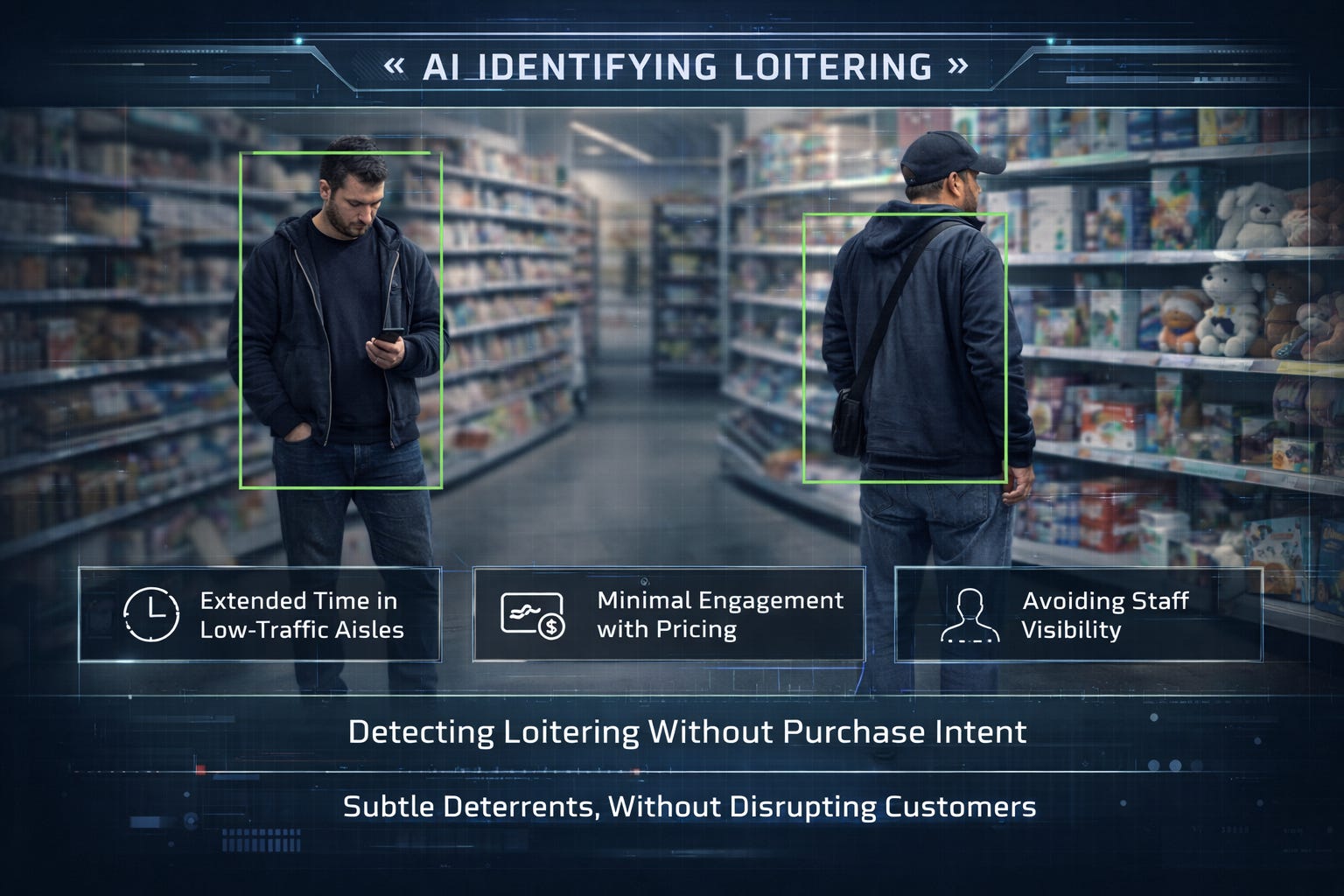
Now consider what becomes possible when you feed an AI system not thousands but millions of hours of therapy footage, prison recordings, detention center surveillance, clinical interviews with people who have committed acts of theft, violence, or predatory sexual abuse. The AI does not think. It does not judge. It finds patterns in facial microexpressions, in the geometry of eye movement, in the timing of certain muscle groups, in behavioral signatures so subtle that no human observer could consciously detect them. And then it generalizes. It builds a model of what a future thief looks like before the theft. What a future abuser looks like before the abuse. It assigns probabilities to faces.

Connect this to the smart cameras already embedded in our streets, our transit systems, our shopping centers, our workplaces. Cameras that do not merely record but analyze, in real time, the faces and bodies of everyone within their field of view. The alert that fires to a police control room does not say this person has committed a crime. It says this person is behaving with seventy percent similarity to the behavioral profile of someone who will. Philip K. Dick imagined this in 1956 and called it science fiction. We have built it and call it public safety.

A Mask Changes Nothing

But facial recognition is, by now, almost the least of it. The more consequential technology is gait recognition, a biometric system that identifies individuals not by their face but by the specific, anatomically determined way they walk. The curvature of the spine, the rotation of the hips, the particular rhythm of a stride, these are as unique as a fingerprint and far harder to disguise. Gait recognition systems currently deployed can identify a person from security footage even when the face is turned away, obscured by a hood, or hidden behind a mask. The protesters who covered their faces at demonstrations believed they were protecting themselves. They were not. The system had already read them from the ankles up.

Gait recognition tells the system who you are, even when you believe you are hidden. What comes next moves deeper. Layer on top of this the emerging field of real-time emotion recognition, AI systems embedded in that same CCTV infrastructure that classify emotional states from facial expression, assigning labels of agitation, hostility, fear, or concealment to the faces of people who have done nothing except exist in a public space.

And the system is getting better.

Accuracy is what billions of dollars of investment buys, and the investment is relentless. The day is approaching — closer than most people understand — when the system reads the thousand markers encoded in your face, your gait, your microexpressions, and states with ninety-five percent certainty that you will commit a murder. That you will commit a rape.

Not that you have. Not that you tried. That you will. And when that threshold of confidence is reached, the pressure to act on it will be overwhelming. Society will accept it as grounds for intervention, for detention, for pre-emptive removal, and pre-crime will stop being a dystopian metaphor and become official state policy. A system that labels your face as hostile does not need to be right today. It only needs to become right. And it is. [...]

Palantir and the Architecture of Control

Palantir is not a hypothetical. It is a company with a current market valuation measured in the hundreds of billions of dollars, deep contractual relationships with the United States military, the CIA, the FBI, the Mossad, MI6, and Immigration and Customs Enforcement, and a product suite specifically designed to do what I have been describing.

Its Gotham platform aggregates data from tax records, DMV files, employment history, educational records, immigration status, subpoenaed social media accounts including private messages and location history, and synthesizes this into individual dossiers that can be searched by tattoo, by neighborhood, by association, by movement pattern. Its immigration enforcement application, called ELITE, populates a map with what it designates as deportation targets and assigns each one a confidence score estimating the probability that a given address is where they currently sleep. The word target is theirs, not mine.

This is not a system built for national security in any meaningful sense of that phrase. National security was the pretext used to build it. What it actually does is make the population legible, sortable, and actionable to whoever holds the contract. Right now, those contract holders include an administration that has already demonstrated its willingness to use these tools against students who attended the wrong protest, academics who signed the wrong letter, immigrants whose only crime was existing without documentation in a country that spent decades depending on their labor.

by Karim, BetBeats Newsletter |  Read more:
Images: uncredited

Paige Jiyoung Moon (South Korean, b. 1984), Warm House, 2018.
via:

via:

[ed. See also: President John F. Kennedy's We choose to go to the Moon speech:]
***
"We set sail on this new sea because there is new knowledge to be gained, and new rights to be won, and they must be won and used for the progress of all people. For space science, like nuclear science and all technology, has no conscience of its own. Whether it will become a force for good or ill depends on man, and only if the United States occupies a position of pre-eminence can we help decide whether this new ocean will be a sea of peace or a new terrifying theater of war. I do not say that we should or will go unprotected against the hostile misuse of space any more than we go unprotected against the hostile use of land or sea, but I do say that space can be explored and mastered without feeding the fires of war, without repeating the mistakes that man has made in extending his writ around this globe of ours. There is no strife, no prejudice, no national conflict in outer space as yet. Its hazards are hostile to us all. Its conquest deserves the best of all mankind, and its opportunity for peaceful cooperation may never come again. But why, some say, the Moon? Why choose this as our goal? And they may well ask, why climb the highest mountain? Why, 35 years ago, fly the Atlantic? Why does Rice play Texas? We choose to go to the Moon. We choose to go to the Moon... We choose to go to the Moon in this decade and do the other things, not because they are easy, but because they are hard; because that goal will serve to organize and measure the best of our energies and skills, because that challenge is one that we are willing to accept, one we are unwilling to postpone, and one we intend to win, and the others, too. - Wikipedia

Yamamoto Masao - # 1171, from the series 'Nakazora', 2004

Joan Miró - Femme entendant de la musique (Woman hearing music), 1945

Monday, July 6, 2026

“Thus did a handful of rapacious citizens come to control all that was worth controlling in America. Thus was the savage and stupid and entirely inappropriate and unnecessary and humorless American class system created. Honest, industrious, peaceful citizens were classed as bloodsuckers, if they asked to be paid a living wage. And they saw that praise was reserved henceforth for those who devised means of getting paid enormously for committing crimes against which no laws had been passed. Thus the American dream turned belly up, turned green, bobbed to the scummy surface of cupidity unlimited, filled with gas, went bang in the noonday sun.”

― Kurt Vonnegut, God Bless You, Mr. Rosewater

Beating the Heat

Long before air-conditioning, people around the world came up with ingenious ways to beat the heat. But, really — wear dark, billowing robes? And drink tea?

The science can be surprising. As big chunks of the United States and Canada roast through the weekend, some of these ideas might be worth a closer look.

Water That Sidewalk

In Japan’s sweltering summer months, you might see storekeepers with a bucket of cold water, dousing hot pavement outside their stores.

The practice, called uchimizu, grew out of Japan’s tea ceremony tradition. It was originally a purifying ritual and an act of welcome for guests. But uchimizu also has an effect on temperature thanks to what’s known as evaporative cooling — when water evaporates, it pulls heat out of the hot ground.

A 2018 study in the journal Water found that uchimizu caused air temperatures to drop by as much as 10 degrees Fahrenheit near the ground, even with small amounts of water.

According to Shigenori Asai, director of the Japan Water Forum, the more neighbors join in and douse the pavement, the more effective it is. “You might even feel a cooling breeze,” he said. His group is sponsoring a global Uchimizu Day on Aug. 1.

Hang Screens of Fragrant Grass

Before air-conditioning, people in some of the hottest parts of India survived intense heat waves by weaving screens made from the spongy roots of a sorghumlike grass called vetiver.

The screens are kept wet and hung over doors and windows facing the wind for another version of evaporative cooling. Hot air blowing through is stripped of some of its heat. The grasses also smell good.

The process works so well, especially in dry environments, that some modern data centers are turning to a variation of this idea called indirect evaporative cooling.

If old-fashioned technologies like this can make a dent in the expected surge in air-conditioning use in India and other countries, that would bring great benefits, said Liza Raju Subhadra, an architect in Kerala, India, who works with alternative materials.

“It’s not just energy-intensive — when a neighbor uses an air-conditioner, the hot air gets passed onto me,” she said. “It makes a big difference if we can passively cool our homes.”

Wear Dark, Flowing Robes (or Seersucker)

It may seem counterintuitive to wear heavy, dark clothing in the desert, but communities in the Middle East and North Africa have done so for centuries.

A study published in Nature in 1980 found that dark robes can indeed create a cooling effect when worn in loosefitting ways. The robe absorbs heat and warms the air inside the garment, but as that hot air expands and rises rapidly, it escapes through the top. The upward flow acts like a pump, drawing cooler air from the bottom of the robe.

“The additional heat absorbed by the black robe was lost before it reached the skin,” the authors concluded.

For a different look, try seersucker. In the hot, humid summers of the American South, linen and seersucker, the thin, puckered cotton fabric, are staples.

Seersucker is woven in a way that causes some threads to bunch together, giving the fabric its distinct wrinkled texture. That prevents it from flattening and sticking to sweaty skin. It also creates tiny pockets that aid air circulation and cooling.

by Hiroko Tabuchi, NY Times |  Read more:
Image: The Yomiuri Shimbun, via Associated Press
[ed. And there are other options too, from architectural to personal/practical. My buddy Jerry was telling me about folks in Texas who used to, maybe still do, dig small pit caverns (like root cellars) a few feet below ground with an attached conduit routed upward into their house. The cool air from just a few feet below ground is enough. Another option would be design features that encourage air flow and ventilation, see also: How Old Dubai's historic streets beat extreme heat (BBC).]

What Does Dressing Up Mean Today?

I understand that we’re all dressing more casually these days, especially so since the pandemic. But there is something special about going to a play or a nice restaurant, and increasingly I’m seeing folks at such places dressed in what they’d wear to the supermarket or to do chores around the house — which kind of makes me sad. Are we losing something? — Janet, New York City
***
Dressing up can be one of the great joys of life. It is a shared human ritual, a mode of self-expression and a sign of respect. It helps mark time and set moments apart. It is an external expression of inner psychological and emotional states. It is a message to those around you.

That’s not me speculating or playing up the importance of clothes because I’m a fashion critic. It’s an actual thing, known as enclothed cognition — and that’s what you’re sensing has been lost.

A term coined in 2012 in The Journal of Experimental Social Psychology by Hajo Adam and Adam D. Galinsky, enclothed cognition refers to “the systematic influence that clothes have on the wearer’s psychological processes.” Essentially, the paper posited that the physical experience of wearing clothes, when combined with their symbolic meaning, affects how we think about ourselves and about other people.

That hypothesis was proved through an experiment involving white lab coats. When people, like doctors, wore them, they tended to pay more attention to what they were doing. The act of wearing the coat changed their behavior.

That is why fairy tales almost always invoke the literal magic of getting dressed. Why people used to dress for the theater, for dinner, for travel, for job interviews, for church, for cocktails, for parties. Why, when I am working at home, I put on my shoes to tell myself it’s time to focus.

But as you say, while we still dress for the big rituals of life, it seems increasingly that more everyday events are considered … well, not worth the trouble.

Somewhere between Silicon Valley’s declaration of independence from the suit and the rise of athleisure, dressing up became conflated with dressing expensively, uncomfortably and (even worse) according to outdated social conventions. Doing so was seen as something you were supposed to do, rather than something you might choose to do, and rejecting those conventions was seen as progress.

What is actually happening, though, is that we are scrambling our signals.

That doesn’t mean we should rush back to the safety of old-fashioned dress codes. At this point, those have definitively gone the way of the dodo. But it does mean we have to reconsider what getting “dressed up” really means, and that has less to do with any mass social definition than with a simple state of mind. Or so I found when I started asking around.

“To me, dressing up is about intention,” the designer Joseph Altuzarra said. “It has to do with the act of getting dressed with purpose and thoughtfulness, with a conscious decision to step into a particular version of yourself.”

Ikram Goldman, the owner of the Chicago retail emporium Ikram, had much the same response. Dressing up, she said, is about “looking polished” — though that term is largely in the brain, and eye, of the individual.

Goldman’s definition of polish: “Never wear jeans; no flip-flops; hair, nails and makeup done.” For Altuzarra, you can dress up in “perfectly fitting jeans and a crisp white T-shirt” as long as there is emphasis on the “perfectly fitting” and the “crisp.”

For his part, Law Roach, the “Project Runway” executive producer and Zendaya’s image architect, said he feels dressed up when he’s wearing “jeans held up with an Hermès scarf for a belt” or one of the “vintage Armani suits from the ’80s I get from a little store in Brooklyn.” [ed. image architect. that is a new one.]

The point, he said, “is putting something on that makes you feel special.” Something that implies a certain amount of care and consideration. Something that signals to your brain, as Adam and Galinsky might say, that what is about to happen is worth anticipating — and triggers the dopamine hit that comes when you realize, as Roach said, that “having somewhere to go is more of a luxury than ever before.”

by Vanessa Friedman, NY Times | Read more:
Image: Jeremy Moeller/Getty Images

Thoughts on a Funeral

I've just visited the largest funeral in history, where millions mourned Sayyed Ali Khamenei, the Iranian leader who was assassinated by the US-Israeli coalition along with members of his family. It is practically impossible to understand what this scene is like, or what it means, unless you're here. I've met people from around the world who've come to pay respects, including many from across the West. The crowds pouring in are endless, and grow larger and more intense into the night. 

From Tehran's Mosala, there are indignant calls for vengeance, displays of sorrow and defiance, protest, songs and marathons of poetry. These days of mourning will amount to one of the most resonant moments in the history of anti-imperialist movements. 

Everyone I've spoken to believes war will return to Iran before long, and none trust the MOU with the US. But they are confident their country can deter another assault. They see their own citizens' mobilization as an integral component of Iran's survival. 

If the assassination of Khamenei was designed to spur regime change, his funeral demonstrates how badly it has backfired. And the crime may blow back in ways its historically illiterate authors could have never imagined. 

What we're witnessing in the Mosala consolidates the Islamic Republic and its revolutionary society as a political reality that can not be erased through regime change war or sanctions. This is a turning point in the region that will echo for a generation.

by Max Blumenthal, X |  Read more:
Image: X

'We Are Screwed'

Data Center Alley is facing a climate test.

Searing temperatures this week could push energy demand to record levels on the mid-Atlantic’s electric grid, which fuels the country’s data center boom in Virginia.

To relieve some of the pressure, the Department of Energy granted permission Tuesday to the region’s grid operator, PJM Interconnection, to potentially force data centers to use backup diesel generators.

The move highlights the growing challenge of meeting rising electricity demand from data centers as the grid strains to keep the region cool during a period of extreme heat.

Many data centers rely on backup diesel generators, which release planet-warming emissions and lack air pollution controls designed to safeguard public health. The challenge is particularly acute in Virginia, the epicenter of the nation’s data center boom. State regulators have permitted more than 8,000 diesel generators at data centers in recent years, according to data from the state Department of Environmental Quality.

DOE’s order would allow data centers to run generators beyond limits for emissions that EPA has categorized as a “possible human carcinogen.”

Meeting higher electricity demand from air conditioning use during heat waves was already a challenge, said Kim Cobb, a climate scientist at Brown University. Adding data centers to the equation makes it harder.

“This is exactly what we expect in a warming world,” she said. “Even a modest increase in baseline temperature causes an exponential increase in heat extremes. You find yourself crossing these heat extremes much more frequently.” [...]

PJM has sufficient generating reserves to withstand intense summer heat waves, according to a recent assessment by the North American Electric Reliability Corp. But it is anticipating electricity demand far in excess of what it was expecting when it issued its summer reliability assessment in May.

Demand is projected to peak around 166 gigawatts on Thursday afternoon, exceeding the all-time record of 165 GW set in 2006. PJM predicted that summer demand would hit 156 GW this year, though it also included an “unlikely but plausible” scenario where electricity demand crests around 169 GW.

“It’s scary. It worries everyone when you see those kind of numbers,” said Abe Silverman, a former New Jersey utility regulator.

The grid should have enough generation to satisfy that power consumption, but the combination of higher temperatures, increased demand from data centers and a regulatory system straining to keep pace with skyrocketing electricity use is a worrisome dynamic, Silverman said.

The future looks even scarier. “The projections for data center loads dwarf the amount of data center load we have now,” he said. [...]

A DOE spokesperson did not respond to a request for comment. But Energy Secretary Chris Wright blamed the tight grid conditions on the Biden administration. [ed. Of course.]

“We are reversing those failures and using every available tool ensuring Americans in the Mid-Atlantic have continued access to affordable, reliable, and secure energy to power and cool their homes,” Wright said in a statement accompanying the order on diesel generators.

Communities are caught in the middle. In Virginia, one-third of data centers are located within 500 feet of residential areas or schools, according to state auditors.

Some neighbors are bracing to see if their Fourth of July celebrations will be affected by unhealthy air.

“Nothing says life, liberty and the pursuit of happiness like breathing in diesel fumes,” said Elena Schlossberg, who runs a grassroots organization opposing data centers in Prince William County, which has 33 completed data centers and 31 more on the way.

No one wants the grid to collapse, she said, but she argued it’s not fair when neighborhoods pay for Virginia’s data center boom with their health.

“Either way, we are screwed,” Schlossberg said. “Either our lights go out or we get to breathe in this pollution.” [...]

“Last summer it was like, is everyone seeing what we are seeing?” said Ann Bennett, who oversees data center issues at the Sierra Club of Virginia. “This time around people are already emailing us asking if they should expect more diesel and how to protect themselves from the fumes during this heat wave.”

The number of diesel generators in the state has grown since then. Bennett, who has tracked DEQ permits for the machines, found that the agency allowed 3,790 additional diesel generators in 2025.

“This time, we are all anxiously anticipating what is going to happen, and we have thousands more generators to worry about,” she said.

by Ariel Wittenberg and Benjamin Storrow, Politico |  Read more:
Image: Francis Chung/Politico
[ed. Water issues, too. Number of data centers in Virginia: 749. Providers: 109.]