Sunday, August 2, 2026

Will Larry Ellison Be the Face of the A.I. Bubble?

[ed. Don't miss this one. It's got everything (and could easily be a Pulitzer contender).]

On Jan. 21, 2025 — the first full day of the second Trump administration — Larry Ellison woke up in his 33-bedroom, 34-bathroom oceanfront mansion in Florida, got into his Gulfstream jet and headed up to Washington. Ellison, who was 80 and worth in the neighborhood of $200 billion, had an appointment at the White House. He didn’t bother to take a driver’s license — he needed to call someone on the president’s staff to vouch for him at the gate — but there he was, at 2 p.m., standing beside Donald Trump in the Roosevelt Room as the president announced “the largest A.I. infrastructure project by far in history” and told the world that his friend Larry Ellison was just the man to get it done. “He’s sort of C.E.O. of everything,” Trump said. “He’s an amazing man and an amazing businessperson.”

Ellison began by thanking Trump. “We certainly couldn’t do this without you,” he said. “It would simply be impossible.” He then proceeded to sketch out the ambitious plan. Ellison’s database software and cloud computing company, Oracle, and its partners — most prominently OpenAI — were going to invest as much as $500 billion over the next four years into a group of sprawling data centers, 500,000 square feet each, that would produce 10 gigawatts of computing power, using enough energy to power as many as 10 million homes. It was called Project Stargate, after the 1994 sci-fi movie in which Kurt Russell steps through a wormhole and finds himself inside a pyramid on an alien planet. This Stargate would be a portal leading humanity from the postindustrial era to the artificial-intelligence age. [...]

For Ellison, it was the capstone of a mad two-year scramble to transform Oracle into an A.I. juggernaut. The effort began in late 2022 when the launch of ChatGPT stunned the world and set in motion a race to master and control the most transformative new technology since the birth of the internet. Ellison, a founding father of Silicon Valley and the last of his generation still in the game, was desperate to avoid getting left behind. He’d moved quickly and aggressively — some might even say recklessly — to turn Oracle into a “hyperscaler,” one of the handful of companies providing the critical infrastructure that would power the A.I. boom. [...]

ChatGPT landed very differently in Washington than it did in Silicon Valley, setting off a scramble of its own inside the Biden administration to regulate the development of A.I. To oversee his A.I. policy, Biden turned to a veteran Democratic policy adviser, Bruce Reed, who believed that the administration needed to be proactive. A year after ChatGPT’s debut, in late 2023, Biden signed a comprehensive executive order on A.I., seeking to define the government’s role in the future of this new technology.

For the Biden administration, artificial intelligence was by no means just a domestic economic issue. Countries around the world were all racing to develop their own A.I. infrastructure and technology, and global power and influence would flow to whoever got there first. From this perspective, A.I. data centers were less businesses than geopolitical assets.

The administration was especially concerned about the A.I. ambitions of China and the Persian Gulf, given the powerful role artificial intelligence was likely to play in reshaping the information ecosystem. [...]

The administration’s concerns and Ellison’s ambitions were on a collision course. China and the Gulf were both critical to Ellison’s A.I. plans. Oracle already had a lot of contracts around the Gulf, and it also had a strong business relationship with one of China’s most important A.I. companies, ByteDance. Oracle was the U.S. cloud provider for the U.S. division of ByteDance’s TikTok, storing and securing the data of the app’s 100 million American users. But with ByteDance itself now pivoting into generative A.I., they had the opportunity to do more business together. In the summer of 2024, Oracle started working on a $6.5 billion deal to build a large data center complex in Malaysia, from which it could convey computing power to ByteDance and other foreign companies through opaque leasing deals.

It would be perfectly legal — but under the Biden administration maybe not for long. By that point, national security officials were growing increasingly concerned about China and the Gulf’s A.I. ambitions and were discussing ways to gain more control over them. The administration was especially worried about the role Oracle might play in fueling these ambitions. They knew that Ellison was trying to scale up the company’s A.I. infrastructure quickly and that it was badly in need of cash, which meant that it might be more tempted to make deals that the administration didn’t think were in America’s best interests. [...]

In early 2024, the administration started working with Congress on a bipartisan bill — the Protecting Americans’ Data From Foreign Adversary Controlled Applications Act — that would force ByteDance to divest its U.S. TikTok operations. Biden signed the bill into law in April 2024, setting a deadline of Jan. 19, 2025, for a sale. If ByteDance failed to meet the deadline, the app would be shut down in the United States.

At the same time, the administration was preparing to shore up its efforts to restrict China’s access to American computing power and to exert more control over the Gulf’s. In late 2024, it circulated the draft of a plan to require hyperscalers to go through a licensing process to operate overseas and to keep 50 percent of their computing power in America.

All of the hyperscalers were looking to build overseas, but Oracle had the most to lose: Its global plans were the most ambitious, at least relative to its size. The company publicly and aggressively opposed the Biden plan. Its top policy executive in Washington, Ken Glueck, called it “one of the most destructive” moves ever taken against the tech industry, arguing that the best way to solidify America’s lead in the artificial intelligence race was for U.S. companies to build and control as much of the world’s A.I. infrastructure as possible.

Biden signed off on the new policy in the final days of his presidency. It was scheduled to go into effect in May 2025. If enacted, it could force Oracle to scale back its ambitions in Malaysia and the Gulf. Ellison’s plan to transform Oracle was in trouble. But a new president was on his way to Washington.

‘The Tsunami’

Relief came almost immediately. Hours after his inauguration in January 2025, Trump sat down at the Resolute Desk and began signing executive orders aimed at dismantling Biden’s A.I. policies. He also signed an order directing his attorney general to hold off on enforcing the congressionally mandated TikTok ban for 75 days. And then, of course, came the Project Stargate announcement with Ellison and Altman.

Trump turned to a very different group of people to shape his new administration’s approach to artificial intelligence. He named as his A.I. and cryptocurrency czar David Sacks, a Silicon Valley venture capitalist who had raised many millions for the Trump campaign and, according to a New York Times investigation, was personally invested in at least 449 companies with ties to artificial intelligence. Sacks, who has denied any conflict of interest, believed that when it came to A.I., the government’s job was to get out of the way.

The National Security Council’s technology and national security division had played a key role in shaping America’s A.I. policy in the Biden years. Trump initially appointed David Feith — who had serious concerns about China’s ability to remotely access computing power through Malaysia and other Southeast Asian nations — to run it. But in April, he fired Feith and a few other China hawks and then eliminated the entire directorate. [...]

Trump saw another benefit to withdrawing the Biden plan: The Gulf states were adamantly opposed to it. They needed U.S. computing power to build out their own A.I. infrastructures and had something to offer in return. Their sovereign wealth funds were sitting on trillions of dollars that they were ready to invest in all sorts of American companies, including some connected to the Trump family.

Two weeks before the Biden policy was scheduled to go into effect, Zach Witkoff — son of the Trump adviser Steven Witkoff and chief executive of the Trump family’s cryptocurrency firm World Liberty Financial — made an announcement at a conference in Dubai: The Emiratis would use $2 billion of the firm’s brand-new stablecoin for an investment in Binance, a crypto exchange. Less than two weeks later — 48 hours before the Biden restrictions would kick in — Trump rescinded the policy.

That same day, Trump landed in Saudi Arabia, the first stop on a three-day tour of the Gulf. He was joined in the United Arab Emirates by Altman to announce Stargate U.A.E., a multibillion-dollar initiative to build one of the world’s largest data centers outside Abu Dhabi. Oracle would be a partner, too.

With the Biden plan dead, Oracle was free to operate its data center complex in Malaysia as it saw fit. By the end of June, the facility was on track to become the second-biggest in the world. Oracle doesn’t release the names of its customers there, but by studying its output, an independent A.I. research firm, SemiAnalysis, determined that the facility was feeding most of its computing power to ByteDance. An analyst at the tech-focused think tank ChinaTalk, Aqib F. Zakaria, ran his own numbers and arrived at a startling conclusion: Oracle was providing a staggering 22.6 percent of China’s known A.I. computing power.

by Jonathan Mahler, Jim Rutenberg and Kirsten Grind, NY Times |  Read more:
Images: Louie Psihoyos; Scott Ball
[ed. Not to be redundant but this came out shortly after I'd posted about Oracle (and Larry Ellison) below in The Hater's Guide to Oracle (Part 2). It contains a treasure trove of new information and a road map to how business and politics intersect in Washington and around the world these days. Well worth a read.]

Saturday, August 1, 2026

Astronauts Returning From Six-Month Missions Describe a Persistent 'Observer' Sensation

Astronauts coming home from long stays on the International Space Station have, for years, described a strange perceptual aftertaste: a sense of watching their own lives from a half-step outside the frame. They sit at dinner with family and feel like a guest. They drive on a familiar street and feel like they’re piloting it. The room is loud and they are in it, but a part of them is hovering near the ceiling, taking notes.

It is not a clinical diagnosis. It does not appear in a DSM. But flight surgeons and crew psychologists who debrief astronauts after six-month rotations describe it often enough that it has become a recognizable readjustment pattern — an observer sensation that lingers for weeks, sometimes months, after splashdown.

What returning crews actually describe

The descriptions are remarkably consistent across agencies. Crew members talk about feeling slightly delayed in conversations. They report a doubled awareness — being present while also watching themselves be present. Some say it feels like the first week of a new job that never quite ends. Others compare it to jet lag of the self.

NASA’s own post-flight reflections from station crews describe the sensation in plainer language: home feels staged. Smells are too sharp. Gravity feels theatrical. The brain, which spent half a year recalibrating for a world without down, treats the familiar as something to be studied rather than inhabited.

Returning astronauts describe walking into their own homes and feeling like they are visiting them. Some talk about being unable to put a glass down without watching their hands do it. The pattern shows up in oral histories, in memoirs, in flight surgeon notes. It is one of the quieter costs of long-duration spaceflight.

by Space Daily, Editorial Team |  Read more:
Image: T Leish on Pexels

Live From Camp David, It's Friday Night!

[ed. Comedy gold.]

President Donald Trump on Friday held what the administration said was the first televised Cabinet meeting at Camp David, assembling his deputies at the secure wooded retreat to tout the administration’s accomplishments.

But the rural Maryland setting, long used by presidents for sensitive private meetings or as a tranquil escape, swiftly became the latest stage for Trump’s frustrations over a series of stalled domestic and foreign policy initiatives.


Trump railed against Republican senators blocking his nominee for attorney general, lamented the collapse of his proposed $1.8 billion Justice Department payout fund, questioned whether Iran was negotiating a potential ceasefire in good faith and warned that Democrats would open U.S. borders if they won the midterm elections.

He again lashed out at Sen. John Cornyn (R-Texas), one of several GOP lawmakers to resist Trump’s policies as his popularity drops and the midterms approach. Cornyn — who lost his primary bid this year after Trump endorsed his opponent — has joined with other lame-duck senators to hold up acting attorney general Todd Blanche’s nomination for the full-time position.

Cornyn has “become a very angry person,” Trump said, also praising Blanche, his former personal attorney. “Todd Blanche is a very, very good man, and he shouldn’t be in the middle of this.”

The president’s remarks Friday, which echoed similar complaints he has made in person and on social media, were most striking because of the unusual backdrop. The media has historically not been allowed to visit Camp David, and reporters who covered Friday’s Cabinet meeting were told to leave their cellphones outside the room, because it was a secure information facility. However, the White House allowed several live video streams of the meeting, and photographers were permitted to take pictures.

The president and White House officials said it was the first televised Cabinet meeting from the rustic compound. Trump in May had planned a Cabinet meeting at the site but canceled it, citing the risk of bad weather. [...]

Trump spent time at Camp David in his first term but has preferred visiting his own properties recently and is set to spend this weekend at his resort in Bedminster, New Jersey [ed. golf course]. He touted his decision Friday to trade the increasingly gold-festooned White House for the wood-paneled walls of the presidential retreat, located in Catoctin Mountain Park.

“This room is a very, very special room,” Trump said, as the meeting began. “I don’t believe the press has ever come anywhere near it, but we are the party of transparency.” [...]

Trump’s Cabinet members, as they have at past meetings, also took the opportunity to lavish praise on the president. Defense Secretary Pete Hegseth credited Trump for policies that he said had boosted morale in the military, including the president’s effort to rebrand the department as the “Department of War” and putting military vehicles on parade and in flyovers to celebrate the nation’s 250th anniversary.

“Parades, 250 [anniversary] flyovers, the American people seeing and feeling their military in ways they have not in  the past,” Hegseth said. “That’s spirit.”

by Dan Diamond, Washington Post |  Read more:
Image: Daniel Heuer/Reuters
[ed. Sorry, worthless news but couldn't resist. Yes, we're all "seeing and feeling" our military in new ways. But "spirit" is not the word I'd use. Who even owns a babyshit blue jacket like that? (well, one person anyway : ). Here's another attendee, sweating an upcoming confirmation vote

I know the feeling... everyone would like to be somewhere else

via:
Nick Cave and the Bad Seeds, Fifteen Feet of Pure White Snow

The Hater’s Guide To Oracle (Part 2)

Oracle has one of the strongest mythologies in the tech industry. Ask a regular person and they’ll tell you that it’s “incredibly profitable” and “growing fast,” that it’s “unstoppable,” and that Larry Ellison has the mandate of heaven with regard to the continual sales of software and hardware related to databases and AI.

And those people are completely and utterly wrong.

The original title of this article was “Is Oracle Dying?” because I assume, when I took a deeper look, that there’d be some sort of debate, some sort of bull case for a decades-old quasi-hyperscaler run by one of the more nakedly-evil CEOs in the history of tech. I assumed — incorrectly, I might add — that Oracle as a business was doing fine other than the ridiculous commitments it made to support the whims of Sam Altman and OpenAI via deals that I believed (and still believe) will kill Oracle.

Except it turns out that Oracle has already been on a death spiral for the best part of a decade (if not longer) and has only survived this long by screwing its customers, taking on masses of debt, and — most importantly — more than $85 billion in acquisitions over the last 23 years. Pretty much every major product line outside of databases is a hodge-podge of other people’s innovation stapled together with a legendary contempt for the customer. These acquisitions (and continual price increases) are the only thing keeping the reaper from Oracle’s door other than margin-destroying GPUs. [...]

After April 2009’s $5.7 billion acquisition of Sun Microsystems, Oracle’s revenues barely kept pace with inflation until December 2021’s $28.3 billion acquisition of Cerner allowed it to create Oracle Health, adding about $6 billion in annual revenue that had 40% lower margins (about 21.7%) than Oracle’s other businesses, though Oracle immediately started closing offices and brutal layoffs to try and bring them up.

And as I mentioned above, Oracle’s other plan was to sink a little over $99 billion in capital expenditures since the middle of calendar year 2020 into AI GPUs. [...]

Oracle is a decades-long mission to keep reapplying lipstick to a pig. Billions of dollars of acquisitions have, for the most part, only succeeded in keeping the company’s revenue growth from going negative, and as noted by forensic accountant Howard M. Schilit, this is one of the most well-documented cases of accounting shenanigans being used to cover up that a business is in decline.

Today’s newsletter is a sequel to the Hater’s Guide To Oracle, where I told the sordid tale of how Larry Ellison grew a massive, lucrative business out of a database business that one reporter once told me was a “law firm with a database company attached,” an Enterprise Resource Planning (ERP) product that competes with SAP to create the most-annoying way to run a large company, and a business built around licensing Java that exists mostly to email people and say “you need to pay us for Java or we’ll sue you.”

Then, as I’ve mentioned, there’s Oracle’s cloud infrastructure business, a decade-old also-ran that was meant to compete with Microsoft Azure and Amazon Web Services, but only managed to catch up following the advent of AI GPUs and a movement where all it took to party was buying billions of GPUs and saying “gosh darn, we love AI.”

I originally started drafting this as a much tamer piece where I’d ask whether Oracle was dying, but as my editor and I started digging into the research, it became obvious that not only is Oracle dying, it’s been dying for years, kept alive through decades of acquisitions and a desperate and dangerous commitment to generative AI.

And AI, I believe, will be what eventually kills Oracle dead. [...]

With revenue plateauing and customers in revolt, Oracle’s future already looked murky, but with the power of AI — and $95 billion in FY2027 capex — it’s becoming increasingly clear that this may be Larry Ellison’s last dance with Silicon Valley.

by Ed Zitron, Where's Your Ed At |  Read more:
Image: Larry Ellison, Bloomberg/Getty
[ed. Larry Ellison. One of the most hated personalities in tech (and unfortunately, owner of my beloved island of Lanai, in Hawaii). Update: What a coincidence. There's quite a story in the NY Times that just came out about Ellison being the face of the AI bubble. See also: The Hater's Guide to Oracle (Zitron); Ellison Empire Beseiged On All Fronts (NC); and, this excellent series The Oracle Files by Drey Dossier on YouTube. (For example, this one: How Larry Ellison and Gulf Money Just Bought Your News):]
***
Warner Brothers Discovery shareholders are getting screwed on this new Paramount deal. Okay. And I would like to get into exactly how before they vote on Thursday, the largest media merger in American history is going to a shareholder vote. A merger worth in the ballpark of $111 billion in case you were wondering.

Which means that Warner Brothers, you know, the big conglomerate that owns CNN and HBO, is potentially getting folded into another conglomerate Paramount Pictures, which is the company that owns CBS, MTV, Showtime, and Nickelodeon. And the shareholder vote is April 23rd, this up coming Thursday.

And last Thursday afternoon, which is one week before the vote, Warner Brothers Discovery filed a 14 page correction to the document that shareholders are voting o n.

Now, this is kind of a big deal because this is a 14page addendum to the biggest media merger in American history. And this was filed on Thursday of last week, 4 days ago at this point. 

Now, public companies don't usually rewrite their own proxy statements a week before a shareholder vote, unless of course someone is forcing them to, which usually means that someone being one of their shareholders is suing them in order to do so. So, I checked to see if there were any lawsuits floating around out there, and what do you know? There is one. A shareholder named Donna Nikosia, apologies if I butchered that last name, filed a lawsuit on April 2nd saying that the original document left out a lot of information that shareholders needed in order to make an informed vote. 

And following Donna's lawsuit were 15 other shareholders who had sent letters more or less saying the same thing. And can we all just take a moment here and say thank you to Donna for filing what we all probably knew to be true in the back seconds of our heads that there is information being left out that you need in order to make an informed decision this upcoming Thursday. Now up top I just want to say that I am not a Warner Brothers Discovery shareholder. I have never owned a share of Warner Brothers Discovery or Paramount Pictures. I am just thanking Donna as a media consumer.

All right, and somebody who works within the media ecosystem because I like to keep my media independent and this deserves a lot more scrutiny than it's getting. So WBD, Warner Brothers Discovery, told the court that this lawsuit had no merit and then two weeks later slightly added the information.

Anyways, so this move in business, I've learned, is how you smother out a lawsuit without ever having to say that we are wrong. Now, we're going to get into what was in this correction in a second here because oh boy, were they leaving information out? [...]

You know, I read that 14 page new filing this weekend and there are two companies in it that WBD is still trying very hard not to have to say out loud and is trying even harder, it seems, to smother this from any of the news outlets taking this to the other shareholders. And I think I figured out which ones they're talking about. 

[ed. And this: Why Iran's Blockade is an Oracle Story:]

Most people know Larry Ellison as the Oracle billionaire, which true, you also probably know that he is the largest private donor to the Israeli military in American history.

He's given over $26 million to the friends of the IDF since 2014, including a single $16.5 million donation in 2017. That is the largest gift in the organization's history. And that is the part we have discussed at length. But here is the part that a lot of people don't know. Ellison is not just the largest funer of the Israeli military. 

His company is the operational backbone of it. According to Open Intel, Oracle holds a 26-year contract to build and operate the IT infrastructure for the IDF's intelligence campus in Negv. For clarity, that is the facility that houses unit 8200, Israel's signals intelligence and cyber warfare division and one of the largest listening bases in the world. That is a 26-year relationship extending into the 2040s between a private American company and the intelligence apparatus of a foreign military. 

And that's just the intelligence side because Oracle also runs the Israeli Air Force entire logistics system, the supply chain that tracks his spare parts for F-35s and F-16s, aviation fuel and mutations inventory. Oracle hosts an AI battlefield management system called Fireweaver that coordinates sensors and weapons on the battlefield in real time, which means that Oracle software is making targeting decisions in the kill chain for Israeli Defense Forces.

The First Word The World’s Phones Say Is Aloha

If you grew up here, you know the drill. Rinse the rice, level it with your hand, dip a finger in, and add water until it reaches the first knuckle. Press the button, walk away, and 20 minutes later the rice is perfect. It came out perfect back when I was 7 too, with tiny fingers.

That bugged me. One day I held my finger up next to my mom’s, saw how different they were, and asked her why the trick still worked no matter whose finger you used. She shrugged. Years later I remembered that conversation and did the thing I often end up doing. My curiosity made me figure out why.

The answer blew my mind. The humble rice cooker is one of the best pieces of real world physics I have ever run into, and it runs on two principles. Boiling water cannot get hotter than 212 degrees no matter how much heat you dump into it. And a magnet loses its pull once it gets hot enough.

So when you press cook, you are sticking a magnet to a piece of metal, and that magnet is what completes the circuit to the heating element. The water starts to boil. As long as there is water in the pot, the temperature stays pinned at boiling, well below the point where the magnet quits. But the moment the last of the water boils off, there is nothing left to hold the temperature down. It shoots up, hits that point, and pop, the magnet lets go and breaks the circuit. The cooker never cared about water levels. It only cared about the moment the water was gone. Absolutely brilliant. [...]

For as long as I can remember I have held a wet finger to the wind like that, asking it about everything. And more often than I ever expected, some answers have traced back to these islands.

Take the Wi-Fi you are using right now. Every phone, laptop, and smart device in the house is sharing the same sliver of invisible air, and somehow they do not all shout over each other. The rule that lets them share was worked out at the University of Hawaiʻi.

In June 1971, a team led by Norman Abramson switched on ALOHAnet, the first wireless packet data network in history. Radio had been carrying data since the 1890s. Morse code is data. What nobody had solved was the crowd. Every system before ALOHAnet handed the channel to one sender at a time and kept order with a schedule, a slot or a roll call. Abramson’s team had cheap UHF radios, terminals scattered across the islands, one computer on a hill in Mānoa and no budget for any of that. So they had to answer a question nobody had answered: How do you let a crowd of machines share one channel with no traffic cop?

Their answer was to stop looking for one. Let each machine talk the second it has something to say. If two of them speak at the same instant and garble each other, neither gets an acknowledgment back, so both go quiet, wait a random beat and try again. Talk, collide, yield, retry. That is the whole idea, and the whole idea only works because every machine agrees to take turns. A single device that refused to back off could starve every other device on the channel.

In 1970 Robert Metcalfe read Abramson’s paper, could not put it down, and spent a month on Oʻahu learning it in person. He went home and built Ethernet on top of it. Ethernet wired the offices of the world. Wi-Fi carried the same rule back into the air. And when your phone wakes and reaches for a tower, the first thing it sends is a short burst on a channel the engineering standards still call slotted ALOHA. Not a metaphor. Aloha as a greeting is written into the specification.

Think about the last time you tapped a credit card at a register. That little terminal, the one sitting on every counter from here to the continent to the far side of the world, traces back to Honolulu. In the late 1970s a Honolulu businessman named Edward Berger saw a problem. Tourists kept showing up with checks and cards that a shopkeeper had no way to trust. So Berger teamed up with a UH engineering graduate named Jimmy Thompson to build a device that could verify a customer over the phone. They named it after exactly what it did, a verification telephone. Verifone.

Verifone was later sold to another Honolulu businessman, Bill Melton, who redesigned the terminals to be cheap enough to go anywhere. Within a few years those little boxes from Honolulu ran most of the American market, then most of the world’s. The original prototype sat in Berger’s widow’s living room for years. Today it sits in the Inspiration Hawaiʻi Museum in downtown Honolulu. I took this picture of it last year. That quiet beep when your card goes through started right here.

Even the food truck down the block has roots here. The plate lunch gets called the original fusion cuisine, and it was born in the plantation camps of the 1880s, when workers from Japan, China, Portugal, Korea, the Philippines, Puerto Rico and beyond got thrown together in the fields. The bosses kept them in separate camps and tried to keep them apart. But at lunch they cracked open their kau kau tins and shared. Rice from one, kim chee from another, adobo from the next. Nobody planned it. Hunger and closeness and a little generosity mixed cuisines that had never met, and out of that came the mixed plate, the fusion lunch wagons and eventually the whole idea that food from everywhere can sit on one plate and belong.

We are the most isolated inhabited islands on the planet, a handful of dots in the middle of the biggest ocean there is. By every rule of size and distance, nothing that starts here should matter much out there. And yet the world learned how to share a crowded signal from us. It learned how to trust a stranger’s card from us. It learned how to put the whole world on one plate from us.

But if you dig a little deeper, these three are really the same thing. Take your turn so everyone gets heard. Trust the person across the counter enough to do business. Share your food with your neighbors. That is not engineering. That is aloha, worked out the hard way by people who had to learn how to live close together on islands.

None of those three things got built by people just being clever. They got built by people being close, and generous, and willing to take turns. That is aloha, and it is not soft at all. The next thing worth building needs the same root. The world could really use more innovators who can spread more aloha.

by Olin Lagon, Honolulu Civil Beat | Read more:
Images: Olan Lagon

Bob Hallinen's Alaska

Bob Hallinen's Alaska (ADN)
[ed. Don't miss this small assortment of Bob's photos. They show why there's no place like Alaska. His obituary is here.]

Friday, July 31, 2026

Chinese All-Terrain Robots


[ed. Holy crap. Unitree's "Super Athlete". It'll take your gear up or down a mountain with ease and do a little pirouette at the end.]

AIs Agree: Outer Worlds is Their Favorite Game


via: Shoshannah Tekofsky/Malo Bourgon/X
[ed. Not a gamer so don't understand the attraction.]

AI #179 Part 1: A Louder Fire Alarm for General Intelligence

[ed. See also: Part 2: Hearing The Fire Alarm.]

What a week.

Anthropic released Claude Opus 5. As usual I covered that in three parts: The system card, model welfare and capabilities.

OpenAI was revealed over the last two weeks to have left an internal model unsupervised for a week during a cybersecurity evaluation, with its cyber safeguards lowered, despite having had multiple previous incidents where models broke out of their sandboxes. During that test, the model broke out of the sandbox, then proceeded to use an agent swarm to hack into HuggingFace to get the test answers. The model was loose for a week before OpenAI realized what had happened.

This event was a really big deal. There are severe alignment problems at OpenAI, along with supervisory and infrastructure failures. The internal research model that did this, which my posts nicknamed Galaxy, has now been permanently deactivated.

There have been further developments, and I anticipate at least one additional post on the HuggingFace incident soon.

Partly as a response to this, over 1,290 employees at frontier labs signed an open letter, Pacing the Frontier. The letter warns that we are close to automating AI research, and that companies are racing ahead on this faster than we can handle it.
We request that the U.S. government support an international effort to develop the technical and governance tools needed to deliberately pace the frontier of automated AI development.
Both OpenAI and Anthropic put out statements of endorsement. Since that post, others have continued to sign, including OpenAI cofounder Ilya Sutskever and DeepMind cofounder Shane Legg. Dario Amodei has signed. Sam Altman has not signed, but is talking in Washington about the need to pace development.

All three of those developments are more important than anything in the weekly. There is plenty here, but catch up on those key events first if you have not done so.

This week was crazy. I am absolutely not moving to a 7-days-a-week posting schedule, and fully intend to take some weekdays off as soon as there is what passes for a lull. However, there is even more speed premium these days, so I will continue the policy of shifting posts to weekends when the speed premium is especially high.

by Zvi Moshowitz, DWAV |  Read more:
Image: via
[ed. Things are moving fast, too fast. Zvi's newsletter has become the first thing I check every morning. People have long speculated that before AI becomes too dangerous (without our knowing it) we might see "warning shots" that give us time to prepare. It appears we've seen those now, so what are we going to do about it? (assuming people actually view recent incidents as warning shots. Or just don't care (Politico):]
***
In the AI political universe, Zac Moffatt and Josh Vlasto are at the helm of the Death Star.

As the top political operatives at Leading the Future, they oversee a network of pro-AI industry super PACs and nonprofits that friends and foes alike describe as an aggressive, well-funded machine attempting to obliterate their opponents much like the Star Wars superweapon.

Their goal: to defeat candidates who support the strictest AI regulations and champion those who want to unleash the development of the industry.

Thursday, July 30, 2026

You Live In This Dump?


[ed. See also: 4 Prompts That Can Tell You What Chatbots Really Know About You (NYT).

Hundreds of millions of people worldwide who have embraced chatbots for web search, work and health care are still trying to understand the privacy implications of conversing with A.I companions. While it’s obvious to users that the chatbots keep a record of whatever they explicitly say to them in their questions and requests, what’s less clear are the inferences drawn about their behavior from those conversations...

To understand what the chatbots have figured out about you, try these prompts.


by Brian X. Chen,  New York Times/Archive Today |  Read more:
Image: Reddit
[ed. It's like Google Maps for humans.]

Bruno Vekemans Belgium
via:

What Will More Intelligence Actually Do For Us?

In lots of sci-fi books, as soon as artificial superintelligence arrives, it bootstraps itself to even more godlike intelligence in an explosive “singularity” that rapidly transforms the entire physical universe. Lots of people, especially “AI safety” and “effective altruist” types, expected things to play out basically the same way in reality. But looking around, not much has changed since we entered the intelligence explosion. There’s a huge data center boom, and most people use AI on a daily basis, but we still live basically the same lives — driving to work or taking the train, sitting in front of a computer, scrolling on our phones, collecting a paycheck. People are staying in their jobs longer, but employment hasn’t been disrupted in a significant way:

A lot of people I know are surprised by this. Ruxandra Teslo writes:
Walking around the world today one might notice that it is weirdly unchanged…To many, this is surprising. Just the other day I was at a conference where someone remarked that if he could have seen today’s AI capabilities a few years ago, he would have been astonished — and would have assumed the world by now would look far more transformed, with much higher GDP growth.
Teslo blames bottlenecks — governance and other “frictions” — for the slow economic impact. But some others are advancing a more radical hypothesis — that intelligence itself is subject to diminishing returns.

One of these is Francois Chollet, an AI researcher who specializes in measuring AI’s capabilities. In a highly controversial series of tweets back in March, he conjectured that intelligence might be subject to diminishing returns:
One of the biggest misconceptions people have about intelligence is seeing it as some kind of unbounded scalar stat, like height. "Future AI will have 10,000 IQ", that sort of thing. Intelligence is a conversion ratio, with an optimality bound. Increasing intelligence is not so much like "making the tower taller", it's more like "making the ball rounder". At some point it's already pretty damn spherical and any improvement is marginal.
Now of course smart humans aren't quite at the optimal bound yet on an individual level, and machines will have many advantages besides intelligence -- mostly the removal of biological bottlenecks: greater processing speed, unlimited working memory, unlimited memory with perfect recall... but these are mostly things humans can also access through externalized cognitive tools.
In fact, this is a possibility I myself had raised in a post a year earlier:
It seems possible that humans are simply incredibly specialized in a few types of cognitive tasks — extracting patterns from sparse data, synthesizing various patterns into “intuition” and “judgement”, and communicating those patterns in language — and that we’ve basically approached the theoretical maximum in those narrow areas…That would explain why AI has gotten much better at things like math and coding and forecasting over the last year, but why the basic chatbot interface doesn’t seem much more “intelligent”. It would also explain why when you talk to Terence Tao about math, it’s like talking to a superhuman, but when you talk to him about where to get lunch or which movies are the best, he’ll just sound like a fairly smart normal dude. AI will eventually get better than Tao at math…but it may never get much better than the most thoughtful, eloquent humans at deciding where to get lunch or recommending movies. It may simply not be mathematically possible to get much better than we already are at that sort of thing.
Why would intelligence top out like this? Well, if we think of intelligence as the ability to extract information from data, then even an infinitely advanced model endowed with infinite compute will be limited by the fact that there’s a limited amount of information that can be extracted from the data.

For one thing, data itself is in limited supply. You can’t transform the world unless you can (in some generalized sense) understand it, and you can’t understand the world unless you can measure it, and our ability to measure the world is inherently limited and finite. [...]

So although we don’t know yet, it’s possible that humans were already hitting the point of diminishing returns with regards to individual cognitive capacity, and that superintelligent machines will never be as far beyond us as we are beyond dogs. But even if that’s true, I can think of at least three reasons why machine superintelligence could still deliver huge productivity gains. [...]

Distributed tacit knowledge

The German company Zeiss makes the best glass on the planet. If one of the mirrors that Zeiss makes for ASML’s EUV chipmaking machines were the size of Germany, the biggest bump on that mirror would be just one millimeter high. Only a few other companies — and maybe no other company on Earth — can match that. Zeiss’ mirrors also have a number of other amazing properties, like not distorting much due to temperature changes.

How does Zeiss make glass this good? No one knows — not even the people at Zeiss. If the technology were capable of being written down on a blueprint, China would have hacked Zeiss and stolen it, the way Huawei hacked Cisco and Nortel. If the technology were capable of being explained by a former Zeiss employee, or even several former Zeiss employees, China would have paid those people many millions of dollars to spill the beans.

Zeiss’ technology basically can’t be stolen, because it’s tacit and distributed. It consists of a vast number of little tricks and techniques that a huge number of individual employees use on a daily basis. These people don’t always even realize all those little things they’re doing that make the glass come out so good. And each employee knows a different set of tricks and techniques. The knowledge exists at the level of the organization itself, and is thus very hard to steal or recreate.

This is true of lots of corporate technology. A big part of the reason China can cut off the supply of rare earths to the rest of the world any time it wants to is that other countries aren’t very good at refining rare earths. Rare earths are difficult to separate from each other in solutions; it takes a ton of little chemistry tricks to do it cheaply at scale. Chinese refiners have spent four decades building up those little tricks and techniques; American or Japanese refiners won’t simply be able to replicate their efficiency overnight, and so it’ll continue to cost much more to produce rare earths outside China.

Except in the age of AI, this might change. Suppose American rare earth refiners give their employees a bunch of equipment to record everything they do — smart glasses, gloves, and so on — in addition to sensors distributed throughout their plants. AI will be able to synthesize all that information and very rapidly suggest small ways to improve the production process. Many of those little experiments will fail; others will succeed and will quickly be adopted, allowing another round of experimentation and improvement to begin very quickly. Crucially, AI’s ability to do this doesn’t depend on its raw intelligence — only on its ability to handle huge amounts of data very quickly.

In other words, in the age of AI, distributed tacit knowledge might not be nearly as big of a barrier to technological diffusion. This could improve economy-wide productivity, as lagging firms catch up to leading firms much more quickly. A more equal distribution of productivity would also make the economy more competitive, creating more surplus for consumers (though possibly reducing the incentive for firms to innovate, by making technology less excludable).

AI’s ability to quickly produce distributed tacit process knowledge might also supercharge productivity growth at the frontier. Imagine if any company could optimize any production process five times faster than today. The whole economy would speed up, as components got cheaper, turnaround times and product cycles got shorter, and scale-up got much faster.

And as with the previous example, improving the production of distributed tacit knowledge wouldn’t depend on AI’s raw intelligence. It would spring from AI’s ability to act like a computer — to interface directly with sensors, to handle lots of data, to perceive tiny details, and to do everything very very quickly.

by Noah Smith, Noahpinion |  Read more:
Image: Zeiss
[ed. Another thing I've wondered about: historians make a living unearthing little known facts and connecting dots from sources that are deeply buried in paper and microfiche respositories (and early data storage technologies - like 8 and 5 1/4 inch floppy disks). Millions of memos and correspondences that were once widely distributed and now sitting in dusty boxes or warehouses, archived somewhere. Items that could help significantly in understaning more about human judgement and decision-making. How much of this has been scraped for training? Very little, I'd presume.] 

via:
[ed. Unexpected fun:  Dust devils.]

Impulse Cooking Revolution


via: Impulse Labs
[ed. Not a recommendation, but I've been hearing more about these lately (for example, see this Wirecutter review):]

These models use the type of battery found in some electric cars; it stores power, which allows the appliance to run on a regular 120-volt outlet instead of the 240-volt version required for most electric stoves. Installing an appliance that runs on 240 volts can be expensive, tricky, and time-consuming, especially in older buildings with multiple apartments.

On the Impulse Cooktop, that battery can also produce a whopping boost of heat by channeling 10,000 watts to a single element — that’s 3,000 more watts than the next most powerful induction cooktop that I've come across in my research.  [...]

I also tested that battery-boost, and I can tell you one thing for sure: This baby does indeed get very hot, and very fast. On medium-high heat, a few tablespoons of oil in the bottom of a pan began smoking in two seconds.

And I'm rounding up.

In my previous tests of high-end induction cooktops, bringing 4 quarts of water to a full, roiling boil took eight to 10 minutes. On the Impulse Cooktop’s battery-powered boost setting, it took just under three minutes. That’s so astoundingly fast, I went around the office showing the timer to my colleagues.
***
[ed. It aint cheap:]

At $7,000 for a 30-inch model (and $7,600 for the 36-inch version), the Impulse Cooktop costs as much as the most expensive luxury models available, which are made by far more established companies. (You can, of course, get a great cooking experience from induction cooktops that cost a lot less.)

But for now, the Impulse Cooktop is in a category of its own. Even if it weren’t lightning fast and extremely powerful, the intuitive design makes cooking over induction so pleasurable that it’s even fun, especially the ability to control the heat down to the degree.

John Zabawa, Stone Clouds, 2018

Wednesday, July 29, 2026

via:

We Asked Too Much of the American University

Our one remaining functional institution is going downhill.

The story of the rise and possible impending fall of the American university system is, in many ways, the story of modern America. It ties together the changes in our culture, our economy, and our politics since the mid-20th century. Understanding why universities came to be our most important and most functional institution, and why that model is now under threat, can help us understand how our country might look different going forward.

Let me try to tell a condensed version of that story.

The United States used to have a bunch of institutions that bound us together and forged us into a unified society. Many American communities were centered around churches; these facilitated networking, helped people find spouses, provided community services like day care and mutual aid, and homogenized values and culture at the local level. During the World Wars (and to a lesser extent, the Vietnam War), the military was very large and threw together Americans from various social classes. In the early postwar decades, corporations were also a unifying institution. Mass media provided us with shared cultural context. Even public transit put people of various backgrounds in close social contact on a daily basis.

In the half-century from around 1970 to 2020, those unifying institutions became much weaker. Church attendance slowly declined and then fell off a cliff in the 2010s. The military shrank into a small, professionalized volunteer force. Corporations ended their brief flirtation with lifetime employment, and outsourced many of their roles. Mass media fragmented in the age of the internet. Public transit dwindled in importance as Americans moved to the suburbs and drove.

As the country’s unifying institutions withered, one new institution attempted to step into the void: the American university. Universities were not new in the late 20th century, of course, but mass attendance certainly was. From 1970 to 2020, the share of Americans age 25-29 with a bachelor’s degree went from 16.4% to 39.6%. Around two out of three have completed some college.

College went from something that only the upper crust did, to something that most people were expected to do if they wanted to be economically successful in life. This expansion inadvertently but inevitably thrust a new role on American universities — that of a broad socially unifying institution. College was where people from a variety of backgrounds mingled and mixed — not just in classes, but in dorms, campus activities, and college towns.

College became the new church, the new military, and the neighborhood bowling alley all rolled into one. Instead of preachers homogenizing Americans’ values from the pulpit, university administrators taught college kids to value things like diversity, consent, and so on, and college students hashed out their own differences in millions of late-night dorm room discussions. Instead of meeting their first love in high school, Americans increasingly delayed sex until college; many of these relationships turned into marriages. Young people went into college as children and came out adults.

This was a heavy burden to bear for an institution that hadn’t been designed for it. But American universities were accustomed to taking on big new duties. Our universities began as essentially a copy of the British model — teaching-focused institutions designed to provide broad education and mentorship to the upper class. In the early 20th century they tacked on the German model — a research-focused lab apprenticeship system by which top scientists taught other top scientists and readied them for research jobs while also producing cutting-edge basic research.

This dual system enabled a remarkable form of cross-subsidization. Undergrad tuition payments — and state support for undergrad education, and undergrad alumni gifts — created a flood of money that paid for grad student stipends, lab facilities, professor salaries, and more. The federal government and companies also funded university research, of course, through grants and sponsorships. But undergrad money was a huge tailwind. And the prestige generated by successful and famous researchers helped universities charge undergrads more.

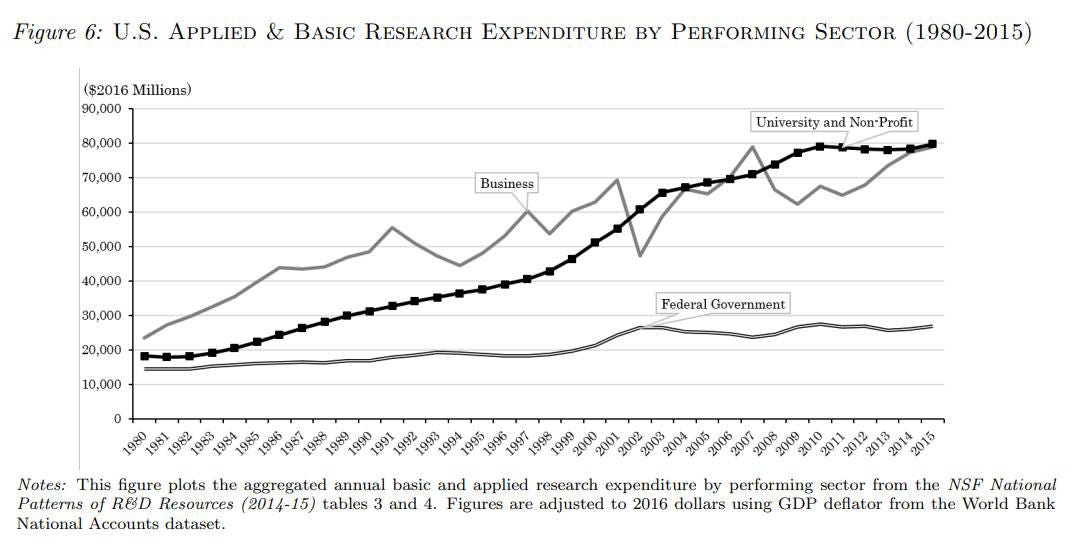
The hybrid of the old British and German models was naturally symbiotic, and it meant that even as America’s other institutions came under pressure, universities thrived and grew — especially once they used their prestige to attract high-paying and highly skilled foreign students from around the globe. Universities became the lynchpin of America’s research effort:

Source: Arora et al. (2019)

American universities had a lock on both the nation’s research output and on its production of human capital, and those roles were mutually reinforcing.

I suspect that their success at handling education and research at the same time probably gave American universities a lot of confidence about their ability to handle society and culture as well. Colleges spent more and more on dorms and “student services” and hired administrators (many of whom dealt with undergrad life) at an astonishing rate.1

But replacing churches, the military, and the neighborhood bowling alley proved harder than replacing the corporate lab had been. There was just one basic problem with college as America’s primary unifying institution, which is that not everyone can go to college.

First of all, college is difficult. To complete college courses, you need some degree of raw intelligence, but you also need work ethic and a certain degree of independence. As much as we might like to believe otherwise, not everyone in America has those traits, and we don’t yet know how to instill them in everyone. As a result, there’s a limit to how much you can expand college enrollment — and college completion — without loosening standards.

In fact, loosening standards is exactly what American colleges have done. Universities have necessarily become less and less selective over the years, as they have taken in a larger and larger fraction of the young American population. For a while, this led to lower college completion rates, but in the 1990s, more and more students began finishing their bachelors’ degrees. Why? Because colleges implemented grade inflation, making it easier to finish school without learning the material well. Here’s Denning et al. (2021):
We find that most of the increase in graduation rates can be explained by grade inflation, and that other factors such as changing student characteristics and institutional resources play little or no role. This is because GPA strongly predicts graduation and that GPAs have been rising since the 1990s. This finding holds in national survey data and in records from 9 large public universities. We also find that at a public liberal arts college, grades increased holding performance on identical exams fixed.
At some point, though, this process hits a wall. A large fraction of young Americans just isn’t prepared for college, even with grade inflation, and doesn’t end up going. College enrollment by recent high school graduates plateaued in the early 2000s and actually fell back to early 1990s levels during and after the pandemic:

Source: NCES via GPT

by Noah Smith, Noahpinion |  Read more:
Image: Ajay Suresh via Wikimedia Commons
[ed. Unfortunately, that's it before you hit the paywall. But you get the idea, and can claim the rest of the article for free once (by providing your email).]

via:
[ed. Thinking outside the box.]

The Girlboss Is Dead

Whose side are you on? You have to choose—Alex or Alix—even though you don’t know what the fight is about. Even if you don’t even know who these women are.

If the words “What is up, daddy gang?” mean nothing to you, a brief primer: Alex Cooper is the host of the podcast Call Her Daddy; Alix Earle is a TikToker and the founder of a skin-care line. They may be the two most talked-about women on the internet right now, and they’re in an argument, and no one knows why. That has offered people the fun opportunity to compare two women and pick a favorite without having to consider any relevant facts. But watching this admittedly absurd conflict play out provides something even more interesting than that: a view into exactly how people react to female ambition. Only a few years ago, in the girlboss era, women were encouraged to openly seek power. Now a major segment of the internet seems to think that female hustle is embarrassing, if not offensive.

Cooper is six years older than Earle, but the two women with long, blond hair look so similar that many people get them confused. In 2023, Cooper started a podcast network, Unwell, and one of her first talent grabs was Earle, her then-friend and protégé, who was going to start her own podcast, called Hot Mess. Eighteen months later, Earle was out, and people started speculating about what had gone wrong. In April, Cooper posted a video to her TikTok: “Alix Earle, hey girl, the passive aggressive reposts and the likes and the commenting on things—I gotta call you out here. You’re gonna need to get specific and just say what you’ve got to say about me. There’s no NDA. No one is stopping you. Stop hiding behind other people and just say it yourself. What’s the beef?”

Earle promptly commented, “Okay on it!!”

Months later, we still have no clue what happened—Saturday Night Live even spoofed the exchange in a “Weekend Update” sketch in which the women talk utter nonsense at each other. But one thing is clear: The internet is Team Earle, and it’s all because of the women’s differing approaches to fame and success.

Cooper has been an unapologetic girlboss from the beginning. She got her start at Barstool Sports in 2018 and climbed the podcast ranks to sign a $60 million deal with Spotify and then a $125 million deal with SiriusXM, making her the highest-earning female podcaster by far. She has been described as “this generation’s Oprah Winfrey,” in part because she is blunt and open about her drive: “I can walk into any single room in business, and I can get the deal done,” she told Forbes. Cooper also speaks regularly about reproductive rights and abortion access, and in 2024, she had Kamala Harris on her podcast.

Earle, meanwhile, treats her success as a happy accident. She describes herself as a “hot mess” and acts like the girl’s girl next door. “I don’t get very political online and that’s my choice,” she told Time for its recent issue devoted to the world’s top-100 “creators”; Earle was on the cover. “A lot of my reasoning for that is when I’ve been younger I think I’ve gone online and spoken before I actually knew what I was speaking about, and I think it’s really important for me to be educated on what I’m speaking on.” She makes $450,000 for each sponsored Instagram story she posts, and her skin-care company sold $1 million worth of products within its first five minutes.

“All the girlies love Alix Earle,” Dave Portnoy, Cooper’s old boss and the founder of Barstool Sports, said in a TikTok video summarizing the dispute. “She’s a girly girl. They love her. Alex Cooper’s this ruthless businesswoman.”

That does seem to be an accurate synopsis of how many people see Cooper. “I think she is a mean girl and she embraces being a mean girl,” the internet personality Brianna “Chickenfry” LaPaglia said on her podcast.

by Annie Joy Williams, The Atlantic |  Read more:
Image: The Atlantic. Source: Kevin Mazur/Getty; Stephanie Augello/Variety/Getty.
[ed. No comment (though... Chickenfry is an awesome nickname).]